Director-dramatist Howard Barker is a restlessly prolific, compulsively controversial and provocative multi-media artist. Beyond his internationally performed and acclaimed theatrical productions, and his award-winning theatre company The Wrestling School, he is also a poet, a painter whose work has been exhibited internationally, and a philosophical essayist cognisant of the unique power of art to provoke moral speculation, and of the distinctive theatricality of the human being in times of crisis.This collection of essays provides international perspectives on the full range of Barker’s achievements, theatrical and otherwise, and argues for their unique importance and urgency at the forefront of several genres of provocative modern art. It includes an interview with the artist and an essay by Barker himself.
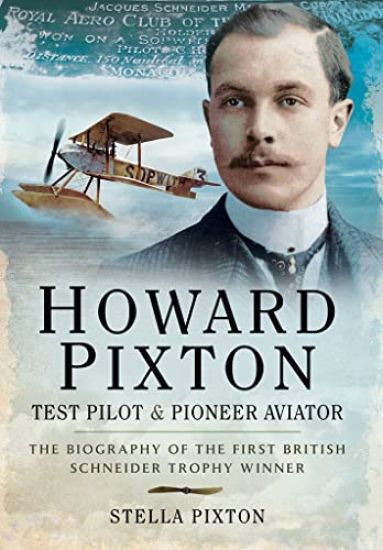
This book is a truly remarkable account that captures the atmosphere, thrills and danger of the pioneering days of aviation. Howard Pixton was flying for A V Roe at Brooklands in 1910 when S F Cody at Laffans Plain tried to persuade him to join him. But in 1911 he test flew A V Roes tractor biplane, the forerunner of the 504\. By now acknowledged as the first professional test pilot, he left A V to join Bristols and for two years demonstrated new models to dignitaries across Europe. In 1913 he joined Tommy Sopwith and in 1914 he became the first Briton in a British plane to win an international race, the coveted Schneider Trophy. This gave Britain air supremacy and Howard was feted as the finest pilot in the World. Sopwiths Tabloid aircraft developed into the Pup, and then into the Camel. Throughout The Great War Pixton test flew many of the rapid evolving designs. For a biography of an early aviation pioneer of the top rank, this book cannot be bettered.
En un peque o pueblo viejo y deshabitado, llamado Dunwich, viv a una mujer junto a su padre, llamada Liviana Watheley que dio a luz a un hijo que tuvo como nombre Wilbur. Despu s del nacimiento por el pueblo corrieron muchos rumores pues el hijo no ten a padre conocido, pero el m s extendido fue que el chico hab a sido concebido gracias a un conjuro.
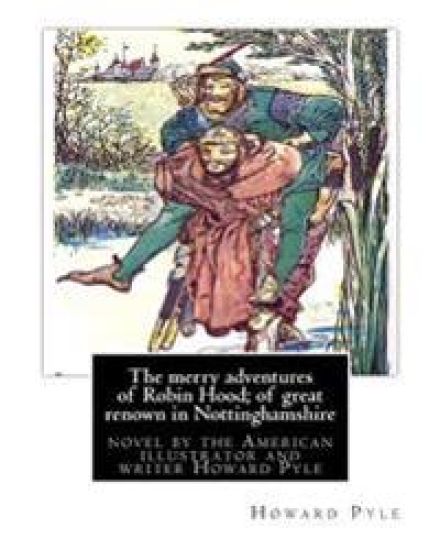
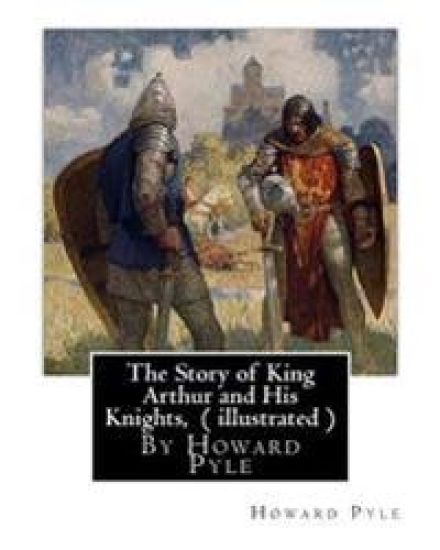
The Story of King Arthur and His Knights is a November 1903 novel by the American illustrator and writer Howard Pyle. It was published by Charles Scribner's Sons. Pyle's illustrations for the stories have been called "glorious", with the text and the illustrations complementing each other.The book consists of a large series of episodes in the legend of the mythological first king of Britain King Arthur and his knights of the Round Table. The Winning of Kinghood-This section of the book tells how young Arthur pulled a sword out of an anvil, how he learned of his royal lineage, and how he thus became king. The Winning of a Sword--King Arthur loses to his enemy, King Pellinore, and is wounded thereof. Merlin advises Arthur to seek Excalibur. The Lady of the Lake instructs Arthur on how to earn the sword, and, following her instructions, takes Excalibur. He then meets Pellinore again, and with Excalibur's magic, he wins against him. The two thereafter make amends and become friends. The Winning of a Queen--King Arthur is infatuated with the Lady Guinevere, the daughter of his friend, King Leodegrance, and visits Cameliard, where she resides. with Merlin's help, disguises himself as a peasant and works as a gardener below her tower. Meanwhile, King Ryence threatens Leodegrance for much of his lands, and also for the notorious Duke of North Umber being able to marry Guinevere. The Duke torments the people of Cameliard by parading in front of the castle, calling for a battle. Arthur, though unrecognized by others, takes up battle and defeats the Duke... Howard Pyle (March 5, 1853 - November 9, 1911) was an American illustrator and author, primarily of books for young people. A native of Wilmington, Delaware, he spent the last year of his life in Florence, Italy. In 1894 he began teaching illustration at the Drexel Institute of Art, Science and Industry (now Drexel University). After 1900, he founded his own school of art and illustration, named the Howard Pyle School of Illustration Art. The scholar Henry C. Pitz later used the term Brandywine School for the illustration artists and Wyeth family artists of the Brandywine region, several of whom had studied with Pyle.Some of his more notable students were N. C. Wyeth, Frank Schoonover, Elenore Abbott, Ethel Franklin Betts, Anna Whelan Betts, Harvey Dunn, Clyde O. DeLand, Philip R. Goodwin, Thornton Oakley, Violet Oakley, Ellen Bernard Thompson Pyle, Olive Rush, Allen Tupper True, Elizabeth Shippen Green, Arthur E. Becher, William James Aylward, and Jessie Willcox Smith. Pyle's home and studio in Wilmington, where he taught his students, is still standing and is listed on the National Register of Historic Places.His 1883 classic publication The Merry Adventures of Robin Hood remains in print, and his other books, frequently with medieval European settings, include a four-volume set on King Arthur. He is also well known for his illustrations of pirates, and is credited with creating what has become the modern stereotype of pirate dress.He published his first novel, Otto of the Silver Hand, in 1888. He also illustrated historical and adventure stories for periodicals such as Harper's Magazine and St. Nicholas Magazine. His novel Men of Iron was adapted as the movie The Black Shield of Falworth (1954).Pyle travelled to Florence, Italy in 1910 to study mural painting. He died there in 1911 of a sudden kidney infection (Bright's Disease). ........
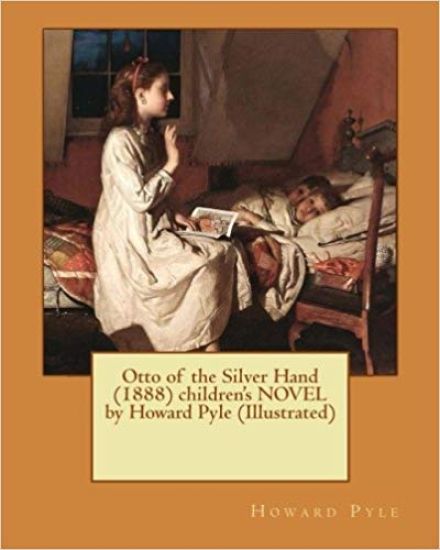
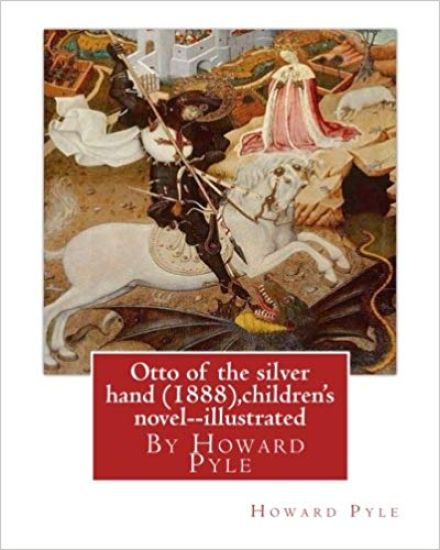
Otto of the Silver Hand is a children's novel about the Dark Ages written and illustrated by Howard Pyle. It was first published in 1888 by Charles Scribner's Sons. The novel was one of the first written for young readers that went beyond the chivalric ideals of the time period, and showed how cruel the time period could really be.Plot summary The book centers around the life of Otto, the son of German warlord Baron Conrad. Otto's mother, Baroness Matilda, has died in premature labour, brought on by the sight of the Baron's battle wounds, prompting Conrad to take his newborn son to be raised in a nearby monastery. When Otto reaches the age of eleven his father returns to claim him from the gentle monks, taking him back to live in Castle Drachenhausen, ("Dragons' House", in German) the ancestral mountaintop fortress from which the Baron launches his attacks. Here Otto learns of and is horrified by his father's life as a robber baron, and particularly the revelation of how Conrad killed a defeated, surrendering enemy, Baron Frederick, a rival robber baron who with his men was defending a column of merchants in return for the tribute they were paying him. Shortly thereafter Baron Conrad obeys a summons to the Imperial Court, taking the vast majority of his men-at-arms with him as an impressive escort but leaving Castle Drachenhausen practically undefended as a result. The late Baron Frederick's heir, his nephew Baron Henry, then attacks the castle, burning it to the ground, and taking Otto captive to his own fortress, Castle Trutzdrachen ("Dragon-scorner," in German). In the dungeon of his castle, Baron Henry explains to Otto that he has sworn a solemn oath that any member of Baron Conrad's House who fell into his hands would never be able to strike a blow like the one which killed his uncle, Baron Frederick. Because Otto is so young, the Baron keeps this oath by cutting off his right hand instead of killing him, and as an afterthought has a healer sent to tend to him. While Otto is feverish from the pain of his wound, he is comforted by Baron Henry's eight-year-old daughter, Pauline, who visits his cell.Otto's father Baron Conrad then returns and rescues him with the help of a few remaining loyal followers. Baron Henry and his men give chase and Otto's father kills Baron Henry in single combat but dies in the process, choosing to sacrifice his life so that his son can escape. Otto flees to the monastery where he grew up, and is given refuge there. After Otto regains his health the Abbot accompanies him to an audience with the Emperor, who promises restitution and takes responsibility for Otto's future upbringing. Otto becomes a respected statesman, marries his former captor's daughter Pauline, and is known for his wise counsel and peaceful nature, his amputated swordhand being replaced by an artificial and immobile one made of silver. The Emperor has Castle Drachenhausen rebuilt for the couple, and over the gatehouse is carved the motto "Manus Argentea Quam Manus Ferrea Melior Est", which translated from Latin means "A hand of silver is better than a hand of iron". Howard Pyle (March 5, 1853 - November 9, 1911) was an American illustrator and author, primarily of books for young people. A native of Wilmington, Delaware, he spent the last year of his life in Florence, Italy.