Kirjojen hintavertailu. Mukana 11 528 796 kirjaa ja 12 kauppaa.

Kirjahaku

Etsi kirjoja tekijän nimen, kirjan nimen tai ISBN:n perusteella.

1000 tulosta hakusanalla Jacques Derrida

Deconstruction in a Nutshell

Deconstruction in a Nutshell

Jacques Derrida

Fordham University Press
1996
sidottu
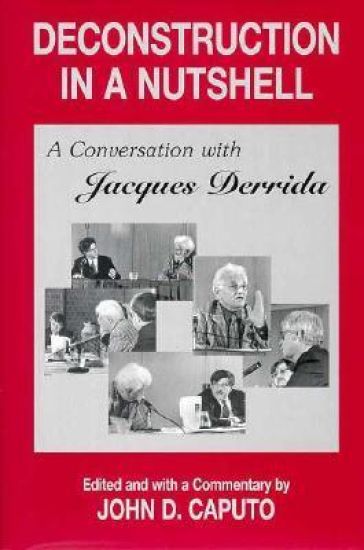
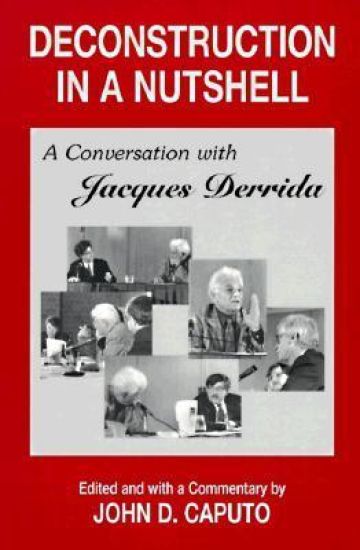
Responding to questions put to him at a Roundtable held at Villanova University in 1994, Jacques Derrida leads the reader through an illuminating discussion of the central themes of deconstruction. Speaking in English and extemporaneously, Derrida takes up with unusual clarity and great eloquence such topics as the task of philosophy, the Greeks, justice, responsibility, the gift, the community, the distinction between the messianic and the concrete messianisms, and his interpretation of James Joyce. Derrida convincingly refutes the charges of relativism and nihilism that are often leveled at deconstruction by its critics and sets forth the profoundly affirmative and ethico-political thrust of his work. The "Roundtable" is marked by the unusual clarity of Derrida's presentation and by the deep respect for the great works of the philosophical and literary tradition with which he characterizes his philosophical work. The Roundtable is annotated by John D. Caputo, the David R. Cook Professor of Philosophy at Villanova University, who has supplied cross references to Derrida's writings where the reader may find further discussion on these topics. Professor Caputo has also supplied a commentary which elaborates the principal issues raised in the Roundtable. In all, this volume represents one of the most lucid, compact and reliable introductions to Derrida and deconstruction available in any language. An ideal volume for students approaching Derrida for the first time, Deconstruction in a Nutshell will prove instructive and illuminating as well for those already familiar with Derrida's work.
Deconstruction in a Nutshell

Deconstruction in a Nutshell

Jacques Derrida

Fordham University Press
1996
pokkari
Responding to questions put to him at a Roundtable held at Villanova University in 1994, Jacques Derrida leads the reader through an illuminating discussion of the central themes of deconstruction. Speaking in English and extemporaneously, Derrida takes up with unusual clarity and great eloquence such topics as the task of philosophy, the Greeks, justice, responsibility, the gift, the community, the distinction between the messianic and the concrete messianisms, and his interpretation of James Joyce. Derrida convincingly refutes the charges of relativism and nihilism that are often leveled at deconstruction by its critics and sets forth the profoundly affirmative and ethico-political thrust of his work. The "Roundtable" is marked by the unusual clarity of Derrida's presentation and by the deep respect for the great works of the philosophical and literary tradition with which he characterizes his philosophical work. The Roundtable is annotated by John D. Caputo, the David R. Cook Professor of Philosophy at Villanova University, who has supplied cross references to Derrida's writings where the reader may find further discussion on these topics. Professor Caputo has also supplied a commentary which elaborates the principal issues raised in the Roundtable. In all, this volume represents one of the most lucid, compact and reliable introductions to Derrida and deconstruction available in any language. An ideal volume for students approaching Derrida for the first time, Deconstruction in a Nutshell will prove instructive and illuminating as well for those already familiar with Derrida's work.
Sovereignties in Question

Sovereignties in Question

Jacques Derrida

Fordham University Press
2005
sidottu
Contents • Shibboleth: For Paul Celan • “A Self-Unsealing Poetic Text”: Poetics and Politics of Witnessing • Language Does Not Belong: An Interview • The Majesty of the Present: Reading Celan’s “The Meridian” • Rams: Uninterrupted Dialogue—between Two Infinities, the Poem This book brings together five powerful encounters. Themes central to all of Derrida’s writings thread the intense confrontation between the most famous philosopher of our time and the Jewish poet writing in German who, perhaps more powerfully than any other, has testified to the European experience of the twentieth century. They include the date or signature and its singularity; the notion of the trace; temporal structures of futurity and the “to come”; the multiplicity of language and questions of translation; such speech acts as testimony and promising, but also lying and perjury; the possibility of the impossible; and, above all, the question of the poem as addressed and destined beyond knowledge, seeking to speak to and for the irreducibly other. The memory of encounters with thinkers who have also engaged Celan’s work animates these writings, which include a brilliant dialogue between two interpretative modes—hermeneutics and deconstruction. Derrida’s approach to a poem is a revelation on many levels, from the most concrete ways of reading —for example, his analysis of a sequence of personal pronouns—to the most sweeping imperatives of human existence (and Derrida’s writings are always a study in the imbrication of such levels). Above all, he voices the call to responsibility in the ultimate line of Celan’s poem: “The world is gone, I must carry you,” which sounds throughout the book’s final essay like a refrain. Only two of the texts in this volume do not appear here in English for the first time. Of these, Schibboleth has been entirely retranslated and has been set following Derrida's own instructions for publication in French; "A Self-Unsealing Poetic Text" was substantially rewritten by Derrida himself and basically appears here as the translation of a new text. Jacques Derrida’s most recent books in English translation include Counterpath: Traveling with Jacques Derrida (with Catherine Malabou). He died in Paris on October 8, 2004. Thomas Dutoit teaches at the Université de Paris 7. He translated Aporias and edited On the Name, both by Jacques Derrida.
Sovereignties in Question

Sovereignties in Question

Jacques Derrida

Fordham University Press
2005
pokkari
Contents • Shibboleth: For Paul Celan • "A Self-Unsealing Poetic Text": Poetics and Politics of Witnessing • Language Does Not Belong: An Interview • The Majesty of the Present: Reading Celan's "The Meridian" • Rams: Uninterrupted Dialogue—between Two Infinities, the Poem This book brings together five powerful encounters. Themes central to all of Derrida's writings thread the intense confrontation between the most famous philosopher of our time and the Jewish poet writing in German who, perhaps more powerfully than any other, has testified to the European experience of the twentieth century. They include the date or signature and its singularity; the notion of the trace; temporal structures of futurity and the "to come"; the multiplicity of language and questions of translation; such speech acts as testimony and promising, but also lying and perjury; the possibility of the impossible; and, above all, the question of the poem as addressed and destined beyond knowledge, seeking to speak to and for the irreducibly other. The memory of encounters with thinkers who have also engaged Celan's work animates these writings, which include a brilliant dialogue between two interpretative modes—hermeneutics and deconstruction. Derrida's approach to a poem is a revelation on many levels, from the most concrete ways of reading —for example, his analysis of a sequence of personal pronouns—to the most sweeping imperatives of human existence (and Derrida's writings are always a study in the imbrication of such levels). Above all, he voices the call to responsibility in the ultimate line of Celan's poem: "The world is gone, I must carry you," which sounds throughout the book's final essay like a refrain. Only two of the texts in this volume do not appear here in English for the first time. Of these, Schibboleth has been entirely retranslated and has been set following Derrida's own instructions for publication in French; "A Self-Unsealing Poetic Text" was substantially rewritten by Derrida himself and basically appears here as the translation of a new text. Jacques Derrida's most recent books in English translation include Counterpath: Traveling with Jacques Derrida (with Catherine Malabou). He died in Paris on October 8, 2004. Thomas Dutoit teaches at the Université de Paris 7. He translated Aporias and edited On the Name, both by Jacques Derrida.
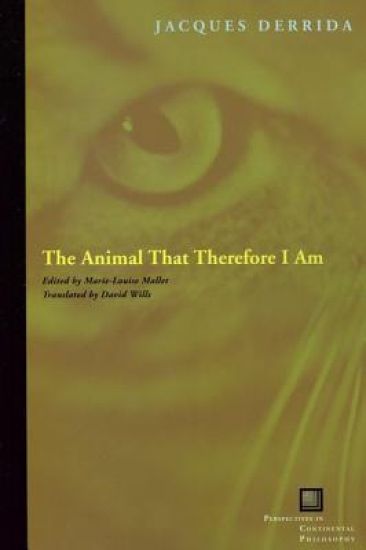
The Animal That Therefore I Am

The Animal That Therefore I Am

Jacques Derrida

Fordham University Press
2008
sidottu
The Animal That Therefore I Am is the long-awaited translation of the complete text of Jacques Derrida's ten-hour address to the 1997 Cérisy conference entitled "The Autobiographical Animal," the third of four such colloquia on his work. The book was assembled posthumously on the basis of two published sections, one written and recorded session, and one informal recorded session. The book is at once an affectionate look back over the multiple roles played by animals in Derrida's work and a profound philosophical investigation and critique of the relegation of animal life that takes place as a result of the distinction—dating from Descartes—between man as thinking animal and every other living species. That starts with the very fact of the line of separation drawn between the human and the millions of other species that are reduced to a single "the animal." Derrida finds that distinction, or versions of it, surfacing in thinkers as far apart as Descartes, Kant, Heidegger, Lacan, and Levinas, and he dedicates extended analyses to the question in the work of each of them. The book's autobiographical theme intersects with its philosophical analysis through the figures of looking and nakedness, staged in terms of Derrida's experience when his cat follows him into the bathroom in the morning. In a classic deconstructive reversal, Derrida asks what this animal sees and thinks when it sees this naked man. Yet the experiences of nakedness and shame also lead all the way back into the mythologies of "man's dominion over the beasts" and trace a history of how man has systematically displaced onto the animal his own failings or bêtises. The Animal That Therefore I Am is at times a militant plea and indictment regarding, especially, the modern industrialized treatment of animals. However, Derrida cannot subscribe to a simplistic version of animal rights that fails to follow through, in all its implications, the questions and definitions of "life" to which he returned in much of his later work.
The Animal That Therefore I Am

The Animal That Therefore I Am

Jacques Derrida

Fordham University Press
2008
pokkari
The Animal That Therefore I Am is the long-awaited translation of the complete text of Jacques Derrida's ten-hour address to the 1997 Cérisy conference entitled "The Autobiographical Animal," the third of four such colloquia on his work. The book was assembled posthumously on the basis of two published sections, one written and recorded session, and one informal recorded session. The book is at once an affectionate look back over the multiple roles played by animals in Derrida's work and a profound philosophical investigation and critique of the relegation of animal life that takes place as a result of the distinction—dating from Descartes—between man as thinking animal and every other living species. That starts with the very fact of the line of separation drawn between the human and the millions of other species that are reduced to a single "the animal." Derrida finds that distinction, or versions of it, surfacing in thinkers as far apart as Descartes, Kant, Heidegger, Lacan, and Levinas, and he dedicates extended analyses to the question in the work of each of them. The book's autobiographical theme intersects with its philosophical analysis through the figures of looking and nakedness, staged in terms of Derrida's experience when his cat follows him into the bathroom in the morning. In a classic deconstructive reversal, Derrida asks what this animal sees and thinks when it sees this naked man. Yet the experiences of nakedness and shame also lead all the way back into the mythologies of "man's dominion over the beasts" and trace a history of how man has systematically displaced onto the animal his own failings or bêtises. The Animal That Therefore I Am is at times a militant plea and indictment regarding, especially, the modern industrialized treatment of animals. However, Derrida cannot subscribe to a simplistic version of animal rights that fails to follow through, in all its implications, the questions and definitions of "life" to which he returned in much of his later work.
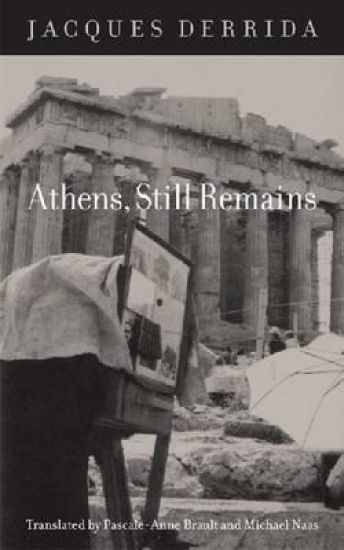
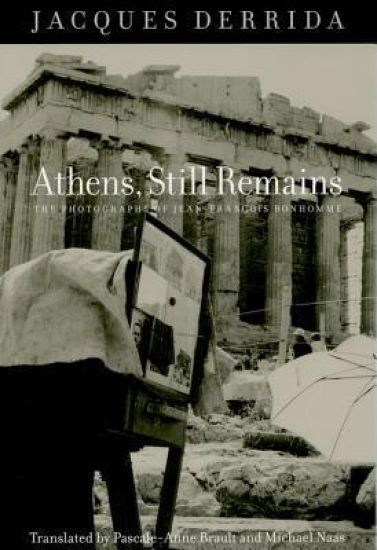
Athens, Still Remains

Athens, Still Remains

Jacques Derrida

Fordham University Press
2010
sidottu
Athens, Still Remains is an extended commentary on a series of photographs of contemporary Athens by the French photographer Jean-François Bonhomme. But in Derrida's hands commentary always has a way of unfolding or, better, developing in several unexpected and mutually illuminating directions. First published in French and Greek in 1996, Athens, Still Remains is Derrida's most sustained analysis of the photographic medium in relationship to the history of philosophy and his most personal reflection on that medium. At once photographic analysis, philosophical essay, and autobiographical narrative, Athens, Still Remains presents an original theory of photography and throws a fascinating light on Derrida's life and work. The book begins with a sort of verbal snapshot or aphorism that haunts the entire book: "we owe ourselves to death." Reading this phrase through Bonhomme's photographs of both the ruins of ancient Athens and contemporary scenes of a still-living Athens that is also on its way to ruin and death, Derrida interrogates a philosophical tradition that runs from Socrates to Heidegger in which the human—and especially the philosopher—is thought to owe himself to death, to a certain thought of death or comportment with regard to death. Combining philosophical speculations on mourning and death, event and repetition, and time and difference with incisive commentary on Bonhomme's photographs and a narrative of Derrida's 1995 trip to Greece, Athens, Still Remains is one of Derrida's most accessible, personal, and moving works without being, for all that, any less philosophical. As Derrida reminds us, the word photography—an eminently Greek word—means "the writing of light," and it brings together today into a single frame contemporary questions about the work of art in the age of mechanical reproduction and much older questions about the relationship between light, revelation, and truth—in other words, an entire philosophical tradition that first came to light in the shadow of the Acropolis.
Athens, Still Remains

Athens, Still Remains

Jacques Derrida

Fordham University Press
2010
pokkari
Athens, Still Remains is an extended commentary on a series of photographs of contemporary Athens by the French photographer Jean-François Bonhomme. But in Derrida's hands commentary always has a way of unfolding or, better, developing in several unexpected and mutually illuminating directions. First published in French and Greek in 1996, Athens, Still Remains is Derrida's most sustained analysis of the photographic medium in relationship to the history of philosophy and his most personal reflection on that medium. At once photographic analysis, philosophical essay, and autobiographical narrative, Athens, Still Remains presents an original theory of photography and throws a fascinating light on Derrida's life and work. The book begins with a sort of verbal snapshot or aphorism that haunts the entire book: "we owe ourselves to death." Reading this phrase through Bonhomme's photographs of both the ruins of ancient Athens and contemporary scenes of a still-living Athens that is also on its way to ruin and death, Derrida interrogates a philosophical tradition that runs from Socrates to Heidegger in which the human—and especially the philosopher—is thought to owe himself to death, to a certain thought of death or comportment with regard to death. Combining philosophical speculations on mourning and death, event and repetition, and time and difference with incisive commentary on Bonhomme's photographs and a narrative of Derrida's 1995 trip to Greece, Athens, Still Remains is one of Derrida's most accessible, personal, and moving works without being, for all that, any less philosophical. As Derrida reminds us, the word photography—an eminently Greek word—means "the writing of light," and it brings together today into a single frame contemporary questions about the work of art in the age of mechanical reproduction and much older questions about the relationship between light, revelation, and truth—in other words, an entire philosophical tradition that first came to light in the shadow of the Acropolis.
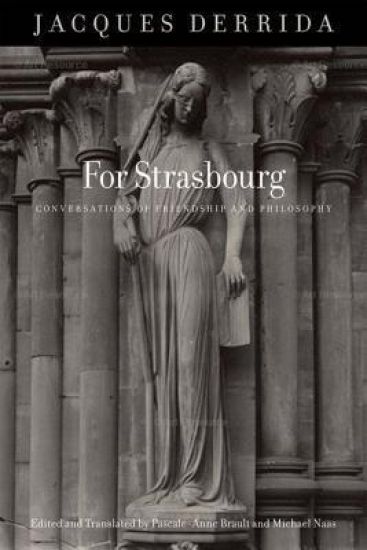
For Strasbourg

For Strasbourg

Jacques Derrida

Fordham University Press
2014
sidottu
For Strasbourg consists of a series of essays and interviews about the city of Strasbourg and the philosophical friendships Jacques Derrida developed there over a period of some forty years. Written just months before his death, the opening essay, "The Place Name(s): Strasbourg," recounts in detail, and in very moving terms, Derrida's deep attachment to this French city on the border between France and Germany. More than just a personal narrative, however, the essay is a profound interrogation of the relationship between philosophy and place, philosophy and language, and philosophy and friendship. As such, it raises a series of philosophical, political, and ethical questions that might all be placed under the aegis of what Derrida once called "philosophical nationalities and nationalism." The other three texts included in the book are long interviews/conversations between Derrida and his two principal interlocutors in Strasbourg, Jean-Luc Nancy and Philippe Lacoue-Labarthe. These interviews are significant both for the themes they focus on (language, politics, friendship, death, life after death, and so on) and for what they reveal about Derrida's relationships to Nancy and Lacoue-Labarthe. Filled with sharp insights into one anothers' work and peppered with personal anecdotes and humor, the interviews bear witness to the decades-long intellectual friendships of these three important contemporary thinkers. This collection thus stands as a reminder of and testimony to Derrida's unique relationship to Strasbourg and to the two thinkers most closely associated with that city.
For Strasbourg

For Strasbourg

Jacques Derrida

Fordham University Press
2014
pokkari
For Strasbourg consists of a series of essays and interviews about the city of Strasbourg and the philosophical friendships Jacques Derrida developed there over a period of some forty years. Written just months before his death, the opening essay, "The Place Name(s): Strasbourg," recounts in detail, and in very moving terms, Derrida's deep attachment to this French city on the border between France and Germany. More than just a personal narrative, however, the essay is a profound interrogation of the relationship between philosophy and place, philosophy and language, and philosophy and friendship. As such, it raises a series of philosophical, political, and ethical questions that might all be placed under the aegis of what Derrida once called "philosophical nationalities and nationalism." The other three texts included in the book are long interviews/conversations between Derrida and his two principal interlocutors in Strasbourg, Jean-Luc Nancy and Philippe Lacoue-Labarthe. These interviews are significant both for the themes they focus on (language, politics, friendship, death, life after death, and so on) and for what they reveal about Derrida's relationships to Nancy and Lacoue-Labarthe. Filled with sharp insights into one anothers' work and peppered with personal anecdotes and humor, the interviews bear witness to the decades-long intellectual friendships of these three important contemporary thinkers. This collection thus stands as a reminder of and testimony to Derrida's unique relationship to Strasbourg and to the two thinkers most closely associated with that city.
Deconstruction in a Nutshell

Deconstruction in a Nutshell

Jacques Derrida

FORDHAM UNIVERSITY PRESS
2020
sidottu
This volume, now with a substantial new Introduction, represents one of the most lucid, compact and reliable introductions to Derrida and deconstruction available in any language. Responding to questions put to him at a roundtable held at Villanova University in 1994, Jacques Derrida leads the reader through an illuminating discussion of the central themes of deconstruction. Speaking in English and extemporaneously, Derrida takes up with unusual clarity and great eloquence such topics as the task of philosophy, the Greeks, justice, responsibility, the gift, community, and the messianic. Derrida refutes the charges of relativism that are often leveled at deconstruction by its critics and sets forth the profoundly affirmative and ethico-political thrust of his work. The roundtable is marked by an unusual clarity that continues into the second part of the book, in which one of Derrida's most influential readers, John D. Caputo, elaborates upon Derrida's comments and supplies material for further discussion. This edition also includes a substantial new Introduction by Caputo that discusses the original context of the book and traces the development of deconstruction since Derrida's death in 2004, from the rise of new materialisms to return to religion. Long one of the most lucid and reliable introductions to Derrida and deconstruction available in any language, and an ideal volume for students, Deconstruction in a Nutshell will also prove illuminating for those already familiar with Derrida's work.
Deconstruction in a Nutshell

Deconstruction in a Nutshell

Jacques Derrida

Fordham University Press
2020
pokkari
This volume, now with a substantial new Introduction, represents one of the most lucid, compact and reliable introductions to Derrida and deconstruction available in any language. Responding to questions put to him at a roundtable held at Villanova University in 1994, Jacques Derrida leads the reader through an illuminating discussion of the central themes of deconstruction. Speaking in English and extemporaneously, Derrida takes up with unusual clarity and great eloquence such topics as the task of philosophy, the Greeks, justice, responsibility, the gift, community, and the messianic. Derrida refutes the charges of relativism that are often leveled at deconstruction by its critics and sets forth the profoundly affirmative and ethico-political thrust of his work. The roundtable is marked by an unusual clarity that continues into the second part of the book, in which one of Derrida's most influential readers, John D. Caputo, elaborates upon Derrida's comments and supplies material for further discussion. This edition also includes a substantial new Introduction by Caputo that discusses the original context of the book and traces the development of deconstruction since Derrida's death in 2004, from the rise of new materialisms to return to religion. Long one of the most lucid and reliable introductions to Derrida and deconstruction available in any language, and an ideal volume for students, Deconstruction in a Nutshell will also prove illuminating for those already familiar with Derrida's work.
Dissemination

Dissemination

Jacques Derrida

Continuum International Publishing Group Ltd.
2004
nidottu
The notorious French philosopher, literary critic and film star(!) First translated in 1983, Dissemination contains three of Derrida's most central and seminal works: 'Plato's Pharmacy', 'The Double Session' and 'Dissemination'. The essays provide original readings of philosophy and literature, and present a re-evaluation of the logic of meaning and the function of writing in Western discourse. This is a groundbreaking work on the relationship and interplay between language, literature and philosophy.
Positions

Positions

Jacques Derrida

T. T.Clark Ltd
2004
nidottu
This new edition of a key, accessible text to the work of the most influential psychoanalytic and literary critic alive today includes a new introduction by Christopher Norris setting these key early interviews in the context of the full trajectory of Derrida's thought.
Specters of Marx

Specters of Marx

Jacques Derrida

TAYLOR FRANCIS LTD
2026
nidottu
Published shortly after the fall of Communism in Eastern Europe and the dissolution of the Soviet regime, Specters of Marx is one of Derrida's most interesting and prophetic books. Whilst many in the West heralded the triumph of liberal democracy and “the end of history”, Derrida takes several steps back to argue that whilst Communism may have disappeared in much of the world, the questions posed by Marx continue to haunt us. In his customary provocative style, he asks some uncomfortable questions: after the fall of Communism, can we preserve Marx's legacy of radicalism? How do we continue his philosophy of responsibility? Uncannily anticipating many of the challenges facing us today, Derrida argues that the capitalist system is plagued by a multitude of ills, including aggression, trade wars, debt, the exploitation of migrant labour and ethnic conflict. This Routledge Classics edition is a translation of the revised French edition and includes a debate between Derrida and Étienne Balibar on Marx and Marxism, published here in English for the first time. It also includes new corrections and additions to the text and footnotes made by Derrida after the book's initial publication in French. Translated by Peggy Kamuf and with a new Foreword by Peter Salmon, this Routledge Classics edition retains the original Editors’ Introduction by Bernd Magnus and Stephen Cullenberg.
Specters of Marx

Specters of Marx

Jacques Derrida

TAYLOR FRANCIS LTD
2026
sidottu
Published shortly after the fall of Communism in Eastern Europe and the dissolution of the Soviet regime, Specters of Marx is one of Derrida's most interesting and prophetic books. Whilst many in the West heralded the triumph of liberal democracy and “the end of history”, Derrida takes several steps back to argue that whilst Communism may have disappeared in much of the world, the questions posed by Marx continue to haunt us. In his customary provocative style, he asks some uncomfortable questions: after the fall of Communism, can we preserve Marx's legacy of radicalism? How do we continue his philosophy of responsibility? Uncannily anticipating many of the challenges facing us today, Derrida argues that the capitalist system is plagued by a multitude of ills, including aggression, trade wars, debt, the exploitation of migrant labour and ethnic conflict. This Routledge Classics edition is a translation of the revised French edition and includes a debate between Derrida and Étienne Balibar on Marx and Marxism, published here in English for the first time. It also includes new corrections and additions to the text and footnotes made by Derrida after the book's initial publication in French. Translated by Peggy Kamuf and with a new Foreword by Peter Salmon, this Routledge Classics edition retains the original Editors’ Introduction by Bernd Magnus and Stephen Cullenberg.
Acts of Literature

Acts of Literature

Jacques Derrida

Routledge
2015
sidottu
First published in 1992. "Acts of Literature", compiled in close association with Derrida, brings together for the first time a number of Derrida's writings on literary texts on the question of literature. The essays discuss literary figures such as Rousseau, Mallarme, Joyce, Shakespeare and Kafka. Comprising pieces spanning Derrida's career, the collection includes a substantial new interview with him on questions of literature, deconstruction, politics, feminism and history. Derek Attridge provides an introductory essay on deconstruction and the question of literature, and offers suggestions for further reading. These essays examine the place and function of literature in Western culture. They highlight Derrida's interest in literature as a significant cultural institution and as a peculiarly challenging form of writing, with inescapable consequences for our thinking about philosophy, politics and ethics. This book should be of interest to undergraduates and academics in the field of literary theory and criticism and continental philosophy.
Dissemination

Dissemination

Jacques Derrida

Bloomsbury Academic
2016
nidottu
First published in 1972, Dissemination contains three of Derrida's most central and seminal works: 'Plato's Pharmacy', 'The Double Session' and 'Dissemination'. The essays present a re-evaluation of the logic of meaning and the function of writing in Western discourse and explore the relationship and interplay between language, literature and philosophy. The text includes a substantial introduction and additional notes on the text by Barbara Johnson.
Thinking What Comes, Volume 1

Thinking What Comes, Volume 1

Jacques Derrida

EDINBURGH UNIVERSITY PRESS
2024
sidottu
In two volumes, Geoffrey Bennington and Kas Saghafi present the majority of Jacques Derrida's untranslated, and previously uncollected, essays and interviews. Dating mostly from 1992 to 2004, these writings offer a fuller picture of Derrida's biography, theoretical engagements and the stakes of his social and political investments. In the interviews in Essays, Interviews, and Interventions by Jacques Derrida: Thinking What Comes, Volume 1, Derrida proposes the foundation of a new European political culture, discusses the strengths of Nelson Mandela, and reflects on the archive. He also considers his experience of political life, his relationship to institutions (particularly the College international de philosophie), and his views on 'intellectualism'. Whether writing about public health, Palestine, or the notion of the promise, Derrida is razor-sharp and impassioned. These volumes allow significant insight into his mature thought.
Thinking What Comes, Volume 2

Thinking What Comes, Volume 2

Jacques Derrida

EDINBURGH UNIVERSITY PRESS
2024
sidottu
In two volumes, Geoffrey Bennington and Kas Saghafi present the majority of Jacques Derrida's untranslated, and previously uncollected, essays and interviews. Dating mostly from 1992 to 2004, these writings offer a fuller picture of Derrida's biography, theoretical engagements and the stakes of his social and political investments. Institutions, Inventions, and Inscriptions by Jacques Derrida: Thinking What Comes, Volume 2 collects Derrida's writings on friends including Emmanuel Levinas, Alain David, Louis Marin, Marie-Louise Mallet, Safaa Fathy, Mathieu Benezet and Jos Joliet. It also features interviews that illuminate his experience at school, his writing habits, the relation he saw between philosophical discourse to the 'poetic', and his views on the singularity of literature and fiction. Whether writing about racism and anti-Semitism, filiation and fidelity, or hospitality and responsibility, Derrida is razor-sharp and impassioned. These volumes allow significant insight into his mature thought.