Kirjojen hintavertailu. Mukana 12 391 040 kirjaa ja 12 kauppaa.

Kirjahaku

Etsi kirjoja tekijän nimen, kirjan nimen tai ISBN:n perusteella.

1000 tulosta hakusanalla Jennifer L. Burrell

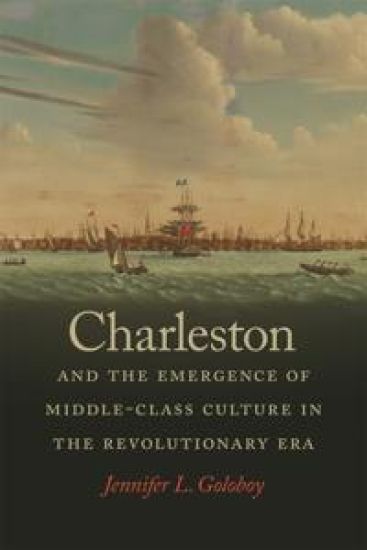
Charleston and the Emergence of Middle-Class Culture in the Revolutionary Era
Too often, says Jennifer L. Goloboy, we equate being middle class with “niceness”—a set of values frozen in the antebellum period and centered on long-term economic and social progress and a close, nurturing family life. Goloboy’s case study of merchants in Charleston, South Carolina, looks to an earlier time to establish the roots of middle-class culture in America. She argues for a definition more applicable to the ruthless pursuit of profit in the early republic. To be middle class then was to be skilled at survival in the market economy.What prompted cultural shifts in the early middle class, Goloboy shows, were market conditions. In Charleston, deference and restraint were the bywords of the colonial business climate, while rowdy ambition defined the post-Revolutionary era, which in turn gave way to institution building and professionalism in antebellum times. Goloboy’s research also supports a view of the Old South as neither precapitalist nor isolated from the rest of American culture, and it challenges the idea that post-Revolutionary Charleston was a port in decline by reminding us of a forgotten economic boom based on slave trading, cotton exporting, and trading as a neutral entity amid warring European states.This fresh look at Charleston’s merchants lets us rethink the middle class in light of the new history of capitalism and its commitment to reintegrating the Old South into the world economy.
Outlaw Capital

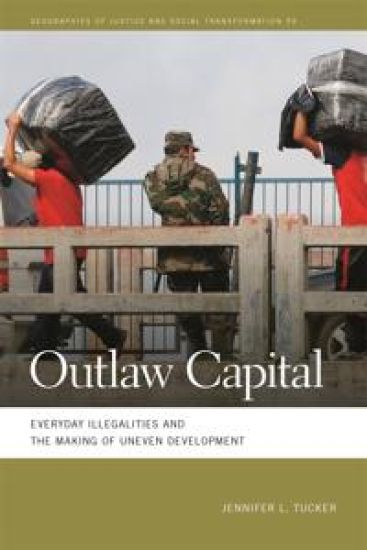
Outlaw Capital

Jennifer L. Tucker

UNIVERSITY OF GEORGIA PRESS
2023
sidottu
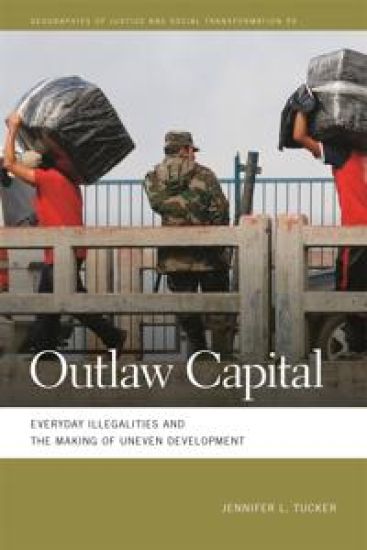
With an ethnography of the largest contraband economy in the Americas running through Ciudad del Este, Paraguay, Outlaw Capital shows how transgressive economies and gray spaces are central to globalized capitalism. A key site on the China-Paraguay-Brazil trade route, Ciudad del Este moves billions of dollars’ worth of consumer goods—everything from cell phones to whiskey—providing cheap transit to Asian manufacturers and invisible subsidies to Brazilian consumers. A vibrant popular economy of Paraguayan street vendors and Brazilian “ant contrabandistas” capture some of the city’s profits, contesting the social distribution of wealth through an insurgent urban epistemology of use, need, and care. Yet despite the city’s centrality, it is narrated as a backward, marginal, and lawless place. Outlaw Capital contests these sensationalist stories, showing how uneven development and the Paraguayan state made Ciudad de Este a gray space of profitable transgression. By studying the everyday illegalities of both elite traders and ordinary workers, Jennifer L. Tucker shows how racialized narratives of economic legitimacy across scales—not legal compliance—sort whose activities count as formal and legal and whose are targeted for reform or expulsion. Ultimately, reforms criminalized the popular economy while legalizing, protecting, and “whitening” elite illegalities.
Outlaw Capital

Outlaw Capital

Jennifer L. Tucker

UNIVERSITY OF GEORGIA PRESS
2023
pokkari
With an ethnography of the largest contraband economy in the Americas running through Ciudad del Este, Paraguay, Outlaw Capital shows how transgressive economies and gray spaces are central to globalized capitalism. A key site on the China-Paraguay-Brazil trade route, Ciudad del Este moves billions of dollars’ worth of consumer goods—everything from cell phones to whiskey—providing cheap transit to Asian manufacturers and invisible subsidies to Brazilian consumers. A vibrant popular economy of Paraguayan street vendors and Brazilian “ant contrabandistas” capture some of the city’s profits, contesting the social distribution of wealth through an insurgent urban epistemology of use, need, and care. Yet despite the city’s centrality, it is narrated as a backward, marginal, and lawless place. Outlaw Capital contests these sensationalist stories, showing how uneven development and the Paraguayan state made Ciudad de Este a gray space of profitable transgression. By studying the everyday illegalities of both elite traders and ordinary workers, Jennifer L. Tucker shows how racialized narratives of economic legitimacy across scales—not legal compliance—sort whose activities count as formal and legal and whose are targeted for reform or expulsion. Ultimately, reforms criminalized the popular economy while legalizing, protecting, and “whitening” elite illegalities.
To Delight and Instruct

To Delight and Instruct

Jennifer L. Holberg; Marcy M. Taylor

Duke University Press
2009
pokkari
This issue considers the sustainability of English studies and of the humanities as a whole in the context of shrinking budgets and job opportunities and of shifting resources. Exploring topics from academic freedom and globalization to digitization, diversity, and the value of a humanities-based education, “To Delight and Instruct” reexamines the work of the English professor and calls for a reassessment of the priorities and means that undergird it.Contributors examine the faculty’s fundamental responsibilities to classroom teaching, the university, and the community. Attending to the relationship between changing technologies and literacy in a global environment, the issue not only argues for a reassertion and reimagining of the humanities in the contemporary university but, perhaps as important, helps articulate a way forward.Contributors: Michael Bérubé, Martin Bickman, Marc Bousquet, Elizabeth Brockman, Sheila T. Cavanagh, Danielle Nicole DeVoss, Patricia Donahue, Gerald Graff, Donald E. Hall, Gail E. Hawisher, Jennifer L. Holberg, Colin Jager, Paul Lauter, Shirley Geok-lin Lim, Julie Lindquist, Harriet Kramer Linkin, Mark C. Long, Donald G. Marshall, Richard E. Miller, James Phelan, Mariolina Rizzi Salvatori, Robert Scholes, Cynthia L. Selfe, Marcy Taylor
Competency-Based Education in Three Pilot Programs

Competency-Based Education in Three Pilot Programs

Jennifer L. Steele; Matthew W. Lewis; Lucrecia Santibanez; Susannah Faxon-Mills; Mollie Rudnick; Brian M. Stecher; Laura S. Hamilton

RAND
2014
pokkari
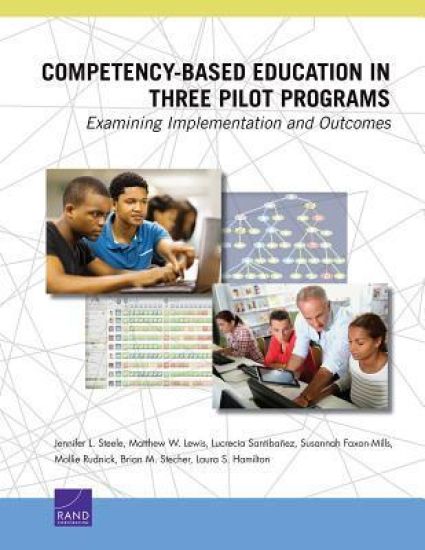
Competency-based education meets students where they are academically, provides students with opportunities for choice, and awards credit for evidence of learning, not for the time students spend studying a subject. The Bill & Melinda Gates Foundation asked RAND to evaluate three competency-based education grants in terms of implementation, students experiences, and student performance."
Race/Class Conflict and Urban Financial Threat

Race/Class Conflict and Urban Financial Threat

Jennifer L. Hochschild

RUSSELL SAGE FOUNDATION
2024
nidottu
Race and class inequality are at the crux of many policy disputes in American cities. But are they the only factors driving political discord? In Race/Class Conflict and Urban Financial Threat, political scientist Jennifer L. Hochschild examines significant policies in four major American cities to determine when race and class shape city politics, when they do not, and what additional forces have the power to shape urban policy choices. Hochschild investigates the root causes of disputes in the arenas of policing, development, schooling, and budgeting. She finds that race and class are central to the Stop-Question-Frisk policing policy in New York City and the development of Atlanta's Beltline. New York's Stop-Question-Frisk policy was intended to fight crime and keep all New Yorkers safe. In practice, however, young Black and Latino men in low-income neighborhoods were disproportionately stopped by a predominantly White police force. The goal of the Atlanta Beltline, a redevelopment project that includes public parks, new housing, commercial development, and a robust public transit system, is to expand access around the city and keep working-class residents in the city by constructing affordable housing. Instead, the construction completed thus far has encouraged gentrification and displacement of poor, disproportionately Black residents, and has increased the wealth and power of both Black and White city elites. However, Hochschild finds that race and class inequality are not central to all urban policy disputes. When investigating the issues of charter schools in Los Angeles and Chicago's pension system she identifies a third driver: financial threat that feels existential to the policy and political actors. In Los Angeles, there is a battle between traditional public schools and independent charter schools. Increasingly, families with sufficient resources are moving out of L.A. to areas with better school districts. Traditional public schools and charter schools must fight for the remaining students and the funding that comes with them. There are not enough students to teach and not enough money to teach them. The school district risks school closures, layoffs, and pension deficits; in this context, race/class conflict fades into the background. Chicago's public sector pension debt is at least three times as large as the city's annual budget and continues to grow. Policy actors agree that the pension system needs to be stably funded. Yet city leaders, fearful of upsetting constituents and jeopardizing their political careers, fail to implement policies that would do so. Meaningful policy change to rectify the pension deficit continues to get kicked down the line for future policy actors to address. In this context also, race/class conflict fades into the background. Race/Class Conflict and Urban Financial Threat is a compelling examination of the role that race, class, and political and fiscal threat play in shaping urban policy.
Crime in America

Crime in America

Jennifer L. Durham

ABC-CLIO
1996
sidottu
This volume approaches the full spectrum of crime as an issue in American society today, describing trends in various types of crime and the more recent rise of computer- and technology-related crime.Crime in America presents different viewpoints on the control of crime, anti-crime efforts through legislation and community action, and the successes and failures of law enforcement and the criminal justice system in dealing with crime in American society today.A chronology detailing historical developments and significant statistical fluctuations in U.S. crime during the 20th century, important figures in the ongoing anti-crime crusade, legislation excerpts, statistics, annotated print and nonprint resource lists, and descriptions of government and private agencies round out this valuable reference tool.A chronology detailing historical developments and significant statistical fluctuations in U.S. crime during the 20th centuryProvides legislation excerpts, statistics, descriptions of government and private agencies, and lists of annotated print and nonprint resources
Activities Keep Me Going and Going

Activities Keep Me Going and Going

Jennifer L Krupa; Mary E Miller; Charles W Peckham

Idyll Arbor
2011
pokkari
Activities Keep Me Going & Going teaches the set of skills defined in the Modular Education Program for Activity Professionals (MEPAP) 2nd Edition created by the Education Re-engineering Committee of the National Certification Council for Activity Professionals (NCCAP). It is preparatory for the NCCAP certification exam and a useful reference for the activity professional.Volume A is an excellent all-around activity book for new and experienced activity professionals. It discusses the first eleven core content areas of MEPAP training. These areas cover the basic functions and duties of an activity professional: to design, deliver and evaluate activity services for older adults across the continuum of care.Specific topics include practice settings, interacting with others, issues of the profession, government and social systems, advocacy, behavioral sciences, information about populations, professional approaches to care, care planning, etc. Updated with MDS 3.0 information.
Activities Keep Me Going and Going: Volume B

Activities Keep Me Going and Going: Volume B

Jennifer L. Krupa; Mary E. Miller; Charles W. Peckham

Idyll Arbor
2008
nidottu
Activities Keep Me Going & Going teach the set of skills defined in the Modular Education Program for Activity Professionals (MEPAP) 2nd Edition created by the Education Re-engineering Committee of the National Certification Council for Activity Professionals (NCCAP). It is preparatory for the NCCAP certification exam and a useful reference for the activity professional. Volume B looks at the management issues that are part of the activity profession. The book will show you how to apply principles of management in your role as an activity professional leading an activity department. It covers MEPAP core content areas 12-20. The specific topics covered are management, leadership, advocacy within the organization, departmental planning (budgets, equipment, resources), organizing (task outlines, policies and procedures, scheduling), staffing, directing and supervising, control (quality assurance, corrective actions, health and safety), volunteers, and practicum guidelines.
Intertidal History in Island Southeast Asia

Intertidal History in Island Southeast Asia

Jennifer L. Gaynor

Southeast Asia Program Publications, Cornell University
2016
pokkari
Intertidal History in Island Southeast Asia shows the vital part maritime Southeast Asians played in struggles against domination of the seventeenth-century spice trade by local and European rivals. Looking beyond the narrative of competing mercantile empires, it draws on European and Southeast Asian sources to illustrate Sama sea people's alliances and intermarriage with the sultanate of Makassar and the Bugis realm of Boné. Contrasting with later portrayals of the Sama as stateless pirates and sea gypsies, this history of shifting political and interethnic ties among the people of Sulawesi's littorals and its land-based realms, along with their shared interests on distant coasts, exemplifies how regional maritime dynamics interacted with social and political worlds above the high-water mark.