Kirjojen hintavertailu. Mukana 12 455 044 kirjaa ja 12 kauppaa.

Kirjahaku

Etsi kirjoja tekijän nimen, kirjan nimen tai ISBN:n perusteella.

1000 tulosta hakusanalla John Locke

John Locke

John Locke

Alexander Moseley

Bloomsbury Academic
2014
nidottu
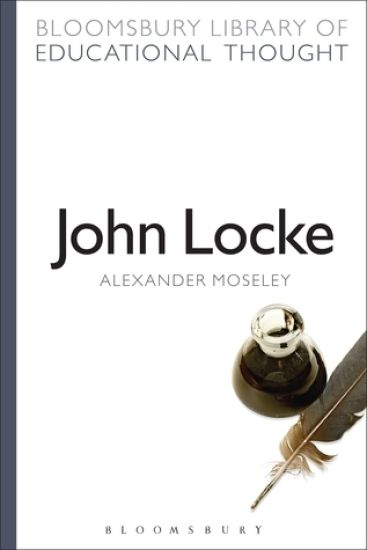
John Locke is one of the great minds in educational history. Drawing on his perceptive observations of families and children he saw the importance of adapting learning to the child's dispositions. Critical of schools, he is the fountainhead of home tutoring, child-centred learning, and the importance of enjoyable learning. But for Locke learning was not about facts: a good education produced gentlemen who could in turn adapt themselves to commerce and politics. Locke's philosophy helped provide rigour to the scientific revolution, the impetus for the expansion of schools for the poor (which should be profitable) and child psychology. Alexander Mosely sets Locke’s educational writings in their context with a sensitive reading of what Locke understood by ‘education’ and highlights the relevance of the study of Locke’s work to our understanding of education today.
John Locke

John Locke

VDM Publishing House
2010
nidottu
Observera att förlaget som ger ut denna produkt baserar innehållet i sina produkter på fria källor som Wikipedia. Boken är med stor sannolikhet endast ett utdrag ur dessa informationskällor, alltså inte en vanlig bok i den bemärkelsen.
John Locke's Theology

John Locke's Theology

Jonathan S. Marko

OXFORD UNIVERSITY PRESS INC
2023
sidottu
In John Locke's Theology: An Ecumenical, Irenic, and Controversial Project, Jonathan S. Marko offers the closest work available to a theological system derived from the writings of John Locke. Marko argues that Locke's intent for The Reasonableness of Christianity, his most noted theological work, was to describe and defend his version of the fundamental doctrines of Christianity and not his personal theological views. Locke, Marko says, intended the work to be an ecumenical and irenic project during a controversial time in philosophy and theology. Locke described what qualifies someone as a Christian in simple and irenic terms, and argued for the necessity of Scripture and the reasonableness of God's means of conveying his authoritative messages. The Reasonableness of Christianity could be construed as personal, but mainly in the sense that it puts the burden of understanding Scripture and arriving at theological convictions on the autonomous individual, rejecting the notion that one should base one's doctrinal opinions on so-called authorities. His work was inadvertently controversial partly because then, like today, readers typically failed to make a distinction between Locke's personal and programmatic positions. Marko also points to places in Locke's corpus where he avoids advocating for a particular sectarian position in his treatment of theological doctrines. What is more, it shows why attempting to categorize Locke--a philosopher, theologian, and political scientist all at once--according to traditional Christian paradigms is a dangerous misstep and a difficult scholarly feat.
John Locke: Selected Correspondence
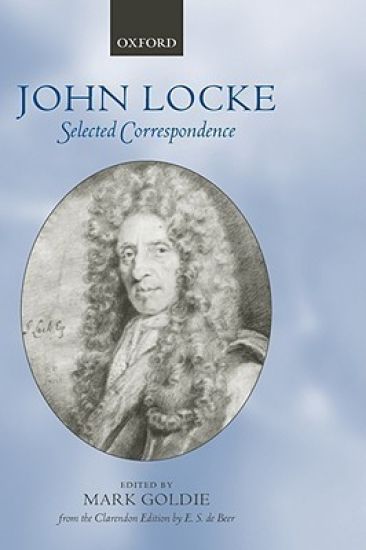
John Locke (1632-1704) was a prolific correspondent and left behind him over 3,600 letters, a collection almost unmatched in pre-modern times. A man of insatiable curiosity and wide social connections, his letters open up the cultural, social, intellectual, and political worlds of the later Stuart age. Spanning half a century, they mark the transition from the era of revolutionary Puritanism to the dawn of the Enlightenment. Locke is chiefly known as a philosopher, a theorist of empiricism in his Essay Concerning Philosophyrstanding, a theorist of liberalism in his Two Treatises of Government, and a theorist of religious toleration in his Letter concerning Toleration. But his interests extended further still, to education, medicine, finance, theology, empire, and the natural world. He was a Fellow of the early Royal Society. He received letters from scholars in Paris and Amsterdam, from colonial administrators in Virginia, from aristocrats and shopkeepers, from children, from tenants, from politicians, from philosophic women, from astronomers, chemists, and physicists. He is one of the first people whose correspondence is as far flung as North America, India, and China. A friend of Anglican archbishops and of freethinking anticlericals, of Isaac Newton and Robert Boyle, of William Molyneux the 'virtuoso' of Dublin, of Jean LeClerc of Amsterdam, and of Damaris Masham, Locke stood in the midst of the 'Republic of Letters'. This book brings together 245 of the most important and revealing letters. Half of them are letters written by Locke (twelve per cent of the total number surviving), the other half are letters written to him. If Locke's place is already secure among those who explore philosophy and political ideas, these letters will give Locke a new presence among those who are interested in the social and cultural worlds of seventeenth-century Britain.
John Locke: An Essay concerning Toleration
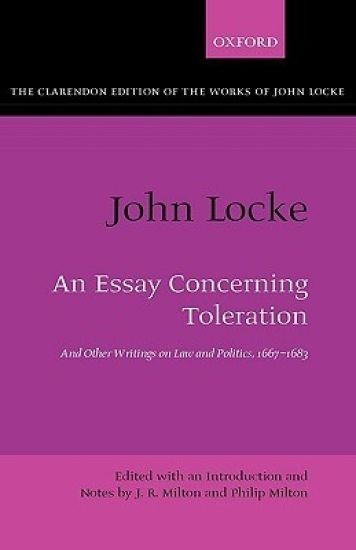
J. R. and Philip Milton present the first critical edition of John Locke's Essay concerning Toleration and a number of other writings on law and politics composed between 1667 and 1683. Although Locke never published any of these works himself they are of very great interest for students of his intellectual development because they are markedly different from the early works he wrote while at Oxford and show him working out ideas that were to appear in his mature political writings, the Two Treatises of Government and the Epistola de Tolerantia. The Essay concerning Toleration was written in 1667, shortly after Locke had taken up residence in the household of his patron Lord Ashley, subsequently Earl of Shaftesbury. It has been in print since the nineteenth century, but this volume contains the first critical edition based on all the extant manuscripts; it also contains a detailed account of Locke's arguments and of the contemporary debates on comprehension and toleration. Also included are a number of shorter writings on church and state, including a short set of queries on Scottish church government (1668), Locke's notes on Samuel Parker (1669), and 'Excommunication' (1674). The other two main works contained in this volume are rather different in character . One is a short tract on jury selection which was written at the time of Shaftesbury's imprisonment in 1681. The other is 'A Letter from a Person of Quality', a political pamphlet written by or for Shaftesbury in 1675 as part of his campaign against the Earl of Danby. This was published anonymously and is of disputed authorship; it was first attributed to Locke in 1720 and since then has occupied an uncertain position in the Locke canon. This volume contains the first critical edition based on contemporary printed editions and manuscripts and it includes a detailed account of the Letter's composition, authorship, and subsequent history. This volume will be an invaluable resource for all historians of early modern philosophy, of legal, political, and religious thought, and of 17th century Britain.
John Locke and the Problem of Depravity

John Locke and the Problem of Depravity

W. M. Spellman

Clarendon Press
1988
sidottu
The religious thought of the philosopher John Locke (1632-1704) is examined in this book, which focuses in particular on his view of original sin and its consequences for education in the early Enlightenment. The author argues that Locke has been wrongly accused of denying original sin, ignoring the atonement, and preaching moralism, and that in fact he was much closer to traditional Protestant teaching on human sinfulness than is generally recognized. While education might serve as an effective counterweight to man's innate propensity to overturn God's laws, he recognised that it could never reduce the importance of the central drama: Christ's work of salvation.
John Locke and America

John Locke and America

Barbara Arneil

Clarendon Press
1996
sidottu
This book considers the context of the colonial policies of Britain, Locke's contribution to them, and the importance of these ideas in his theory of property. It also reconsiders the debate about John Locke's influence in America, challenging a number of other interpretations. The author breaks new ground in her interpretation of Locke's writings about the Indians and English colonization of America--a subject largely overlooked in the past. The book argues that Locke's theory of property must be understood in connection with the philosopher's political concerns, as part of his endeavour to justify the colonialist policies of Lord Shaftesbury's cabinet, with which he was personally associated. The author maintains that traditional scholarship has failed to do justice to Locke by ignoring the implications of contemporary British imperial policy for the interpretation of his political thought. The book offers a new insight into Locke's theory of property, suggesting a solution to the problem of why Locke himself assigned such importance to property in the state of nature being based on labour while at the same time asserting that property in civil society is based on convention.
John Locke: Drafts for the Essay Concerning Human Understanding
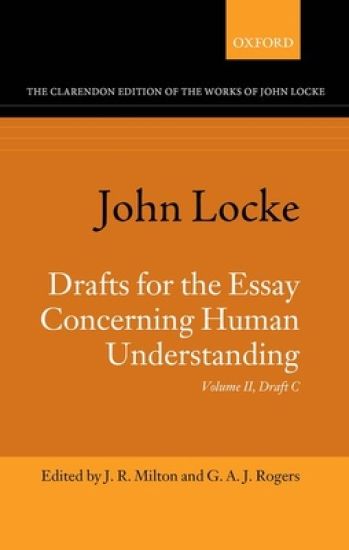
This volume provides the first complete edition of the third and final surviving draft of John Locke's Essay Concerning Human Understanding, dating from 1685, four years before the publication of the Essay itself (December 1689). There is a General Introduction that gives a detailed account of the content and circumstances of composition of this draft, and a Textual Introduction that provides a full description of the manuscript and its history.
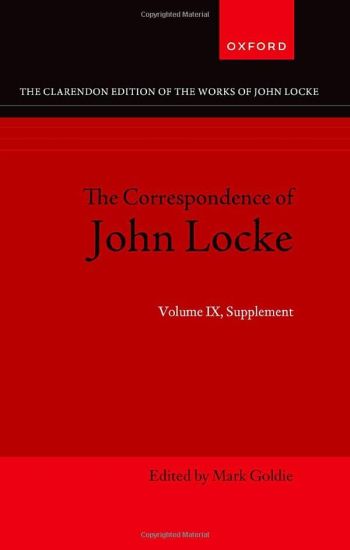
John Locke: Correspondence

John Locke: Correspondence

Oxford University Press
2023
sidottu
This is the twenty-first volume in the Clarendon Edition of the Works of John Locke. The series aims to provide authoritative critical editions of all the writings of one of the most important intellectuals in the early-modern Anglophone world. The present volume completes the Correspondence edited by the late E. S. de Beer, published between 1976 and 1989. It contains some 300 documents: newly discovered or augmented, or newly collected, letters by or to Locke, or between his close associates. New finds have emerged from archives worldwide; previously known letters are now improved from new manuscripts or supplemented by enclosures that had become detached from them; 'epistles dedicatory' in books by Locke or addressed to him are collected; third-party letters with direct bearing on Locke are included; as also Locke's agreements with publishers for the printing of his books. The volume covers Locke's manifold interests, from childrearing to medicine to cartography; from the exercise of patronage to the political economy of England's burgeoning empire; from the management of his Somerset tenants to relations with fellow philosopher Damaris Masham; from a trial for heresy to surveillance letters when Locke was suspect; from book collecting to calendrical reform. Locke's critics and vindicators are here, attacking and defending his published works. Considerable material has come to light bearing on Locke's encounters with Carolina and policies when a founding member of the Board of Trade and Plantations. The volume is supported by Mark Goldie's introduction and by an extensive explanatory editorial apparatus.
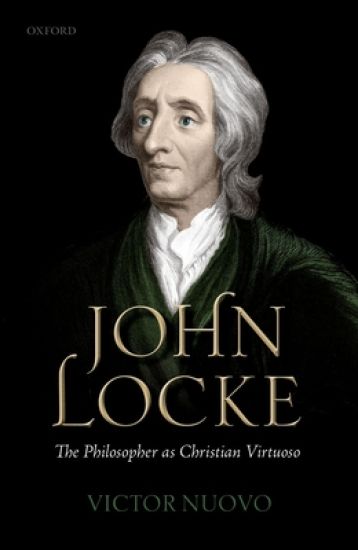
John Locke: The Philosopher as Christian Virtuoso

John Locke: The Philosopher as Christian Virtuoso

Victor Nuovo

Oxford University Press
2017
sidottu
Early modern Europe was the birthplace of the modern secular outlook. During the seventeenth century nature and human society came to be regarded in purely naturalistic, empirical ways, and religion was made an object of critical historical study. John Locke was a central figure in all these events. This study of his philosophical thought shows that these changes did not happen smoothly or without many conflicts of belief: Locke, in the role of Christian Virtuoso, endeavoured to resolve them. He was an experimental natural philosopher, a proponent of the so-called 'new philosophy', a variety of atomism that emerged in early modern Europe. But he was also a practising Christian, and he professed confidence that the two vocations were not only compatible, but mutually sustaining. He aspired, without compromising his empirical stance, to unite the two vocations in a single philosophical endeavour with the aim of producing a system of Christian philosophy.
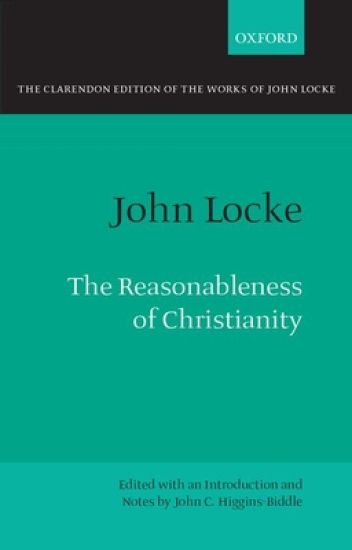
John Locke: The Reasonableness of Christianity
n 1695 John Locke published The Reasonableness of Christianity, an enquiry into the foundations of Christian belief. He did so anonymously, to avoid public involvement in the fiercely partisan religious controversies of the day. In the Reasonableness Locke considered what it was to which all Christians must assent in faith; he argued that the answer could be found by anyone for themselves in the divine revelation of Scripture alone. He maintained that the requirements of Scripture were few and simple, and therefore offered a basis for tolerant agreement among all Christians, and the promise of peace, stability, and security through toleration. This is the first critical edition of the Reasonableness: for the first time an authoritative annotated text is presented, with full information about sources, variants, amendments, and the publishing history of the work. Also provided in the editorial notes are cross-references, references to other works by Locke, definitions of terms, and other information conducive to an understanding of the text. Though modern interest has focused particularly on Locke's philosophy and political theory, increasing attention is being paid to his religious thought. These different strands cannot be understood properly in isolation from each other: so the broader aim of this edition is to help towards an improved understanding of his religious thought in the context of his work as a philosopher, political theorist, and exponent of religious toleration. In his editorial introduction John Higgins-Biddle investigates how Locke's ideas developed, and offers a critical assessment of the three main contemporary and subsequent interpretations of Locke's religious thought, all of which are shown to be unsatisfactory.
John Locke: Literary and Historical Writings
This is the first critical edition (and in some cases, the first edition ever) of the various literary and historical writings of the philosopher John Locke (1632-1704). The writings published here include poems, orations, a plan for a play, detailed instructions on how to compile a commonplace book, two sets of rules for a society meeting for general discussion, writings on the liberty of the press, and a memoir of Locke's patron, the first Earl of Shaftesbury. A General Introduction gives a detailed account of the content and circumstances of composition of these works, and a Textual Introduction provides a full description of the manuscripts and early printed editions consulted by the editors.
John Locke: Locke on Money, Volume I

John Locke: Locke on Money, Volume I

Patrick Hyde Kelly

Oxford University Press
2025
nidottu
Locke on Money presents for the first time the entire body of the philosopher's writings on this important subject (other than Two Treatises of Government). Accurate texts, together with an apparatus listing variant readings and significant manuscript changes, record the evolution of Locke's ideas from the original 1668-74 paper on interest to the three pamphlets on interest and coinage published in the 1690s. The introduction by Patrick Hyde Kelly establishes the wider context of Locke's writings in terms of contemporary debates on these subjects, the economic conditions of the time, and the circumstances of writing and publication. It shows, notably, that Locke's supposed responsibility for the 1696 recoinage is a myth. The account of what Locke derived from Mercantilist writings and of how he reformulated these in accordance with his philosophy illuminates his contribution to the evolution of economics, and will aid reappraisal of Two Treatises. The picture that emerges confirms Locke's status as major economic thinker, contrary to the prevalent view of recent decades. There are two volumes in the present edition. This first volume of Locke on Money contains the frontmatter and the texts of 'The Early Writings on Interest, 1688-74' and 'Some Considerations'.
John Locke: Locke on Money, Volume II

John Locke: Locke on Money, Volume II

Patrick Hyde Kelly

Oxford University Press
2025
nidottu
Locke on Money presents for the first time the entire body of the philosopher's writings on this important subject (other than Two Treatises of Government). Accurate texts, together with an apparatus listing variant readings and significant manuscript changes, record the evolution of Locke's ideas from the original 1668-74 paper on interest to the three pamphlets on interest and coinage published in the 1690s. The introduction by Patrick Hyde Kelly establishes the wider context of Locke's writings in terms of contemporary debates on these subjects, the economic conditions of the time, and the circumstances of writing and publication. It shows, notably, that Locke's supposed responsibility for the 1696 recoinage is a myth. The account of what Locke derived from Mercantilist writings and of how he reformulated these in accordance with his philosophy illuminates his contribution to the evolution of economics, and will aid reappraisal of Two Treatises. The picture that emerges confirms Locke's status as major economic thinker, contrary to the prevalent view of recent decades. There are two volumes in the present edition. This second volume of Locke on Money contains the texts 'Short Observations' and 'Further Considerations', as well as the Appendices and endmatter.
John Locke: Vindications of the Reasonableness of Christianity
This volume makes available for the first time critical editions of John Locke's A Vindication and A Second Vindication of the Reasonableness of Christianity, in which Locke defends his interpretation of the New Testament and of the Christian Religion against charges of heterodoxy. These works contribute greatly to our understanding of Locke's Christian commitments, which it is now recognized played an important role in shaping his philosophical opinions; they also demonstrate his sophistication as a biblical scholar, and the breadth of his theological learning. The texts are accompanied by a historical introduction explaining the origin of the works and setting them in context. In addition to a textual introduction and critical apparatus, editorial notes help to clarify the text. The volume also includes a French translation and abridgment by Pierre Coste, a Huguenot scholar, who was patronized by Locke and worked on his translations while residing in Locke's household. This definitive edition is an important contribution to an understanding of the development of modern enlightened Christian attitudes.
John Locke: Correspondence

John Locke: Correspondence

Oxford University Press
2010
sidottu
E. S. de Beer's eight-volume edition of the correspondence of John Locke is a classic of modern scholarship. The intellectual range of the correspondence is universal, covering philosophy, theology, medicine, history, geography, economics, law, politics, travel and botany. This first volume covers the years 1650 to 1679. 'When the eight volumes of correspondence have appeared they will be recognized as one of the great scholarly achievements of their day.' K. H. D. Haley, Times Literary Supplement
John Locke: An Essay concerning Toleration
J. R. and Philip Milton present the first critical edition of John Locke's Essay concerning Toleration and a number of other writings on law and politics composed between 1667 and 1683. Although Locke never published any of these works himself they are of very great interest for students of his intellectual development because they are markedly different from the early works he wrote while at Oxford and show him working out ideas that were to appear in his mature political writings, the Two Treatises of Government and the Epistola de Tolerantia. The Essay concerning Toleration was written in 1667, shortly after Locke had taken up residence in the household of his patron Lord Ashley, subsequently Earl of Shaftesbury. It has been in print since the nineteenth century, but this volume contains the first critical edition based on all the extant manuscripts; it also contains a detailed account of Locke's arguments and of the contemporary debates on comprehension and toleration. Also included are a number of shorter writings on church and state, including a short set of queries on Scottish church government (1668), Locke's notes on Samuel Parker (1669), and 'Excommunication' (1674). The other two main works contained in this volume are rather different in character . One is a short tract on jury selection which was written at the time of Shaftesbury's imprisonment in 1681. The other is 'A Letter from a Person of Quality', a political pamphlet written by or for Shaftesbury in 1675 as part of his campaign against the Earl of Danby. This was published anonymously and is of disputed authorship; it was first attributed to Locke in 1720 and since then has occupied an uncertain position in the Locke canon. This volume contains the first critical edition based on contemporary printed editions and manuscripts and it includes a detailed account of the Letter's composition, authorship, and subsequent history. This volume will be an invaluable resource for all historians of early modern philosophy, of legal, political, and religious thought, and of 17th century Britain.