Kirjojen hintavertailu. Mukana 11 378 083 kirjaa ja 12 kauppaa.

Kirjahaku

Etsi kirjoja tekijän nimen, kirjan nimen tai ISBN:n perusteella.

1000 tulosta hakusanalla Kenneth L Decroo

Computation and Control III

Computation and Control III

Kenneth L. Bowers; John Lund

Springer-Verlag New York Inc.
2012
nidottu
The third Conference on Computation and Control was held at Mon­ tana State University in Bozeman, Montana from August 5-11, 1992 and this proceedings represents the evolution that the conference has taken since its 1988 and 1990 predecessors. The first conference and proceedings (Volume 1 in PSCT) nurtured a dialogue between researchers in control theory and the area of numerical computation. This cross-fertilization was continued with the 1990 conference and proceedings (Volume 11 in PSCT) while forecasting the theme for this conference. The present volume contains a collection of papers addressing issues ranging from noise abatement via smart material technology, robotic vi­ sion, and parameter identification to feedback design challenges in fluid control and other areas of topical interest. The area of feedback design in fluid control spawns computational challenges in the form of Burgers' equation which is addressed both with standard numerical methods as well as new computational procedures. Applications which involve inverse prob­ lems include material parameter estimation and sampling in observability. Whether motivated by the plant or arising as the distributed system in the design of a feedback compensator for problems in nonlinear control, the theme of this conference placed an emphasis on the use of partial dif­ ferential equations in control theory. Through challenges initiated via the control problem or the subsequent computational problem, the joint efforts of experts from the respective disciplines enhance the development of both.
Symbolic Model Checking

Symbolic Model Checking

Kenneth L. McMillan

Springer-Verlag New York Inc.
2012
nidottu
Formal verification means having a mathematical model of a system, a language for specifying desired properties of the system in a concise, comprehensible and unambiguous way, and a method of proof to verify that the specified properties are satisfied. When the method of proof is carried out substantially by machine, we speak of automatic verification. Symbolic Model Checking deals with methods of automatic verification as applied to computer hardware. The practical motivation for study in this area is the high and increasing cost of correcting design errors in VLSI technologies. There is a growing demand for design methodologies that can yield correct designs on the first fabrication run. Moreover, design errors that are discovered before fabrication can also be quite costly, in terms of engineering effort required to correct the error, and the resulting impact on development schedules. Aside from pure cost considerations, there is also a need on the theoretical side to provide a sound mathematical basis for the design of computer systems, especially in areas that have received little theoretical attention.
Biochemistry of the Elemental Halogens and Inorganic Halides

Biochemistry of the Elemental Halogens and Inorganic Halides

Kenneth L. Kirk

Springer-Verlag New York Inc.
2012
nidottu
The elements in group 17 (VIlA) of the periodic table of elements-fluorine (F), chlorine (CI), bromine (Br), and iodine (I)-were designated by Berzelius as "halogens" (Greek hals, sea salt; gennao, I beget) because of their propensity to form salts. In this first of the two volumes of Bio­ chemistry of the Halogens, the biochemistry of the elemental halogens and inorganic halides is reviewed. Discovery, properties, and biochemistry of the elemental halogens are reviewed first (Chapter 1). This is followed by a review of the developments in the various areas of inorganic halide biochemistry (Chapters 2 through 5). The biochemistry of thyroid hor­ mones is considered in Chapter 6, while biohalogenation, an important link between inorganic and organic halogen biochemistry, is reviewed in Chapter 7. Chapter 8 covers the biochemistry of products produced by human-inspired halogenation, in particular, poly halogenated compounds that present environmental problems. In Chapter 9, the process is reversed and biodehalogenation is reviewed. In each subject, the attempt has been made to find an appropriate balance between depth and breadth of treatment, since a thorough, in­ depth review of this field would not be possible in a single volume. To provide readers not familiar with subjects with the necessary background to place subsequent discussions in perspective, brief historical develop­ ments of many of the topics are given.
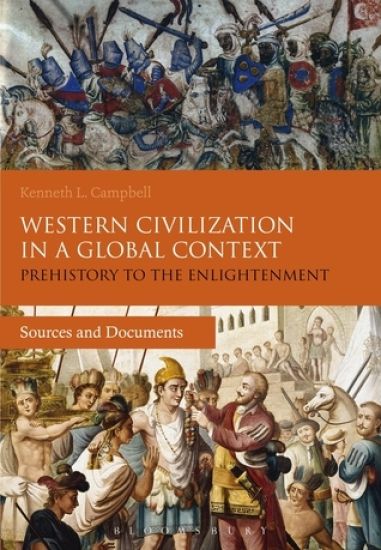
Western Civilization in a Global Context: Prehistory to the Enlightenment
Western Civilization in a Global Context is a source collection that introduces a comparative element to the study of Western civilization, offering students an opportunity to explore non-Western perspectives. An interesting and provocative set of readings are included, from a range of primary sources, including official documents, historical writings, literary sources, letters, speeches, interviews as well as visual sources. These different sources are carefully selected with a view to generating class discussion and providing students with a sense of the different approaches historians might take to understanding the past. Volume I covers prehistory to the Enlightenment, including sources that offer insight into the political, social, religious, cultural and intellectual history of this period. Topics covered include: - The Rise of Rome - Byzantine Civilization - The Renaissance in Europe and China - Religious Reformation - European Expansion - The Scientific Revolution To aid student engagement and understanding, the book begins with a guide to using primary sources and includes questions for discussion throughout. Western Civilization in a Global Context is the ideal companion for students who want to explore the contribution of non-Western cultures, and gain a more thorough understanding of the complex history of the world as a result.
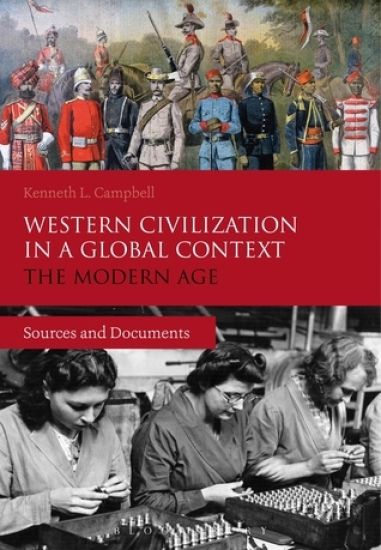
Western Civilization in a Global Context: The Modern Age

Western Civilization in a Global Context: The Modern Age

Kenneth L. Campbell

Bloomsbury Academic
2015
nidottu
Western Civilization in a Global Context is a source collection that introduces a comparative element to the study of Western civilization, offering students an opportunity to explore non-Western perspectives. An interesting and provocative set of readings are included, from a range of primary sources, including official documents, historical writings, literary sources, letters, speeches, interviews as well as visual sources. These different sources are carefully selected with a view to generating class discussion and to provide students with a sense of the different approaches historians might take to understanding the past. Volume II covers the modern period, from the Enlightenment to the 21st century, including sources that help gain insight into the political, social, religious, cultural and intellectual history of this period. Topics covered include:- The American and French Revolutions - The Age of Nationalism - The New Imperialism - Two World Wars and the Interwar Crisis - The Cold War - Decolonization To aid student engagement and understanding, the book begins with a guide to using primary sources and includes questions for discussion throughout. Western Civilization in a Global Context is the ideal companion for students who want to explore the contribution of non-Western cultures, and gain a more thorough understand the complex history of the world as a result.
Western Civilization in a Global Context: The Modern Age

Western Civilization in a Global Context: The Modern Age

Kenneth L. Campbell

Bloomsbury Academic
2015
sidottu
Western Civilization in a Global Context is a source collection that introduces a comparative element to the study of Western civilization, offering students an opportunity to explore non-Western perspectives. An interesting and provocative set of readings are included, from a range of primary sources, including official documents, historical writings, literary sources, letters, speeches, interviews as well as visual sources. These different sources are carefully selected with a view to generating class discussion and to provide students with a sense of the different approaches historians might take to understanding the past. Volume II covers the modern period, from the Enlightenment to the 21st century, including sources that help gain insight into the political, social, religious, cultural and intellectual history of this period. Topics covered include:- The American and French Revolutions - The Age of Nationalism - The New Imperialism - Two World Wars and the Interwar Crisis - The Cold War - Decolonization To aid student engagement and understanding, the book begins with a guide to using primary sources and includes questions for discussion throughout. Western Civilization in a Global Context is the ideal companion for students who want to explore the contribution of non-Western cultures, and gain a more thorough understand the complex history of the world as a result.
Western Civilization in a Global Context: Prehistory to the Enlightenment
Western Civilization in a Global Context is a source collection that introduces a comparative element to the study of Western civilization, offering students an opportunity to explore non-Western perspectives. An interesting and provocative set of readings are included, from a range of primary sources, including official documents, historical writings, literary sources, letters, speeches, interviews as well as visual sources. These different sources are carefully selected with a view to generating class discussion and providing students with a sense of the different approaches historians might take to understanding the past. Volume I covers prehistory to the Enlightenment, including sources that offer insight into the political, social, religious, cultural and intellectual history of this period. Topics covered include: - The Rise of Rome - Byzantine Civilization - The Renaissance in Europe and China - Religious Reformation - European Expansion - The Scientific Revolution To aid student engagement and understanding, the book begins with a guide to using primary sources and includes questions for discussion throughout. Western Civilization in a Global Context is the ideal companion for students who want to explore the contribution of non-Western cultures, and gain a more thorough understanding of the complex history of the world as a result.
Logistics in the Falklands War: A Case Study in Expeditionary Warfare
While many books have been written on the Falklands War, this is the first to focus on the vital aspect of logistics. The challenges were huge; the lack of preparation time; the urgency; the huge distances involved; the need to requisition ships from trade to name but four. After a brief discussion of events leading to Argentina's invasion the book describes in detail the rush to re-organise and deploy forces, despatch a large task force, the innovative solutions needed to sustain the Task Force, the vital staging base at Ascension Island, the in-theatre resupply, the set-backs and finally the restoring of order after victory. Had the logistics plan failed, victory would have been impossible and humiliation inevitable, with no food for the troops, no ammunition for the guns, no medical support for casualties etc. The lessons learnt have never been more important with increasing numbers of out-of-area operations required in remote trouble spots at short notice. The Falklands experience is crucial for the education of new generations of military planners and fascinating for military buffs and this book fills an important gap.
A History of the British Isles

A History of the British Isles

Kenneth L. Campbell

Bloomsbury Academic
2017
sidottu
CHOICE Outstanding Academic Title 2017A History of the British Isles is a balanced and integrated political, social, cultural and religious history of the British Isles in all its complexity, exploring the constantly evolving dialogue and relationship between the past and the present.A wide range of topics and questions are addressed for each period and territory discussed, including England’s Wars of the Roses of the 15th century and their influence on court politics during the 16th century; Ireland’s Rebellion of 1798, the Potato Famine of the 1840s and the Easter Rising of 1916; the two World Wars and the Great Depression; British cultural and social change during the 1960s; and the history and future of the British Isles in the present day.Kenneth Campbell integrates the histories of England, Ireland, Scotland, and Wales by exploring common themes and drawing on comparative examples, while also demonstrating how those histories are different, making this a genuinely integrated text. Campbell’s approach allows readers to appreciate the history of the British Isles not just for its own sake, but for the purposes of understanding our current political divisions, our world and ourselves.
A History of the British Isles

A History of the British Isles

Kenneth L. Campbell

Bloomsbury Academic
2017
nidottu
CHOICE Outstanding Academic Title 2017A History of the British Isles is a balanced and integrated political, social, cultural and religious history of the British Isles in all its complexity, exploring the constantly evolving dialogue and relationship between the past and the present.A wide range of topics and questions are addressed for each period and territory discussed, including England’s Wars of the Roses of the 15th century and their influence on court politics during the 16th century; Ireland’s Rebellion of 1798, the Potato Famine of the 1840s and the Easter Rising of 1916; the two World Wars and the Great Depression; British cultural and social change during the 1960s; and the history and future of the British Isles in the present day.Kenneth Campbell integrates the histories of England, Ireland, Scotland, and Wales by exploring common themes and drawing on comparative examples, while also demonstrating how those histories are different, making this a genuinely integrated text. Campbell’s approach allows readers to appreciate the history of the British Isles not just for its own sake, but for the purposes of understanding our current political divisions, our world and ourselves.
Biochemistry of Halogenated Organic Compounds

Biochemistry of Halogenated Organic Compounds

Kenneth L. Kirk

Springer-Verlag New York Inc.
2013
nidottu
Biochemistry of Halogenated Organic Compounds has been written as a general reference source for researchers in several related areas, including organic chemists, medicinal chemists, pharmacologists, toxicologists, and medical researchers. The development of halogenated compounds as medicinal agents and pharmacological tools and the fascinating biochemi­ cal processes that have been discovered and studied using these analogues have generated extremely active areas of research and an enormous volume of literature. Thus, halogenated organic compounds pervade every aspect of biochemistry, a fact made apparent by the numerous reviews and monographs available on individual topics-halogenated nucleosides, halogenated carbohydrates, and so forth. Given the quantity of material already written on these topics, some of which material is quite current, it might be asked whether a one-volume review of these subjects is useful, or possible. Having now completed this work, I feel the answer to both questions is an emphatic yes. There are fascinating stories to be related in each area, and, where appropriate, I have attempted to develop these topics . from a historical perspective. For example, the discovery of the anticancer activity of fluorouracil, the unraveling of the several mechanisms of its action, and the development of a host of later generations of anticancer and antiviral agents based on the parent fluoro-, iodo-, bromo-, and trifluoromethylpyrimidines were, and are, contributions of major magnitude to medical science.
The Cosmic Music Community Essential Music for Effective Living

The Cosmic Music Community Essential Music for Effective Living

Kenneth L. Green

Createspace Independent Publishing Platform
2012
nidottu
Cosmic Music is a high music, thousands of years on this planet and most certainly others as its origins lie in the cosmos. It has been asserted by the ancient Kemetans that this world was called forth from chaos by sound and/or harmony and constructed according to the principles of music proportion. Truly, each heavenly sphere, orb or planet emits a definite tone in its physically assigned orbit. Together, these tones play out a continuous celestial symphony beyond the scope of man, yet echoes of this heavenly music reaches our physical world and is often accessed by the receptive, resulting in a Cosmic Music Experience. Musician John Coltrane among others, related and recorded many such experiences. It has been said that; "a time will come when we may harness the energy from a John Coltrane performance to power entire cities."