

Kirjahaku
Etsi kirjoja tekijän nimen, kirjan nimen tai ISBN:n perusteella.
1000 tulosta hakusanalla Kristin Neff


In An Ethnography of Hunger Kristin D. Phillips examines how rural farmers in central Tanzania negotiate the interconnected projects of subsistence, politics, and rural development. Writing against stereotypical Western media images of spectacular famine in Africa, she examines how people live with—rather than die from—hunger. Through tracing the seasonal cycles of drought, plenty, and suffering and the political cycles of elections, development, and state extraction, Phillips studies hunger as a pattern of relationships and practices that organizes access to food and profoundly shapes agrarian lives and livelihoods. Amid extreme inequality and unpredictability, rural people pursue subsistence by alternating between—and sometimes combining—rights and reciprocity, a political form that she calls "subsistence citizenship." Phillips argues that studying subsistence is essential to understanding the persistence of global poverty, how people vote, and why development projects succeed or fail.
In An Ethnography of Hunger Kristin D. Phillips examines how rural farmers in central Tanzania negotiate the interconnected projects of subsistence, politics, and rural development. Writing against stereotypical Western media images of spectacular famine in Africa, she examines how people live with—rather than die from—hunger. Through tracing the seasonal cycles of drought, plenty, and suffering and the political cycles of elections, development, and state extraction, Phillips studies hunger as a pattern of relationships and practices that organizes access to food and profoundly shapes agrarian lives and livelihoods. Amid extreme inequality and unpredictability, rural people pursue subsistence by alternating between—and sometimes combining—rights and reciprocity, a political form that she calls "subsistence citizenship." Phillips argues that studying subsistence is essential to understanding the persistence of global poverty, how people vote, and why development projects succeed or fail.
As the slave trade entered its last, illegal phase in the 19th century, the town of Lagos on West Africa's Bight of Benin became one of the most important port cities north of the equator. Slavery and the Birth of an African City explores the reasons for Lagos's sudden rise to power. By linking the histories of international slave markets to those of the regional suppliers and slave traders, Kristin Mann shows how the African slave trade forever altered the destiny of the tiny kingdom of Lagos. This magisterial work uncovers the relationship between African slavery and the growth of one of Africa's most vibrant cities.

An exploration of the economization of the ocean through the small modifications that enable great transformations of nature. The ocean is the site of an ongoing transformation that is aimed at creating new economic opportunities and prosperity. In Nature-Made Economy, Kristin Asdal and Tone Huse explore how the ocean has been harnessed to become a space of capital investment and innovation, and how living nature is wrested into the economy even as nature, in turn, resists, adapts to, or changes the economy. The authors' innovative methodological and conceptual approaches examine the economy by focusing on surprising and numerous "little tools"--such as maps and policy documents, quality patrols, and dietary requirements for the enhancement of species' biological propensities--that value, direct, reorder, accomplish, and sometimes fail to serve our ends, but also add up to great change. Throughout Nature-Made Economy, Asdal and Huse follow one species, the Atlantic cod, and explore how it is subjected to different versions of economization. Taking this species as a point of departure, they then provide novel analyses of the innovation economy, the architecture of markets, the settling of prices, and more, revealing how the ocean is rendered a space of intense economic exploitation. Through their analysis, the authors develop a distinct theoretical approach and conceptual vocabulary for studying nature-economy relations. Nature-Made Economy is a significant contribution to the broad field of STS and social studies of markets, as well as to studies of the Anthropocene, the environment, and human-animal relations.

Fast Cars, Clean Bodies examines the crucial decade from Dien Bien Phu to the mid-1960s when France shifted rapidly from an agrarian, insular, and empire-oriented society to a decolonized, Americanized, and fully industrial one. In this analysis of a startling cultural transformation Kristin Ross finds the contradictions of the period embedded in its various commodities and cultural artifacts-automobiles, washing machines, women's magazines, film, popular fiction, even structuralism-as well as in the practices that shape, determine, and delimit their uses.In each of the book's four chapters, a central object of mythical image is refracted across a range of discursive and material spaces: social and private, textual and cinematic, national and international. The automobile, the new cult of cleanliness in the capital and the colonies, the waning of Sartre and de Beauvoir as the couple of national attention, and the emergence of reshaped, functionalist masculinities (revolutionary, corporate, and structural) become the key elements in this prehistory of postmodernism in France.Modernization ideology, Ross argues, offered the promise of limitless, even timeless, development. By situating the rise of "end of history" ideologies within the context of France's transition into mass culture and consumption, Ross returns the touted timelessness of modernization to history. She shows how the realist fiction and film of the period, as well as the work of social theorists such as Barthes, Lefebvre, and Morin who began at the time to conceptualize "everyday life," laid bare the disruptions and the social costs of events. And she argues that the logic of the racism prevalent in France today, focused on the figure of the immigrant worker, is itself the outcome of the French state's embrace of capitalist modernization ideology in the 1950s and 1960s.

The fields of comparative and world literature tend to have a unidirectional, Eurocentric focus, with attention to concepts of “origin” and “arrival.” DisOrientations challenges this viewpoint. Kristin Dickinson employs a unique multilingual archive of German and Turkish translated texts from the early nineteenth through the mid-twentieth century. In this analysis, she reveals the omnidirectional and transtemporal movements of translations, which, she argues, harbor the disorienting potential to reconfigure the relationships of original to translation, past to present, and West to East. Through the work of three key figures—Johann Wolfgang von Goethe, Friedrich Schrader, and Sabahattin Ali—Dickinson develops a concept of translational orientation as a mode of omnidirectional encounter. She sheds light on translations that are not bound by the terms of economic imperialism, Orientalism, or Westernization, focusing on case studies that work against the basic premises of containment and originality that undergird Orientalism’s system of discursive knowledge production. By linking literary traditions across retroactively applied periodizations, the translations examined in this book act as points of connection that produce new directionalities and open new configurations of a future German-Turkish relationship.Groundbreaking and erudite, DisOrientations examines literary translation as a complex mode of cultural, political, and linguistic orientation. This book will appeal to scholars and students of translation theory, comparative literature, Orientalism, and the history of German-Turkish cultural relations.

The fields of comparative and world literature tend to have a unidirectional, Eurocentric focus, with attention to concepts of “origin” and “arrival.” DisOrientations challenges this viewpoint. Kristin Dickinson employs a unique multilingual archive of German and Turkish translated texts from the early nineteenth through the mid-twentieth century. In this analysis, she reveals the omnidirectional and transtemporal movements of translations, which, she argues, harbor the disorienting potential to reconfigure the relationships of original to translation, past to present, and West to East. Through the work of three key figures—Johann Wolfgang von Goethe, Friedrich Schrader, and Sabahattin Ali—Dickinson develops a concept of translational orientation as a mode of omnidirectional encounter. She sheds light on translations that are not bound by the terms of economic imperialism, Orientalism, or Westernization, focusing on case studies that work against the basic premises of containment and originality that undergird Orientalism’s system of discursive knowledge production. By linking literary traditions across retroactively applied periodizations, the translations examined in this book act as points of connection that produce new directionalities and open new configurations of a future German-Turkish relationship.Groundbreaking and erudite, DisOrientations examines literary translation as a complex mode of cultural, political, and linguistic orientation. This book will appeal to scholars and students of translation theory, comparative literature, Orientalism, and the history of German-Turkish cultural relations.

Minority Protection in Post-Apartheid South Africa
Kristin Henrard
Praeger Publishers Inc
2002
sidottu
Accommodation of population diversity is a vital issue for any multinational society. The legacy of Apartheid in South Africa complicates this effort considerably. Henrard introduces a theoretical framework regarding how to accommodate minority protection in the most appropriate way and analyzes the respective contributions of individual rights, minority rights, and the right to self-determination. Subsequent chapters examine the case study of post-apartheid South Africa and attempt to investigate its constitutional development. Henrard finds that provisions within the 1996 Constitution do acknowledge an interrelation between these three important factors; however, implementation of minority protection policy is often quite a different matter. In seeking appropriate means of minority protection, this study stresses inclusionism, integration, and the essential right to identity and real equality. While Henrard reviews and discusses the entire democratic transformation process in South Africa, she cautions that, because current developments are characterized by their unsettled nature, major transformation and flux, analysis of the implementation phase can be only indicative. The apartheid history does not in itself inhibit progressive stances on this important issue. Still, despite the promising nature of the 1996 Constitution, the picture that emerges in terms of policy development aimed at minority protection is ambivalent.
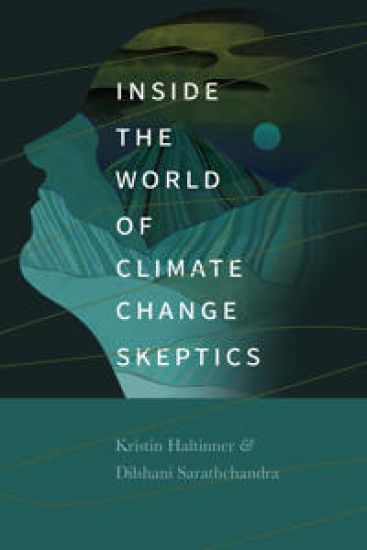
Inside the World of Climate Change Skeptics
Kristin Haltinner; Dilshani Sarathchandra
UNIVERSITY OF WASHINGTON PRESS
2023
sidottu
An extraordinary look into doubt, denial, and distrustAs wildfires rip across the western United States and sea levels rise along coastal cities from Louisiana to Alaska, some people nevertheless reject the mainstream scientific consensus on anthropogenic climate change. What leads people to doubt or outright denial? What leads skeptics to change their minds? Drawing from a rich collection of interviews and surveys with self-identified climate change skeptics (and some former ones), sociologists Kristin Haltinner and Dilshani Sarathchandra delve into the underlying dynamics of climate skepticism in the United States. In probing how ideas about science, religion, politics, and media affect perceptions of climate change, they find a far greater diversity of attitudes and beliefs than one might expect—including some pro-environmental views. With this nuanced understanding of climate change skepticism, Inside the World of Climate Change Skeptics offers much-needed insights on improving communication in ways that can move us toward a better future while advancing environmental policies with widespread political support.
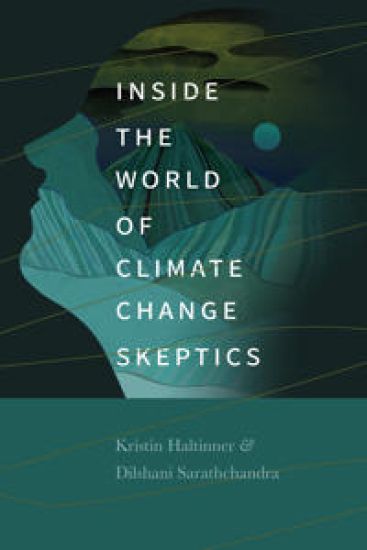
Inside the World of Climate Change Skeptics
Kristin Haltinner; Dilshani Sarathchandra
UNIVERSITY OF WASHINGTON PRESS
2023
pokkari
An extraordinary look into doubt, denial, and distrustAs wildfires rip across the western United States and sea levels rise along coastal cities from Louisiana to Alaska, some people nevertheless reject the mainstream scientific consensus on anthropogenic climate change. What leads people to doubt or outright denial? What leads skeptics to change their minds? Drawing from a rich collection of interviews and surveys with self-identified climate change skeptics (and some former ones), sociologists Kristin Haltinner and Dilshani Sarathchandra delve into the underlying dynamics of climate skepticism in the United States. In probing how ideas about science, religion, politics, and media affect perceptions of climate change, they find a far greater diversity of attitudes and beliefs than one might expect—including some pro-environmental views. With this nuanced understanding of climate change skepticism, Inside the World of Climate Change Skeptics offers much-needed insights on improving communication in ways that can move us toward a better future while advancing environmental policies with widespread political support.

The Bible tells stories of big things God can do in small portions. From Gideon's army to a five-word sermon to a few loaves and fish feeding multitudes. Why shouldn't we believe that God can take twenty minutes and multiply our efforts to produce a spiritual overflow? Kristin will share her "why" of Bible study and help users articulate their own reasons for taking a deeper journey into God's Word. You will see and experience the extraordinary work God can do with our willingness to commit just twenty minutes a day to His Word. Sixty psalms will be covered, and each psalm's study will include the entire psalm, a key verse to memorize, a commentary with any critical context or notes, and a devotional thought. Each day will also include guidance for personal study, if you have more time, and questions for deeper reflection.

What's the secret to keeping love alive and full of laughter? Kristin and Danny Adams, the couple behind numerous hilarious viral lip sync videos, draw from their own experience in marriage and entertainment to encourage you to live loudly, love radically, and laugh uncontrollably.Every relationship needs plenty of love and laughter. But how do you keep the fun going when the road gets hard? Viral video creators Kristin and Danny Adams's journey has involved more "heated fellowship" than their hilarious lip sync videos might lead you to think. Kristin and Danny invite you to:Turn roadblocks into opportunities for growth, wisdom, and even laughterHave faith in God to sustain you in difficult times and bring back your joyLet go of the fear of change and find courage to face all of life togetherFace the "laugh blockers" that get in the way of the joy of connectionRediscover the joy of your unique connection for a deeper and more fulfilling marriage journey."You will come away changed. . . . This is a must-read!" -- Jefferson and Alyssa Bethke"With humor and so much wisdom, this story will leave you inspired and feeling like you're not alone." -- Jeremy and Audrey Roloff

Darien is a young woman who seems to have everything: a successful job, an adoring husband, and a bright future. She also has a tendency towards violent, self-destructive outbursts when she's alone. When her private life spirals out of control, her husband and her therapist desperately try to help her uncover her horrible secrets before she destroys herself. Unfortunately, she just as desperately tries to keep them hidden.

From the New York Times bestselling author Kristin Hannah comes a powerful novel of love, loss, and the magic of friendship. . . . now a #1 Netflix series In the turbulent summer of 1974, Kate Mularkey has accepted her place at the bottom of the eighth-grade social food chain. Then, to her amazement, the "coolest girl in the world" moves in across the street and wants to be her friend. Tully Hart seems to have it all--beauty, brains, ambition. On the surface they are as opposite as two people can be: Kate, doomed to be forever uncool, with a loving family who mortifies her at every turn. Tully, steeped in glamour and mystery, but with a secret that is destroying her. They make a pact to be best friends forever; by summer's end they've become TullyandKate. Inseparable. So begins Kristin Hannah's magnificent new novel. Spanning more than three decades and playing out across the ever-changing face of the Pacific Northwest, Firefly Lane is the poignant, powerful story of two women and the friendship that becomes the bulkhead of their lives. From the beginning, Tully is desperate to prove her worth to the world. Abandoned by her mother at an early age, she longs to be loved unconditionally. In the glittering, big-hair era of the eighties, she looks to men to fill the void in her soul. But in the buttoned-down nineties, it is television news that captivates her. She will follow her own blind ambition to New York and around the globe, finding fame and success . . . and loneliness. Kate knows early on that her life will be nothing special. Throughout college, she pretends to be driven by a need for success, but all she really wants is to fall in love and have children and live an ordinary life. In her own quiet way, Kate is as driven as Tully. What she doesn't know is how being a wife and mother will change her . . . how she'll lose sight of who she once was, and what she once wanted. And how much she'll envy her famous best friend. . . . For thirty years, Tully and Kate buoy each other through life, weathering the storms of friendship--jealousy, anger, hurt, resentment. They think they've survived it all until a single act of betrayal tears them apart . . . and puts their courage and friendship to the ultimate test. Firefly Lane is for anyone who ever drank Boone's Farm apple wine while listening to Abba or Fleetwood Mac. More than a coming-of-age novel, it's the story of a generation of women who were both blessed and cursed by choices. It's about promises and secrets and betrayals. And ultimately, about the one person who really, truly knows you--and knows what has the power to hurt you . . . and heal you. Firefly Lane is a story you'll never forget . . . one you'll want to pass on to your best friend.

#1 New York Times Instant Bestseller In Kristin Hannah's The Great Alone, a desperate family seeks a new beginning in the near-isolated wilderness of Alaska only to find that their unpredictable environment is less threatening than the erratic behavior found in human nature. Alaska, 1974. Ernt Allbright came home from the Vietnam War a changed and volatile man. When he loses yet another job, he makes the impulsive decision to move his wife and daughter north where they will live off the grid in America's last true frontier. Cora will do anything for the man she loves, even if means following him into the unknown. Thirteen-year-old Leni, caught in the riptide of her parents' passionate, stormy relationship, has little choice but to go along, daring to hope this new land promises her family a better future. In a wild, remote corner of Alaska, the Allbrights find a fiercely independent community of strong men and even stronger women. The long, sunlit days and the generosity of the locals make up for the newcomers' lack of preparation and dwindling resources. But as winter approaches and darkness descends, Ernt's fragile mental state deteriorates. Soon the perils outside pale in comparison to threats from within. In their small cabin, covered in snow, blanketed in eighteen hours of night, Leni and her mother learn the terrible truth: they are on their own.

Women across America laughed, cried, and reconnected with their friends after reading Kristin Hannah's smash hit, Firefly Lane. Now, in True Colors, she explores the poignant, powerful, complex world of sisters... The Grey sisters had only each other when their mother died years ago. Their stern, unyielding father gave them almost no attention. Winona, the oldest, needs her father's approval most of all. An overweight dreamer, she never felt at home on the sprawling horse ranch that had been in her family for three generations. Aurora, the middle, is the peacemaker. Vivi Ann, the youngest, is the undisputed star of the family. Everything comes easily to Vivi Ann, her father's love most of all. But when Vivi Ann makes a fateful decision to follow her heart, rather than take the route of a dutiful daughter, events are set in motion that will test the love and loyalties of the Grey sisters. They will be pitted against each other in ways none could have imagined. Secrets will be revealed, and a terrible, shocking crime will shatter both the family and their beloved town. With breathtaking pace and penetrating insight, Kristin Hannah's True Colors is a novel about sisters, vengeance, jealousy, betrayal--and ultimately, what it truly means to be a family.