Dieser Buchtitel ist Teil des Digitalisierungsprojekts Springer Book Archives mit Publikationen, die seit den Anfängen des Verlags von 1842 erschienen sind. Der Verlag stellt mit diesem Archiv Quellen für die historische wie auch die disziplingeschichtliche Forschung zur Verfügung, die jeweils im historischen Kontext betrachtet werden müssen. Dieser Titel erschien in der Zeit vor 1945 und wird daher in seiner zeittypischen politisch-ideologischen Ausrichtung vom Verlag nicht beworben.
Melli wohnt im Deutschland der nahen Zukunft und tr gt ein Stigma, das sie zunehmend vom gesellschaftlichen Leben ausschlie t. Als die Einschr nkungen immer gr er werden und sie Angst um ihr Leben bekommt, fl chtet sie nach Schweden in die Einsamkeit eines abgelegenen Waldes. Von dort aus schreibt sie Emails an ihre Freundin Charlotte, die in der Heimat zur ckgeblieben ist. Sie bekommt nie eine Antwort, Charlotte scheint spurlos verschwunden. Stigma - Eine Geschichte ber bunte Menschen in gr nen W ldern, einen schwarzen Hund und den leisen Kampf f r Freiheit und Vielfalt.
This volume consists of one expository paper and two research papers:T Hirai, A Hora and E Hirai, Introductory expositions on projective representations of groups (referred as [E])T Hirai, E Hirai and A Hora, Projective representations and spin characters of complex reflection groups G(m,p,n) and G(m,p,8), I;T Hirai, A Hora and E Hirai, Projective representations and spin characters of complex reflection groups G(m,p,n) and G(m,p,8), II, Case of generalized symmetric groups.Since Schur's trilogy on 1904 and so on, many mathematicians studied projective representations of groups and algebras, and also of their characters. Nevertheless, to invite mathematicians to this interesting and important areas, the paper [E] collects introductory expositions, with a historical plotting, for the theory of projective representations of groups and their characters. The paper [I] treats general theory for projective (or spin) representations and spin characters of complex reflection groups G(m,p,n) and G(m,p,8)=lim n?8G(m,p,n), and clarifies the intimate relations between mother groups, G(m,1,n), G(m,1,8)(p=1), called generalized symmetric groups, and their child groups, G(m,p,n), G(m,p,8),(p|m, p>1). Also we treat explicitly a case of spin type in connection with the case of non-spin type (i.e. of linear representations). A detailed and general account on the so-called Vershik-Kerov theory on limits of characters is added. The paper [II] treats spin irreducible representations and spin characters of generalized symmetric groups (mother groups) for other spin types.Published by Mathematical Society of Japan and distributed by World Scientific Publishing Co. for all markets
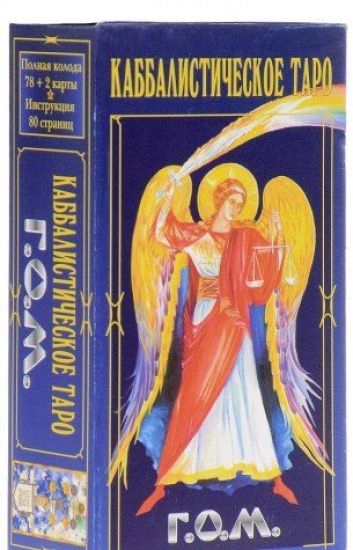
Nastojaschaja koloda soedinjaet v sebe silu Kabbaly, predskazatelnuju mudrost Taro i realizatsionnuju vlast Simvola. Ona sostavlena po printsipam, izlozhennym v knige G.O.M. "Kurs Entsiklopedii okkultizma". Vse mazhornye i minornye Arkany Tarota tochno vosproizvodjat kharakteristiki kart, dannye G.O.M. Eto otnositsja ne tolko k risunkam, no i k podboru tsvetov, znakam i simvolam, ispolzovannym na kazhdoj karte. Na kartakh pomimo privychnykh nazvanij stojat podpisi dukhov, neobkhodimye kabbalisticheskie znaki, astrologicheskie sootvetstvija, chto pozvoljaet dobitsja porazitelnoj tochnosti v gadanijakh. Bolshoj format karty nailuchshim obrazom podkhodit dlja meditatsii. V rukovodstve pomimo rasshifrovki simvolov privedeny dva originalnykh rasklada dlja opredelenija realnykh prichin, vyzvavshikh bespokojstvo, a takzhe razreshenija slozhnykh karmicheskikh i filosofskikh voprosov. Primenenie etikh metodik proritsanija podrobno razbiraetsja na konkretnykh primerakh. Koloda obladaet jarko vyrazhennymi magicheskimi svojstvami....
M.G. Smith: Social Theory and Anthropology in the Caribbean and Beyond invites readers to explore the life and work of Michael Garfield Smith, one of the most prolific Caribbean thinkers of the post-war era. M. G., as he was known, is credited with having made significant contributions in the fields of anthropology, social theory, sociology and politics. This collection of essays, presented at the 2008 Caribbean Reasonings conference held in honour of M. G. Smith, is divided into three parts. In part one, Critical Contestations, both sides of the creole society debate are argued while the argument is also made for and against Smith s plural society theory. In part two, Anthropological Excursions, Smith s fieldwork observations and conclusions in both Africa and the Caribbean are also thoroughly examined, while part three, Beyond M. G. Smith, demonstrates the impact that M. G. Smith has had on scholarship coming out of the Caribbean, as his work is used as a point of departure in rethinking aspects of Caribbean social theory. Includes contributions from: Philip Burnham, Jean Besson, Mervyn Alleyne, Don Robotham, Colin Clarke, Mohammed Bashir Salau, Murray Last, Christine Barrow, Wyatt MacGaffey, Rivke Jaffe, Jack Menke, Peter Meel, Anton Allahar, Huon Wardle. This exciting work ends with A Brief Personal Memoir, a postscript by Mary Smith, his widow, which gives an insight into the personal life of M. G. Smith and the important moments that shaped his life.
This essay collection proposes that G.W.M. Reynolds’s contribution to Victorian print culture reveals the interrelations between authorship, genre, and radicalism in popular print culture of the nineteenth century. As a best-selling author of popular fiction marketed to the lower classes, and a passionate champion of radical politics and "the industrious classes," Reynolds and his work demonstrate the relevance of Victorian Studies to topics of pressing contemporary concern including populism, working-class fiction, the concept of ‘originality’, and the collective scholarly endeavour to ‘widen’ and ‘undiscipline’ Victorian Studies. Bringing together well-known and newly-emerging scholars from across different disciplinary perspectives, the volume explores the importance of Reynolds Studies to scholarship on the nineteenth-century. This book will appeal to students and scholars of the nineteenth-century press, popular culture, and of authorship, as well as to Victorian Studies scholars interested in the translation of Victorian texts into new and indigenous markets.
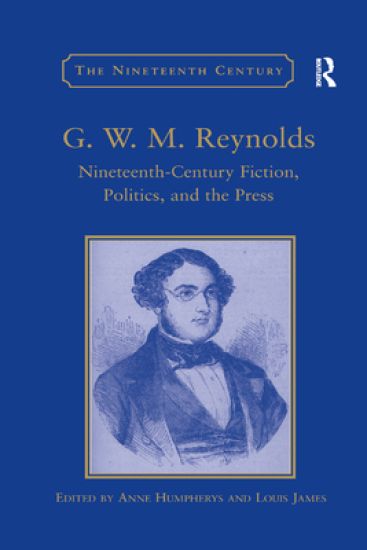
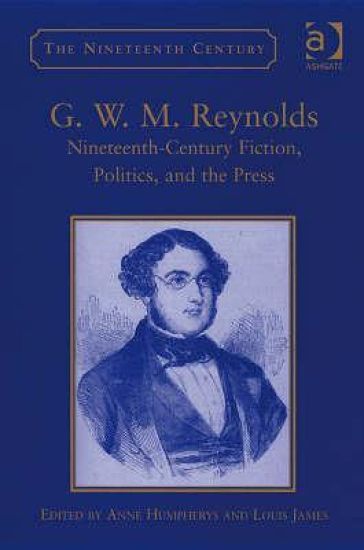
G.W.M. Reynolds (1814-1879) had a major impact on the mid-Victorian era that until now has been largely unacknowledged. A prolific novelist whose work had a massive circulation, and an influential journalist and editor, he was a man of contradictions in both his life and writing: a middle-class figure who devoted his life to working class issues but seldom missed a chance to profit from the exploitation of current issues; the founder of the radical newspaper Reynolds Weekly, as well as a bestselling author of historical romances, gothic and sensation novels, oriental tales, and domestic fiction; a perennial bankrupt who nevertheless ended his life prosperously. A figure of such diversity requires a collaborative study. Bringing together a distinguished group of scholars, this volume does justice to the full range of Reynolds's achievement and influence. With proper emphasis on new work in the field, the contributors take on Reynolds's involvement with Chartism, serial publication, the mass market periodical, commodity culture, and the introduction of French literature into British consciousness, to name just a few of the topics covered. The Mysteries of London, the century's most widely read serial, receives the extensive treatment this long-running urban gothic work deserves. Adding to the volume's usefulness are comprehensive bibliographies of Reynolds's own writings and secondary criticism relevant to the study of this central figure in mid-nineteenth-century Britain.
G.W.M. Reynolds (1814-1879) had a major impact on the mid-Victorian era that until now has been largely unacknowledged. A prolific novelist whose work had a massive circulation, and an influential journalist and editor, he was a man of contradictions in both his life and writing: a middle-class figure who devoted his life to working class issues but seldom missed a chance to profit from the exploitation of current issues; the founder of the radical newspaper Reynolds Weekly, as well as a bestselling author of historical romances, gothic and sensation novels, oriental tales, and domestic fiction; a perennial bankrupt who nevertheless ended his life prosperously. A figure of such diversity requires a collaborative study. Bringing together a distinguished group of scholars, this volume does justice to the full range of Reynolds's achievement and influence. With proper emphasis on new work in the field, the contributors take on Reynolds's involvement with Chartism, serial publication, the mass market periodical, commodity culture, and the introduction of French literature into British consciousness, to name just a few of the topics covered. The Mysteries of London, the century's most widely read serial, receives the extensive treatment this long-running urban gothic work deserves. Adding to the volume's usefulness are comprehensive bibliographies of Reynolds's own writings and secondary criticism relevant to the study of this central figure in mid-nineteenth-century Britain.