Kirjojen hintavertailu. Mukana 11 244 527 kirjaa ja 12 kauppaa.

Kirjahaku

Etsi kirjoja tekijän nimen, kirjan nimen tai ISBN:n perusteella.

1000 tulosta hakusanalla Maria Ward

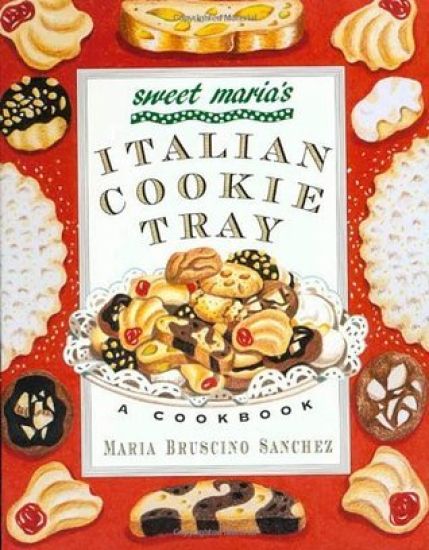
Sweet Maria's Italian Cookie Tray: A Cookbook

Sweet Maria's Italian Cookie Tray: A Cookbook

Maria Bruscino Sanchez

St. Martin's Griffin
1997
nidottu
Sweet Maria's Italian Cookie Tray presents sixty-five recipes for the delicious, festive cookies that brighten every Italian home, at the holidays and all year-round. Maria Bruscino Sanchez opened Sweet Maria's bakery when she was just twenty-six years old, specializing in authentic Italian cookies and cakes made from handed-down family recipes. The result has been a booming business, and this very special cookbook. The irresistible reciples range from drop, molded and filled cookies; biscotti; taralle and biscuits; pizelles, and more. Easy to prepare and perfect for any occasion (or no occasion at all) they include: Chocolate Almond Macaroons, Pignoli Nut Cookies, Amaretto Biscotti Sesame Cookies, Almond Crescents, Lemon Drop Cookies, Chocolate Puffs, Florentines, Lady Fingers, Sweet Ravioli Cookies, Christmas Honey Clusters, Angel Wings, Cinnamon Nut Bars, and more. Whether you grew up in an Italian home or just wish you did, this wonderful collection is sure to become a cookie lover's favorite--one you will return to again and again.
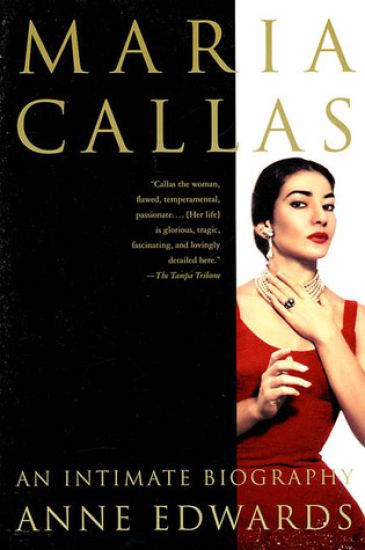
Maria Callas: An Intimate Biography

Maria Callas: An Intimate Biography

Anne Edwards

St. Martins Press-3pl
2003
nidottu
A candid and compelling portrait of the legendary opera diva describes Callas's youth in New York City, her struggle to transform herself into a glamorous star of international operatic theater, and her passionate love affair with Aristotle Onassis. Reprint.
Maria Irene Fornes and Her Critics

Maria Irene Fornes and Her Critics

Assunta Kent

Praeger Publishers Inc
1996
sidottu
This first book dedicated to US-Cuban playwright/director Maria Irene Fornes is a lucid theoretical, historical, and production-oriented study of Fornes' published works and their critical legacy. Kent argues that most critics, including a range of theatre feminists, have yet to fully explicate the incisive social critique presented in Fornes' work. Examining the complex relationships between Fornes' aesthetic innovations and her unconventional social politics, Kent presents a comprehensive, contextualized study of Fornes work and the critics' response.
Maria Edgeworth's Irish Writing

Maria Edgeworth's Irish Writing

B. Hollingworth

Palgrave Macmillan
1997
sidottu
Edgeworth is regarded as a pioneer in the development of the regional novel and the use of vernacular language. This study investigates her attitudes towards language and regionalism. It shows, by a detailed discussion of her major Irish texts - Castle Rackrent , Essay on Irish Bulls , Ennui , The Absentee and Ormond - how her intellectual 'Lunar' background, and her life in Ireland during the momentous years of the Union is reflected in the form and language of her writing.
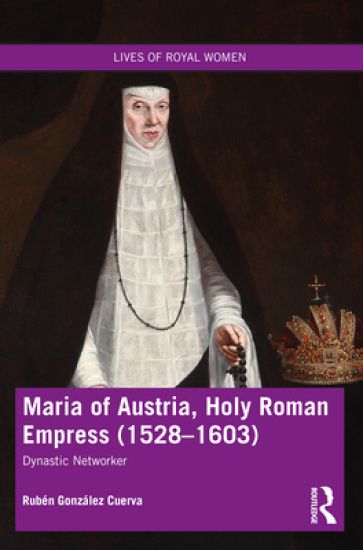
Maria of Austria, Holy Roman Empress (1528-1603)

Maria of Austria, Holy Roman Empress (1528-1603)

Rubén González Cuerva

Routledge
2021
nidottu
Maria of Austria was one of the longest surviving Renaissance Empresses but until now has received little attention by biographers. This book explores her life, actions, and management of domestic affairs, which became a feared example of how an Empress could control alternative spheres of power.The volume traces the path of a Castilian orphan infanta, raised among her mother’s Portuguese ladies-in-waiting and who spent thirty years of marriage between the imperial courts of Prague and Vienna. Empress Maria encapsulates the complex dynastic functioning of the Habsburgs: devotedly married to her cousin Maximilian II, Maria had constant communication with her father Charles V and her brother Philip II while preserving her Spanish background. Her unique intertwining of roles and positions allows a fresh approach to female agency and the discussion of current issues: the rules of dynastic entente, the negotiation of discreet political roles for royal women, the reassessment of informal diplomacy, and the creation of dynastic networks parallel to the embassies. With chronological chapters discussing Empress Maria’s roles such as infanta, regent, Empress, and a widow, this volume is the perfect resource for scholars and students interested in the history of gender, court culture, and early modern Central Europe.
Maria of Austria, Holy Roman Empress (1528-1603)

Maria of Austria, Holy Roman Empress (1528-1603)

Rubén González Cuerva

Routledge
2021
sidottu
Maria of Austria was one of the longest surviving Renaissance Empresses but until now has received little attention by biographers. This book explores her life, actions, and management of domestic affairs, which became a feared example of how an Empress could control alternative spheres of power.The volume traces the path of a Castilian orphan infanta, raised among her mother’s Portuguese ladies-in-waiting and who spent thirty years of marriage between the imperial courts of Prague and Vienna. Empress Maria encapsulates the complex dynastic functioning of the Habsburgs: devotedly married to her cousin Maximilian II, Maria had constant communication with her father Charles V and her brother Philip II while preserving her Spanish background. Her unique intertwining of roles and positions allows a fresh approach to female agency and the discussion of current issues: the rules of dynastic entente, the negotiation of discreet political roles for royal women, the reassessment of informal diplomacy, and the creation of dynastic networks parallel to the embassies. With chronological chapters discussing Empress Maria’s roles such as infanta, regent, Empress, and a widow, this volume is the perfect resource for scholars and students interested in the history of gender, court culture, and early modern Central Europe.
Maria Irene Fornes

Maria Irene Fornes

Scott T. Cummings

Routledge
2012
sidottu
Maria Irene Fornes is the most influential female American dramatist of the 20th century. That is the argument of this important new study, the first to assess Fornes's complete body of work. Scott T. Cummings considers comic sketches, opera libretti and unpublished pieces, as well as her best-known plays, in order to trace the evolution of her dramaturgy from the whimsical Off-Off Broadway plays of the 1960s to the sober, meditative work of the 1990s. The book also reflects on her practice as an inspirational teacher of playwriting and the primary director of her own plays. Drawing on the latest scholarship and his own personal research and interviews with Fornes over two decades, Cummings examines Fornes's unique significance and outlines strategies for understanding her fragmentary, enigmatic, highly demanding theater.
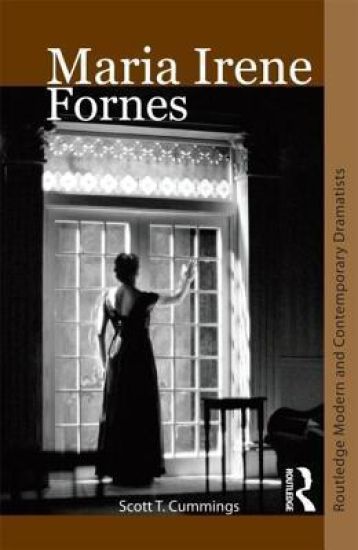
Maria Irene Fornes

Maria Irene Fornes

Scott T. Cummings

Routledge
2012
nidottu
Maria Irene Fornes is the most influential female American dramatist of the 20th century. That is the argument of this important new study, the first to assess Fornes's complete body of work. Scott T. Cummings considers comic sketches, opera libretti and unpublished pieces, as well as her best-known plays, in order to trace the evolution of her dramaturgy from the whimsical Off-Off Broadway plays of the 1960s to the sober, meditative work of the 1990s. The book also reflects on her practice as an inspirational teacher of playwriting and the primary director of her own plays. Drawing on the latest scholarship and his own personal research and interviews with Fornes over two decades, Cummings examines Fornes's unique significance and outlines strategies for understanding her fragmentary, enigmatic, highly demanding theater.
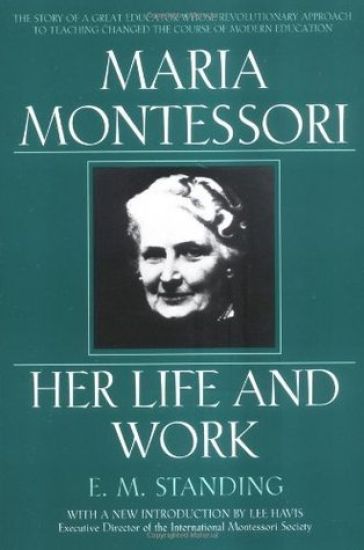
Maria Montessori

Maria Montessori

E. M. Standing

Penguin Putnam Inc
1998
pokkari
Maria Montessori is important background reading for parents considering Montessori education for their children, as well as for those training to become Montessori teachers. The first woman to win a degree as a Doctor of Medicine in Italy in 1896, Maria Montessori's mission to improve children's education began in the slums of Rome in 1907, and continued throughout her lifetime. Her insights into the minds of children led her to develop prepared environments and other tools and devices that have come to characterize Montessori education today. Her influence in other countries has been profound and many of her teaching methods have been adopted by educators generally. Part biography and part exposition of her ideas, this engaging book reveals through her letters and personal diaries Maria Montessori's humility and delight in the success of her educational experiments and is an ideal introduction to the principals and practices of the greatest educational pioneer of the 20th century.
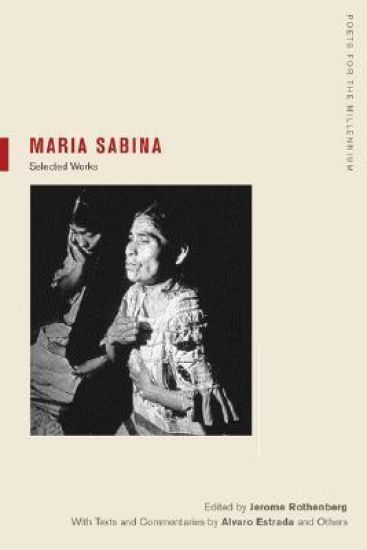
Maria Sabina

Maria Sabina

Maria Sabina

University of California Press
2003
pokkari
A shaman and visionary - not a poet in any ordinary sense - Maria Sabina lived out her life in the Oaxacan mountain village of Huautla de Jimenez, and yet her words, always sung or spoken, have carried far and wide, a principal instance and a powerful reminder of how poetry can arise in a context far removed from literature as such. Seeking cures through language - with the help of Psilocybe mushrooms, said to be the source of language itself - she was, as Henry Munn describes her, 'a genius [who] emerges from the soil of the communal, religious-therapeutic folk poetry of a native Mexican campesino people'. She may also have been, in the words of the Mexican poet Homero Aridjis, 'the greatest visionary poet in twentieth-century Latin America'. These selections include a generous presentation from Sabina's recorded chants and a complete English translation of her oral autobiography, her vida, as written and arranged in her native language by her fellow Mazatec Alvaro Estrada. Accompanying essays and poems include an introduction to "The Life of Maria Sabina" by Estrada, an early description of a nighttime 'mushroom velada' by the ethnomycologist R. Gordon Wasson, an essay by Henry Munn relating the language of Sabina's chants to those of other Mazatec shamans, and more.
Maria Pasqua

Maria Pasqua

Magdalen Goffin

Faber Faber
2009
nidottu
Based on family diaries and letters, Maria Pasqua tells the story of a beautiful, unhappy woman who achieved fame in Paris as a child, and whose later life consisted of a hopeless and frustrated longing to return to the scenes of her childhood.Born in 1856, Maria Pasqua was blessed with an exceptional and unfading beauty. From an early age she was modelling for artists in Rome. When six her father took her to Paris where she was adopted by the Comtesse de Noailles, a member of the Baring family. The Comtesse was domineering and eccentric on the grand scale. She had an invincible faith in the salubrious benefit of the breath of cattle, and would keep a cow tethered to every ground floor window so that its wholesome breath could infuse the room. When she married a doctor turned country gentleman some twenty years her senior, Maria Pasqua , whilst still subject to the constant interference of the Comtesse, found herself cocooned within the enervating routine of a typical country house of that time.Madgalen Goffin has written a haunting and entirely delightful memoir which combines, to an extraordinary extent, humour, vitality and a most attractive sympathy for the tragedy of life.The book has an interesting genesis. The first draft was written by Magdalen Goffin's mother, who sent it to Evelyn Waugh: he was haunted by what he considered to be a unique and poignant story, and the suggestions he made for its improvement and presentation proved invaluale when Madgalen Goffin herself took up the task following her mother's death.'Mrs Goffin has made a work of great beauty and interest , intesely sad but artistically vigorous; the moral seems to be that we tamper at our peril with basic affections and can stunt, in a sense kill the heart, by the sort of desertion Maria Pasqua had to bear: sold, as she was, out of happy penury into plushy, eccentric slavery.' Isabel Quigly. Financial Times Books of the Year 1979'The book is beuatifully written in an unobtrusive way . . . The whole thing is like a piece of quiet music, drawing no attention to itself, yet insisting its way into the memory. I do not expect to ahve such a pleasantly haunting book to review for many a long year.' Robert Nye, The Scotsman'Mrs goffin is descended from both the exile and her captor so that pity for Maria is balanced by an acute sense of Philip's solitude, silence and constraint. What in part is a lament becomes also a kind of hymn to the solid, stuffy, monotonous pleasures of English country life; and it is this subtle equivocation which makes Maria Pasqua like 'Petita', a classic of its kind. Hilary Spurling, Observer