
Kirjahaku
Etsi kirjoja tekijän nimen, kirjan nimen tai ISBN:n perusteella.
1000 tulosta hakusanalla Moses Stuart
Narrative Of The Adventures And Escape Of Moses Roper From American Slavery
Moses Roper
Kessinger Pub
2007
pokkari

Moses And The Prophets
W. Robertson Smith; A. Kuenen; William Henry (EDT) Green
Kessinger Pub
2007
pokkari
Diaries Of Sir Moses And Lady Montefiore
Moses Montefiore; Judith Cohen Montefiore; Louis (EDT) Loewe
Kessinger Pub
2008
pokkari

from the sinister echoes of a water-filled tunnel under the city of Jerusalem to a windswept fortress whose name spells death. A DEADLY CHASE FOR THE TRUTH ... Threatened on every side by violent extremists, Bronson is plunged into a mystery rooted in biblical times.
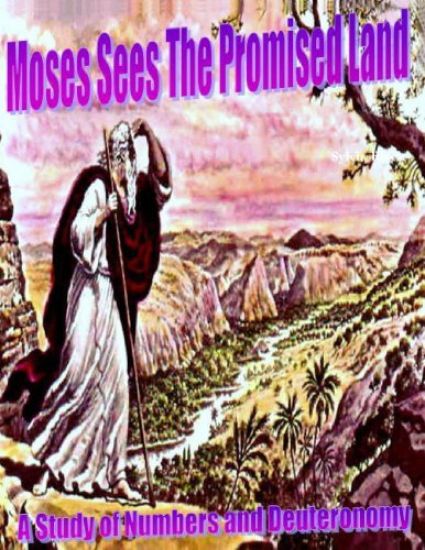
"Moses Sees the Promised Land" A Study of Numbers and Deuteronomy
Sylvia Black
Lulu.com
2011
nidottu
In today's rapidly changing global business arena, undaunted leadership seems as fleeting as yesterday's software. Yet the wisdom of one reluctant leader, Moses, has grown more relevant with each passing century. In MOSES ON MANAGEMENT, nationally renowned spiritual leader and businessman Rabbi David Baron draws surprising parallels between the world of Moses and our own, and conveys fifty wise lessons for the modern business manager, including: * How to cure your staff of the 'slave mentality' * Why negotiating face-to-face brings optimum results * Why symbols of strength inspire extraordinary effort * Why crises are an open door to change, and empowerment. In a time of downsizing, mergers and increasing uncertainty in the marketplace, MOSES ON MANAGEMENT is an invaluable resource for finding and sustaining a deeply satisfying balance between life and livelihood.
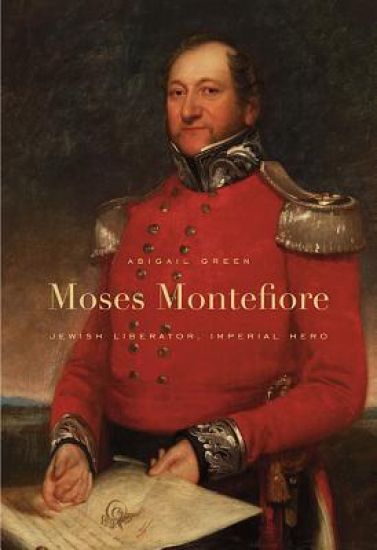
Humanitarian, philanthropist, and campaigner for Jewish emancipation on a grand scale, Sir Moses Montefiore (1784–1885) was the preeminent Jewish figure of the nineteenth century—and one of the first truly global celebrities. His story, told here in full for the first time, is a remarkable and illuminating tale of diplomacy and adventure. Abigail Green’s sweeping biography follows Montefiore through the realms of court and ghetto, tsar and sultan, synagogue and stock exchange.Interweaving the public triumph of Montefiore’s foreign missions with the private tragedy of his childless marriage, this book brings the diversity of nineteenth-century Jewry brilliantly to life—from London to Jerusalem, Rome to St. Petersburg, Morocco to Istanbul. Here we see the origins of Zionism and the rise of international Jewish consciousness, the faltering birth of international human rights, and the making of the modern Middle East. With the globalization and mobilization of religious identities now at the top of the political agenda, Montefiore’s life story is relevant as never before.Mining materials from eleven countries in nine languages, Green’s masterly biography bridges the East-West divide in modern Jewish history, presenting the transformation of Jewish life in Europe, the Middle East, and the New World as part of a single global phenomenon. As it reestablishes Montefiore’s status as a major historical player, it also restores a significant chapter to the history of our modern world.
Standing at the very foundation of monotheism, and so of Western culture, Moses is a figure not of history, but of memory. As such, he is the quintessential subject for the innovative historiography Jan Assmann both defines and practices in this work, the study of historical memory--a study, in this case, of the ways in which factual and fictional events and characters are stored in religious beliefs and transformed in their philosophical justification, literary reinterpretation, philological restitution (or falsification), and psychoanalytic demystification.To account for the complexities of the foundational event through which monotheism was established, Moses the Egyptian goes back to the short-lived monotheistic revolution of the Egyptian king Akhenaten (1360-1340 B.C.E.). Assmann traces the monotheism of Moses to this source, then shows how his followers denied the Egyptians any part in the origin of their beliefs and condemned them as polytheistic idolaters. Thus began the cycle in which every "counter-religion," by establishing itself as truth, denounced all others as false. Assmann reconstructs this cycle as a pattern of historical abuse, and tracks its permutations from ancient sources, including the Bible, through Renaissance debates over the basis of religion to Sigmund Freud's Moses and Monotheism. One of the great Egyptologists of our time, and an exceptional scholar of history and literature, Assmann is uniquely equipped for this undertaking--an exemplary case study of the vicissitudes of historical memory that is also a compelling lesson in the fluidity of cultural identity and beliefs.

Former Assistant Chief Watergate Committee prosecutor David Dorsen has veered from his scholarly non-fiction works to delve into a humorous fictional account of Donald Trump. Dorsen said he felt compelled to pen what is a slightly burlesque treatment of the election and leadership of Donald Trump. Frank Serpico, retired NYC Police Detective and subject of the movie Serpico, praised the book as "a brilliant, witty, page-turning political parody that reads like the evening news." John Dean, former counsel to President Richard M. Nixon and a CNN contributor, calls the book "sorely needed entertainment" with "a convincing court proceeding in the era of Trump and with the inclusion of Trump." Derek Bok, former President of Harvard University, describes the book as "an engrossing, cleverly plotted tale."

Moses Maimonides (1135--1204) is recognized both as a leading Jewish thinker and as one of the most radical philosophers of the Islamic world. The study reveals the significance of Maimonides to contemporary philosophical and theological problems.

Relating the Muslim understanding of Moses in the Qur'an to the Epic of Gilgamesh, Alexander Romances, Aramaic Targums, Rabbinic Bible exegesis, and folklore from the ancient and medieval Mediterranean, this book shows how Muslim scholars authorize and identify themselves through allusions to the Bible and Jewish tradition. Exegesis of Qur'an 18:60-82 shows how Muslim exegetes engage Biblical theology through interpretation of the ancient Israelites, their prophets, and their Torah. This Muslim use of a scripture shared with Jews and Christians suggests fresh perspectives for the history of religions, Biblical studies, cultural studies, and Jewish-Arabic studies.

10 copies of the popular bible story Moses and His Sister are in the multipack. Part of the My Very First Bible Stories series, there are 10 little paperback books of Moses and His Sister. These 10 paperbacks offer a smart and economical way of collecting multiple books for use in groups and classes, for award-giving, or for anyone wanting a pocket-money gift. This shrink-wrapped pack of 10 copies of Moses and His Sister enables an easy, multiple-purchase of this wonderful bible story.

This shrink-wrapped pack of 10 copies of Moses and the Princess enables easy multiple-purchase of a key Bible story. This is one of 12 key Bible stories that have been made available as part of the Bible Story Time My Little Library. Each story is retold in about 500 words with bright and cheerful pictures.
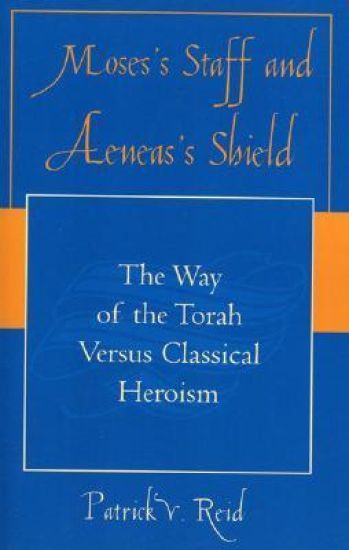
Moses' Staff and Aeneas' Shield uses two emblems to symbolize the important differences between the tragic but triumphant heroism of Virgil's Aeneid and the kenotic heroism of Moses in the Exodus story of Aeneas' shield and Moses' staff. The shield of Aeneas represents Rome's imperial destiny to rule the earth's peoples by strength, and Aeneas' personal destiny to end in triumph as a warrior. In contrast, the staff of Moses represents the saving wonders the Lord works through him to save the children of Israel from slavery in Egypt and bind them to himself in covenant, and his mission to go beyond being simply a wonder worker to "a man of words" who preaches the Lord's Torah.