Kirjojen hintavertailu. Mukana 12 595 353 kirjaa ja 12 kauppaa.

Kirjahaku

Etsi kirjoja tekijän nimen, kirjan nimen tai ISBN:n perusteella.

1000 tulosta hakusanalla Pointe-J-P

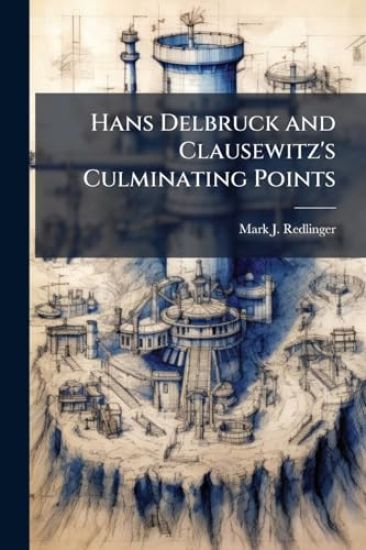
Hans Delbruck and Clausewitz's Culminating Points
This monograph searches for an answer to the question: "What is the relationship between strategies and operational culminating points?" It begins by examining the theoretical position of Hans Delbruck and his dual strategies of annihilation and exhaustion. It then turns to Clausewitz and investigates the concept of culminating points. Finally, it develops a model of strategic combat power which is used to aid the reader in understanding the theoretical link between operational culminating points and the strategies of exhaustion and annihilation. This concludes the first part of the monograph. The second section of the monograph is a case study of the Yom Kippur War of 1973. This war is used to test the validity of our analysis concerning strategies and culminating points. Our theory not only is valid, but also demonstrates that a strategic planner must consider operational culminating points as an integral element to the success of any campaign. Not to understand the relationship of culminating points to the success of strategies will only end in disaster. This work has been selected by scholars as being culturally important, and is part of the knowledge base of civilization as we know it. This work was reproduced from the original artifact, and remains as true to the original work as possible. Therefore, you will see the original copyright references, library stamps (as most of these works have been housed in our most important libraries around the world), and other notations in the work. This work is in the public domain in the United States of America, and possibly other nations. Within the United States, you may freely copy and distribute this work, as no entity (individual or corporate) has a copyright on the body of the work. As a reproduction of a historical artifact, this work may contain missing or blurred pages, poor pictures, errant marks, etc. Scholars believe, and we concur, that this work is important enough to be preserved, reproduced, and made generally available to the public. We appreciate your support of the preservation process, and thank you for being an important part of keeping this knowledge alive and relevant.

The Heat Kernel Lefschetz Fixed Point Formula for the Spin-c Dirac Operator
When visiting M.I.T. for two weeks in October 1994, Victor Guillemin made me enthusiastic about a problem in symplectic geometry which involved the use of the so-called spin-c Dirac operator. Back in Berkeley, where I had l spent a sabbatical semester , I tried to understand the basic facts about this operator: its definition, the main theorems about it, and their proofs. This book is an outgrowth of the notes in which I worked this out. For me this was a great learning experience because of the many beautiful mathematical structures which are involved. I thank the Editorial Board of Birkhauser, especially Haim Brezis, for sug­ gesting the publication of these notes as a book. I am also very grateful for the suggestions by the referees, which have led to substantial improvements in the presentation. Finally I would like to express special thanks to Ann Kostant for her help and her prodding me, in her charming way, into the right direction. J.J. Duistermaat Utrecht, October 16, 1995.
Statistical Analysis of Spatial and Spatio-Temporal Point Patterns
Written by a prominent statistician and author, the first edition of this bestseller broke new ground in the then emerging subject of spatial statistics with its coverage of spatial point patterns. Retaining all the material from the second edition and adding substantial new material, Statistical Analysis of Spatial and Spatio-Temporal Point Patterns, Third Edition presents models and statistical methods for analyzing spatially referenced point process data.Reflected in the title, this third edition now covers spatio-temporal point patterns. It explores the methodological developments from the last decade along with diverse applications that use spatio-temporally indexed data. Practical examples illustrate how the methods are applied to analyze spatial data in the life sciences.This edition also incorporates the use of R through several packages dedicated to the analysis of spatial point process data. Sample R code and data sets are available on the author’s website.
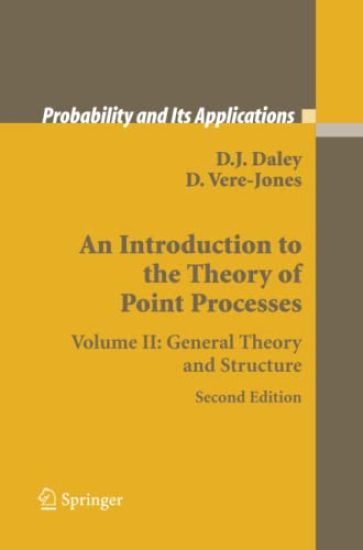
An Introduction to the Theory of Point Processes

An Introduction to the Theory of Point Processes

D.J. Daley; D. Vere-Jones

Springer-Verlag New York Inc.
2013
nidottu
Point processes and random measures find wide applicability in telecommunications, earthquakes, image analysis, spatial point patterns, and stereology, to name but a few areas. The authors have made a major reshaping of their work in their first edition of 1988 and now present their Introduction to the Theory of Point Processes in two volumes with sub-titles "Elementary Theory and Models" and "General Theory and Structure". Volume One contains the introductory chapters from the first edition, together with an informal treatment of some of the later material intended to make it more accessible to readers primarily interested in models and applications. The main new material in this volume relates to marked point processes and to processes evolving in time, where the conditional intensity methodology provides a basis for model building, inference, and prediction. There are abundant examples whose purpose is both didactic and to illustrate further applications of theideas and models that are the main substance of the text. Volume Two returns to the general theory, with additional material on marked and spatial processes. The necessary mathematical background is reviewed in appendices located in Volume One. Daryl Daley is a Senior Fellow in the Centre for Mathematics and Applications at the Australian National University, with research publications in a diverse range of applied probability models and their analysis; he is co-author with Joe Gani of an introductory text in epidemic modelling. David Vere-Jones is an Emeritus Professor at Victoria University of Wellington, widely known for his contributions to Markov chains, point processes, applications in seismology.
An Introduction to the Theory of Point Processes

An Introduction to the Theory of Point Processes

D.J. Daley; David Vere-Jones

Springer-Verlag New York Inc.
2014
nidottu
Point processes and random measures find wide applicability in telecommunications, earthquakes, image analysis, spatial point patterns and stereology, to name but a few areas. The authors have made a major reshaping of their work in their first edition of 1988 and now present An Introduction to the Theory of Point Processes in two volumes with subtitles Volume I: Elementary Theory and Methods and Volume II: General Theory and Structure. Volume I contains the introductory chapters from the first edition together with an account of basic models, second order theory, and an informal account of prediction, with the aim of making the material accessible to readers primarily interested in models and applications. It also has three appendices that review the mathematical background needed mainly in Volume II. Volume II sets out the basic theory of random measures and point processes in a unified setting and continues with the more theoretical topics of the first edition: limit theorems, ergodic theory, Palm theory, and evolutionary behaviour via martingales and conditional intensity. The very substantial new material in this second volume includes expanded discussions of marked point processes, convergence to equilibrium, and the structure of spatial point processes.
Pinch Point: A Theodore Mallory Thriller

Pinch Point: A Theodore Mallory Thriller

A. J. Graham

Createspace Independent Publishing Platform
2017
nidottu
Theodore Mallory is a man who's been existing but not living. Stuck in his nowhere life, Ted is forced out of his warm, dormant existence in favor of one that tests not only his strength of will but his convictions. Taken by forces he cannot understand, Ted is forced to make a choice, and it's a choice no one should have to make; doing the right thing or saving his love. Sparks fly as Ted is pursued by powerful forces. He's taken to the deepest places in his heart as he is deceived. He has no way to know who he can trust. Then a possibility emerges that sends his whole world into a tailspin. Can he man up and get the job done? Can he control the tidal wave of deception that has descended upon him? Can he win the day? Only by reading can you find out the truth. Only by searching the pages of this tale can you know for yourself. Can Ted find a way to get the justice he so richly deserves? With AJ Graham telling the story ... you can never be sure.
Breaking Point

Breaking Point

C. J. Box

Head of Zeus
2013
nidottu
Butch Roberson was known to all as a hard worker, a family man, a local business owner. Now he's disappeared, leaving two dead bodies in his wake.Joe Pickett cannot believe the gentle Butch is a cold-blooded killer - but when he hears the story of how Butch was bullied by the authorities, of how his longed-for retirement home was taken away from him, of how it tore his family apart - he starts to wonder if perhaps the man just cracked. It's an awful story. But is it the whole story? When Joe investigates further, he finds himself in the middle of a war he never expected and never wanted. Powerful forces want Roberson not just caught, but dead - and the same goes for anyone who stands in their way.
Stone's River: The Turning-Point of the Civil War

Stone's River: The Turning-Point of the Civil War

Wilson J. Vance

Createspace Independent Publishing Platform
2018
nidottu
On the banks of a shallow winding stream, traversing the region known as Middle Tennessee, on the last day of December, 1862, and on the first and second days of January, 1863, a great battle was fought, - a battle that marked the turning point of the Civil War. Stone's River, as the North designated it, or Murfreesboro, - to give it the Southern name, - has hitherto not been estimated at its true importance. To the people of the two sections it seemed at the time but another Shiloh, - horrifying, saddening, and bitterly disappointing. Its significance, likewise, has escaped almost all historians and military critics. But now the perspective of half a century gives it its proper place in the panorama of the great conflict. Gettysburg, indeed, may have been the wound mortal of the Confederacy. But Gettysburg was, in very truth, a counsel of desperation, undertaken when the South was bleeding from many a vein. When Lee turned the faces of his veterans toward the fruitful fields of Pennsylvania, a wall of steel and fire encompassed his whole country. War- worn Virginia cried out for relief from the marchings of armies, that her people might raise the crops that would save them from starvation. Grant had at last established his lines around the fortress that dominated the Mississippi, and only by such a diversion, was there hope that his death- grip would be shaken. The day after Pickett's shattered columns had drifted back to Seminary Ridge Vicksburg was surrendered, and the control of the mighty river passed to the forces of the North. But it was at Stone's River that the South was at the very pinnacle of confidence and warlike power; and it was here that she was halted and beaten back, - never again to exhibit such strength and menace. It was here that the tide of the Confederacy passed its flood, henceforth to recede; here that its sun crossed the meridian and began its journey to the twilight and the dark. Southern valor was manifested in splendid luster on many a field thereafter, but the capacity for sustained aggression was gone. After Stone's River, the Southern soldier fought to repel rather than to drive his foe. Yet Stone's River was almost a tale of triumph for the Confederacy. "God has granted us a happy New Year " was the message flashed to Richmond at the close of the first day's fighting by General Braxton Bragg, Commander of the Army of the Tennessee. Two-thirds of the Army of the Cumberland had been hurled out of line, and now lay clinging with desperation to the only road from which it could secure supplies, or by which it could retreat, and to lose which meant destruction. There was reason, therefore, in the Southern general's exultation, as he waited for the morrow to give him complete success. He could not know that the army upon which had been inflicted so terrific a blow was to gather new strength out of the very magnitude of its disaster and to return such a counterstroke as would give it the field and the victory. Neither could he see that his failure here meant failure for his cause; that because at Stone's River success had not crowned his efforts, his own magnificent army was to be pressed further and further from the territory it claimed as its own; that Fate had here entered the decree, - against which all appeals would fail, - for the preservation of the Federal Union and the death of the Confederate States of America.