Kirjojen hintavertailu. Mukana 11 441 187 kirjaa ja 12 kauppaa.

Kirjahaku

Etsi kirjoja tekijän nimen, kirjan nimen tai ISBN:n perusteella.

1000 tulosta hakusanalla Robert D. Lesslie

The Holy and the Daemonic from Sir Thomas Browne to William Blake
Focusing particularly on literary texts, but including biographical and intellectual background, this study examines numinous feeling as it is recorded by a number of seventeenth and eighteenth-century writers: Browne, Drydcn, Pascal; Pope and Swift; Hume and Johnson; eight other poets, including Watts, Smart, Cowper, and Blake; and four novelists, including Richardson, Radcliffe, and Monk" Lewis. Professor Stock demonstrates that the Enlightenment was far more complicated than can be grasped by an exclusive focus on its rationalism and skepticism. Originally published in 1982. The Princeton Legacy Library uses the latest print-on-demand technology to again make available previously out-of-print books from the distinguished backlist of Princeton University Press. These editions preserve the original texts of these important books while presenting them in durable paperback and hardcover editions. The goal of the Princeton Legacy Library is to vastly increase access to the rich scholarly heritage found in the thousands of books published by Princeton University Press since its founding in 1905.

The Holy and the Daemonic from Sir Thomas Browne to William Blake
Focusing particularly on literary texts, but including biographical and intellectual background, this study examines numinous feeling as it is recorded by a number of seventeenth and eighteenth-century writers: Browne, Drydcn, Pascal; Pope and Swift; Hume and Johnson; eight other poets, including Watts, Smart, Cowper, and Blake; and four novelists, including Richardson, Radcliffe, and Monk" Lewis. Professor Stock demonstrates that the Enlightenment was far more complicated than can be grasped by an exclusive focus on its rationalism and skepticism. Originally published in 1982. The Princeton Legacy Library uses the latest print-on-demand technology to again make available previously out-of-print books from the distinguished backlist of Princeton University Press. These editions preserve the original texts of these important books while presenting them in durable paperback and hardcover editions. The goal of the Princeton Legacy Library is to vastly increase access to the rich scholarly heritage found in the thousands of books published by Princeton University Press since its founding in 1905.

Gene "Kentuck" Oberst

Gene "Kentuck" Oberst

Robert D Oberst

Global Future Press
2016
pokkari
This is the story of the USA's first track and field medal winner in the 1924 Paris Olympics when the American flag would fly above an Olympic stadium for the first time. Once timesaving innovations gave Americans leisure time, the golden age of sports emerged. Enter Gene Oberst. Born with a disability, it took a haphazard event involving a stray javelin to make the entire world, and Gene himself, realize he was more than a bookworm--he- was a natural-born athlete.Growing up in a Twain-like, Ohio River town, the ideals of his large, self-sustaining family and their dedication to educate themselves fed Gene's persistent and diligent nature. That determination led him to play college football for the National Championship, Notre Dame team under legendary coach Knute Rockne where he played with the Gipper and perhaps the most renowned backfield of the century, the Four Horsemen. Then he went on to the highest achievement for athletes--the Olympics.Including fascinating stories taken directly from Gene's Olympic journal, this biography offers a firsthand, behind-the-scenes look at one of the most persistent and innovative athletes of the 1900s and the other pioneering athletes and iconic coaches who shared in his success and led the way to football's glorious future and America's fascination with the Olympics.Covering the journeys Gene's ancestors took during their emigration to America from Germany to Gene's time journeying to the epic Chariots of Fire Olympics in Paris, follow the story of the miraculous and obstacle-defying life of American Olympian Gene Oberst.
Global Humanitarianism

Global Humanitarianism

Robert D. DeChaine

Lexington Books
2005
sidottu
In Global Humanitarianism: NGOs and the Crafting of Community, author Rob DeChaine explores a narrative common to the nongovernmental organization community about the promise and confusion of living together in post/modern times. Palpable in their affective admixture of idealism, fear, hope, anger and uncertainty, the protagonists of the story are humanitarian social actors, engaged in a vivid social drama. Their audience, as made apparent by DeChaine's excellent scholarship, is intimately engaged in the drama as well. According to DeChaine, the action takes shape in a multivocal polyphony of solidarity and, at times, cacophony of protest and dissent, with actors mobilizing symbolic resources in the service of uniting a public who would join with them in the cause. A major source of the actors' labor is symbolic, consisting in the successful rallying of formative energies in and around a cluster of key related terms, words and phrases, in order to dramatize and publicize the exigency of the crisis at hand. DeChaine argues that crises are embodied in the form of an intensifying hegemonic struggle over the articulation of "community" in a global/ized world. The struggle brings into tension local and global priorities, national governments and civil society, and state-centered forms of identity and allegiance and a broad-based vision of global citizenship and belonging. DeChaine demonstrates that the crisis of community is one of the defining themes of our contemporary era, one that we ignore at our peril. This book is not only important to the NGO community but represents cutting edge analysis in rhetoric, cultural studies, semiotics, sociology and social organizations.
Global Humanitarianism

Global Humanitarianism

Robert D. DeChaine

Lexington Books
2005
nidottu
In Global Humanitarianism: NGOs and the Crafting of Community, author Rob DeChaine explores a narrative common to the nongovernmental organization community about the promise and confusion of living together in post/modern times. Palpable in their affective admixture of idealism, fear, hope, anger and uncertainty, the protagonists of the story are humanitarian social actors, engaged in a vivid social drama. Their audience, as made apparent by DeChaine's excellent scholarship, is intimately engaged in the drama as well. According to DeChaine, the action takes shape in a multivocal polyphony of solidarity and, at times, cacophony of protest and dissent, with actors mobilizing symbolic resources in the service of uniting a public who would join with them in the cause. A major source of the actors' labor is symbolic, consisting in the successful rallying of formative energies in and around a cluster of key related terms, words and phrases, in order to dramatize and publicize the exigency of the crisis at hand. DeChaine argues that crises are embodied in the form of an intensifying hegemonic struggle over the articulation of 'community' in a global/ized world. The struggle brings into tension local and global priorities, national governments and civil society, and state-centered forms of identity and allegiance and a broad-based vision of global citizenship and belonging. DeChaine demonstrates that the crisis of community is one of the defining themes of our contemporary era, one that we ignore at our peril. This book is not only important to the NGO community but represents cutting edge analysis in rhetoric, cultural studies, semiotics, sociology and social organizations.
Supply-Side Follies

Supply-Side Follies

Robert D. Atkinson

Rowman Littlefield Publishers
2006
sidottu
Supply-Side Follies is a progressive political and economic challenge to the current George W. Bush policies. It debunks commonly held assumptions of conservative economic policies centered on the obsession that tax cuts led to greater productivity and prosperity. These fundamentally flawed policies are setting the United States up for a major economic downturn in the near future. The 21st century knowledge economy requires a fundamentally different approach to boosting growth than simply cutting taxes on the richest investors. The alternative is not, however, to resurrect old Keynesian, populist economics as too many Democrats hope to do. Rather, as Rob Atkinson makes clear, our long-term national welfare and prosperity depends on new economic strategy that fits the realities of the 21st century global, knowledge-based economy: innovation-based growth economics.
Supply-Side Follies

Supply-Side Follies

Robert D. Atkinson

Rowman Littlefield Publishers
2007
nidottu
Supply-Side Follies is a progressive political and economic challenge to the current George W. Bush policies. It debunks commonly held assumptions of conservative economic policies centered on the obsession that tax cuts led to greater productivity and prosperity. These fundamentally flawed policies are setting the United States up for a major economic downturn in the near future. The 21st century knowledge economy requires a fundamentally different approach to boosting growth than simply cutting taxes on the richest investors. The alternative is not, however, to resurrect old Keynesian, populist economics as too many Democrats hope to do. Rather, as Rob Atkinson makes clear, our long-term national welfare and prosperity depends on new economic strategy that fits the realities of the 21st century global, knowledge-based economy: innovation-based growth economics.
Better Together

Better Together

Robert D. Putnam; Lewis Feldstein

Simon Schuster
2005
pokkari
For his new book Robert Putnam visited a number of places across America where individuals and groups are engaged in unusual forms of social activism and civic renewal. These are people who are renewing their communities and investing in new forms of 'social capital.' Approximately a dozen such stories of civic innovation are told in this book. They range from a mentoring and reading programme in Philadelphia that brings together retirees and primary school children to a revitalised neighbourhood association and revitalised neighbourhoods in Boston to a successful community organising effort in the impoverished Rio Grande Valley. All across America and the UK such organizations are starting up and thriving, giving hope that the message of BOWLING ALONE has reached people and that civic institutions are taking new forms to adapt to new times and new needs.
Completing the Revolution

Completing the Revolution

Robert D. Novak

The Free Press
2002
pokkari
Twice in the past generation, the Republican party has proclaimed a "revolution" in American politics. In 1980, Ronald Reagan won a landslide victory on a platform of tax cuts, smaller government, and a stronger defense. And in 1994, Newt Gingrich took up the revolutionary mantle, tossing out the Democratic Congress and proclaiming the end of "business as usual" in Washington. As the 2000 presidential election draws near, the optimism of those heady days seems like ancient history. The Reagan years are a dim memory, and the Republican leadership on Capitol Hill after five years in power has failed to enact the Contract with America. In 2000, the GOP faces not only the possibility of a third consecutive presidential defeat but the prospect of losing its House majority as well. The time for dithering is over, and the time for action is now. "Completing the Revolution" is Robert Novak's manifesto for a Republican victory in November and for implementing a conservative vision for government in the years to come. He brings to his analysis the combativeness familiar to those who watch him on CNN's "Crossfire, " and the insight and perspective that have helped to make him one of America's leading political columnists. He is not afraid to criticize the various presidential candidates or the Republican leaders in Congress, especially those who fail to stand up for the party's principles -- whom he calls "Clintonized Republicans." At the center of "Completing the Revolution" is Novak's bold proposal for a new Republican agenda, one that remains true to the party's core values and can command a majority in the country. He offers surprising and original perspectives on taxes, Social Security, abortion, campaign finance, race and gender politics, and term limits, among other issues. He also lays bare the fault lines that have emerged in the 2000 presidential race and shows how they offer the party a stark choice: division and defeat, or principled victory. The road to the White House, Novak admonishes, requires one thing above all, from candidates and supporters alike: the courage to stick to real Republican principles. For any conservative who cares about the direction of public life in America, Robert Novak has provided the essential guide to our nation's millennial election.
The University of Edinburgh

The University of Edinburgh

Robert D. Anderson; Michael Lynch; Nicholas Phillipson

Edinburgh University Press
2003
nidottu
From a small city college in the sixteenth century the University of Edinburgh grew to be one of the world's greatest centres of scholarship, research and learning. Its history is told here by three of its leading historians with wit, verve and style. Copiously illustrated in colour and black and white, this is a book for everyone concerned with the university or the city of Edinburgh to read and enjoy. The authors consider the impacts of Reformation, Union with England, Enlightenment, and scientific and industrial revolutions. They show the university rising to the challenge of competition from Europe, describe the great periods of expansion in the nineteenth and twentieth centuries, and chart the university's building from Old College to George Square. They explore its tense relationship with the city, explore the histories of student outrage and unrest, recall the days when blasphemy could be punished by death, and reveal that the university's department of anatomy once supported a thriving trade in body-snatching. Upheaval and crisis, triumph and achievement succeed each other by turns in a story that is entertaining, intriguing and surprising -- and always interesting.
Blowout and Well Control Handbook

Blowout and Well Control Handbook

Robert D. Grace

Gulf Publishing
2003
sidottu
As with his 1994 book, Advanced Blowout and Well Control, Grace offers a book that presents tested practices and procedures for well control, all based on solid engineering principles and his own more than 25 years of hands-on field experience. Specific situations are reviewed along with detailed procedures to analyze alternatives and tackle problems. The use of fluid dynamics in well control, which the author pioneered, is given careful treatment, along with many other topics such as relief well operations, underground blowouts, slim hole drilling problems, and special services such as fire fighting, capping, and snubbing. In addition, case histories are presented, analyzed, and discussed.
Golborne

Golborne

Robert D. Hughes

The History Press Ltd
2011
nidottu
This fascinating selection of 200 archive images, many previously unpublished, captures some of the changes and developments that have taken place in the former mining and textile town of Golborne during the last century. Each image is accompanied by a detailed caption, describing many aspects of life here during this time, including schooldays, street life, work and recreation, as well as sporting events and celebrations. This book will appeal to everyone with an interest in the history of Golborne, and will awaken memories of days gone by for all who know and love this part of Greater Manchester.
Religion, Politics and Dissent, 1660–1832

Religion, Politics and Dissent, 1660–1832

Robert D. Cornwall

Ashgate Publishing Limited
2009
sidottu
The idea of the long eighteenth century (1660-1832) as a period in which religious and political dissent were regarded as antecedents of the Enlightenment has recently been advanced by several scholars. The purpose of this collection is further to explore these connections between religious and political dissent in Enlightenment Britain. Addressing the many and rich connections between political and religious dissent in the long eighteenth century, the volume also acknowledges the work of Professor James E. Bradley in stimulating interest in these issues among scholars. Contributors engage directly with ideas of secularism, radicalism, religious and political dissent and their connections with the Enlightenment, or Enlightenments, together with other important themes including the connections between religious toleration and the rise of the 'enlightenments'. Contributors also address issues of modernity and the ways in which a 'modern' society can draw its inspiration from both religion and secularity, as well as engaging with the seventeenth-century idea of the synthesis of religion and politics and its evolution into a system in which religion and politics were interdependent but separate. Offering a broadly-conceived interpretation of current research from a more comprehensive perspective than is often the case, the historiographical implications of this collection are significant for the development of ideas of the nature of the Enlightenment and for the nature of religion, society and politics in the eighteenth century. By bringing together historians of politics, religion, ideas and society to engage with the central theme of the volume, the collection provides a forum for leading scholars to engage with a significant theme in British history in the 'long eighteenth century'.
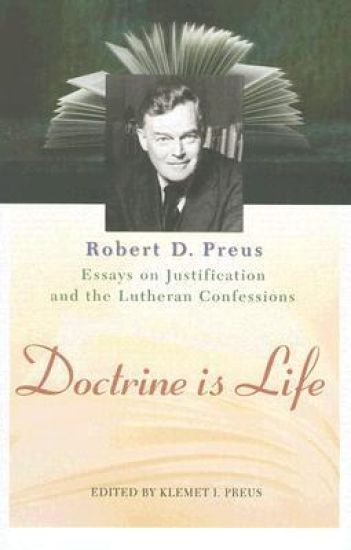
Doctrine Is Life

Doctrine Is Life

Robert D Preus

Concordia Publishing House
2006
sidottu
The 18 essays in this volume offer a cross-section of Preus's research and commentary on the doctrine of justification and on the Lutheran Confessions and their application in the life of the church today. Also included in this volume are 4 reflections on the life and ministry of Robert Preus provided by David P. Scaer, John Stephenson, Kurt Marquart and Daniel Preus.Preface and introduction written by Klemet I. Preus, Robert's son.
The Theology of Post-Reformation Lutheranism: A Study of Theological Prolegomena
This is an exhaustive, scholarly study of the age of Lutheran orthodoxy, the period from 1577 to 1713, in which Lutheran doctrine was developed, systematized, and defended by theologians such as Melanchthon, Chemnitz, Gerhard, Calov, Quenstedt, and other.Section 1: An analysis of the rise and decline of Lutheran orthodoxy, indicating the main contributions of the major theologians.Section 2: An analysis of the orthodox Lutheran approaches to the theological prolegomena-the methodology of theology, the relationships between natural and revealed religion, the nature of theology, and the training and posture of the theologian.Section 3: A thorough discussion of the orthodox theologians' approach to Scripture-its inspiration, authority, interpretation, reliability, and efficacy.Volume 1 of 2
The Theology of Post-Reformation Lutheranism Volume II

The Theology of Post-Reformation Lutheranism Volume II

Robert D Preus

Concordia Publishing House
1972
sidottu
This book discusses classical contributions to two major articles of faith: the doctrine of God and the doctrine of creation. The author presents a thorough analysis, drawing from the works of prominent theologians of the period from 1577 to 1713, including Chemnitz, Selnecker, Mentzer, Gerhard, Quenstedt, and Hollaz. Because of his focus on doctrine and methodology, Preus is able to give a fair picture of classical Lutheran theology as a whole.The first section of the book on the doctrine of God explores the knowledge of God, His existence and essence, His attributes, and the triune nature of God.In the second section, Preus examines the doctrine of creation, discussing practical applications of the orthodox view of divine providence and the eschatological overtones.The final section is an outline of orthodox theologians' attitudes toward emerging scientific cosmologies and describes implications of the modern scientific picture for Lutheran theology.