Kirjojen hintavertailu. Mukana 11 372 706 kirjaa ja 12 kauppaa.

Kirjahaku

Etsi kirjoja tekijän nimen, kirjan nimen tai ISBN:n perusteella.

1000 tulosta hakusanalla Robert L Perry

The Role Of Centrosema, Desmodium, And Stylosanthes In Improving Tropical Pastures

The Role Of Centrosema, Desmodium, And Stylosanthes In Improving Tropical Pastures

Robert L Burt; Peter P Rotar; J. L. Walker; M. W. Silvey

CRC Press
2021
nidottu
This integrated collection describes the importance of forage legumes for pasture development and improvement in the tropics and subtropics. Leading agronomists review the magnitude of the need for pasture improvement; tropical and subtropical soil and climate environments; reports of the successful use of legumes in pasture development in a wet and a dry tropical environment; and the scope of the problem in terms of area to be developed and development logistics required. Three legume genera,Centrosema, Desmodium,andStylosanthes,are discussed in detail--information is presented on taxonomy, adaptation, distribution, productivity, and usefulness--and considerable emphasis is placed onRhizobiumgermplasm resources for these genera. A concluding section of technical essays addresses special considerations in using tropical legumes in pasture development and presents a coordinated multidisciplinary approach to legume exploration and evaluation.

The Third World And U.s. Foreign Policy

The Third World And U.s. Foreign Policy

Robert L. Rothstein

TAYLOR FRANCIS LTD
2022
nidottu
The quest for a viable policy toward the Third World will be a dominant theme in U.S. foreign policy throughout this decade. But before any judgments can be made about the range of choices for U.S. policymakers, it is necessary to understand the pressures that are likely to confront developing nations during the 1980s as well as the efforts of these nations as a group to extract greater resources and attention from the international system. This book considers policy responses that have been and are likely to be implemented by developing nations as they face increasing pressures in the areas of food, energy, trade, and debt – the main areas of interaction within the international system. The author also presents an analysis of how the North-South Dialogue functions and why it has produced so few genuine settlements, providing an additional perspective on whether the pressures on the developing countries might be diminished by successful global negotiations. The conclusions reached by examining policy responses and the Dialogue itself provide the basis for a number of specific policy prescriptions. They also help to establish a framework within which U.S. policy initiatives toward the Third World must be formed. The two concluding chapters discuss these policy choices in detail, carefully analyzing the advantages and disadvantages of persisting in present policies, attempting a genuine global restructuring, choosing to concentrate attention on a few "new influentials" in the Third World, and trying to construct a new approach out of selected elements of the other policy approaches.
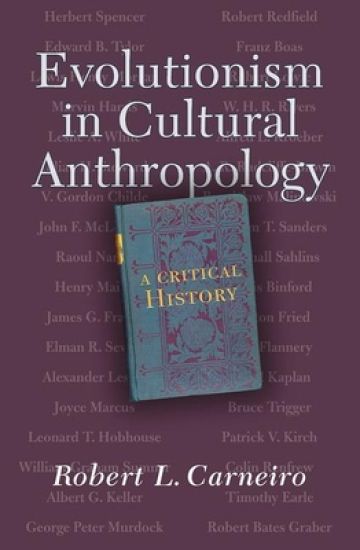
Evolutionism In Cultural Anthropology

Evolutionism In Cultural Anthropology

Robert L. Carneiro

Routledge
2019
sidottu
Evolutionism in Cultural Anthropologytraces the interaction of evolutionary thought and anthropological theory from Herbert Spencer to the twenty-first century. It is a focused examination of how the idea of evolution has continued to provide anthropology with a master principle around which a vast body of data can be organized and synt
Fair Play

Fair Play

Robert L. Simon; Cesar R. Torres; Peter F. Hager

Routledge
2019
sidottu
This book is primarily concerned with some of the most important kinds of philosophical issues that arise in sport which are ethical or moral ones. It focuses on the nature of principles and values that should apply to sport.
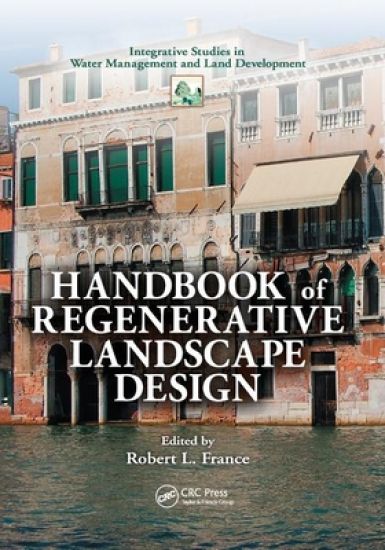
Handbook of Regenerative Landscape Design
What if environmentally damaged landscapes could not only be remediated from an ecological standpoint, but also designed to replenish an entire community as well as the nature surrounding it? The Handbook of Regenerative Landscape Design incorporates ecology, engineering, sociology, and design elements into a new paradigm for environmental restoration and the renewal of urban and cultural sites.This is the first resource in the field to examine the collaborative roles of scientists, landscape architects, and urban planners in transforming degraded landscapes into sustainable communities for both people and wildlife. Top practitioners and theorists from different fields and perspectives contribute innovative case studies that converge in their emphasis on new uses for reclaimed land, rather than a return to its original state. In addition, this book is one in only a handful to address the system conditions necessary for the repair of severely degraded landscapes, especially in an urban context. It elucidates the most suitable remediation strategies for treating degraded environments such as industrial landfills, mining sites, buried urban rivers, heavily polluted or effectively destroyed wetlands, Superfund sites, and abandoned factories. Bringing the perspectives of landscape architects, scientists, and urban planners to a wider audience, the Handbook of Regenerative Landscape Design demonstrates how ecological landscape restoration processes can facilitate sociological and urban renewal initiatives.
In Vitro Percutaneous Absorption

In Vitro Percutaneous Absorption

Robert L. Bronaugh; Howard I. Maibach

CRC Press
2020
nidottu
This book covers all major areas of interest in the rapidly expanding field of in vitro methods for percutaneous absorption studies. Specific areas discussed include diffusion cell design, receptor fluid, preparation of skin, and temperature. The book covers experimental methodology, as well as the underlying principles and fundamentals that help professionals and students gain an understanding of the basis for currently used methodology.
Project Management Basics

Project Management Basics

Robert L. Kimmons

CRC Press
2019
nidottu
Presented in a condensed, comprehensive and graphic format this book contains the basics of project management. It looks at project objectives, the life cycle, short and long term planning and roles with a task force. Providing clear information on planning, defining scope, identifying unique problems, costing and budgets, scheduling, control and the value of reporting. Included is a section on engineering, construction and materials management projects as well as subcontractor relationships and testing and project completion.
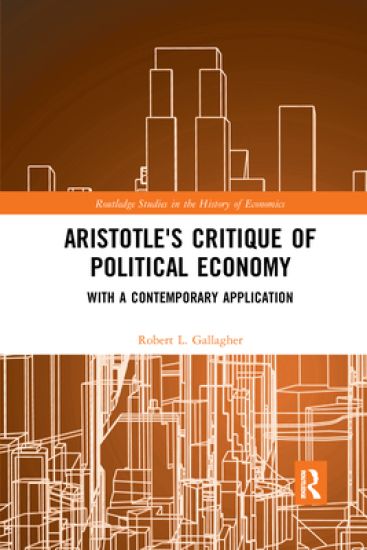
Aristotle's Critique of Political Economy

Aristotle's Critique of Political Economy

Robert L. Gallagher

Routledge
2020
nidottu
This book presents a positive account of Aristotle’s theory of political economy, arguing that it contains elements that may help us better understand and resolve contemporary social and economic problems.The book considers how Aristotle’s work has been utilized by scholars including Marx, Polanyi, Rawls, Nussbaum and Sen to develop solutions to the problem of injustice. It then goes on to present a new Social Welfare Function (SWF) as an application of Aristotle’s theory. In exploring how Aristotle’s theories can be applied to contemporary social welfare analysis, the book offers a study that will be of relevance to scholars of the history of economic thought, political theory and the philosophy of economics.
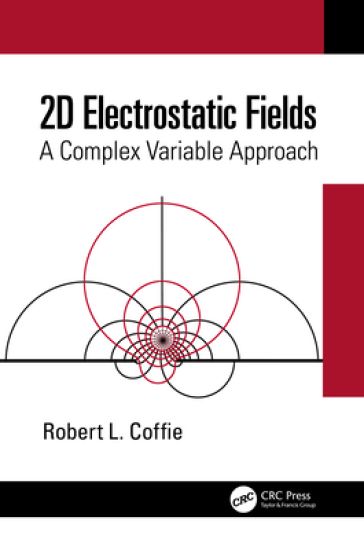
2D Electrostatic Fields

2D Electrostatic Fields

Robert L. Coffie

CRC Press
2021
sidottu
This book demonstrates how to use functions of a complex variable to solve engineering problems that obey the 2D Laplace equation (and in some cases the 2D Poisson equation). The book was written with the engineer/physicist in mind and the majority of the book focuses on electrostatics. A key benefit of the complex variable approach to electrostatics is the visualization of field lines through the use of field maps. With todays’ powerful computers and mathematical software programs, field maps are easily generated once the complex potential has been determined. Additionally, problems that would have been considered out of scope previously are now easily solved with these mathematical software programs. For example, solutions requiring the use of non-elementary functions such as elliptic and hypergeometric functions would have been viewed as not practical in the past due to the tedious use of look up tables for evaluation. Now, elliptic and hypergeometric functions are built-in functions for most mathematical software programs making their evaluation as easy as a trigonometric function. Key highlights in the book include 2D electrostatics completely formulated in terms of complex variables More than 60 electrostatic field maps Comprehensive treatment for obtaining Green’s functions with conformal mapping Fully worked Schwarz-Christoffel transformations to more than usual number of problems A full chapter devoted to solving practical problems at an advanced level Detailed solutions to all end of chapter problems available on book’s websiteAlthough the text is primarily self-contained, the reader is assumed to have taken differential and integral calculus and introductory courses in complex variables and electromagnetics.
2D Electrostatic Fields

2D Electrostatic Fields

Robert L. Coffie

TAYLOR FRANCIS LTD
2024
nidottu
This book demonstrates how to use functions of a complex variable to solve engineering problems that obey the 2D Laplace equation (and in some cases the 2D Poisson equation). The book was written with the engineer/physicist in mind and the majority of the book focuses on electrostatics. A key benefit of the complex variable approach to electrostatics is the visualization of field lines through the use of field maps. With todays’ powerful computers and mathematical software programs, field maps are easily generated once the complex potential has been determined. Additionally, problems that would have been considered out of scope previously are now easily solved with these mathematical software programs. For example, solutions requiring the use of non-elementary functions such as elliptic and hypergeometric functions would have been viewed as not practical in the past due to the tedious use of look up tables for evaluation. Now, elliptic and hypergeometric functions are built-in functions for most mathematical software programs making their evaluation as easy as a trigonometric function. Key highlights in the book include 2D electrostatics completely formulated in terms of complex variables More than 60 electrostatic field maps Comprehensive treatment for obtaining Green’s functions with conformal mapping Fully worked Schwarz-Christoffel transformations to more than usual number of problems A full chapter devoted to solving practical problems at an advanced level Detailed solutions to all end of chapter problems available on book’s websiteAlthough the text is primarily self-contained, the reader is assumed to have taken differential and integral calculus and introductory courses in complex variables and electromagnetics.
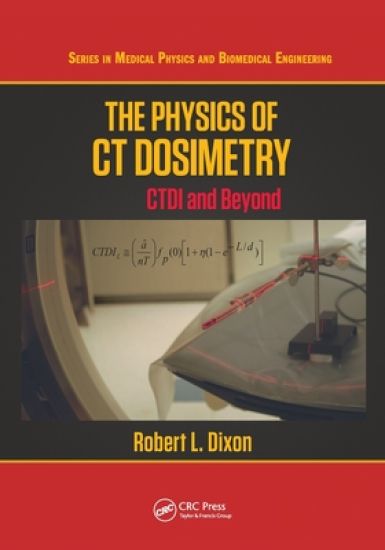
The Physics of CT Dosimetry

The Physics of CT Dosimetry

Robert L. Dixon

CRC Press
2021
nidottu
This book explores the physics of CT dosimetry and provides practical guidance on best practice for medical researchers and practitioners. A rigorous description of the basic physics of CT dosimetry is presented and illustrates flaws of the current methodology. It also contains helpful (and rigorous) shortcuts to reduce the measurement workload for medical physicists. The mathematical rigor is accompanied by easily-understood physical explanations and numerous illustrative figures.Features:Authored by a recognised expert in the field and award-winning teacherIncludes derivations for tube current modulation and variable pitch as well as stationary table techniquesExplores abnormalities present in dose-tracking software based on CTDI and presents methods to correct them
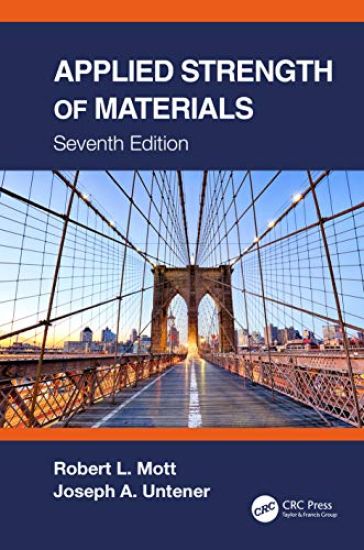
Applied Strength of Materials

Applied Strength of Materials

Robert L. Mott; Joseph A. Untener

CRC Press
2021
sidottu
This text is an established bestseller in engineering technology programs, and the Seventh Edition of Applied Strength of Materials continues to provide comprehensive coverage of the mechanics of materials. Focusing on active learning and consistently reinforcing key concepts, the book is designed to aid students in their first course on the strength of materials.Introducing the theoretical background of the subject, with a strong visual component, the book equips readers with problem-solving techniques. The updated Seventh Edition incorporates new technologies with a strong pedagogical approach. Emphasizing realistic engineering applications for the analysis and design of structural members, mechanical devices, and systems, the book includes such topics as torsional deformation, shearing stresses in beams, pressure vessels, and design properties of materials. A "big picture" overview is included at the beginning of each chapter, and step-by-step problem-solving approaches are used throughout the book.FEATURES Includes "the big picture" introductions that map out chapter coverage and provide a clear context for readers Contains everyday examples to provide context for students of all levels Offers examples from civil, mechanical, and other branches of engineering technology Integrates analysis and design approaches for strength of materials, backed up by real engineering examples Examines the latest tools, techniques, and examples in applied engineering mechanicsThis book will be of interest to students in the field of engineering technology and materials engineering as an accessible and understandable introduction to a complex field.
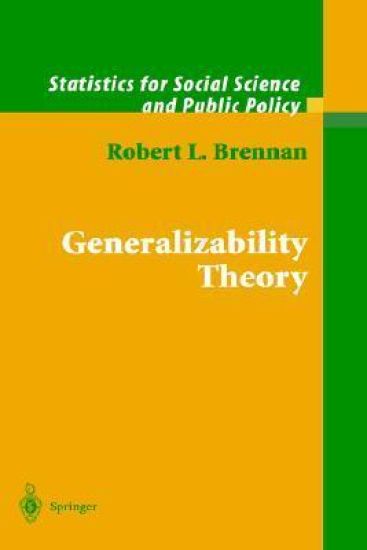
Generalizability Theory

Generalizability Theory

Robert L. Brennan

Springer-Verlag New York Inc.
2001
sidottu
In 1972 a monograph by Cronbach, Gleser, Nanda, and Rajaratnam was published entitled The Dependability of Behavioral Measurements. That book incorporated, systematized, and extended their previous research into what came to be called generalizability theory, which liberalizes classical test theory, in part through the application of analysis of variance proce­ dures that focus on variance components. Generalizability theory is perhaps the most broadly defined measurement model currently in existence, and the Cronbach et al. (1972) treatment of the theory represents a major con­ tribution to psychometrics. However, as Cronbach et al. (1972, p. 3) state, their book is "complexly organized and by no means simple to follow" and, of course, it is nearly 30 years old. In 1983, ACT, Inc. published my monograph entitled Elements of Gen­ eralizability Theory, with a slightly revised version appearing in 1992. That treatment is considerably less comprehensive than Cronbach et al. (1972) but still detailed enough to convey much ofthe richness of the theory and to facilitate its application. However, the 1983/1992 monograph is essen­ tially two decades old, it does not cover multivariate generalizability theory in depth, and it does not incorporate recent developments in statistics that bear upon the estimation of variance components. Also, of course, there have been numerous developments in generalizability theory in the last 20 years.
Tracks to Innovation

Tracks to Innovation

Robert L. Fleischer

Springer-Verlag New York Inc.
1998
sidottu
A serendipitous discovery in nuclear physics has led to a useful tool in materials science. In the late 1950s, scientists at General Electric (among them the author) discovered that when mica is exposed to energetic charged particles (such as are emitted in radioactive decay or occur in cosmic rays), the particles leave latent tracks in the material. When such a material is chemically etched, the tracks are revealed as narrow, deep pits, whose size and shape is determined both by the particle that made the track and by the technique used in etching. It soon turned out that glass, plastics, or certain other materials can be similarly treated. This discovery paved the way not only for a new and useful method of measuring radioactivity, it has also found widespread applications in other fields, ranging from geology and materials science to archaeology and art history. Thus, for example, naturally produced tracks can be used to estimate the age of a mineral deposit or an archaeological material; and deliberately produced tracks can be used to make extremely fine filters. Fleischer presents the history of these developments and discusses the applications of the technique in a way that will be interesting to anyone with a minimal knowledge of physics.
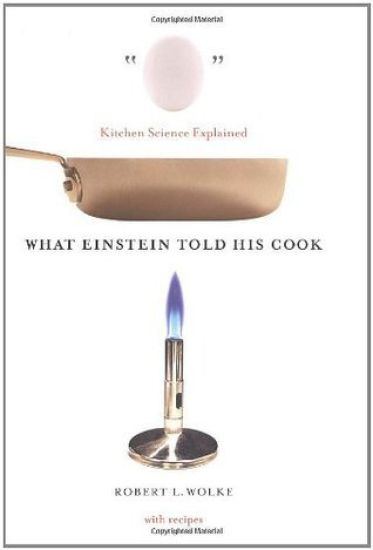
What Einstein Told His Cook

What Einstein Told His Cook

Robert L. Wolke

WW Norton Co
2002
sidottu
Do you wish you understood the science of foods, but don't want to plow through dry technical books? What Einstein Told His Cook is like having a scientist at your side to answer your questions in plain, nontechnical terms. Chemistry professor and syndicated Washington Post food columnist Robert L. Wolke provides over 100 reliable and witty explanations, while debunking misconceptions and helping you to see through confusing advertising and labeling. In "Sweet Talk" you will learn that your taste buds don't behave the way you thought they did, that starch is made of sugar, and that raw sugar isn't raw. Did you know that roads have been paved with molasses? Why do cooked foods turn brown? What do we owe to Christopher Columbus's mother-in-law? In "The Salt of the Earth" you will learn about the strange salts in your supermarket. Does sea salt really come from the sea? (Don't bet on it.) Why do we salt the water for boiling pasta? And how can you remove excess salt from oversalted soup? (You may be surprised.) In "The Fat of the Land" you will learn the difference between a fat and a fatty acid, what makes them saturated or unsaturated, and that nonfat cooking sprays are mostly fat. Why don't the amounts of fats on food labels add up? Why does European butter taste better than ours? In "Chemicals in the Kitchen" you will learn what's in your tap water, how baking powder and baking soda differ, and what MSG does to food. What Japanese taste sensation is sweeping this country? Is your balsamic vinegar fake? Why do potato chips have green edges? In "Turf and Surf" you will learn why red meat is red, why ground beef may look as if it came from the Old Gray Mare, and how bones contribute to flavor. Want a juicy turkey with smooth gravy? How does one deal with a live clam, oyster, crab, or lobster? In "Fire and Ice" you will learn how to buy a range and the difference between charcoal and gas for grilling. Did you know that all the alcohol does not boil off when you cook with wine? How about a surprising way to defrost frozen foods? And yes, hot water can freeze before cold water. In "Liquid Refreshment" you will learn about the acids and caffeine in coffee, and why "herb teas" are not teas. Does drinking soda contribute to global warming? Why does champagne foam up? Should you sniff the wine cork? How can you find out how much alcohol there is in your drink? In "Those Mysterious Microwaves" you will learn what microwaves do—and don't do—to your food. What makes a container "microwave safe"? Why mustn't you put metal in a microwave oven? How can you keep microwave-heated water from blowing up in your face? In "Tools and Technology" you will learn why nothing sticks to nonstick cookware, and what the pressure-cooker manufacturers don't tell you. What's the latest research on juicing limes? Why are "instant read" thermometers so slow? Can you cook with magnetism and light? What does irradiation do to our foods?
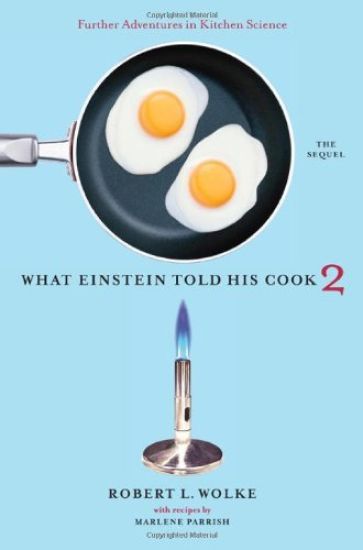
What Einstein Told His Cook 2

What Einstein Told His Cook 2

Robert L. Wolke

WW Norton Co
2005
sidottu
This sequel to the best-selling What Einstein Told His Cook continues Bob Wolke's investigations into the science behind our foods—from the farm or factory to the market, and through the kitchen to the table. In response to ongoing questions from the readers of his nationally syndicated Washington Post column, "Food 101," Wolke continues to debunk misconceptions with reliable, commonsense answers. He has also added a new feature for curious cooks and budding scientists, "Sidebar Science," which details the chemical processes that underlie food and cooking. In the same plain language that made the first book a hit with both techies and foodies, Wolke combines the authority, clarity, and wit of a renowned research scientist, writer, and teacher. All those who cook, or for that matter go to the market and eat, will become wiser consumers, better cooks, and happier gastronomes for understanding their food.
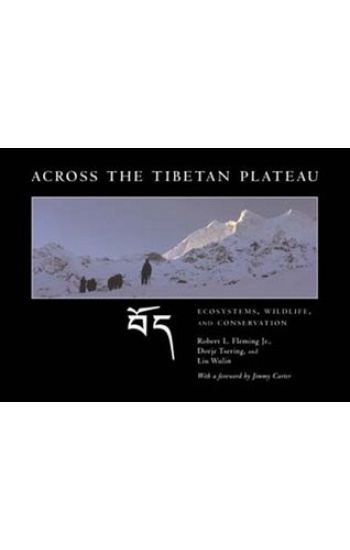
Across the Tibetan Plateau

Across the Tibetan Plateau

Robert L. Fleming; Dorje Tsering; Liu Wulin; Jimmy Carter

WW Norton Co
2007
sidottu
Here is the most comprehensive photography to date of a little-known and seldom-visited land whose area equals western Europe. The beauty and diversity of Tibet is staggering: from Mount Everest to the world’s deepest gorge, from tropical jungles to arctic-like tundra, from trees twenty feet in diameter to vast herds and solitary specimens of some of the least-known animals on the planet. Certain photographs, such as those of a newborn Tibetan antelope or the elusive red ghoral, are among the first ever taken of these subjects. The book brings American, Tibetan, and Chinese scholarship to bear on the natural history of Tibet, and it also describes an extraordinary conservation accomplishment that has gone virtually unnoticed by the outside world. Where else has 40 percent of the land been set aside in nature preserves in twenty years? As a result of this effort, the animals and landscapes shown here will be saved for future generations.
Behind the Veil of Economics

Behind the Veil of Economics

Robert L. Heilbroner

WW Norton Co
1989
nidottu
What lies behind the veil of economics? Power and ideology, answers Robert Heilbroner—the power of our economic involvement in society to shape the ways we think about it; the visions and values that add unsuspected ideological color to our economic beliefs about it. Most important, Heilbroner shows why economics has become the reigning form of social inquiry and how we might penetrate its mystique.
The Debt and the Deficit

The Debt and the Deficit

Robert L. Heilbroner; Peter L. Bernstein

WW Norton Co
1989
nidottu
The authors explain what national debts and deficits are, and what they are not. One thing they are not nearly as big as we think. Another thing they are not is a burden on the shoulders of our grandchildren. And one thing they are is a potential means of financing economic growth. Heilbroner and Bernstein do not shrug aside the debt and deficit. "The only remedy for our present frightened state of mind", they write, "is explanations that are simple but accurate, facts that will defuse unreasoning panic, and arguments that will stand up under the most skeptical examination."