

Kirjahaku
Etsi kirjoja tekijän nimen, kirjan nimen tai ISBN:n perusteella.
1000 tulosta hakusanalla Samuel Augustus Mitchell
When Samuel Johnson is discussed as an essayist, his and Idler are generally the works that are considered. This is the first study to take account of the effect of Johnson's essayistic talents on the entirety of his writing. Setting forth the particular characteristics of the genre that are present in Johnson's contributions to the political controversies of his time, this analysis examines those qualities of Johnson's thought and methods that naturally led to his dependence on the essay form in polemical engagements throughout his career. In detail, Spector's study then goes on to explore the manner in which Johnson employed the essay not only in forms normally related to the genre, but in literary types ordinarily considered remote from it. The and Idler, along with Johnson's periodical essays in the Adventurer, are themselves looked at from a fresh point of view—the ways in which Johnson the professional writer, without regard for posterity, addressed the interests of the common reader of his century.
No modern play in the western dramatic tradition has provoked as much controversy or generated as much diversity of opinion as Samuel Beckett's Waiting for Godot. Since its initial production in 1953, it has revolutionized the stage through its existentialism and apparent rejection of plot. This book is a valuable introduction to the play. It begins with a summary of the play and its origins and editions. It then explores the play's meaning and the historical and intellectual contexts informing Beckett's work. The book then examines Beckett's dramatic art and gives full coverage of the play's performance history. A bibliographical essay surveys the most important critical studies.

Samuel Beckett: Waiting for Godot
Red Globe Press
1987
nidottu
In this provocative and incisive book the author re-examines Samuel Johnson's major texts, focusing on his famous review of Soame Jenyns's A Free Inquiry into the Nature and Origin of Evil as a principal source of insight and innovation. He offers a lucid exposition of its ideas and methods, defining for the first time its relation to an important strand in eighteenth-century intellectual history, and assessing its implications for Johnson's moral vision. Hinnant's book will be an indispensable guide for anyone interested in understanding what is most modern in Johnson's thought and writings.
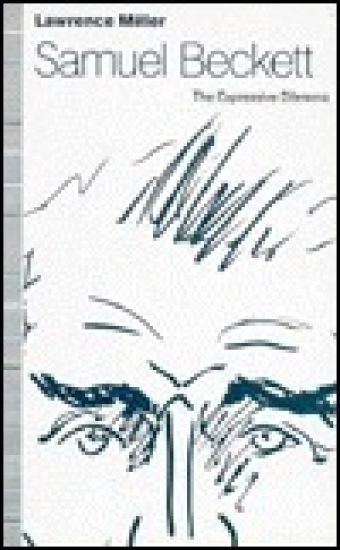
In this detailed study of Molloy, Malone Dies, and The Unnamable, Lawrence Miller traces Beckett's attempt to voice the expressive dilemma that is posed by the assumptions of modernist art and art criticism. A preliminary examination of Beckett's critical writings on literature and painting reveals a growing suspicion of modernist ambitions; it is the trilogy of novels, however, which represents Beckett's most sustained rejection of the 'feasible' aspirations of an expressive theory of art.
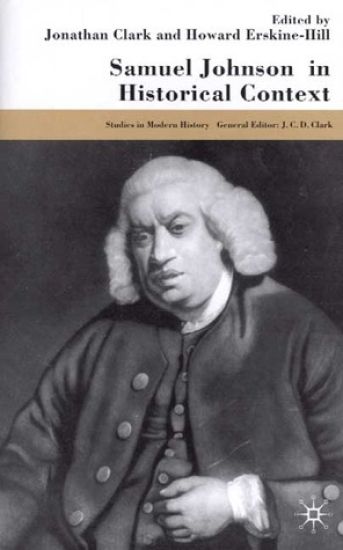
In one of the more sudden shifts of perspective, and hotly contested controversies of recent historical and literary scholarship, our view of Johnson has been fundamentally changed. This volume offers the best up-to-the-moment account of what has been achieved, and points to the new directions in which scholarship is developing. It will be essential reading for all concerned with eighteenth-century studies.
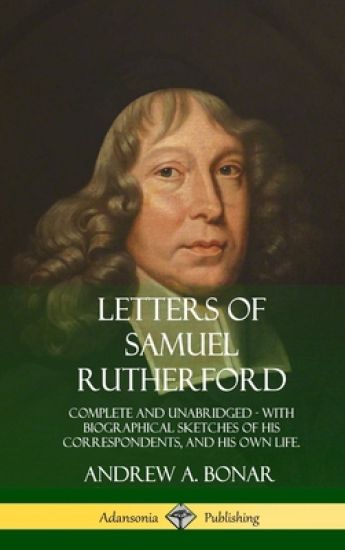
This superb collection of Samuel Rutherford's letters includes a biographical account of his life, together with a copious arrangement of notes and an appendix. As one of Scotland's foremost theologians and authors in the 17th century, Samuel Rutherford was a gifted and busy wordsmith. Throughout a career spanning decades, he wrote a series of valued books on both religious topics and Presbyterianism in the political sphere. A lively and engaged thinker, Rutherford's life and thoughts offers a good portrayal of the evolution in both church and state in his era. Although most known for his ideas on constitutionalism and on military principles, Samuel Rutherford in the day-to-day lived for ordinary men and women believers who frequented his church in Kirkcudbrightshire, Galloway. He would often pay visits to the sick, correspond with their families, and offer emotional comfort and reassurance in times of difficulty.
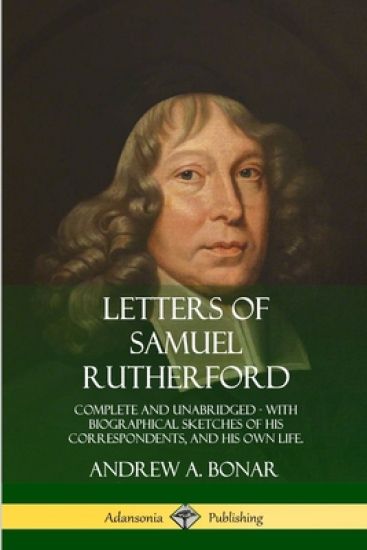
This superb collection of Samuel Rutherford's letters includes a biographical account of his life, together with a copious arrangement of notes and an appendix. As one of Scotland's foremost theologians and authors in the 17th century, Samuel Rutherford was a gifted and busy wordsmith. Throughout a career spanning decades, he wrote a series of valued books on both religious topics and Presbyterianism in the political sphere. A lively and engaged thinker, Rutherford's life and thoughts offers a good portrayal of the evolution in both church and state in his era. Although most known for his ideas on constitutionalism and on military principles, Samuel Rutherford in the day-to-day lived for ordinary men and women believers who frequented his church in Kirkcudbrightshire, Galloway. He would often pay visits to the sick, correspond with their families, and offer emotional comfort and reassurance in times of difficulty.
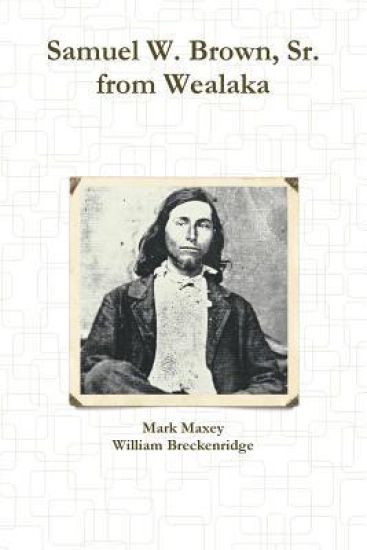
A prominent member of the Yuchi in the Creek Nation, after the removal to the Indian territory, was Chief Samuel W. Brown, Sr., who was born in Van Buren, Arkansas, in June 1843. He was the eldest son of S. W. Williams, a lieutenant in the United States Army. Brown's mother called Suttah was a sister of Chief Tissoso of the Yuchi. She was the granddaughter of Cosenna Barnard or "Cussinne Barnett", a prominent leader among the Yuchi.Yuchi Chief Brown, Sr., maintained his home near Jenks where he kept "the trophies of his long eventful life" for he lived to the age of ninety-two years. One who knew him well described him as low, heavy set man with a fair complexion.

This book provides new insight into a fascinating but often misunderstood writer, Samuel Butler. It offers a much-needed reappraisal of Butler's work and shows how Lamarckian ideas pervaded the whole of Butler's wide-ranging ouevre, and not merely his evolutionary theory.
Samuel Beckett and the Arts
Routledge
2021
sidottu
This book, first published in 1999, addresses Beckett’s visual and musical sensibilities, and examines his visionary use of such diverse modes of creative expression as stage, radio, television and film, when his medium was the written word. The first section of the book focuses on music; the second part analyses the visual arts; and the third part examines film, radio and television. This book uncovers aspects of his thinking on, and use of the arts that have been little studied, including the nonfigurative function of music and art in Beckett’s work; the ‘collaborations’ undertaken by composers, painters and choreographers with his texts; the relation of his literary to his visual and musical artistry; and his use of film, radio and television as innovative means and celebration of artistic process.

Samuel Beckett and the Arts
TAYLOR FRANCIS LTD
2022
nidottu
This book, first published in 1999, addresses Beckett’s visual and musical sensibilities, and examines his visionary use of such diverse modes of creative expression as stage, radio, television and film, when his medium was the written word. The first section of the book focuses on music; the second part analyses the visual arts; and the third part examines film, radio and television. This book uncovers aspects of his thinking on, and use of the arts that have been little studied, including the nonfigurative function of music and art in Beckett’s work; the ‘collaborations’ undertaken by composers, painters and choreographers with his texts; the relation of his literary to his visual and musical artistry; and his use of film, radio and television as innovative means and celebration of artistic process.

Music abounds in twentieth- century Irish literature. Whether it be the "thought-tormented" music of Joyce’s "The Dead", the folk tunes and opera that resound throughout Ulysses, or the four- part threnody in Beckett’s Watt, it is clear that the influence of music on the written word in Ireland is deeply significant. Samuel Beckett arguably went further than any other writer in the incorporation of musical ideas into his work. Musical quotations inhabit his texts, and structural devices such as the da capo are metaphorically employed. Perhaps most striking is the erosion of explicit meaning in Beckett’s later prose brought about through an extensive use of repetition, influenced by his reading of Schopenhauer’s philosophy of music. Exploring this notion of "semantic fluidity", John McGrath discusses the ways in which Beckett utilised extreme repetition to create texts that operate and are received more like music. Beckett’s writing has attracted the attention of numerous contemporary composers and an investigation into how this Beckettian "musicalized fiction" has been retranslated into contemporary music forms the second half of the book. Close analyses of the Beckett- inspired music of experimental composer Morton Feldman and the structured improvisations of avantjazz guitarist Scott Fields illustrate the cross- genre appeal of Beckett to musicians, but also demonstrate how repetition operates in diverse ways. Through the examination of the pivotal role of repetition in both music and literature of the twentieth century and beyond, John McGrath’s book is a significant contribution to the field of Word and Music Studies.

For a decade, beginning in 1660, an ambitious young London civil servant kept an astonishingly candid account of his life during one of the most defining periods in British history. In Samuel Pepys, Claire Tomalin offers us a fully realized and richly nuanced portrait of this man, whose inadvertent masterpiece would establish him as the greatest diarist in the English language. Against the backdrop of plague, civil war, and regicide, with John Milton composing diplomatic correspondence for Oliver Cromwell, Christopher Wren drawing up plans to rebuild London, and Isaac Newton advancing the empirical study of the world around us, Tomalin weaves a breathtaking account of a figure who has passed on to us much of what we know about seventeenth-century London. We witness Pepys's early life and education, see him advising King Charles II before running to watch the great fire consume London, learn about the great events of the day as well as the most intimate personal details that Pepys encrypted in the Diary, follow him through his later years as a powerful naval administrator, and come to appreciate how Pepys's singular literary enterprise would in many ways prefigure our modern selves. With exquisite insight and compassion, Samuel Pepys captures the uniquely fascinating figure whose legacy lives on more than three hundred years after his death.
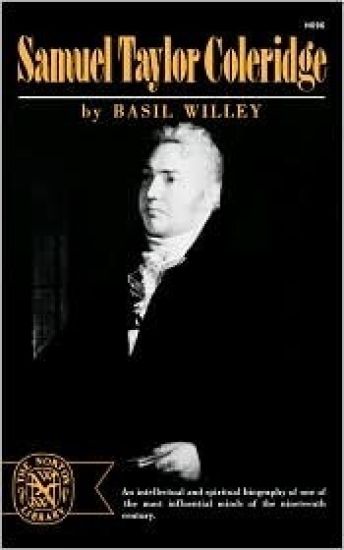
The central thread of the book is Coleridge's life-long search--in Professor Willey's words, "for a mind not passive but active; a will not frozen in necessity, but free and responsible; an Imagination not decorative but creative in the highest sense; and a God not identified or confused with Nature, but at once transcendent and redemptive." Basil Willey's rich understanding of Coleridge, and his lucid analysis of the complex philosophical issues in his work, will make this book invaluable to readers interested in English intellectual history.
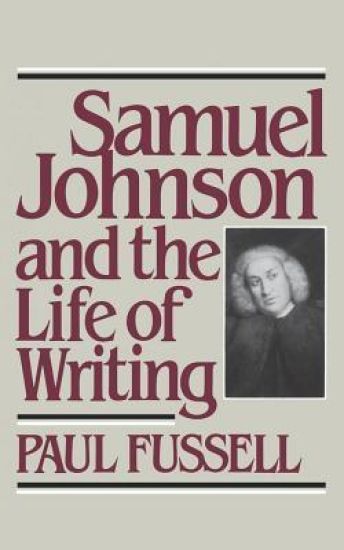
Not everyone is as innocent as this engaging complainant. Most people who read know something about Johnson, enough at least to summon up images of him asseverating "No, Sir," knocking back endless cups of tea, rambling over the Hebrides, puffing out his breath like a whale, repressing Boswell, standing bareheaded in Uttoxeter Market, and having a frisk with Beauclerk and Langton. And now, thanks to the Johnsonians of Yale, Columbia, Oxford, and Lichfield, our knowledge of the man and his social environment has increased more than anyone fifty years ago could have imagined. But despite prodigies of research and documentation, an interest in Johnson that could be called literary has been wanting. One suspects that for every hundred persons familiar with the classic Johnson anecdotes there is perhaps only one who has actually read the Rambler or the Idler or even the Lives of the Poets. And if the writings are still little read for their own sake, they are almost as little written about as attractive objects of criticism. Yale's new edition of the writings, the first since the early nineteenth century, is an occasion to perceive that for all his value as conversational goad and wit and for all his attractiveness as a moral and religious hero, Johnson's identity remains stubbornly that of a writer.

Samuel Johnson
Routledge
1995
sidottu
The Critical Heritage gathers together a large body of critical sources on major figures in literature. Each volume presents contemporary responses to a writer's work, enabling students and researchers to read for themselves, for example, comments on early performances of Shakespeare's plays, or reactions to the first publication of Jane Austen's novels. The carefully selected sources range from landmark essays in the history of criticism to journalism and contemporary opinion, and little published documentary material such as letters and diaries. Significant pieces of criticism from later periods are also included, in order to demonstrate the fluctuations in an author's reputation. Each volume contains an introduction to the writer's published works, a selected bibliography, and an index of works, authors and subjects. The Collected Critical Heritage set will be available as a set of 68 volumes and the series will also be available in mini sets selected by period (in slipcase boxes) and as individual volumes.
Samuel Taylor Coleridge
Routledge
1995
sidottu
The Critical Heritage gathers together a large body of critical sources on major figures in literature. Each volume presents contemporary responses to a writer's work, enabling students and researchers to read for themselves, for example, comments on early performances of Shakespeare's plays, or reactions to the first publication of Jane Austen's novels.The carefully selected sources range from landmark essays in the history of criticism to journalism and contemporary opinion, and little published documentary material such as letters and diaries. Significant pieces of criticism from later periods are also included, in order to demonstrate the fluctuations in an author's reputation.Each volume contains an introduction to the writer's published works, a selected bibliography, and an index of works, authors and subjects.

Samuel Taylor Coleridge
Routledge
1995
sidottu
The Critical Heritage gathers together a large body of critical sources on major figures in literature. Each volume presents contemporary responses to a writer's work, enabling student and researcher to read the material themselves.