Kirjojen hintavertailu. Mukana 12 595 353 kirjaa ja 12 kauppaa.

Kirjahaku

Etsi kirjoja tekijän nimen, kirjan nimen tai ISBN:n perusteella.

1000 tulosta hakusanalla Thomas F Staley

Enrico Dandolo and the Rise of Venice

Enrico Dandolo and the Rise of Venice

Thomas F. Madden

Johns Hopkins University Press
2006
pokkari
Between the eleventh and thirteenth centuries, Venice transformed itself from a struggling merchant commune to a powerful maritime empire that would shape events in the Mediterranean for the next four hundred years. In this magisterial new book on medieval Venice, Thomas F. Madden traces the city-state's extraordinary rise through the life of Enrico Dandolo (c. 1107-1205), who ruled Venice as doge from 1192 until his death. The scion of a prosperous merchant family deeply involved in politics, religion, and diplomacy, Dandolo led Venice's forces during the disastrous Fourth Crusade (1201-1204), which set out to conquer Islamic Egypt but instead destroyed Christian Byzantium. Yet despite his influence on the course of Venetian history,we know little about Dandolo, and much of what is known has been distorted by myth. The first full-length study devoted to Dandolo's life and times, Enrico Dandolo and the Rise of Venice corrects the many misconceptions about him that have accumulated over the centuries, offering an accurate and incisive assessment of Dandolo's motives, abilities, and achievements as doge, as well as his role-and Venice's-in the Fourth Crusade. Madden also examines the means and methods by which the Dandolo family rose to prominence during the preceding century, thus illuminating medieval Venice's singular political, social, and religious environment. Culminating with the crisis precipitated by the failure of the Fourth Crusade, Madden's groundbreaking work reveals the extent to which Dandolo and his successors became torn between the anxieties and apprehensions of Venice's citizens and its escalating obligations as a Mediterranean power.

What about Darwin?

What about Darwin?

Thomas F. Glick

Johns Hopkins University Press
2010
pokkari
Charles Darwin and his revolutionary ideas inspired pundits the world over to put pen to paper. In this unique dictionary of quotations, Darwin scholar Thomas Glick presents fascinating observations about Darwin and his ideas from such notable figures as P. T. Barnum, Anton Chekhov, Mahatma Gandhi, Carl Jung, Martin Luther King, Mao Tse-tung, Pius IX, Jules Verne, and Virginia Woolf. What was it about Darwin that generated such widespread interest? His Origin of Species changed the world. Naturalists, clerics, politicians, novelists, poets, musicians, economists, and philosophers alike could not help but engage his theory of evolution. Whatever their view of his theory, however, those who met Darwin were unfailingly charmed by his modesty, kindness, honesty, and seriousness of purpose. This diverse collection drawn from essays, letters, novels, short stories, plays, poetry, speeches, and parodies demonstrates how Darwin's ideas permeated all areas of thought. The quotations trace a broad conversation about Darwin across great distances of time and space, revealing his profound influence on the great thinkers of the nineteenth and twentieth centuries.
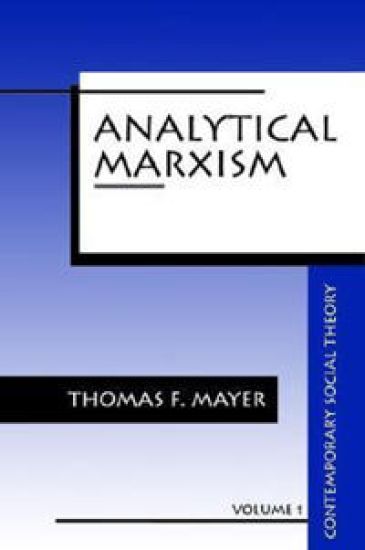
Analytical Marxism

Analytical Marxism

Thomas F. Mayer

SAGE Publications Inc
1994
sidottu
Analytical Marxism blends the tenets of Marxist theory with many of the more traditional methods of social science. In this brief introduction to the major ideas and scholars in the Analytical Marxist school, Thomas F. Mayer assesses the achievements, strengths, and criticisms of their work. Focusing on the work of Elster, Roemer, Wright, and others, Mayer examines their writing on class, the state, exploitation, and revolution. Sections addressing communism and socialism define these terms in historical and current contexts, enabling the author to establish the patterns from which political predictions may be drawn. The book also explores the challenge to Marxist thought brought about by contemporary developments in Eastern Europe and suggests how the future of Marxism is shaped by these events. "Designed to help undergraduates understand the complex literature on the topic, this volume is written in an accessible style, and includes a glossary and annotated reading list. The language is exceptionally clear and free of mathematical equations. Thomas F. Mayer demonstrates in fact how needless equations so often are. Thomas F. Mayer's Analytical Marxism is a theoretical statement in its own right. As such, it is far more compelling than the edited volume with the same title that came out in 1986. What makes Mayer's book superior is that it has abandoned or muted many of the philosophically objectionable positions associated with its predecessor." -Contemporary Sociology "Thomas F. Mayer's book admirably demonstrates the robust and provacative results wrought by Cohen, ELster, Przeworski, Roemer, and Wright with their chosen tools. The liveliness and intensity of the debates provoked by these theorists' assertions suggests that the Marxian analytical tradition has a robust future." --Science and Society
Analytical Marxism

Analytical Marxism

Thomas F. Mayer

SAGE Publications Inc
1994
nidottu
Analytical Marxism blends the tenets of Marxist theory with many of the more traditional methods of social science. In this brief introduction to the major ideas and scholars in the Analytical Marxist school, Thomas F. Mayer assesses the achievements, strengths, and criticisms of their work. Focusing on the work of Elster, Roemer, Wright, and others, Mayer examines their writing on class, the state, exploitation, and revolution. Sections addressing communism and socialism define these terms in historical and current contexts, enabling the author to establish the patterns from which political predictions may be drawn. The book also explores the challenge to Marxist thought brought about by contemporary developments in Eastern Europe and suggests how the future of Marxism is shaped by these events. "Designed to help undergraduates understand the complex literature on the topic, this volume is written in an accessible style, and includes a glossary and annotated reading list. The language is exceptionally clear and free of mathematical equations. Thomas F. Mayer demonstrates in fact how needless equations so often are. Thomas F. Mayer's Analytical Marxism is a theoretical statement in its own right. As such, it is far more compelling than the edited volume with the same title that came out in 1986. What makes Mayer's book superior is that it has abandoned or muted many of the philosophically objectionable positions associated with its predecessor." -Contemporary Sociology "Thomas F. Mayer's book admirably demonstrates the robust and provacative results wrought by Cohen, ELster, Przeworski, Roemer, and Wright with their chosen tools. The liveliness and intensity of the debates provoked by these theorists' assertions suggests that the Marxian analytical tradition has a robust future." --Science and Society
Convergence

Convergence

Thomas F. Baldwin; D . Stevens McVoy; Charles W. Steinfield

SAGE Publications Inc
1996
nidottu
Convergence offers the reader an insightful guide to the digital transformation of the communication landscape. Elegantly written, the text clearly articulates how the telecommunications landscape has undergone a metamorphosis in the age of digital technology. Broadband communications, compression, and network integration are key concepts in this groundbreaking book. Students, scholars, communication professionals, and policymakers will find this book an invaluable resource for understanding the nature and consequences of the new information infrastructure. --John V. Pavlik, Director, School of Communication, San Diego State University Convergence is the central symbol of communication for the future--where broadcasting, cable, and telecommunications services band together to form the new media world of the future. Convergence: Integrating Media, Information & Communication is the first book to provide a comprehensive analysis of the conditions that have led to the convergence of the media and communication industries. The authors explore the remaining obstacles to convergence and the consequences of convergence for society, the individual, and businesses involved. This timely volume examines the impact of convergence on interactive information and entertainment services and their management and marketing, economic and public policy concerns, and the effects of multinational development and hackers--linking them to the changes we experience in our culture and daily existence. Convergence: Integrating Media, Information & Communication is a multifaceted analysis that will be of great interest to those interested in future media developments and their impact. This informative book can be used as a primary text in courses in communication technology, mass communication, telecommunication, organizational communication, and international communication.
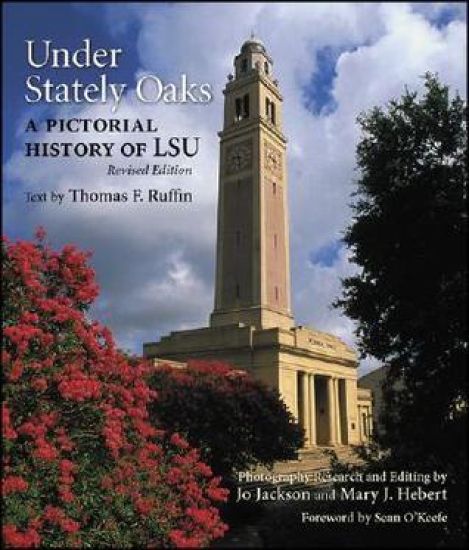
Under Stately Oaks

Under Stately Oaks

Thomas F. Ruffin; Sean O'Keefe

Louisiana State University Press
2006
sidottu
In a captivating blend of photographs and text, Under Stately Oaks showcases over 150 years of Louisiana State University's past, following the evolution of the tiny Seminary of Learning of the State of Louisiana, founded near Pineville in 1853, into a university of well over 30,000 students for the twenty-first century. Thomas F. Ruffin has written an affectionate history of LSU, but it is also an honest one. The notorious scandals of 1939, the university's desegregation struggles, and free-speech alley confrontations during the civil rights movement and the Vietnam War, as well as the football team's 2003 NCAA championship and the university's pivotal role in relief efforts following Hurricane Katrina -- all are chronicled here.From the red pantile roofs and honey-colored stucco of its Italian Renaissance architecture to the ""stately oaks and broad magnolias"" hailed in the alma mater, the distinct beauty of the LSU campus is unrivaled. The history of the state's flagship university is as colorful as the azaleas that adorn its landscape every spring. Its first superintendent, William Tecumseh Sherman, later opposed its first faculty member and future president, David F. Boyd, in war. Yet both also fought for an LSU curriculum that embraced a liberal education with a classical component. When LSU lost its state funding during the 1870s, it was Boyd who maneuvered a merger with Louisiana A&M College, a move that ensured LSU's survival and preserved its identity. In the 1930s, Huey Long demanded the best for LSU on many fronts, and by the mid-twentieth century the institution was not only the state's premier university but also nationally recognized for its prestigious faculty and cutting-edge research. This newly updated edition features a foreword by Chancellor Sean O'Keefe and a final chapter entitled ""The 21st Century and Beyond,"" which details the concrete steps LSU has taken towards fulfilling its goal of becoming a nationally competitive flagship institution. The last chapter also portrays, in text and striking photographs, the central role LSU played in emergency relief efforts following Hurricane Katrina, and examines how the university is faring in the post-Katrina world. Under Stately Oaks captures the spirit of the university as never before. Though the book shows that much has changed over the years, it is primarily a celebration of the timeless aspects of the LSU experience and a compelling testimony to the university's ongoing commitment to progress.
Toward a Cosmic Theology

Toward a Cosmic Theology

Thomas F. O'Meara

PAULIST PRESS INTERNATIONAL,U.S.
2024
nidottu
Toward a Cosmic Theology considers topics and areas from Christian revelation as they draw on forces and worlds, insights and developments, now unfolded by science. It explores such topics as: the vastness of the universe of nature; implications for what God might be like; relationships of the Trinity to being and evolution; divine presence and the world of the universe and of the subatomic realm; extraterrestrials; time, the future, and change and transformation; the personal and religious world as a society of planets and their cultures. The author draws on the theologies of earlier theologians like Origen, Thomas Aquinas, and more recent ones such as Yves Congar, Karl Rahner, Douglas Vakoch, John Haught, and Jacques Arnould. Thomas F. O'Meara, OP, is the author of over a dozen books in theology, including Theology of Ministry and God in the World. He taught at Aquinas Institute of Theology and served as the Warren Professor of Theology at the University of Notre Dame; he has served as visiting professor at Weston Jesuit School of Theology, Wartburg Lutheran Seminary, and the Dominican Institute of Theology, Ibadan, Nigeria. He is a past president of the Catholic Theological Society of America. †
Women Making War

Women Making War

Thomas F. Curran

Southern Illinois University Press
2020
nidottu
Partisan activities of disloyal women and the Union army’s reaction During the American Civil War, more than four hundred women were arrested and imprisoned by the Union Army in the St. Louis area. The majority of these women were fully aware of the political nature of their actions and had made conscious decisions to assist Confederate soldiers in armed rebellion against the U.S. government. Their crimes included offering aid to Confederate soldiers, smuggling, spying, sabotaging, and, rarely, serving in the Confederate army. Historian Thomas F. Curran’s extensive research highlights for the first time the female Confederate prisoners in the St. Louis area, and his thoughtful analysis shows how their activities affected Federal military policy. Early in the war, Union officials felt reluctant to arrest women and waited to do so until their conduct could no longer be tolerated. The war progressed, the women’s disloyal activities escalated, and Federal response grew stronger. Some Confederate partisan women were banished to the South, while others were held at Alton Military Prison and other sites. The guerilla war in Missouri resulted in more arrests of women, and the task of incarcerating them became more complicated. The women’s offenses were seen as treasonous by the Federal government. By determining that women—who were excluded from the politics of the male public sphere—were capable of treason, Federal authorities implicitly acknowledged that women acted in ways that had serious political meaning. Nearly six decades before U.S. women had the right to vote, Federal officials who dealt with Confederate partisan women routinely referred to them as citizens. Federal officials created a policy that conferred on female citizens the same obligations male citizens had during time of war and rebellion, and they prosecuted disloyal women in the same way they did disloyal men. The women arrested in the St. Louis area are only a fraction of the total number of female southern partisans who found ways to advance the Confederate military cause. More significant than their numbers, however, is what the fragmentary records of these women reveal about the activities that led to their arrests, the reactions women partisans evoked from the Federal authorities who confronted them, the impact that women’s partisan activities had on Federal military policy and military prisons, and how these women’s experiences were subsumed to comport with a Lost Cause myth—the need for valorous men to safeguard the homes of defenseless women.
The Republic of St. Peter

The Republic of St. Peter

Thomas F. X. Noble

University of Pennsylvania Press
1986
pokkari
The Republic of St. Peter seeks to reclaim for central Italy an important part of its own history. Noble's thesis is at once original and controversial: that the Republic, an independent political entity, was in existence by the 730s and was not a creation of the Franks in the 750s. Noble examines the political, economic, and religious problems that impelled the central Italians-and a succession of resolute popes-to seek emancipation from the Byzantine Empire. He delineates the social structures and historical traditions that produced a distinctive political society, describes the complete governmental apparatus of the Republic, and provides a comprehensive assessment of the Franco-papal alliance.
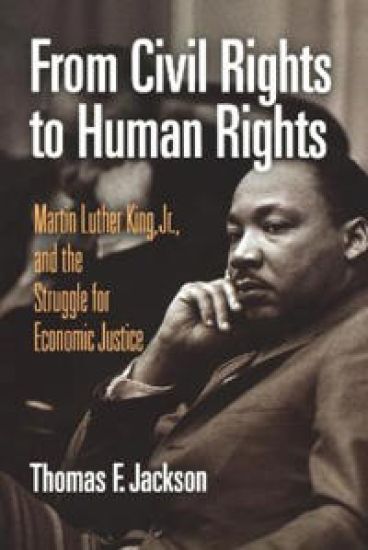
From Civil Rights to Human Rights

From Civil Rights to Human Rights

Thomas F. Jackson

University of Pennsylvania Press
2009
pokkari
Martin Luther King, Jr., is widely celebrated as an American civil rights hero. Yet King's nonviolent opposition to racism, militarism, and economic injustice had deeper roots and more radical implications than is commonly appreciated, Thomas F. Jackson argues in this searching reinterpretation of King's public ministry. Between the 1940s and the 1960s, King was influenced by and in turn reshaped the political cultures of the black freedom movement and democratic left. His vision of unfettered human rights drew on the diverse tenets of the African American social gospel, socialism, left-New Deal liberalism, Gandhian philosophy, and Popular Front internationalism. King's early leadership reached beyond southern desegregation and voting rights. As the freedom movement of the 1950s and early 1960s confronted poverty and economic reprisals, King championed trade union rights, equal job opportunities, metropolitan integration, and full employment. When the civil rights and antipoverty policies of the Johnson administration failed to deliver on the movement's goals of economic freedom for all, King demanded that the federal government guarantee jobs, income, and local power for poor people. When the Vietnam war stalled domestic liberalism, King called on the nation to abandon imperialism and become a global force for multiracial democracy and economic justice. Drawing widely on published and unpublished archival sources, Jackson explains the contexts and meanings of King's increasingly open call for "a radical redistribution of political and economic power" in American cities, the nation, and the world. The mid-1960s ghetto uprisings were in fact revolts against unemployment, powerlessness, police violence, and institutionalized racism, King argued. His final dream, a Poor People's March on Washington, aimed to mobilize Americans across racial and class lines to reverse a national cycle of urban conflict, political backlash, and policy retrenchment. King's vision of economic democracy and international human rights remains a powerful inspiration for those committed to ending racism and poverty in our time.
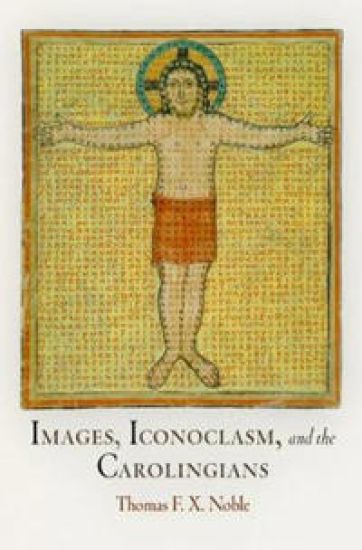
Images, Iconoclasm, and the Carolingians

Images, Iconoclasm, and the Carolingians

Thomas F. X. Noble

University of Pennsylvania Press
2013
pokkari
In the year 726 C.E., the Byzantine emperor Leo III issued an edict declaring images to be idols, forbidden by Exodus, and ordering all such images in churches to be destroyed. Thus commenced the first wave of Byzantine iconoclasm, which ran its violent course until 787, when the underlying issues were temporarily resolved at the Second Council of Nicaea. In 815, a second great wave of iconoclasm was set off, only to end in 842 when the icons were restored to the churches of the East and the iconoclasts excommunicated. The iconoclast controversies have long been understood as marking major fissures between the Western and Eastern churches. Thomas F. X. Noble reveals that the lines of division were not so clear. It is traditionally maintained that the Carolingians in the 790s did not understand the basic issues involved in the Byzantine dispute. Noble contends that there was, in fact, a significant Carolingian controversy about visual art and, if its ties to Byzantine iconoclasm were tenuous, they were also complex and deeply rooted in central concerns of the Carolingian court. Furthermore, he asserts that the Carolingians made distinctive and original contributions to the whole debate over religious art. Images, Iconoclasm, and the Carolingians is the first book to provide a comprehensive study of the Western response to Byzantine iconoclasm. By comparing art-texts with laws, letters, poems, and other sources, Noble reveals the power and magnitude of the key discourses of the Carolingian world during its most dynamic and creative decades.
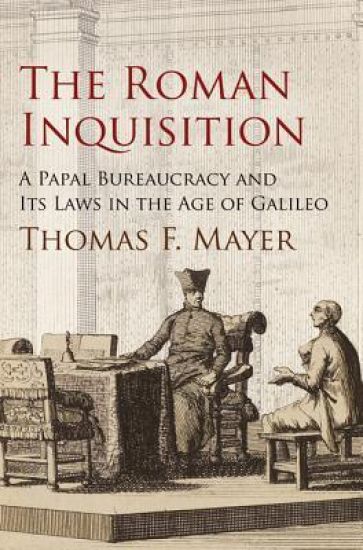
The Roman Inquisition

The Roman Inquisition

Thomas F. Mayer

University of Pennsylvania Press
2013
sidottu
While the Spanish Inquisition has laid the greatest claim to both scholarly attention and the popular imagination, the Roman Inquisition, established in 1542 and a key instrument of papal authority, was more powerful, important, and long-lived. Founded by Paul III and originally aimed to eradicate Protestant heresy, it followed medieval antecedents but went beyond them by becoming a highly articulated centralized organ directly dependent on the pope. By the late sixteenth century the Roman Inquisition had developed its own distinctive procedures, legal process, and personnel, the congregation of cardinals and a professional staff. Its legal process grew out of the technique of inquisitio formulated by Innocent III in the early thirteenth century, it became the most precocious papal bureaucracy on the road to the first "absolutist" state. As Thomas F. Mayer demonstrates, the Inquisition underwent constant modification as it expanded. The new institution modeled its case management and other procedures on those of another medieval ancestor, the Roman supreme court, the Rota. With unparalleled attention to archival sources and detail, Mayer portrays a highly articulated corporate bureaucracy with the pope at its head. He profiles the Cardinal Inquisitors, including those who would play a major role in Galileo's trials, and details their social and geographical origins, their education, economic status, earlier careers in the Church, and networks of patronage. At the point this study ends, circa 1640, Pope Urban VIII had made the Roman Inquisition his personal instrument and dominated it to a degree none of his predecessors had approached.
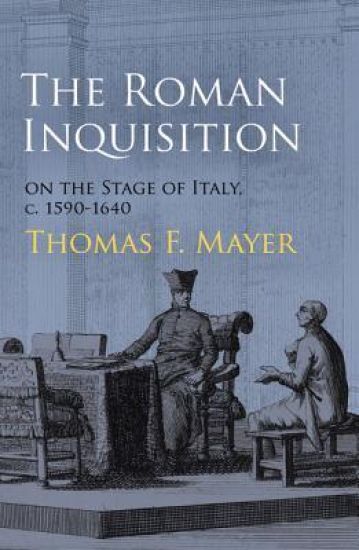
The Roman Inquisition on the Stage of Italy, C. 1590-1640

The Roman Inquisition on the Stage of Italy, C. 1590-1640

Thomas F. Mayer

University of Pennsylvania Press
2014
sidottu
From the moment of its founding in 1542, the Roman Inquisition acted as a political machine. Although inquisitors in earlier centuries had operated somewhat independently of papal authority, the gradual bureaucratization of the Roman Inquisition permitted the popes increasing license to establish and exercise direct control over local tribunals, though with varying degrees of success. In particular, Pope Urban VIII's aggressive drive to establish papal control through the agency of the Inquisition played out differently among the Italian states, whose local inquisitions varied in number and secular power. Rome's efforts to bring the Venetians to heel largely failed in spite of the interdict of 1606, and Venice maintained lay control of most religious matters. Although Florence and Naples resisted papal intrusions into their jurisdictions, on the other hand, they were eventually brought to answer directly to Rome-due in no small part to Urban VIII's subversions of the law. Thomas F. Mayer provides a richly detailed account of the ways the Roman Inquisition operated to serve the papacy's long-standing political aims in Naples, Venice, and Florence. Drawing on the Inquisition's own records, diplomatic correspondence, local documents, newsletters, and other sources, Mayer sheds new light on papal interdicts and high-profile court cases that signaled significant shifts in inquisitorial authority for each Italian state. Alongside his earlier volume, The Roman Inquisition: A Papal Bureaucracy and Its Laws in the Age of Galileo, this masterful study extends and develops our understanding of the Inquisition as a political and legal institution.
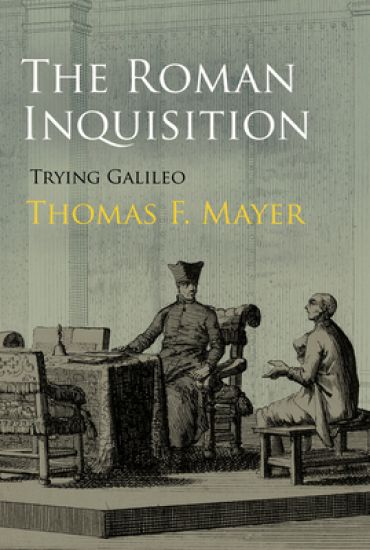
The Roman Inquisition

The Roman Inquisition

Thomas F. Mayer

University of Pennsylvania Press
2015
sidottu
Few legal events loom as large in early modern history as the trial of Galileo. Frequently cast as a heroic scientist martyred to religion or as a scapegoat of papal politics, Galileo undoubtedly stood at a watershed moment in the political maneuvering of a powerful church. But to fully understand how and why Galileo came to be condemned by the papal courts-and what role he played in his own downfall-it is necessary to examine the trial within the context of inquisitorial law. With this final installment in his magisterial trilogy on the seventeenth-century Roman Inquisition, Thomas F. Mayer has provided the first comprehensive study of the legal proceedings against Galileo. By the time of the trial, the Roman Inquisition had become an extensive corporatized body with direct authority over local courts and decades of documented jurisprudence. Drawing deeply from those legal archives as well as correspondence and other printed material, Mayer has traced the legal procedure from Galileo's first precept in 1616 to his formal trial in 1633. With an astonishing mastery of the legal underpinnings and bureaucratic workings of inquisitorial law, Mayer's work compares the course of legal events to other possible outcomes within due process, showing where the trial departed from standard procedure as well as what available recourse Galileo had to shift its direction. The Roman Inquisition: Trying Galileo presents a detailed and corrective reconstruction of the actions both in the courtroom and behind the scenes that led to one of history's most notorious verdicts.
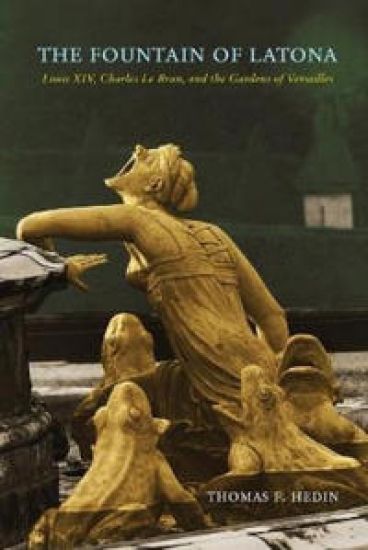
The Fountain of Latona

The Fountain of Latona

Thomas F. Hedin

UNIVERSITY OF PENNSYLVANIA PRESS
2022
sidottu
Ovid tells the story of Latona, the mother by Jupiter of Apollo and Diana. In her flight from the jealous Juno, she arrives faint and parched on the coast of Asia Minor. Kneeling to sip from a pond, Latona is met by the local peasants, who not only deny her effort but muddy the water in pure malice. Enraged, Latona calls a curse down upon the stingy peasants, turning them to frogs. In his masterful study, Thomas F. Hedin reveals how and why a fountain of this strange legend was installed in the heart of Versailles in the 1660s, the inaugural decade of Louis XIV's patronage there. The natural supply of water was scarce and unwieldy, and it took the genius of the king's hydraulic engineers, working in partnership with the landscape architect André Le Nôtre, to exploit it. If Ovid's peasants were punished for their stubborn denial of water, so too the obstacles of coarse nature at Versailles were conquered; the aquatic iconography of the fountain was equivalent to the aquatic reality of the gardens. Latona was designed by Charles Le Brun, the most powerful artist at the court of Louis XIV, and carried out by Gaspard and Balthazar Marsy. The 1660s were rich in artistic theory in France, and the artists of the fountain delivered substantial lectures at the Académie royale de peinture et de sculpture on subjects of central concern to their current work. What they professed was what they were visualizing in the gardens. As such, the fountain is an insider's guide to the leading artistic ideals of the moment. Louis XIV was viewed as the reincarnation of Apollo, the god of creativity, the inspiration of artists and scientists. Hedin's original argument is that Latona was a double declaration: a glorification of the king and a proud manifesto by artists.
Carnival and National Identity in the Poetry of Afrocubanismo

Carnival and National Identity in the Poetry of Afrocubanismo

Thomas F. Anderson

University Press of Florida
2017
nidottu
The poetry associated with Afrocubanismo has been of great interest to academics since the movement began in the late 1920s. Thomas Anderson’s detailed analysis infuses new life into the study of these remarkable works. Focusing on the representations of carnival and its comparsas (carnival bands and music), Carnival and National Identity in the Poetry of Afrocubanismo offers thought-provoking new readings of poems by seminal Cuban poets, demonstrating how their writings on and about these traditions both contributed to and detracted from the development of a recognizable Afro-Cuban identity.This volume is the first to examine, from a literary perspective, the long-running debate between the proponents of Afro-Cuban cultural manifestations and the predominantly white Cuban intelligentsia who viewed these traditions as “backward” and counter to the interests of the young Republic. Including analyses of the work of Felipe Pichardo Moya, Alejo Carpentier, Nicolás Guillén, Emilio Ballagas, José Zacarías Tallet, Felix B. Caignet, Marcelino Arozarena, and Alfonso Camín, this rigorous, interdisciplinary volume offers a fresh look at the canon of Afrocubanismo and offers surprising insights into Cuban culture during the early years of the Republic.
The Status of the Church in American Civil Law and Canon Law

The Status of the Church in American Civil Law and Canon Law

Thomas F. Donovan

The Catholic University of America Press
2015
sidottu
CUA Press is proud to announce the CUA Studies in Canon Law. In conjunction with the School of Canon Law of the Catholic University of America, we are making available, both digitally and in print, more than 400 canon law dissertations from the 1920s - 1960s, many of which have long been unavailable. These volumes are rich in historical content, yet remain relevant to canon lawyers today. Topics covered include such issues as abortion, excommunication, and infertility. Several studies are devoted to marriage and the annulment process; the acquiring and disposal of church property, including the union of parishes; the role and function of priests, vicars general, bishops, and cardinals; and juridical procedures within the church. For those who seek to understand current ecclesial practices in light of established canon law, these books will be an invaluable resource.
Hard Sayings

Hard Sayings

Thomas F Haddox

Ohio State University Press
2020
pokkari
Hard Sayings: The Rhetoric of Christian Orthodoxy in Late Modern Fiction by Thomas F. Haddox examines the work of six avowedly Christian writers of fiction in the period from World War II to the present. This period is often characterized in western societies by such catchphrases as "postmodernism" and "secularization," with the frequent implication that orthodox belief in the dogmas of Christianity has become untenable among educated readers. How, then, do we account for the continued existence of writers of self-consciously literary fiction who attempt to persuade readers of the truth, desirability, and utility of the dogmas of Christianity? Is it possible to take these writers' efforts on their own terms and to understand and evaluate the rhetorical strategies that this kind of persuasion might entail? Informed by the school of rhetorical narratology that includes such critics as Wayne Booth, James Phelan, and Richard Walsh, Hard Sayings offers fresh new readings of fictive works by Flannery O'Connor, Muriel Spark, John Updike, Walker Percy, Mary Gordon, and Marilynne Robinson. In its argument that orthodox Christianity, as represented in fiction, still has the power to persuade and to trouble, it contributes to ongoing debates about the nature and scope of modernity, postmodernity, and secularization.
The Transition of Finance in Japan and the United States

The Transition of Finance in Japan and the United States

Thomas F. Cargill; Shoichi Royama

Hoover Institution Press,U.S.
1988
nidottu
This book discusses the transition of finance and money in Japan and the United States from the 1970s through the first few months of 1987. The similarities are noted here, but the differences are emphasized. The financial changes that have occurred in both countries are particularly important today and deserve close study on the basis of the size of the two economies and their impact on world markets, their relative macroeconomic performance since 1975, and the role financial issues have come to play in proposals dealing with the massive trade imbalances that emerged after 1980.