

Kirjahaku
Etsi kirjoja tekijän nimen, kirjan nimen tai ISBN:n perusteella.
1000 tulosta hakusanalla Timothy C Davis
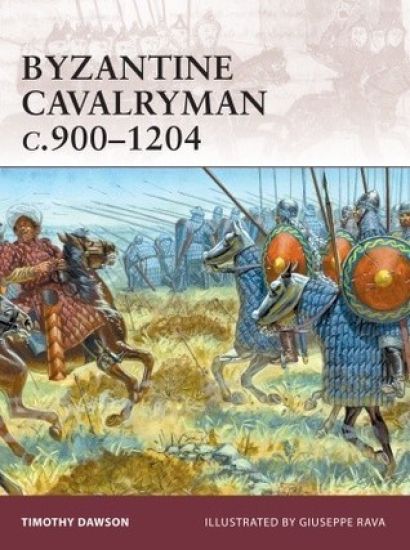
Regarded as the elite arm of the military during the Middle Byzantine period, the cavalry executed high speed reconnaissance, agile arrow barrages and crippling blows to enemy formations. Its ranks were filled primarily through direct recruitment or hereditary service by holders of military lands, but in times of crisis irregulars would be temporarily enlisted. Few books provide any accessible study of the medieval Romaic soldier's life, and this colourful addition to the Warrior series seeks to redress this imbalance. Offering a thorough and detailed examination of their training, weaponry, dress and daily life, this book re-affirms the importance of cavalry troops in military victories of the period. Making use of original Greek source material, and featuring unpublished manuscript images, this follow-on volume to "Warrior 118 Byzantine Infantryman c.900-1204" brings the world of the Byzantine cavalryman vividly to life.

Thomas Oden provides a modern commentary on the pastoral letters grounded in the classical, consensual tradition of interpretation. Oden uses the best and most accurate research concerning the historical, literary, and philological aspects of the pastoral letters. He addresses tough issues: the role of women in worship, problems of the rich and poor, the relation between servants and masters, policies concerning support of elderly widows, and how to handle church disruptions.

Thomas Oden provides a modern commentary on the pastoral letters grounded in the classical, consensual tradition of interpretation. Oden utilizes the best and most accurate research concerning the historical, literary, and philological aspects of the pastoral letters. He addresses tough issues: the role of women in worship, problems of the rich and poor, the relation between servants and masters, policies concerning support of elderly widows, and how to handle church disruptions.Interpretation: A Bible Commentary for Teaching and Preaching is a distinctive resource for those who interpret the Bible in the church. Planned and written specifically for teaching and preaching needs, this critically acclaimed biblical commentary is a major contribution to scholarship and ministry.
Discover hidden relationships among the variables in your data, and learn how to exploit these relationships. This book presents a collection of data-mining algorithms that are effective in a wide variety of prediction and classification applications. All algorithms include an intuitive explanation of operation, essential equations, references to more rigorous theory, and commented C++ source code.Many of these techniques are recent developments, still not in widespread use. Others are standard algorithms given a fresh look. In every case, the focus is on practical applicability, with all code written in such a way that it can easily be included into any program. The Windows-based DATAMINE program lets you experiment with the techniques before incorporating them into your own work.What You'll LearnUse Monte-Carlo permutation tests to provide statistically sound assessments of relationships present in your dataDiscover how combinatorially symmetric cross validation reveals whether your model has true power or has just learned noise by overfitting the dataWork with feature weighting as regularized energy-based learning to rank variables according to their predictive power when there is too little data for traditional methodsSee how the eigenstructure of a dataset enables clustering of variables into groups that exist only within meaningful subspaces of the dataPlot regions of the variable space where there is disagreement between marginal and actual densities, or where contribution to mutual information is highWho This Book Is ForAnyone interested in discovering and exploiting relationships among variables. Although all code examples are written in C++, the algorithms are described in sufficient detail that they can easily be programmed in any language.
Discover the essential building blocks of the most common forms of deep belief networks. At each step this book provides intuitive motivation, a summary of the most important equations relevant to the topic, and concludes with highly commented code for threaded computation on modern CPUs as well as massive parallel processing on computers with CUDA-capable video display cards. The first of three in a series on C++ and CUDA C deep learning and belief nets, Deep Belief Nets in C++ and CUDA C: Volume 1 shows you how the structure of these elegant models is much closer to that of human brains than traditional neural networks; they have a thought process that is capable of learning abstract concepts built from simpler primitives. As such, you’ll see that a typical deep belief net can learn to recognize complex patterns by optimizing millions of parameters, yet this model can still be resistant to overfitting. All theroutines and algorithms presented in the book are available in the code download, which also contains some libraries of related routines. What You Will LearnEmploy deep learning using C++ and CUDA CWork with supervised feedforward networks Implement restricted Boltzmann machines Use generative samplingsDiscover why these are importantWho This Book Is ForThose who have at least a basic knowledge of neural networks and some prior programming experience, although some C++ and CUDA C is recommended.
Discover the essential building blocks of a common and powerful form of deep belief net: the autoencoder. You’ll take this topic beyond current usage by extending it to the complex domain for signal and image processing applications. Deep Belief Nets in C++ and CUDA C: Volume 2 also covers several algorithms for preprocessing time series and image data. These algorithms focus on the creation of complex-domain predictors that are suitable for input to a complex-domain autoencoder. Finally, you’ll learn a method for embedding class information in the input layer of a restricted Boltzmann machine. This facilitates generative display of samples from individual classes rather than the entire data distribution. The ability to see the features that the model has learned for each class separately can be invaluable. At each step this book provides you with intuitive motivation, a summary of the most important equations relevant to the topic, and highly commented code for threaded computation on modern CPUs as well as massive parallel processing on computers with CUDA-capable video display cards. What You'll LearnCode for deep learning, neural networks, and AI using C++ and CUDA CCarry out signal preprocessing using simple transformations, Fourier transforms, Morlet wavelets, and moreUse the Fourier Transform for image preprocessingImplement autoencoding via activation in the complex domainWork with algorithms for CUDA gradient computationUse the DEEP operating manualWho This Book Is ForThose who have at least a basic knowledge of neural networks and some prior programming experience, although some C++ and CUDA C is recommended.
Discover the essential building blocks of a common and powerful form of deep belief network: convolutional nets. This book shows you how the structure of these elegant models is much closer to that of human brains than traditional neural networks; they have a ‘thought process’ that is capable of learning abstract concepts built from simpler primitives. These models are especially useful for image processing applications. At each step Deep Belief Nets in C++ and CUDA C: Volume 3 presents intuitive motivation, a summary of the most important equations relevant to the topic, and concludes with highly commented code for threaded computation on modern CPUs as well as massive parallel processing on computers with CUDA-capable video display cards. Source code for all routines presented in the book, and the executable CONVNET program which implements these algorithms, are available for free download.What You Will LearnDiscover convolutional nets and how to use themBuild deep feedforward nets using locally connected layers, pooling layers, and softmax outputsMaster the various programming algorithms requiredCarry out multi-threaded gradient computations and memory allocations for this threadingWork with CUDA code implementations of all core computations, including layer activations and gradient calculationsMake use of the CONVNET program and manual to explore convolutional nets and case studiesWho This Book Is ForThose who have at least a basic knowledge of neural networks and some prior programming experience, although some C++ and CUDA C is recommended.
Discover a variety of data-mining algorithms that are useful for selecting small sets of important features from among unwieldy masses of candidates, or extracting useful features from measured variables. As a serious data miner you will often be faced with thousands of candidate features for your prediction or classification application, with most of the features being of little or no value. You’ll know that many of these features may be useful only in combination with certain other features while being practically worthless alone or in combination with most others. Some features may have enormous predictive power, but only within a small, specialized area of the feature space. The problems that plague modern data miners are endless. This book helps you solve this problem by presenting modern feature selection techniques and the code to implement them. Some of these techniques are:Forward selection component analysisLocal feature selectionLinking features and a target with a hidden Markov modelImprovements on traditional stepwise selectionNominal-to-ordinal conversion All algorithms are intuitively justified and supported by the relevant equations and explanatory material. The author also presents and explains complete, highly commented source code. The example code is in C++ and CUDA C but Python or other code can be substituted; the algorithm is important, not the code that's used to write it. What You Will Learn Combine principal component analysis with forward and backward stepwise selection to identify a compact subset of a large collection of variables that captures the maximum possible variation within the entire set.Identify features that may have predictive power over only a small subset of the feature domain. Such features can be profitably used by modern predictive models but may be missed by other feature selection methods.Find an underlying hidden Markov model that controls the distributions of feature variables and the target simultaneously. The memory inherent in this method is especially valuable in high-noise applications such as prediction of financial markets.Improve traditional stepwise selection in three ways: examine a collection of 'best-so-far' feature sets; test candidate features for inclusion with cross validation to automatically and effectively limit model complexity; and at each step estimate the probability that our results so far could be just the product of random good luck. We also estimate the probability that the improvement obtained by adding a new variable could have been just good luck. Take a potentially valuable nominal variable (a category or class membership) that is unsuitable for input to a prediction model, and assign to each category a sensible numeric value that can be used as a model input. Who This Book Is For Intermediate to advanced data science programmers and analysts.

Timothy Diamond's latest epic takes us into the realm of deep space, as he turns his hand to science fiction.Where we will follow the captain and crew of the battle Space Cruiser Defiant through war and peace.

The first volume chronologically in a new multi-volume History of Germany, Timothy Reuter's book is the first full-scale survey to appear in English for nearly fifty years of this formative period of German history -- the period in which Germany itself, and many of its internal divisions and characteristics, were created and defined. Filling an important gap, the book is itself a formidable scholarly achievement.

An Exegetical Summary of 1 Timothy
Richard C Blight
Sil International, Global Publishing
2009
pokkari

Discipling America: A Study of I Timothy
David C. Rogers
Createspace Independent Publishing Platform
2018
nidottu
There is a desperate need for disciples in today's modern world. 1 Timothy provides a guide book to follow for every person who calls Jesus Christ, Lord. While many see 1 Timothy as the pastoral book, the teachings found within it illustrate the character that a disciple of Jesus should have. Therefore, the encouragement and instruction found in 1 Timothy is for all who strive to be true disciples. We all are called to a ministry, and we all have a mission.

The first volume chronologically in a new multi-volume History of Germany, Timothy Reuter's book is the first full-scale survey to appear in English for nearly fifty years of this formative period of German history -- the period in which Germany itself, and many of its internal divisions and characteristics, were created and defined. Filling an important gap, the book is itself a formidable scholarly achievement.
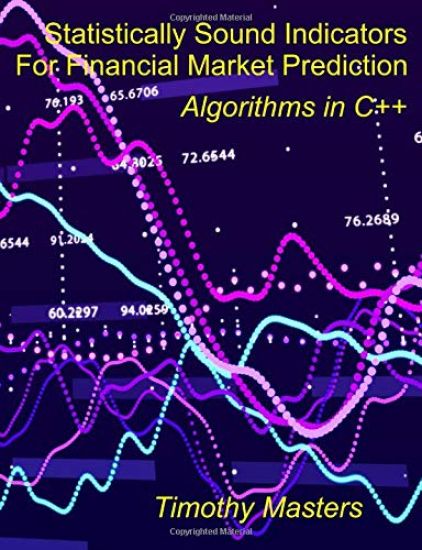
Statistically Sound Indicators For Financial Market Prediction: Algorithms in C++
Timothy Masters
Independently Published
2019
nidottu
NEWS FLASH... This book was just awarded "Book of the Year" by The Technical Analyst In my decades of professional experience as a statistical consultant in the field of financial market trading, the single most important lesson that I've learned about trading is this: the quality of the indicators is vastly more important than the quality of the trading algorithm or predictive model. If you are sloppy about your indicator computation, no high-tech model or algorithm is going to bail you out. Garbage in, garbage out still rules.This book presents numerous traditional and modern indicators that have been shown to carry significant predictive information. But it will do far more than just that. In addition to a wealth of useful indicators, you will see the following issues discussed: There are simple tests that let you measure the potential information-carrying capacity of an indicator. If your proposed indicator fails this information-capacity test, you should consider revising it. This book describes simple transformations that raise the information-carrying capacity of your indicators and make them more useful for algorithmic trading. You will learn how to locate the regions in your indicator's domain where maximum predictive power occurs so that you can focus on these important values. You will learn how to compute statistically sound probabilities to help you decide whether the performance of an indicator is legitimate or just the product of random good luck. Most traditional indicators examine one market at a time. But you will learn how examining pairs of markets, or even large collections of markets simultaneously, can provide valuable indicators that quantify complex inter-market relationships. Govinda Khalsa devised a powerful indicator called the Follow-Through Index which reveals how likely it is that an existing trend will continue. This indicator is extremely useful to trend-following traders, but due to its complexity it is not widely employed. This book presents its essential theory and implementation in C++. Gary Anderson developed a detailed and profound theory of market behavior that he calls The JANUS Factor. This theory enables computation of several powerful indicators that tell us, among other things, when trading opportunities are most likely to be profitable and when we should stay out of the market. This book provides the fundamental theory behind The JANUS Factor along with extensive C++ code.Whether you compute a few indicators and trade by watching their plots on a computer screen, or do simple automated algorithmic trading, or employ sophisticated predictive models, this book provides tools that help you take your trading to a higher, more profitable level.
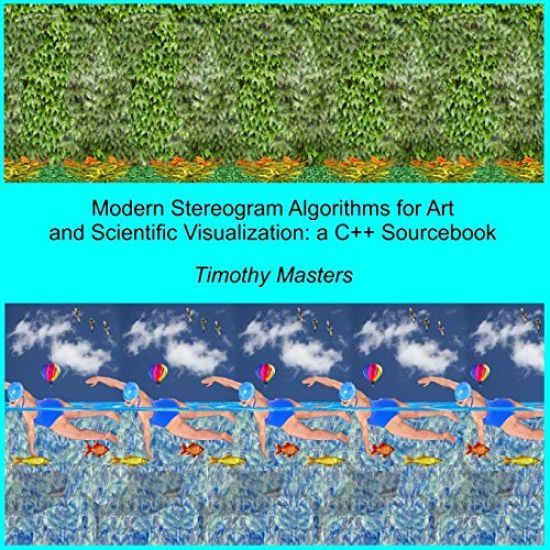
Modern Stereogram Algorithms for Art and Scientific Visualization: A C++ Sourcebook
Timothy Masters
Createspace Independent Publishing Platform
2018
nidottu
Imagine looking at a picture on a printed page or computer screen, adjusting your eyes in a manner that most people can learn easily, and suddenly having objects pop out at you in vivid 3D. Many people have already experienced this with the Magic Eye and related posters that were massively popular in the 90's. But what is not so well known is that this single-image stereogram technology has come a long way since those early days. The big breakthrough came when algorithms were discovered that could map textures onto the surface of single-image stereograms. I believe this is the only available book that delves deeply into stereogram algorithms, including highly documented C++ source code. These algorithms can be used to great effect by artists to create works of art that are far beyond the crude stereograms of yesteryear. Perhaps even more importantly, the ability to display depth maps in clear stereo using only a single printed image can be invaluable for scientific presentations. This book is an essential resource for anyone writing programs for stereogram generation.

The Dialogues of Athanasius and Zacchaeus and of Timothy and Aquila
Frederick C. Conybeare
Hansebooks
2018
nidottu

Hepatitis A, B and C Viruses in Viral Hepatitis
Timothy Waje
LAP Lambert Academic Publishing
2019
pokkari

Blood Lies: The Evidence That Every Accusation Against Joseph Stalin and the Soviet Union in Timothy Snyder's Bloodlands Is False
Grover C. Furr
Red Star Publishers
2014
nidottu