Kirjojen hintavertailu. Mukana 12 083 983 kirjaa ja 12 kauppaa.

Kirjahaku

Etsi kirjoja tekijän nimen, kirjan nimen tai ISBN:n perusteella.

1000 tulosta hakusanalla Walter Benjamin

Die Bildwelt in Walter Benjamins Kafka-Lekture
Die Bildwelt in Walter Benjamins Kafka-Lekture illuminates Benjamin's enigmatic 'image world', and reveals why he sees hope in such Kafkaesque figures as "the unfinished and the bunglers". The study delves into the connections between linguistic and material images, such as portrait, Chinese and expressionist paintings, and films in Benjamin's Kafka-complex.
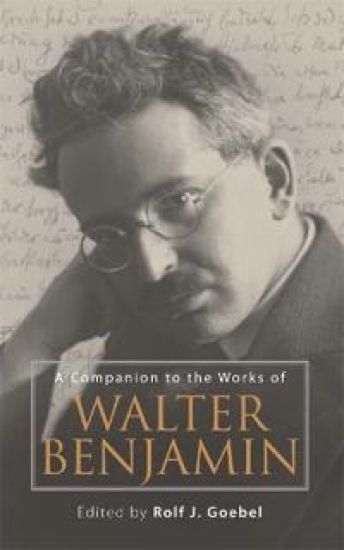
A Companion to the Works of Walter Benjamin
An advanced introduction to Benjamin's work and its actualization for our own times. Walter Benjamin (1892-1940) has emerged as one of the leading cultural critics of the twentieth century. His work encompasses aesthetics, metaphysical language and narrative theories, German literary history, philosophies of history, the intersection of Marxism and Messianic thought, urban topography, and the development of photography and film. Benjamin defined the task of the critic as one that blasts endangered moments of the past out of the continuum of history so that they attain new significance. This volume of new essays employs this principle of actualization as its methodological program in offering a new advanced introduction to Benjamin's own work. The essays analyze Benjamin's central texts, themes, terminologies, and genres in their original contexts while simultaneously situating them in new parameters, such as contemporary media, memory culture, constructions of gender, postcoloniality, and theories of urban topographies. The Companion brings together an international group of established and emerging scholars to explicate Benjamin's actuality from a multidisciplinary perspective. Designed for audiences interested in literary criticism, cultural studies, and neighboring disciplines, the volume serves as a stimulus for new debates about Benjamin's intellectual legacy today. Contributors: Wolfgang Bock, Willi Bolle, Dianne Chisholm, Adrian Daub, Dominik Finkelde, Eric Jarosinski, Lutz Koepnick, Vivian Liska, Karl Ivan Solibakke, Marc de Wilde, Bernd Witte Rolf J. Goebel is Distinguished Professor of German and Chair of the Department of WorldLanguages and Cultures at the University of Alabama in Huntsville.
A Companion to the Works of Walter Benjamin
An advanced introduction to Benjamin's work and its actualization for our own times. Walter Benjamin (1892-1940) has emerged as one of the leading cultural critics of the twentieth century. His work encompasses aesthetics, metaphysical language and narrative theories, German literary history, philosophies of history, the intersection of Marxism and Messianic thought, urban topography, and the development of photography and film. Benjamin defined the task of the critic as one that blasts endangered moments of the past out of the continuum of history so that they attain new significance. This volume of new essays employs this principle of actualization as its methodological program in offering a new advanced introduction to Benjamin's own work. The essays analyze Benjamin's central texts, themes, terminologies, and genres in their original contexts while simultaneously situating them in new parameters, such as contemporary media, memory culture, constructions of gender, postcoloniality, and theories of urban topographies. The Companion brings together an international group of established and emerging scholars to explicate Benjamin's actuality from a multidisciplinary perspective. Designed for audiences interested in literary criticism, cultural studies, and neighboring disciplines, the volume serves as a stimulus for new debates about Benjamin's intellectual legacy today. Contributors: Wolfgang Bock, Willi Bolle, Dianne Chisholm, Adrian Daub, Dominik Finkelde, Eric Jarosinski, Lutz Koepnick, Vivian Liska, Karl Ivan Solibakke, Marc de Wilde, Bernd Witte Rolf J. Goebel is Distinguished Professor of German and Chair of the Department of WorldLanguages and Cultures at the University of Alabama in Huntsville.
Utopia from Thomas More to Walter Benjamin

Utopia from Thomas More to Walter Benjamin

Miguel Abensour

Univocal Publishing LLC
2017
nidottu
Utopia poses a question. Not simply in the sense of a problem to be resolved and at the same time eliminated . . . but in the sense that, within the economy of the human condition, utopia, the aim of social alterity-of all social otherness-is ceaselessly being reborn, coming back to life despite all the blows rained down upon it, as if human resistance had taken up residence within it. For the French philosopher Miguel Abensour, the fictional genre of utopia has provided thinkers and artists a fertile ground to explore for the past 500 years, both as a way to imagine new emancipatory practices of shared existence and as a tyrannical imposition of power. Here, Abensours project is to examine the idea of utopia in two different but powerful moments in its trajectory: first, utopias beginning, when Thomas More sought a path for justice through a world in transformation, and second, when utopia faced its greatest danger, the moment that Walter Benjamin called catastrophe.
City and Modernity in Georg Simmel and Walter Benjamin

City and Modernity in Georg Simmel and Walter Benjamin

Vincenzo Mele

Springer International Publishing AG
2023
sidottu
This book reconstructs and compares the social theories of modernity of Georg Simmel and Walter Benjamin, two classic thinkers in German social thought. The author focuses on five main topics: the historical-sociological method through which they investigate modernity; how are the concepts of history and society possible; the consequences of modern metropolis on the construction of individual subjectivity; the aestheticization of everyday life caused by the expansion of commodity culture; and the female culture as a counter-power to the domination of masculine objective culture. In the decades since Simmel and Benjamin, urban reality has undergone profound changes and we may even question the very existence of the subject of analysis: what is the city, the metropolis in today’s context of globalization and capital flows? Simmel’s and Benjamin’s metropolis has thus become an “endless city," beyond the physical and geographical confines of urban reality.
City and Modernity in Georg Simmel and Walter Benjamin
This book reconstructs and compares the social theories of modernity of Georg Simmel and Walter Benjamin, two classic thinkers in German social thought. The author focuses on five main topics: the historical-sociological method through which they investigate modernity; how are the concepts of history and society possible; the consequences of modern metropolis on the construction of individual subjectivity; the aestheticization of everyday life caused by the expansion of commodity culture; and the female culture as a counter-power to the domination of masculine objective culture. In the decades since Simmel and Benjamin, urban reality has undergone profound changes and we may even question the very existence of the subject of analysis: what is the city, the metropolis in today's context of globalization and capital flows? Simmel's and Benjamin's metropolis has thus become an "endless city," beyond the physical and geographical confines of urban reality.
Die Fotografietheorien von Roland Barthes und Walter Benjamin in Bezug auf die Werke Andreas Gurskys
Studienarbeit aus dem Jahr 2021 im Fachbereich Germanistik - Neuere Deutsche Literatur, Note: 1,3, Ruhr-Universit t Bochum, Sprache: Deutsch, Abstract: Lesen Sie in dieser Arbeit etwas ber den Vergleich von Roland Barthes' Werk und der Fotografietheorie von Walter Benjamin. Dem Vergleich folgt in dieser Arbeit direkt eine Bezugnahme der Inhalte der beiden Werke auf die Arbeiten von Andreas Gursky, einem Fotok nstler unserer Zeit. Roland Barthes ist ein besonderer Autor. Bereits 1980 verstorben, hinterl sst er ein umfangreiches literarisches Werk, welches noch in der heutigen Zeit rezipiert und analysiert wird. Mit seinem Werk "Die helle Kammer" lenkt Barthes den Blick auf einen elementaren Bestandteil unserer heutigen Medien- und Informationswelt. Die Flut der Bilder, die Entwicklung der Fotografie und die Wirkungsmacht von Fotografien bilden f r ihn den Gegenstand dieses Werkes.
Der Begriff der Ästhetisierung der Politik bei Walter Benjamin

Der Begriff der Ästhetisierung der Politik bei Walter Benjamin

Gabriel Do Nascimento Vieira

Verlag Unser Wissen
2023
pokkari
Dieses Buch verortet seine berlegungen mit gr erem Nachdruck in der zweiten Periode von Walter Benjamins philosophischem Werdegang, einer Phase, in der sich seine Schriften st rker in den Dienst des politischen Engagements stellen. Wir versuchen, den Weg seiner Analyse der sthetisierung der Politik und der Politisierung der Kunst in seiner sthetischen Theorie aufzuzeigen. Dabei geht es darum, sich nicht nur mit den Skandalen zu begn gen, die die sthetisierung der Politik und des Lebens in den kapitalistischen Industriel ndern hervorgerufen hat, sondern auch einen Blick auf die M glichkeiten der Emanzipation des Einzelnen zu werfen. Der eingeschlagene Weg beinhaltet eine Reflexion ber die Philosophie von W. Benjamin und eine Analyse des Prozesses der Zerst rung der Aura der K nste, den er in seinem Essay Das Kunstwerk im Zeitalter seiner technischen Reproduzierbarkeit von 1936 beschreibt. Walter Benjamin, der in einer Zeit lebt, in der die Barbarei des Krieges und der politische Totalitarismus herrschen, versucht in seiner Analyse eine dialektische Perspektive aufzuzeigen, um eine revolution re Intervention der politisierten Massen durch das Kino, das epische Theater und die weithin reproduzierte Avantgardekunst zu wecken. Es geht auch darum, das Vorherrschen der sthetisierung der Politik aufzuzeigen, die in der starken Einmischung der Medien verankert ist.
The concept of aestheticisation of politics in Walter Benjamin

The concept of aestheticisation of politics in Walter Benjamin

Gabriel Do Nascimento Vieira

Our Knowledge Publishing
2023
pokkari
This book situates his reflections with greater emphasis on the second period of Walter Benjamin's philosophical trajectory, a phase in which his writings place themselves more incisively at the service of political engagement. We seek to highlight the path of his analysis of the aestheticisation of politics and the politicisation of art in his aesthetic theory. The intention is not to be satisfied only with the scandals that the aestheticisation of politics and life have caused in industrialised capitalist countries, but to glimpse the possibilities of emancipation of individuals. The path followed involves a reflection on the philosophy of W. Benjamin and an analysis of the process of destruction of the aura of the arts described in his essay The Work of Art in the Age of Its Technical Reproducibility of 1936. Living in a time where the barbarism of war and political totalitarianism reigns, Walter Benjamin seeks to print, in his analysis, a dialectical perspective in order to arouse a revolutionary intervention of the politicised masses through cinema and epic theatre and widely reproduced avant-garde art. It also aims to demonstrate the prevalence of the aestheticisation of politics anchored in the strong interference of the media.