Kirjojen hintavertailu. Mukana 11 717 486 kirjaa ja 12 kauppaa.

Kirjahaku

Etsi kirjoja tekijän nimen, kirjan nimen tai ISBN:n perusteella.

1000 tulosta hakusanalla William G. Cook

Coping with a Picky Eater

Coping with a Picky Eater

William G. Wilkoff

Touchstone
1998
pokkari
End the Food Wars! Do you feel as if you're running a restaurant instead of cooking dinner for a family? Are you tired of dumping plates of uneaten food in the garbage? Then you must read Coping with a Picky Eater. This fresh, practical, and realistic guide explains to parents how they can avoid mealtime battles with kids aged one to six years, using sensible strategies that will establish a lifetime of healthful eating habits. With cases ranging from the toddler who eats only peanut butter and jelly on white bread to the six-year-old who insists on scrambled eggs and cheese at every meal, pediatrician William G. Wilkoff, M.D., has been counseling picky eaters and their concerned parents for more than twenty years. Debunking common myths and soothing parents' fears, Dr. Wilkoff covers such practical matters as: providing appropriate nutritional guidelines for youngsters one to six, including serving sizes; dealing with nutritional saboteurs -- from indulgent grandparents to accommodating (or impatient) caregivers; resisting the temptation to "whip up" special orders that disrupt family meals and give the picky eater control over the family dynamic. Dr. Wilkoff shows that by establishing reasonable rules when children are young, parents can not only eliminate daily fights about food, but also reduce the possibility of eating disorders later in life.
Cherokee Renascence in the New Republic

Cherokee Renascence in the New Republic

William G. McLoughlin

Princeton University Press
1992
pokkari
The Cherokees, the most important tribe in the formative years of the American Republic, became the test case for the Founding Fathers' determination to Christianize and "civilize" all Indians and to incorporate them into the republic as full citizens. From the standpoint of the Cherokees, rather than from that of the white policymakers, William McLoughlin tells the dramatic success story of the "renascence" of the tribe. He goes on to give a full account of how the Cherokees eventually fell before the expansionism of white America and the zeal of Andrew Jackson.
Socializing Capital

Socializing Capital

William G. Roy

Princeton University Press
1999
pokkari
Ever since Adolph Berle and Gardiner Means wrote their classic 1932 analysis of the American corporation, The Modern Corporation and Private Property, social scientists have been intrigued and challenged by the evolution of this crucial part of American social and economic life. Here William Roy conducts a historical inquiry into the rise of the large publicly traded American corporation. Departing from the received wisdom, which sees the big, vertically integrated corporation as the result of technological development and market growth that required greater efficiency in larger scale firms, Roy focuses on political, social, and institutional processes governed by the dynamics of power. The author shows how the corporation started as a quasi-public device used by governments to create and administer public services like turnpikes and canals and then how it germinated within a system of stock markets, brokerage houses, and investment banks into a mechanism for the organization of railroads. Finally, and most particularly, he analyzes its flowering into the realm of manufacturing, when at the turn of this century, many of the same giants that still dominate the American economic landscape were created. Thus, the corporation altered manufacturing entities so that they were each owned by many people instead of by single individuals as had previously been the case.
The Shape of the River

The Shape of the River

William G. Bowen; Derek Bok; Glenn C. Loury

Princeton University Press
2000
pokkari
This is the book that has forever changed the debate on affirmative action in America. The Shape of the River is the most far-reaching and comprehensive study of its kind. It brings a wealth of empirical evidence to bear on how race-sensitive admissions policies actually work and clearly defines the effects they have had on over 45,000 students of different races. Its conclusions mark a turning point in national discussions of affirmative action--anything less than factual evidence will no longer suffice in any serious debate of this vital question. Glenn Loury's new foreword revisits the basic logic behind race-sensitive policies, asserting that since individuals use race to conceptualize themselves, we must be conscious of race as we try to create rules for a just society. Loury underscores the need for confronting opinion with fact so we can better see the distinction between the "morality of color-blindness" and the "morality of racial justice."
Power without Persuasion

Power without Persuasion

William G. Howell

Princeton University Press
2003
pokkari
Since the early 1960s, scholarly thinking on the power of U.S. presidents has rested on these words: "Presidential power is the power to persuade." Power, in this formulation, is strictly about bargaining and convincing other political actors to do things the president cannot accomplish alone. Power without Persuasion argues otherwise. Focusing on presidents' ability to act unilaterally, William Howell provides the most theoretically substantial and far-reaching reevaluation of presidential power in many years. He argues that presidents regularly set public policies over vocal objections by Congress, interest groups, and the bureaucracy. Throughout U.S. history, going back to the Louisiana Purchase and the Emancipation Proclamation, presidents have set landmark policies on their own. More recently, Roosevelt interned Japanese Americans during World War II, Kennedy established the Peace Corps, Johnson got affirmative action underway, Reagan greatly expanded the president's powers of regulatory review, and Clinton extended protections to millions of acres of public lands. Since September 11, Bush has created a new cabinet post and constructed a parallel judicial system to try suspected terrorists. Howell not only presents numerous new empirical findings but goes well beyond the theoretical scope of previous studies. Drawing richly on game theory and the new institutionalism, he examines the political conditions under which presidents can change policy without congressional or judicial consent. Clearly written, Power without Persuasion asserts a compelling new formulation of presidential power, one whose implications will resound.
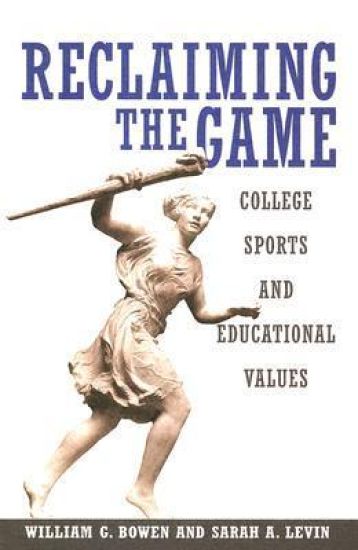
Reclaiming the Game

Reclaiming the Game

William G. Bowen; Sarah A. Levin

Princeton University Press
2005
pokkari
In Reclaiming the Game, William Bowen and Sarah Levin disentangle the admissions and academic experiences of recruited athletes, walk-on athletes, and other students. In a field overwhelmed by reliance on anecdotes, the factual findings are striking--and sobering. Anyone seriously concerned about higher education will find it hard to wish away the evidence that athletic recruitment is problematic even at those schools that do not offer athletic scholarships. Thanks to an expansion of the College and Beyond database that resulted in the highly influential studies The Shape of the River and The Game of Life, the authors are able to analyze in great detail the backgrounds, academic qualifications, and college outcomes of athletes and their classmates at thirty-three academically selective colleges and universities that do not offer athletic scholarships. They show that recruited athletes at these schools are as much as four times more likely to gain admission than are other applicants with similar academic credentials. The data also demonstrate that the typical recruit is substantially more likely to end up in the bottom third of the college class than is either the typical walk-on or the student who does not play college sports. Even more troubling is the dramatic evidence that recruited athletes "underperform:" they do even less well academically than predicted by their test scores and high school grades. Over the last four decades, the athletic-academic divide on elite campuses has widened substantially. This book examines the forces that have been driving this process and presents concrete proposals for reform. At its core, Reclaiming the Game is an argument for re-establishing athletics as a means of fulfilling--instead of undermining--the educational missions of our colleges and universities.
While Dangers Gather

While Dangers Gather

William G. Howell; Jon Pevehouse

Princeton University Press
2007
pokkari
Nearly five hundred times in the past century, American presidents have deployed the nation's military abroad, on missions ranging from embassy evacuations to full-scale wars. The question of whether Congress has effectively limited the president's power to do so has generally met with a resounding "no." In While Dangers Gather, William Howell and Jon Pevehouse reach a very different conclusion. The authors--one an American politics scholar, the other an international relations scholar--provide the most comprehensive and compelling evidence to date on Congress's influence on presidential war powers. Their findings have profound implications for contemporary debates about war, presidential power, and Congress's constitutional obligations. While devoting special attention to the 2003 invasion of Iraq, this book systematically analyzes the last half-century of U.S. military policy. Among its conclusions: Presidents are systematically less likely to exercise military force when their partisan opponents retain control of Congress. The partisan composition of Congress, however, matters most for proposed deployments that are larger in size and directed at less strategically important locales. Moreover, congressional influence is often achieved not through bold legislative action but through public posturing--engaging the media, raising public concerns, and stirring domestic and international doubt about the United States' resolve to see a fight through to the end.
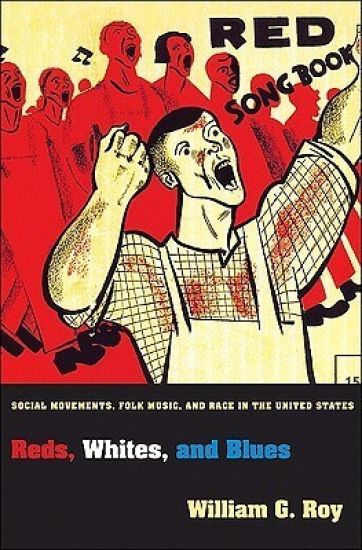
Reds, Whites, and Blues

Reds, Whites, and Blues

William G. Roy

Princeton University Press
2010
sidottu
Music, and folk music in particular, is often embraced as a form of political expression, a vehicle for bridging or reinforcing social boundaries, and a valuable tool for movements reconfiguring the social landscape. Reds, Whites, and Blues examines the political force of folk music, not through the meaning of its lyrics, but through the concrete social activities that make up movements. Drawing from rich archival material, William Roy shows that the People's Songs movement of the 1930s and 40s, and the Civil Rights Movement of the 1950s and 60s implemented folk music's social relationships--specifically between those who sang and those who listened--in different ways, achieving different outcomes. Roy explores how the People's Songsters envisioned uniting people in song, but made little headway beyond leftist activists. In contrast, the Civil Rights Movement successfully integrated music into collective action, and used music on the picket lines, at sit-ins, on freedom rides, and in jails. Roy considers how the movement's Freedom Songs never gained commercial success, yet contributed to the wider achievements of the Civil Rights struggle. Roy also traces the history of folk music, revealing the complex debates surrounding who or what qualified as "folk" and how the music's status as racially inclusive was not always a given. Examining folk music's galvanizing and unifying power, Reds, Whites, and Blues casts new light on the relationship between cultural forms and social activity.
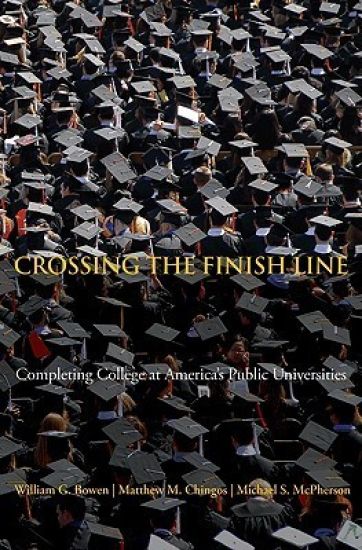
Crossing the Finish Line

Crossing the Finish Line

William G. Bowen; Matthew M. Chingos; Michael McPherson

Princeton University Press
2011
pokkari
The United States has long been a model for accessible, affordable education, as exemplified by the country's public universities. And yet less than 60 percent of the students entering American universities today are graduating. Why is this happening, and what can be done? Crossing the Finish Line provides the most detailed exploration ever of college completion at America's public universities. This groundbreaking book sheds light on such serious issues as dropout rates linked to race, gender, and socioeconomic status. Probing graduation rates at twenty-one flagship public universities and four statewide systems of public higher education, the authors focus on the progress of students in the entering class of 1999--from entry to graduation, transfer, or withdrawal. They examine the effects of parental education, family income, race and gender, high school grades, test scores, financial aid, and characteristics of universities attended (especially their selectivity). The conclusions are compelling: minority students and students from poor families have markedly lower graduation rates--and take longer to earn degrees--even when other variables are taken into account. Noting the strong performance of transfer students and the effects of financial constraints on student retention, the authors call for improved transfer and financial aid policies, and suggest ways of improving the sorting processes that match students to institutions. An outstanding combination of evidence and analysis, Crossing the Finish Line should be read by everyone who cares about the nation's higher education system.
Thinking about the Presidency

Thinking about the Presidency

William G. Howell

Princeton University Press
2013
sidottu
All American presidents, past and present, have cared deeply about power--acquiring, protecting, and expanding it. While individual presidents obviously have other concerns, such as shaping policy or building a legacy, the primacy of power considerations--exacerbated by expectations of the presidency and the inadequacy of explicit powers in the Constitution--sets presidents apart from other political actors. Thinking about the Presidency explores presidents' preoccupation with power. Distinguished presidential scholar William Howell looks at the key aspects of executive power--political and constitutional origins, philosophical underpinnings, manifestations in contemporary political life, implications for political reform, and looming influences over the standards to which we hold those individuals elected to America's highest office. Howell shows that an appetite for power may not inform the original motivations of those who seek to become president. Rather, this need is built into the office of the presidency itself--and quickly takes hold of whoever bears the title of Chief Executive. In order to understand the modern presidency, and the degrees to which a president succeeds or fails, the acquisition, protection, and expansion of power in a president's political life must be recognized--in policy tools and legislative strategies, the posture taken before the American public, and the disregard shown to those who would counsel modesty and deference within the White House. Thinking about the Presidency assesses how the search for and defense of presidential powers informs nearly every decision made by the leader of the nation.
Lessons Learned

Lessons Learned

William G. Bowen

Princeton University Press
2013
pokkari
Lessons Learned gives unprecedented access to the university president's office, providing a unique set of reflections on the challenges involved in leading both research universities and liberal arts colleges. In this landmark book, William Bowen, former president of Princeton University and of the Andrew W. Mellon Foundation, and coauthor of the acclaimed best-seller The Shape of the River, takes readers behind closed faculty-room doors to discuss how today's colleges and universities serve their age-old missions. With extraordinary candor, clarity, and good humor, Bowen shares the sometimes-hard lessons he learned about working with trustees, faculty, and campus groups; building an effective administrative team; deciding when to speak out on big issues and when to insist on institutional restraint; managing dissent; cultivating alumni and raising funds; setting academic priorities; fostering inclusiveness; eventually deciding when and how to leave the president's office; and much more. Drawing on more than four decades of experience, Bowen demonstrates how his greatest lessons often arose from the missteps he made along the way, and how, when it comes to university governance, there are important general principles but often no single right answer. Full of compelling stories, insights, and practical wisdom, Lessons Learned frames the questions that leaders of higher education will continue to confront at a complex moment in history.
Higher Education in the Digital Age

Higher Education in the Digital Age

William G. Bowen

Princeton University Press
2013
sidottu
Two of the most visible and important trends in higher education today are its exploding costs and the rapid expansion of online learning. Could the growth in online courses slow the rising cost of college and help solve the crisis of affordability? In this short and incisive book, William G. Bowen, one of the foremost experts on the intersection of education and economics, explains why, despite his earlier skepticism, he now believes technology has the potential to help rein in costs without negatively affecting student learning. As a former president of Princeton University, an economist, and author of many books on education, including the acclaimed bestseller The Shape of the River, Bowen speaks with unique expertise on the subject. Surveying the dizzying array of new technology-based teaching and learning initiatives, including the highly publicized emergence of "massive open online courses" (MOOCs), Bowen argues that such technologies could transform traditional higher education--allowing it at last to curb rising costs by increasing productivity, while preserving quality and protecting core values. But the challenges, which are organizational and philosophical as much as technological, are daunting. They include providing hard evidence of whether online education is cost-effective in various settings, rethinking the governance and decision-making structures of higher education, and developing customizable technological platforms. Yet, Bowen remains optimistic that the potential payoff is great. Based on the 2012 Tanner Lectures on Human Values, delivered at Stanford University, the book includes responses from Stanford president John Hennessy, Harvard University psychologist Howard Gardner, Columbia University literature professor Andrew Delbanco, and Coursera cofounder Daphne Koller.
Reds, Whites, and Blues

Reds, Whites, and Blues

William G. Roy

Princeton University Press
2013
pokkari
Music, and folk music in particular, is often embraced as a form of political expression, a vehicle for bridging or reinforcing social boundaries, and a valuable tool for movements reconfiguring the social landscape. Reds, Whites, and Blues examines the political force of folk music, not through the meaning of its lyrics, but through the concrete social activities that make up movements. Drawing from rich archival material, William Roy shows that the People's Songs movement of the 1930s and 40s, and the Civil Rights Movement of the 1950s and 60s implemented folk music's social relationships--specifically between those who sang and those who listened--in different ways, achieving different outcomes. Roy explores how the People's Songsters envisioned uniting people in song, but made little headway beyond leftist activists. In contrast, the Civil Rights Movement successfully integrated music into collective action, and used music on the picket lines, at sit-ins, on freedom rides, and in jails. Roy considers how the movement's Freedom Songs never gained commercial success, yet contributed to the wider achievements of the Civil Rights struggle. Roy also traces the history of folk music, revealing the complex debates surrounding who or what qualified as "folk" and how the music's status as racially inclusive was not always a given. Examining folk music's galvanizing and unifying power, Reds, Whites, and Blues casts new light on the relationship between cultural forms and social activity.

Higher Education in the Digital Age

Higher Education in the Digital Age

William G. Bowen; Kevin M. Guthrie

Princeton University Press
2015
pokkari
Two of the most visible and important trends in higher education today are its exploding costs and the rapid expansion of online learning. Could the growth in online courses slow the rising cost of college and help solve the crisis of affordability? In this short and incisive book, William G. Bowen, one of the foremost experts on the intersection of education and economics, explains why, despite his earlier skepticism, he now believes technology has the potential to help rein in costs without negatively affecting student learning. As a former president of Princeton University, an economist, and author of many books on education, including the acclaimed bestseller The Shape of the River, Bowen speaks with unique expertise on the subject. Surveying the dizzying array of new technology-based teaching and learning initiatives, including the highly publicized emergence of "massive open online courses" (MOOCs), Bowen argues that such technologies could transform traditional higher education--allowing it at last to curb rising costs by increasing productivity, while preserving quality and protecting core values. But the challenges, which are organizational and philosophical as much as technological, are daunting. They include providing hard evidence of whether online education is cost-effective in various settings, rethinking the governance and decision-making structures of higher education, and developing customizable technological platforms. Yet, Bowen remains optimistic that the potential payoff is great. Based on the 2012 Tanner Lectures on Human Values, delivered at Stanford University, the book includes responses from Stanford president John Hennessy, Harvard University psychologist Howard Gardner, Columbia University literature professor Andrew Delbanco, and Coursera cofounder Daphne Koller.
Thinking About the Presidency

Thinking About the Presidency

William G. Howell

Princeton University Press
2015
pokkari
All American presidents, past and present, have cared deeply about power--acquiring, protecting, and expanding it. While individual presidents obviously have other concerns, such as shaping policy or building a legacy, the primacy of power considerations--exacerbated by expectations of the presidency and the inadequacy of explicit powers in the Constitution--sets presidents apart from other political actors. Thinking about the Presidency explores presidents' preoccupation with power. Distinguished presidential scholar William Howell looks at the key aspects of executive power--political and constitutional origins, philosophical underpinnings, manifestations in contemporary political life, implications for political reform, and looming influences over the standards to which we hold those individuals elected to America's highest office. Howell shows that an appetite for power may not inform the original motivations of those who seek to become president. Rather, this need is built into the office of the presidency itself--and quickly takes hold of whoever bears the title of Chief Executive. In order to understand the modern presidency, and the degrees to which a president succeeds or fails, the acquisition, protection, and expansion of power in a president's political life must be recognized--in policy tools and legislative strategies, the posture taken before the American public, and the disregard shown to those who would counsel modesty and deference within the White House. Thinking about the Presidency assesses how the search for and defense of presidential powers informs nearly every decision made by the leader of the nation. In a new preface, Howell reflects on presidential power during the presidency of Barack Obama.
Locus of Authority

Locus of Authority

William G. Bowen; Eugene M. Tobin

Princeton University Press
2015
sidottu
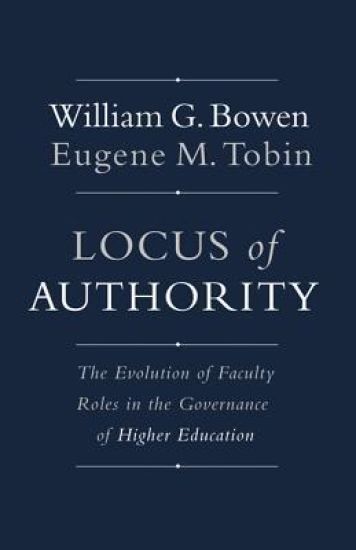
Do higher education institutions have what it takes to reform effectively from within? Locus of Authority argues that every issue facing today's colleges and universities, from stagnant degree completion rates to worrisome cost increases, is exacerbated by a century-old system of governance that desperately requires change. While prior studies have focused on boards of trustees and presidents, few have looked at the place of faculty within the governance system. Bowen and Tobin explore whether departments remain the best ways through which to organize decision making and if the concepts of academic freedom and shared governance need to be sharpened and redefined. Using case studies of four very different institutions, the authors demonstrate that college and university governance has capably adjusted to the necessities of the moment and governance norms and policies should be assessed in the context of historical events. They also demonstrate that successful reform depends on the artful consideration of technological, financial, and cultural developments. Locus of Authority shows that the consequences of not addressing college and university governance are more than the nation can afford.
Lesson Plan

Lesson Plan

William G. Bowen; Michael McPherson

Princeton University Press
2016
sidottu
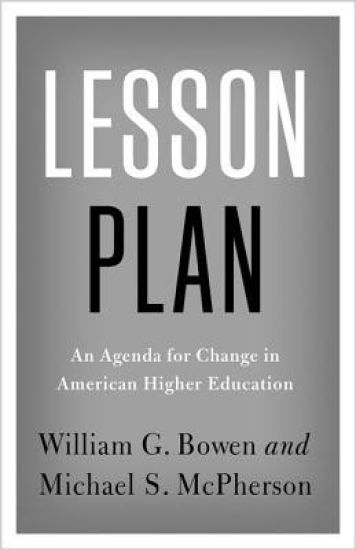
American higher education faces some serious problems--but they are not the ones most people think. In this brief and accessible book, two leading experts show that many so-called crises--from the idea that typical students are drowning in debt to the belief that tuition increases are being driven by administrative bloat--are exaggerated or simply false. At the same time, many real problems--from the high dropout rate to inefficient faculty staffing--have received far too little attention. In response, William G. Bowen and Michael S. McPherson provide a frank assessment of the biggest challenges confronting higher education and propose a bold agenda for reengineering essential elements of the system to meet them. The result promises to help shape the debate about higher education for years to come. Lesson Plan shows that, for all of its accomplishments, higher education today is falling short when it comes to vital national needs. Too many undergraduates are dropping out or taking too long to graduate; minorities and the poor fare worse than their peers, reinforcing inequality; and college is unaffordable for too many. But these problems could be greatly reduced by making significant changes, including targeting federal and state funding more efficiently; allocating less money for "merit aid" and more to match financial need; creating a respected "teaching corps" that would include nontenure faculty; improving basic courses in fields such as math by combining adaptive learning and face-to-face teaching; strengthening leadership; and encouraging more risk taking. It won't be easy for faculty, administrators, trustees, and legislators to make such sweeping changes, but only by doing so will they make it possible for our colleges and universities to meet the nation's demands tomorrow and into the future.
Locus of Authority

Locus of Authority

William G. Bowen; Eugene M. Tobin

Princeton University Press
2017
pokkari
Do higher education institutions have what it takes to reform effectively from within? Locus of Authority argues that every issue facing today's colleges and universities, from stagnant degree completion rates to worrisome cost increases, is exacerbated by a century-old system of governance that desperately requires change. While prior studies have focused on boards of trustees and presidents, few have looked at the place of faculty within the governance system. Bowen and Tobin explore whether departments remain the best ways through which to organize decision making and if the concepts of academic freedom and shared governance need to be sharpened and redefined. Using case studies of four very different institutions, the authors demonstrate that college and university governance has capably adjusted to the necessities of the moment and governance norms and policies should be assessed in the context of historical events. They also demonstrate that successful reform depends on the artful consideration of technological, financial, and cultural developments. Locus of Authority shows that the consequences of not addressing college and university governance are more than the nation can afford.
Ever the Leader

Ever the Leader

William G. Bowen; Hanna Holborn Gray

Princeton University Press
2017
sidottu
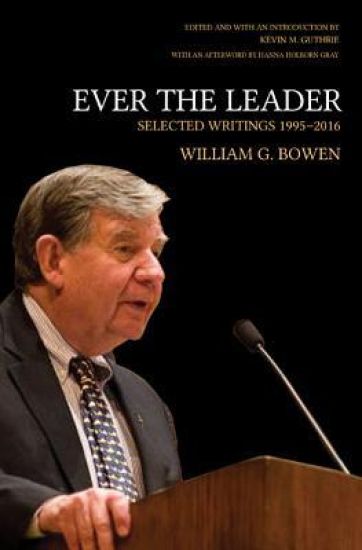
Ever the Leader gathers together selected speeches and writings from one of the great scholars and commentators of higher education. William G. Bowen's career at Princeton University--from economics professor to provost to a sixteen-year tenure as president--was marked by extraordinary accomplishments during times of great change, both at the university and in the country. But it was in Bowen's second act, as president of the Andrew W. Mellon Foundation and founding chairman of ITHAKA, that he took the lessons he learned as a highly productive leader of one of the nation's most esteemed universities and applied them to a broader set of problems in higher education. This volume of work from Bowen's later career captures this expansion of his thought and influence. Comprising remarks and articles on the subjects of university values, educational opportunity, college sports, technology, and Bowen's own colleagues and friends, Ever the Leader is more than just a concise distillation of Bowen's research and thinking on some of the most urgent issues of the day--it is a portrait of leadership in action. The selected papers, talks, and articles exemplify Bowen's commitment and singular ability to communicate strong, persuasive arguments for change, and to motivate others to engage with the truly hard questions facing higher education leaders. Filled with formidable insights, Ever the Leader will be required reading for university presidents, policymakers, and all those who carry on the struggle for equity and excellence in higher education.