Kirjahaku
Etsi kirjoja tekijän nimen, kirjan nimen tai ISBN:n perusteella.
1000 tulosta hakusanalla Arvil Wiley

New Constructive Solutions of Anvil-Blocks of Percussion Mining Machines
Ivan Alekseevich Zhukov; Leonid Trofimovich Dvornikov
Createspace Independent Publishing Platform
2015
nidottu

roman policier humoristique dont l'action se passe en France dans les ann es soixante
Most of the poems in the first part of this book, ""Six Seasons,"" were written according to formal strictures. They use various sorts of rhyme (internal or at a line-stop) and rhythms that match the motion of their subject matter. I've worked with traditional verse: songs, carols, quatrains, lyrics with refrains, and so on. They follow the seasons of the liturgical year from Advent to the green season of Ordinary Time. The second part of the book, ""Leroy James Hopson,"" is written in free verse in order to allow for the development of a narrative with characters and a setting, an atmosphere and a plot. The entire story takes place during the night of November 10, 1974. ""Wangerin wields one of the most unique voices of our time. In his poetry, the eternal and the earthly collide and grapple with one another, and the outworking of that tension is Wangerin's hard-won gift to the reader."" --Pete Peterson, Executive Director, The Rabbit Room Walter Wangerin Jr. has won the National Book Award, the New York Times Best Children's Book of the Year Award, and several Gold Medallion Awards, including best fiction awards for both The Book of God and Paul: A Novel. The author of more than forty books--including The Absolute, Relatively Inaccessible (Cascade Books, 2017)--Wangerin lives in Valparaiso, Indiana, where he is Senior Research Professor at Valparaiso University.
Most of the poems in the first part of this book, ""Six Seasons,"" were written according to formal strictures. They use various sorts of rhyme (internal or at a line-stop) and rhythms that match the motion of their subject matter. I've worked with traditional verse: songs, carols, quatrains, lyrics with refrains, and so on. They follow the seasons of the liturgical year from Advent to the green season of Ordinary Time. The second part of the book, ""Leroy James Hopson,"" is written in free verse in order to allow for the development of a narrative with characters and a setting, an atmosphere and a plot. The entire story takes place during the night of November 10, 1974. ""Wangerin wields one of the most unique voices of our time. In his poetry, the eternal and the earthly collide and grapple with one another, and the outworking of that tension is Wangerin's hard-won gift to the reader."" --Pete Peterson, Executive Director, The Rabbit Room Walter Wangerin Jr. has won the National Book Award, the New York Times Best Children's Book of the Year Award, and several Gold Medallion Awards, including best fiction awards for both The Book of God and Paul: A Novel. The author of more than forty books--including The Absolute, Relatively Inaccessible (Cascade Books, 2017)--Wangerin lives in Valparaiso, Indiana, where he is Senior Research Professor at Valparaiso University.

Hammer and Anvil A Novel
Friedrich Spielhagen
Createspace Independent Publishing Platform
2017
nidottu

The richness of African American culture during the early years of the century emerges from Robert Gregg's wide-reaching study of African Methodist Churches, southern migrants, and expanding ghettos in Philadelphia. Contending that isolating these powerful forces distorts social history, Gregg examines their interconnected developments to reveal a new and less monolithic picture of African American communities. While some histories have charged black religious institutions with failure to help southern migrants adjust to urban life, Sparks from the Anvil of Oppression cites the work of African American Methodist intellectuals and ministers to illustrate the philosophy of "uplift" preached and practiced in A.M.E. churches. The church and many of its established members attempted to create community and respond to the migrants' depressed living and work environments. Class and regional differences, diversity among migrant populations, and the consolidation of the ghetto undermined attempts to create a unified black community, Gregg argues. African Methodist churches became sites of struggle for the status and power that could not be attained outside the black community. Author note: Robert Gregg is Assistant Professor of History at the Richard Stockton College of New Jersey and currently a Fellow at the Shelby Cullom Davis Center for Historical Studies at Princeton University.
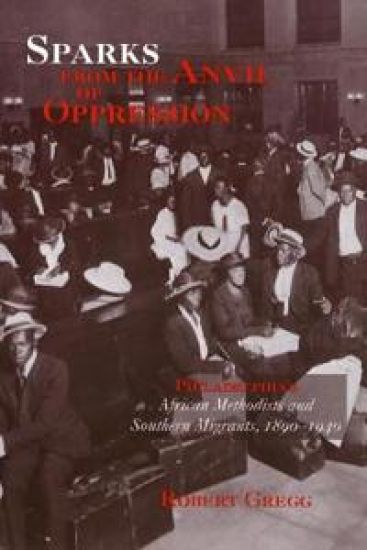
The richness of African American culture during the early years of the century emerges from Robert Gregg's wide-reaching study of African Methodist Churches, southern migrants, and expanding ghettos in Philadelphia. Contending that isolating these powerful forces distorts social history, Gregg examines their interconnected developments to reveal a new and less monolithic picture of African American communities. While some histories have charged black religious institutions with failure to help southern migrants adjust to urban life, "Sparks from the Anvil of Oppression" cites the work of African American Methodist intellectuals and ministers to illustrate the philosophy of "uplift" preached and practiced in A.M.E. churches. The church and many of its established members attempted to create community and respond to the migrants' depressed living and work environments. Class and regional differences, diversity among migrant populations, and the consolidation of the ghetto undermined attempts to create a unified black community, Gregg argues. African Methodist churches became sites of struggle for the status and power that could not be attained outside the black community. Author note: Robert Gregg is Assistant Professor of History at the Richard Stockton College of New Jersey and currently a Fellow at the Shelby Cullom Davis Center for Historical Studies at Princeton University.
This piece is written mostly in dialogue. It is set in present day Chicago, and is written in the second person singular. The viewpoint character is the Satan character. His name is Piano Man. The Christ character is called Juke Johnson. They are both in their sixties. The story opens with them playing chess at Juke's house and talking about old times. They were members of the same jazz quartet. Juke confronts Piano Man with photographs of Piano Man screwing a white woman. Piano Man can't remember when they were taken. When asked where the pictures came from, Juke says they were found under the bed of another now deceased friend of their's named Dempsey. Juke then admits for the first time in their friendship that Dempsey was his half-brother. He explains that his father had had an affair years ago, and that Dempsey was the result. Dempsey was put up for adoption, and when his adoptive parents died, he looked for and found his birth family. Piano Man was nonplused that Juke had kept this information from him all these years. They discover things about each other that they did not previously known. In particular, Juke learns that Piano Man had sexual affairs with the wives of all the other members of the quartet, including his. He pulls a gun to even the score. The gun changes hands a couple of times, and, finally, they both-- along with a third member who is introduced late in the story- end up shot.The revelation of Piano Man's character allows the reader to see how truly wicked one's friends could turn out to be. The piece is laced with some disguised and some not-so-disguised symbols.

Beneath the finished work of a painting lies the brush strokes of life - seemingly random splashes of color dashed against a white backdrop. Therein lies the life of a young woman and her new-found friend in the woods. Both escaping for vastly different reasons. As Charlotte's life is brought forth onto the canvas, Royal steps into the scene mesmerized and challenged by Charlotte's quiet manner and is haunted by her memory. All of which seem to be captured upon the canvas of the Painter - a mysterious man who appears in the most unlikely places. He ultimately captures their spirit upon his final masterpiece of the Hammer and the Anvil.

Beneath the finished work of a painting lies the brush strokes of life - seemingly random splashes of color dashed against a white backdrop. Therein lies the life of a young woman and her new-found friend in the woods. Both escaping for vastly different reasons. As Charlotte's life is brought forth onto the canvas, Royal steps into the scene mesmerized and challenged by Charlotte's quiet manner and is haunted by her memory. All of which seem to be captured upon the canvas of the Painter - a mysterious man who appears in the most unlikely places. He ultimately captures their spirit upon his final masterpiece of the Hammer and the Anvil.

Carnet de voyage fantaisie mois d'avril. 120 pages lign es et blanches.On dit qu'au mois d'avril, on ne devrait pas se d couvrir d'un fil Mais on peut aussi bien filler au soleil.

Happy Birthday Avril - The Big Birthday Activity Book: Personalized Children's Activity Book
Birthdaydr
Createspace Independent Publishing Platform
2018
nidottu
Happy Birthday Avril is a personalized kids activity book, it includes personalized crosswords, word searches, number puzzles, jokes, drawing and coloring >It is suitable for children between 6-11 years old It is the perfect birthday present for Avril, and is a great keepsake for parents to remember their child's early years and birthdays This personalized book is available for other names also This is a great gift for children and an amazing keepsake for parents Happy Birthday Avril

A personal and lyrical rediscovery of the history of England through archaeology and the imagination.History thrives on stories. TIME'S ANVIL explores archaeology's influence on what such stories say, how they are told, who tells them and how we listen.In a dazzlingly wide-ranging exploration, Richard Morris casts fresh light on three quarters of a million years of history in the place we now think of as England. Drawing upon genres that are usually pursued in isolation - like biography, poetry, or physics - he finds potent links between things we might imagine to be unrelated. His subjects range from humanity's roots to the destruction of the wildwood, from the first farmers to industrialization, and from Tudor drama to 20th-century conflict. Each topic sits at a different point along the continuum between epoch and the fleeting moment.In part, this is a history of archaeology; in part, too, it is a personal account of the author's history in archaeology. But mainly it is about how the past is read, and about what we bring to the reading as well as what we find. The result is a book that defies categorisation, but one which will by turns surprise, enthrall and provoke anyone who cares for England, who we are and where we have come from. TIME'S ANVIL was longlisted for the Samuel Johnson Prize for Non-Fiction 2013.

The third official novel set in the world of the blockbuster video game GEARS OF WAR, one of the fastest selling Xbox 360 games of all time.

Tales of the Anvil evokes a time when the forge served as the local meeting place, where news and gossip were exchanged; a time when the smith had a central role in rural communities and was highly-respected for his skills and expertise. Eamon Doyle charts the trade in Wexford through the centuries, listing the blacksmiths and their locations in every parish. He also preserves the stories of the men who carried the pikes in 1798, of the sportsmen and patriots who worked at the anvil, those who struggled and those who thrived: establishing world-renowned industries. Tales of the Anvil is a tribute to the forges and blacksmiths of County Wexford in which the author praises the wit and wisdom of those who knew the sound of the heavy sledge on red hot iron.


Toulouse-Lautrec and Jane Avril
Nancy (EDT) Ireson; Anna Gruetzner Robins
Paul Holberton Publishing
2011
pokkari
This publication celebrates for the first time the important creative collaboration between the artist Henri Toulouse-Lautrec (1864 1901) and his muse, the dancer Jane Avril (1868 1943). Avril was one of the stars of Moulin Rouge in the 1890s, and was nicknamed La Melinite after a form of explosive. She was known for her alluring style and exotic persona, and her fame was assured by a series of dazzlingly inventive posters designed by Lautrec."