Benjamin Franklin - American Writers 19 was first published in 1962. Minnesota Archive Editions uses digital technology to make long-unavailable books once again accessible, and are published unaltered from the original University of Minnesota Press editions.
Primitive Baptist singing traditions in the South. This collection of essays, best described as an extended set of liner notes to its accompanying compact disc, frames its topic with deceptive modesty. Benjamin Lloyd (1804 60) was a Primitive Baptist preacher, who in 1841 published some 535 hymn texts under the title "Primitive Hymns." "Lloyd s Hymnal" (as it is often called now) has been a small but consistent seller ever since, finding wide use among Primitive Baptists throughout the South. The CD [as well as the book] appropriately uses" Lloyd s" as a point of reference from which to navigate the varied landscape of folk worship in the South. Those who find beauty in the music and worship of the southern folk will be overwhelmed by the sounds and the spiritual intensity; those who grapple with the tangled biracial culture of the South will find a key to understanding the devotion of southerners, black and white, to this small book. "-- The Alabama Review" "
A comprehensive collection of the most important sources on the late historic Creek Indians and their environment.In 1795 Benjamin Hawkins, a former U.S. senator and advisor to George Washington, was appointed U.S. Indian agent and superintendent of all the tribes south of the Ohio River. Unlike most other agents, he lived among the Creek Indians for his entire tenure, from 1796 to 1816. Journeying forth from his home on the Flint River in Georgia, he served southeastern Indians as government intermediary during one of the longest eras of peace in the historic period.Hawkins's journals provide detailed information about European-Indian relations in the 18th-century frontier of the South. His descriptions of the natural and cultural environment are considered among the best sources for the ethnohistory of the Choctaw, Cherokee, Chickasaw, and, especially, the Creek Indians and the natural history of their territory. Two previously published bodies of work by Benjamin Hawkins are included here-A Sketch of the Creek Country in the Years 1798 and 1799 and The Letters of Benjamin Hawkins 1796-1806. A third body of work that has never been published, "A Viatory or Journal of Distances" (describing routes and distances of a 3,578-mile journey through parts of Georgia, Alabama, and Mississippi), has been added. Together, these documents make up the known body of Hawkins' work—his talks, treaties, correspondence, aboriginal vocabularies, travel journals, and records of the manners, customs, rites, and civil polity of the tribes. Hawkins' work provides an invaluable record of the time period.
Published in 1951, Benjamin Hawkins, Indian Agent examines the social and diplomatic work of Hawkins, a congressman from North Carolina who served as a mediator between the states and Native Americans until his death in 1816. Hawkins worked to lessen the constant tension between the frontier states and the Indian nations and to increase agriculture in order to settle Native Americans to the land.Washington, Jefferson, Adams, and other national figures recognized in Hawkins the ability to navigate Indian and state negotiations. Hawkins's fairness earned him respect among the Cherokees, Creeks, and other tribes. Such fairness also created enemies among the land-hungry frontier states, which continually strived for Indian removal. More than anyone else, Hawkins was responsible for the policy of Indian relations between the treaty of Paris in 1783 and the end of the War of 1812.
This is the first book length study of one of Romania's greatest poets. Benjamin Fondane was a close friend of Lev Cheslov, a profound critic of contemporary European thought, and a thoughtful critic of the role of the Jew in Western civilization. In Fondane's work we confront the moral fiber of our age.
In transposing the Freudian dream work from the individual subject to the collective, Walter Benjamin projected a "macroscosmic journey" of the individual sleeper to "the dreaming collective, which, through the arcades, communes with its own insides." Benjamin's effort to transpose the dream phenomenon to the history of a collective remained fragmentary, though it underlies the principle of retrograde temporality, which, it is argued, is central to his idea of history. The "passages" are not just the Paris arcades: They refer also to Benjamin's effort to negotiate the labyrinth of his work and thought. Gelley works through many of Benjamin's later works and examines important critical questions: the interplay of aesthetics and politics, the genre of The Arcades Project, citation, language, messianism, aura, and the motifs of memory, the crowd, and awakening. For Benjamin, memory is not only antiquarian; it functions as a solicitation, a call to a collectivity to come. Gelley reads this call in the motif of awakening, which conveys a qualified but crucial performative intention of Benjamin's undertaking.
In transposing the Freudian dream work from the individual subject to the collective, Walter Benjamin projected a "macroscosmic journey" of the individual sleeper to "the dreaming collective, which, through the arcades, communes with its own insides." Benjamin's effort to transpose the dream phenomenon to the history of a collective remained fragmentary, though it underlies the principle of retrograde temporality, which, it is argued, is central to his idea of history. The "passages" are not just the Paris arcades: They refer also to Benjamin's effort to negotiate the labyrinth of his work and thought. Gelley works through many of Benjamin's later works and examines important critical questions: the interplay of aesthetics and politics, the genre of The Arcades Project, citation, language, messianism, aura, and the motifs of memory, the crowd, and awakening. For Benjamin, memory is not only antiquarian; it functions as a solicitation, a call to a collectivity to come. Gelley reads this call in the motif of awakening, which conveys a qualified but crucial performative intention of Benjamin's undertaking.
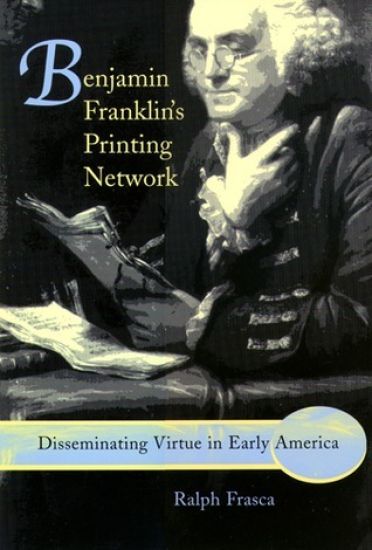
In ""Benjamin Franklin's Printing Network"", Ralph Frasca explores Franklin's partnerships and business relationships with printers and their impact on the early American press. Besides analyzing the structure of the network, Frasca addresses two equally important questions: How did Franklin establish this informal group? And what were his motivations for doing so? This network grew to be the most prominent and geographically extensive of the early American printing organizations, lasting from the 1720s until the 1790s. Stretching from New England to the West Indies, it comprised more than two dozen members, including such memorable characters as the Job-like James Parker, the cunning Francis Childs, the malcontent Benjamin Mecom, the vengeful Benjamin Franklin Bache, the steadfast David Hall, and the deranged Anthony Armbruster. Franklin's network altered practices in both the European and American colonial printing trades by providing capital and political influence to set up workers as partners and associates. As an economic entity and a source of mutual support, the network was integral to the success of many eighteenth-century printers, as well as to the development of American journalism. Frasca argues that Franklin's principal motivation in establishing the network was his altruistic desire to assist Americans in their efforts to be virtuous. Using a variety of sources, Frasca shows that Franklin viewed virtuousness as a path to personal happiness and social utility. Franklin intended for his network of printers to teach virtue and encourage its adoption. The network would disseminate his moral truths to a mass audience, and this would in turn further his own political, economic, and moral ambitions. By exploring Franklin's printing network and addressing these questions, this work fills a substantial void in the historical treatment of Franklin's life. Amateur historians and professional scholars alike will welcome Frasca's clear and capable treatment of this subject.
In 1975, legendary value investor Benjamin Graham wrote that his net-net stock strategy worked so well that he had renounced all other value investing strategies.In his 2014 shareholder letter, Warren Buffett wrote that he earned the highest returns of his career employing this 'cigar butt' approach to investing.And despite the widespread assumption that net-net stocks are a relic of the past, Graham's net-net stock strategy is just as viable today for small private investors as it was for Buffett's 'superinvestors' during their early careers. Net-net investing remains the most powerful value investing approach a small investor can adopt.This book is your ultimate practical guide to implementing it – and reaping the rewards – in today's markets.Evan Bleker has spent ten years studying Graham's strategy to uncover its real-world performance, how to employ it, and why it works. He's also dug deeply to identify additional criteria to boost returns and ensure a greater number of winners.In this book, Evan defines the strategy for investors, then walks readers through the strategy's philosophy, as well as academic and industry studies assessing the framework, and its implementation by world-class value investors such as Benjamin Graham, Warren Buffett, and Peter Cundill.He also compiles selection criteria into a practical checklist for investors, and documents how the strategy works in today's markets with exclusive detailed case studies.
This volume contains the lectures of Dr. Benjamin Rush on physiology, which deal with the mind. Regarded as "the father of American psychiatry," for over 30 years Dr. Rush treated insane patients at the Pennsylvania Hospital in Philadelphia. He published the first American book on psychiatry, "Medical Inquiries and Observations Upon the Disease of the Mind," in 1812. Contents of this volume: General Introduction; The Syllabus; The Introductory Lecture; Introduction to the Lectures on Animal Life; Benjamin Rush Lectures on the Mind; Introduction to the Mind; Introduction to Sleep and Dreams; and Epilogue.
Too often dismissed as the least philosophic of the Founding Fathers, Benjamin Franklin had a deep and lasting impact on the shape of American political thought. In this substantial collection of Franklins letters, essays, and lesser-known papers, Ralph Ketcham traces the development of Franklins practicaland distinctly Americanpolitical thought from his earliest Silence Dogood essays to his final writings on the Constitution and The Evils of the Slave Trade.
Too often dismissed as the least philosophic of the Founding Fathers, Benjamin Franklin had a deep and lasting impact on the shape of American political thought. In this substantial collection of Franklin's letters, essays, and lesser-known papers, Ralph Ketcham traces the development of Franklin's practical-and distinctly American-political thought from his earliest Silence Dogood essays to his final writings on the Constitution and The Evils of the Slave Trade.
Benjamin Capps has been called the Texas author whose work will be read 100 years from now, but Clayton notes that Caps has not been the frequent subject of nationally disseminated critical interpretation, perhaps because he is an anomaly--a writer of serious, literary fiction set in the West. Notable are Capps's perceptive characterizations and his use of historical background and folklore.