Kirjojen hintavertailu. Mukana 11 342 296 kirjaa ja 12 kauppaa.

Kirjahaku

Etsi kirjoja tekijän nimen, kirjan nimen tai ISBN:n perusteella.

1000 tulosta hakusanalla C. Edwards Lester

Superior Women

Superior Women

Jennifer C. Edwards

Oxford University Press
2019
sidottu
Superior Women examines the claims of abbesses of the abbey of Sainte-Croix in medieval Poitiers to authority from the abbey's foundation to its 1520 reform. These women claimed to hold authority over their own community, over dependent chapters of male canons, and over extensive properties in Poitou; male officials such as the king of France and the pope repeatedly supported these claims. To secure this support, the abbesses relied on two strategies that the abbey's founder, the sixth-century Saint Radegund, established: they documented support from a network of allies made up of powerful secular and ecclesiastical officials, and they used artefacts left from Radegund's life to shape her cult and win new patrons and allies. Abbesses across the 900 years of this study routinely turned to these strategies successfully when faced with conflict from dependents, or more local officials such as the bishop of Poitiers. Sainte-Croix's nuns proved adept at tailoring these strategies to shifting historical contexts, turning from Frankish bishops to the kings of Frankia, then to the Pope and finally to the King of France as former allies became unavailable to them. The book demonstrates respectful cooperation between men and monastic women, and more extensive respect for female monastic authority than scholars typically recognize. Chapters focus on the cult's manuscripts, church decoration, procession, jurisdictions between cult institutions, reform, and rebellion.
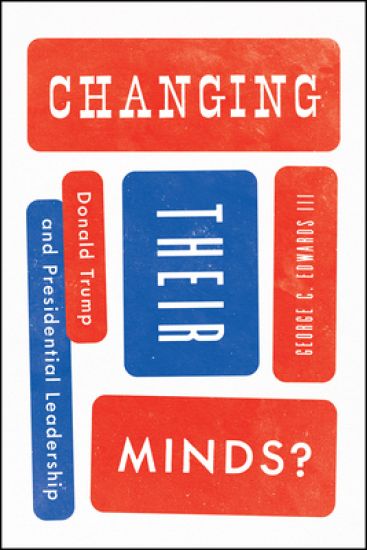
Changing Their Minds?

Changing Their Minds?

George C. Edwards III

University of Chicago Press
2021
sidottu
Despite popular perceptions, presidents rarely succeed in persuading either the public or members of Congress to change their minds and move from opposition to particular policies to support of them. As a result, the White House is not able to alter the political landscape and create opportunities for change. Instead, successful presidents recognize and skillfully exploit the opportunities already found in their political environments. If they fail to understand their strategic positions, they are likely to overreach and experience political disaster. Donald Trump has been a distinctive president, and his arrival in the Oval Office brought new questions. Could someone with his decades of experience as a self-promoter connect with the public and win its support? Could a president who is an experienced negotiator obtain the support in Congress needed to pass his legislative programs? Would we need to adjust the theory of presidential leadership to accommodate a president with unique persuasive skills? Building on decades of research and employing extensive new data, George C. Edwards III addresses these questions. He finds that President Trump has been no different than other presidents in being constrained by his environment. He moved neither the public nor Congress. Even for an experienced salesman and dealmaker, presidential power is still not the power to persuade. Equally important was the fact that, as Edwards shows, Trump was not able to exploit the opportunities he had. In fact, we learn here that the patterns of the president’s rhetoric and communications and his approach to dealing with Congress ultimately lessened his chances of success. President Trump, it turns out, was often his own agenda’s undoing.
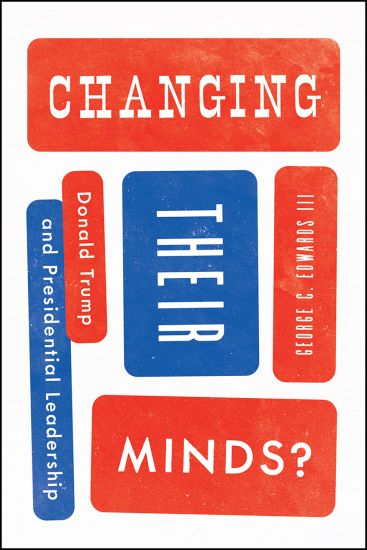
Changing Their Minds?

Changing Their Minds?

George C. Edwards III

University of Chicago Press
2021
nidottu
Despite popular perceptions, presidents rarely succeed in persuading either the public or members of Congress to change their minds and move from opposition to particular policies to support of them. As a result, the White House is not able to alter the political landscape and create opportunities for change. Instead, successful presidents recognize and skillfully exploit the opportunities already found in their political environments. If they fail to understand their strategic positions, they are likely to overreach and experience political disaster. Donald Trump has been a distinctive president, and his arrival in the Oval Office brought new questions. Could someone with his decades of experience as a self-promoter connect with the public and win its support? Could a president who is an experienced negotiator obtain the support in Congress needed to pass his legislative programs? Would we need to adjust the theory of presidential leadership to accommodate a president with unique persuasive skills? Building on decades of research and employing extensive new data, George C. Edwards III addresses these questions. He finds that President Trump has been no different than other presidents in being constrained by his environment. He moved neither the public nor Congress. Even for an experienced salesman and dealmaker, presidential power is still not the power to persuade. Equally important was the fact that, as Edwards shows, Trump was not able to exploit the opportunities he had. In fact, we learn here that the patterns of the president’s rhetoric and communications and his approach to dealing with Congress ultimately lessened his chances of success. President Trump, it turns out, was often his own agenda’s undoing.
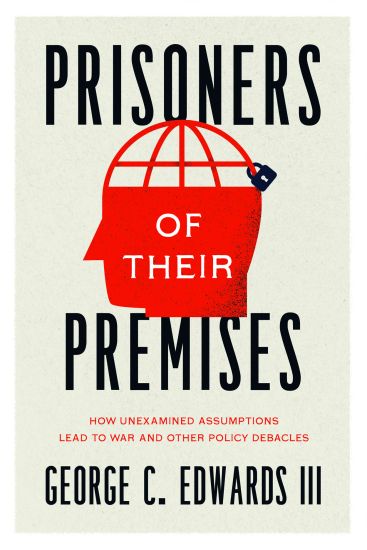
Prisoners of Their Premises

Prisoners of Their Premises

George C. Edwards III

THE UNIVERSITY OF CHICAGO PRESS
2022
sidottu
A timely look at the real costs of leaders not examining their assumptions. Why do accomplished and stable leaders frequently make calamitous decisions with devastating consequences for their countries—and other nations? We debate debacles such as the American involvement in Vietnam, seeking to understand why leaders pursued disastrous policies. In Prisoners of Their Premises, George C. Edwards III argues that the failure of leaders to examine their premises—the assumptions they make about the world and situation they are dealing with—cause them to ignore real problems or pursue policies that, in costly ways, deal with problems that are different than they think or simply don’t exist. Edwards looks at the role of premises in identifying (or ignoring) a problem in a series of case studies that range from strategic decisions in World War I and the Korean War to the wars in Vietnam and Iraq. Too often, unexamined premises color initial decisions to pursue a policy and shape the strategies leaders employ to achieve their goals, with grave consequences for their countries, organizations, and potentially the world. Timely and important, Prisoners of Their Premises demonstrates the real costs leaders incur by failing to question their assumptions.
Prisoners of Their Premises

Prisoners of Their Premises

George C. Edwards III

THE UNIVERSITY OF CHICAGO PRESS
2022
nidottu
A timely look at the real costs of leaders not examining their assumptions. Why do accomplished and stable leaders frequently make calamitous decisions with devastating consequences for their countries—and other nations? We debate debacles such as the American involvement in Vietnam, seeking to understand why leaders pursued disastrous policies. In Prisoners of Their Premises, George C. Edwards III argues that the failure of leaders to examine their premises—the assumptions they make about the world and situation they are dealing with—cause them to ignore real problems or pursue policies that, in costly ways, deal with problems that are different than they think or simply don’t exist. Edwards looks at the role of premises in identifying (or ignoring) a problem in a series of case studies that range from strategic decisions in World War I and the Korean War to the wars in Vietnam and Iraq. Too often, unexamined premises color initial decisions to pursue a policy and shape the strategies leaders employ to achieve their goals, with grave consequences for their countries, organizations, and potentially the world. Timely and important, Prisoners of Their Premises demonstrates the real costs leaders incur by failing to question their assumptions.
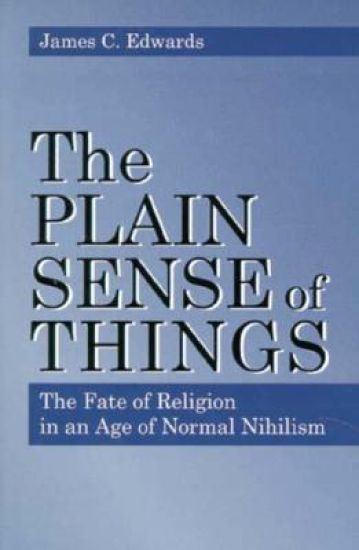
The Plain Sense of Things

The Plain Sense of Things

James C. Edwards

Pennsylvania State University Press
1997
pokkari
What could it mean to be religious in a world where religion no longer retains its former authority? Posing this question for his fellow Western intellectuals who inhabit just such a world, James C. Edwards investigates the loss of religion's traditional power in a culture characterized by what he calls "normal nihilism"—a situation in which one's commitment to a particular set of values is all one really has, and in which traditional religion is only a means of interpretation used to preserve what one most cares about. Recognizing the important historical role of religion in making us the people we are, he seeks to establish a viable understanding of religion without traditional beliefs and within the context of contemporary skepticism. The Plain Sense of Things is a book more interested in the power of religion that in its truth and in what happens to that power when the claims to truth slacken their grip.
At the Margins

At the Margins

George C. Edwards

Yale University Press
1990
pokkari
In this book George Edwards seeks a deeper understanding of the relationship between the president and Congress, exploring how and under what conditions presidents lead Congress, what we can reasonably expect of them, and how we should evaluate their performance. He makes a persuasive case for his thesis that presidential leadership of Congress is typically at the margins, not the core, of policymaking. Edwards focuses on three important resources for presidential leadership: party, public opinion, and legislative skills. For each source of influence he analyzes the president's strategic position, the theoretical potential of the resource as an instrument of leadership. He then examines presidents' attempts to employ each resource to obtain support in Congress, showing that they are rarely able to expand their resource base or manipulate their resources reliably. Integrating quantitative analysis with documentary and historical research, Edwards argues that the effective leader is not the dominant chief executive of political folklore who restructures the contours of the political landscape to pave the way for change but is rather a facilitator who works at the margins of coalition building to exploit opportunities presented by a favorable configuration of political forces in his environment. Presidents are not by themselves going to bring about major changes in public policy, says Edwards, and we must adjust accordingly our expectations of their leadership. The implications of his book are broad, and his findings are an important corrective for those who personalize politics and attribute more influence to a single person or strategy than is usually merited.
The Historical Development of the Calculus

The Historical Development of the Calculus

C.H.Jr. Edwards

Springer-Verlag New York Inc.
1994
nidottu
The calculus has served for three centuries as the principal quantitative language of Western science. In the course of its genesis and evolution some of the most fundamental problems of mathematics were first con­ fronted and, through the persistent labors of successive generations, finally resolved. Therefore, the historical development of the calculus holds a special interest for anyone who appreciates the value of a historical perspective in teaching, learning, and enjoying mathematics and its ap­ plications. My goal in writing this book was to present an account of this development that is accessible, not solely to students of the history of mathematics, but to the wider mathematical community for which my exposition is more specifically intended, including those who study, teach, and use calculus. The scope of this account can be delineated partly by comparison with previous works in the same general area. M. E. Baron's The Origins of the Infinitesimal Calculus (1969) provides an informative and reliable treat­ ment of the precalculus period up to, but not including (in any detail), the time of Newton and Leibniz, just when the interest and pace of the story begin to quicken and intensify. C. B. Boyer's well-known book (1949, 1959 reprint) met well the goals its author set for it, but it was more ap­ propriately titled in its original edition-The Concepts of the Calculus­ than in its reprinting.
A Carceral Ecology

A Carceral Ecology

Ryan C. Edwards

University of California Press
2021
sidottu
Closer to Antarctica than to Buenos Aires, the port town of Ushuaia, Argentina is home to a national park as well as a museum that is housed in the world’s southernmost prison. Ushuaia’s radial panopticon operated as an experimental hybrid penal colony and penitentiary from 1902 to 1947, designed to revolutionize modern prisons globally. A Carceral Ecology offers the first comprehensive study of this notorious prison and its afterlife, documenting how the Patagonian frontier and timber economy became central to ideas about labor, rehabilitation, and resource management. Mining the records of penologists, naturalists, and inmates, Ryan C. Edwards shows how discipline was tied to forest management, but also how inmates gained situated geographical knowledge and reframed debates on the regeneration of the land and the self. Bringing a new imperative to global prison studies, Edwards asks us to rethink the role of the environment in carceral practices as well as the impact of incarceration on the natural world.
A Carceral Ecology

A Carceral Ecology

Ryan C. Edwards

University of California Press
2021
pokkari
Closer to Antarctica than to Buenos Aires, the port town of Ushuaia, Argentina is home to a national park as well as a museum that is housed in the world’s southernmost prison. Ushuaia’s radial panopticon operated as an experimental hybrid penal colony and penitentiary from 1902 to 1947, designed to revolutionize modern prisons globally. A Carceral Ecology offers the first comprehensive study of this notorious prison and its afterlife, documenting how the Patagonian frontier and timber economy became central to ideas about labor, rehabilitation, and resource management. Mining the records of penologists, naturalists, and inmates, Ryan C. Edwards shows how discipline was tied to forest management, but also how inmates gained situated geographical knowledge and reframed debates on the regeneration of the land and the self. Bringing a new imperative to global prison studies, Edwards asks us to rethink the role of the environment in carceral practices as well as the impact of incarceration on the natural world.
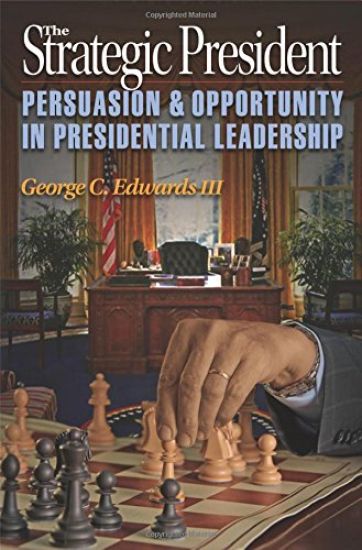
The Strategic President

The Strategic President

George C. Edwards

Princeton University Press
2012
pokkari
How do presidents lead? If presidential power is the power to persuade, why is there a lack of evidence of presidential persuasion? George Edwards, one of the leading scholars of the American presidency, skillfully uses this contradiction as a springboard to examine--and ultimately challenge--the dominant paradigm of presidential leadership. The Strategic President contends that presidents cannot create opportunities for change by persuading others to support their policies. Instead, successful presidents facilitate change by recognizing opportunities and fashioning strategies and tactics to exploit them. Edwards considers three extraordinary presidents--Abraham Lincoln, Franklin D. Roosevelt, and Ronald Reagan--and shows that despite their considerable rhetorical skills, the public was unresponsive to their appeals for support. To achieve change, these leaders capitalized on existing public opinion. Edwards then explores the prospects for other presidents to do the same to advance their policies. Turning to Congress, he focuses first on the productive legislative periods of FDR, Lyndon Johnson, and Reagan, and finds that these presidents recognized especially favorable conditions for passing their agendas and effectively exploited these circumstances while they lasted. Edwards looks at presidents governing in less auspicious circumstances, and reveals that whatever successes these presidents enjoyed also resulted from the interplay of conditions and the presidents' skills at understanding and exploiting them. The Strategic President revises the common assumptions of presidential scholarship and presents significant lessons for presidents' basic strategies of governance.
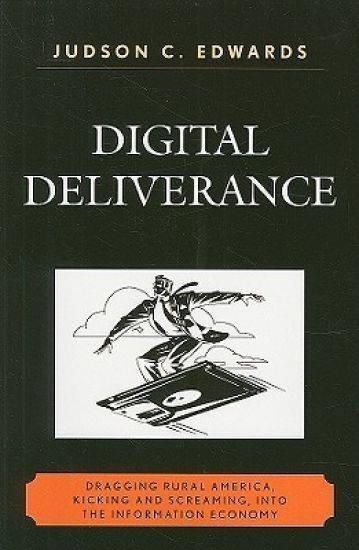
Digital Deliverance

Digital Deliverance

Judson C. Edwards

University Press of America
2009
nidottu
This book offers a practice-based approach to developing strategies for utilizing broadband telecommunications for rural economic development. Edwards addresses four key questions in the publication: 1) How important is broadband telecommunications in the achievement of rural economic development success in the information-based economy? 2) What are the critical factors in assessing the potential of rural communities to utilize broadband telecommunications for economic development? 3) What policy trends are proposed to assist communities in the advancement of telecommunication-based economic development strategies? And 4) How can local leadership assist in the implementation of broadband for economic development success? By answering these important questions, Edwards provides the reader a step-by-step, practice-oriented framework for implementing a rural economic development planning strategy through the implementation of broadband telecommunications. Broadband connectivity is vital for rural communities to be actively engaged in the global information economy, but being connected is not enough. Utilization of technology is required if communities want to increase their potential for economic development success.
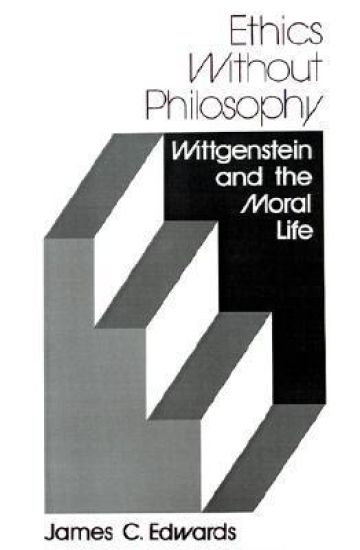
Ethics Without Philosophy

Ethics Without Philosophy

James C. Edwards

University Press of Florida
1985
nidottu
"Ethics Without Philosophy is the first full-scale attempt to relate Wittgenstein's ethical and religious concerns to his philosophical work. The attempt is splendidly carried out. I have found it more useful in helping me to understand Wittgenstein than any other book about him which I have read." --Richard Rorty, Princeton University
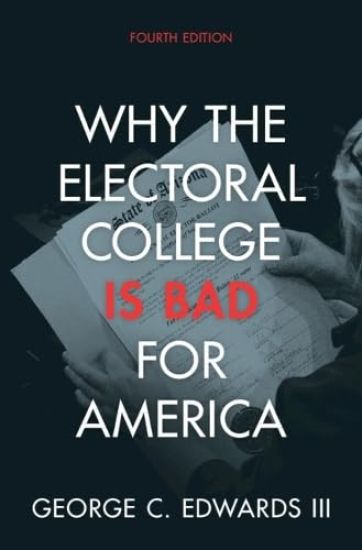
Why the Electoral College Is Bad for America

Why the Electoral College Is Bad for America

George C. Edwards III

Cambridge University Press
2023
sidottu
The electoral college is the extraordinarily complex mechanism by which Americans choose their president. Is there any justification for such a system, which may elect the candidate who does not receive the most votes? Today, with two of the last five presidential elections having gone to the popular vote loser and the debacle following the 2020 election, the electoral college's flaws are more apparent than ever. In this fourth edition of the definitive book on the electoral college, George Edwards employs rigorous analysis and systemic data to show how the system violates core democratic principles and does not provide the benefits its advocates claim. With a new chapter focusing on the 2020 election, Edwards addresses justifications for the electoral college that were popular among Trump supporters following the 2016 and 2020 elections. Edwards concludes by offering a straightforward approach to selecting the president that maximizes political equality.