Kirjojen hintavertailu. Mukana 11 342 296 kirjaa ja 12 kauppaa.

Kirjahaku

Etsi kirjoja tekijän nimen, kirjan nimen tai ISBN:n perusteella.

1000 tulosta hakusanalla Candace Rowe

The Tide Pool Waits

The Tide Pool Waits

Candace Fleming

Neal Porter Books
2025
nidottu
Dive into the rich ecology of tide pools and watch a hidden world spring in this masterful nonfiction picture book for very young readers. Twice a day when the tide goes out, an astonishing world is revealed in the tide pools that form along the Pacific Coast. Some of the creatures that live here look like stone. Others look like plants. Some move so slowly it's hard to tell if they're moving at all, while others are so fast you're not sure you really saw them. The biggest animals in the pool are smaller than your hand, while the smallest can't be seen at all without a microscope. During low tide, all these creatures - big, small, fast, slow - are exposed to air and the sun's drying heat. And so they have developed ways to survive the wait until the ocean's return. Candace Fleming is the author of Honeybee, which received an Orbis Pictus Honor and 7 starred reviews. She brings her knack for making science and nature appealing to the very young in The Tidepool Waits with detailed accounts of dozens of species of sea life, culminating in a perfect primer for students and nature lovers taking their first trip to the shore. Her text is accompanied by effervescent artwork by Amy Hevron and substantial backmatter. A Junior Library Guild Gold Standard SelectionA Charlotte Zolotow Highly Commended Book

Biosynthesis and Biodegradation of Cellulose

Biosynthesis and Biodegradation of Cellulose

Candace H. Haigler

CRC Press Inc
1990
sidottu
A gathering of articles bringing together knowledge of both the synthesis and degradation of a pervasive biological substance, cellulose. Topics include native cellulose; particle rosettes and terminal globules; microfibril biogenesis; synthesis in Acetobacter xylinum ; biodegradation measurement; e
Climbing the Ladder, Chasing the Dream

Climbing the Ladder, Chasing the Dream

Candace O'Connor; Eva Louise Frazier

University of Missouri Press
2022
sidottu
Nothing about Homer G. Phillips Hospital came easily. Built to serve St. Louis’s rapidly expanding African-American population, the grand new hospital opened its doors in 1937, toward the end of the Great Depression, amid a national period of institutional segregation and strong racial prejudice. When the beautiful, up-to-date hospital opened, it attracted more black residents than any other such program in the United States. Patients also flocked to the hospital, as did nursing students who found there excellent training, ready employment, and a boost into the middle class. But the 1960s and 1970s brought less need for all-black hospitals, as faculty, residents, and patients were increasingly welcome in the many newly integrated institutions. Ever tightening city budgets meant increasingly less money for the hospital, and in 1979, despite protests from the African-American community, HGPH closed. Candace O’Connor draws upon contemporary newspaper articles, institutional records, and her own oral history project to tell the first full history of the Homer G. Phillips Hospital—as well as brings new facts and insights into the life and mysterious murder (still an unsolved case) of the hospital’s namesake, a pioneering Black attorney and civil rights activist who spearheaded the efforts to raise funds to build the sorely needed medical facility to the Ville.
Peace Weavers

Peace Weavers

Candace Wellman

Washington State University Press
2017
pokkari
Throughout the mid-1800s, outsiders, including many Euro-Americans, arrived in what is now northwest Washington. As they interacted with Samish, Lummi, S'Klallam, Sto:lo, and other groups, some of the men sought relationships with young local women. Hoping to establish mutually beneficial ties, Coast and Interior Salish families arranged strategic cross-cultural marriages. Some pairs became lifelong partners while other unions were short. These were crucial alliances that played a critical role in regional settlement and spared Puget Sound's upper corner from the tragic conflicts other regions experienced. Accounts of the men, who often held public positions--army officer, Territorial Supreme Court justice, school superintendent, sheriff--exist in a variety of records. Some, like the nephew of Confederate President Jefferson Davis, were from prominent eastern families. Yet across the West, the contributions of their native wives remain unacknowledged.The women's lives were marked by hardships and heartbreaks common for the time, but the four profiled--Caroline Davis Kavanaugh, Mary Fitzhugh Lear Phillips, Clara Tennant Selhameten, and Nellie Carr Lane--exhibited exceptional endurance, strength, and adaptability. Far from helpless victims, they influenced their husbands and controlled their homes. Remembered as loving mothers and good neighbors, they ran farms, nursed and supported family, served as midwives, and operated businesses. They visited relatives and attended ancestral gatherings, often with their children. Each woman's story is uniquely hers, but together they and other intermarried women helped found Puget Sound communities and left lasting legacies. They were peace weavers.Author Candace Wellman hopes to shatter stereotypes surrounding these relationships. Numerous collaborators across the United States and Canada--descendants, local historians, academics, and more--graciously participated in her seventeen-year effort.
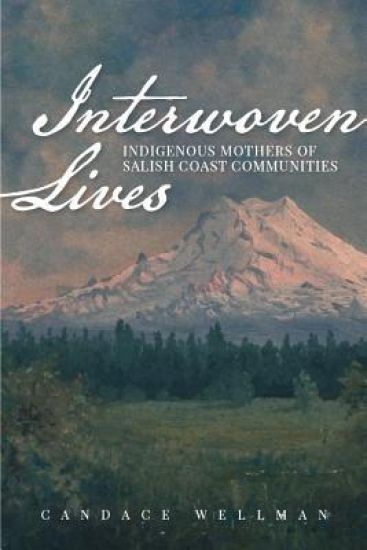
Interwoven Lives

Interwoven Lives

Candace Wellman

Washington State University Press
2019
pokkari
In this companion work to Peace Weavers, her award-winning first book on Puget Sound's cross-cultural marriages, author Candace Wellman depicts the lives of four additional intermarried indigenous women who influenced mid-1800s settlement in the Bellingham Bay area. She describes each wife's native culture, details ancestral history and traits for both spouses, and traces descendants' destinies, highlighting the families' contributions to new communities.Jenny Wynn was the daughter of an elite Lummi and his Songhees wife, and was a strong voice for justice for her people. She and her husband Thomas owned a farm and donated land and a cabin for the second rural school. Several descendants became teachers. Snoqualmie Elizabeth Patterson, daughter of the most powerful native leader in western Washington, married a cattleman. After her death from tuberculosis, kind foster parents raised her daughters, who ultimately grew up to enhance Lynden's literary and business growth. Resilient and strong, Mary Allen was the daughter of an Nlaka'pamux leader on British Columbia's Fraser River. The village of Marietta arose from her long marriage. Later, her sons played important roles in southeast Alaska's early fishing industry. The indigenous wife of Fort Bellingham commander George W. Pickett (later a brigadier general in the Civil War) left no name to history after her early death, but gifted the West with one of its most important early artists, James Tilton Pickett.Interwoven Lives was a finalist for the 2020 Willa Literary Award, scholarly nonfiction.
Man of Treacherous Charm

Man of Treacherous Charm

Candace A. Wellman

Washington State University Press
2023
pokkari
In 1857, coal mine manager Edmund C. Fitzhugh killed a drunken trespasser in his garden. Though Fitzhugh was under indictment for murder and only marginally qualified for the position, U.S. president James Buchanan made the stunning decision to appoint him to Washington Territory's District and Supreme Courts.The blue blood Virginian lawyer migrated to the California gold rush in 1849. After Fitzhugh's San Francisco law partner and others invested in a new Bellingham Bay coal mine, he moved north to open it. During the next ten years--including a few as Democratic Party chairman--he built and exploited his political network. In addition to serving on the federal bench and managing the militarily strategic mine, he was a county auditor, became Governor Isaac Stevens' Treaty War military aide and Indian agent, and helped Stevens run the 1860 Breckinridge for President national campaign. During the Civil War he returned home and was Confederate General Eppa Hunton's staff officer. After the war, he practiced law in a small Iowa town. Fitzhugh devastated the lives of four wives and six children, and eventually died alone in the fleabag remnant of a once-prestigious San Francisco hotel.Author Candace Wellman spent more than two decades researching Fitzhugh's life and contributions--both good and bad--to Pacific Northwest history. Although the court system played a large part in the region's future, Man of Treacherous Charm is the first full biography of an early Washington Territory justice. The volume offers unique insights into the people, personalities, politics, and practices of the territory and the American West in the 19th century.
Holding Police Accountable

Holding Police Accountable

Candace McCoy

Urban Institute Press,U.S.
2010
nidottu
In Holding Police Accountable, nine of todays leading scholars on police work examine seminal research on the use of force and how it can inform today's research. The volume celebrates the late James J. Fyfe, the preeminent scholar on police use of force. In 1978 Fyfe found that administrative controls—training, guidelines, and regulation—reduced deadly shootings by officers without adversely affecting law enforcement or crime rates. The finding not only had profound impact on firearms policy, but compelled police departments to cooperate with independent researchers. Here, the scholars pick up the torch to work toward effective yet fair policing that will better protect all Americans.
Pomme De Terre Volume 2

Pomme De Terre Volume 2

Candace Simar

North Star Press of St. Cloud
2010
nidottu
1862 was a tumultuous year in Minnesota history. The youngest state in the Union, Minnesota was one of the first to send men to fight in the Civil War. With the men gone, women and children were left to fend for themselves. The Civil War drained soldiers formerly stationed in Minnesota military outposts leaving the state undermanned and unprotected. Budget woes related to war expenses caused treaty payments to be very late. Indian Agents at the Lower Sioux Agency refused to hand out needed supplies until the gold arrived. The Sioux were starving.The result was the Sioux Uprising of 1862, the largest Indian war in U.S. history. Because it happened between the bloody battles of Shiloh and Antietam, it was largely unknown. Its effects on Minnesota and the Sioux Nation still reverberate today. Abercrombie Trail, the first book in the series, tells the story of Scandinavian immigrants caught up in the clash of cultures. Although the government declared the uprising over in the fall of 1862, Pomme de Terre tells the story of settlers living in the western part of the state where raids continued through the following year.
Birdie Volume 3

Birdie Volume 3

Candace Simar

North Star Press of St. Cloud
2011
nidottu
1873 Minnesota. Evan and Inga Jacobson struggle to raise their family in the midst of bank failures, grasshoppers and lingering effects of the 1862 Uprising. Harsh economic realities force them to relocate to Otter Tail County where they must begin again in a hostile environment. Ragna Larson, their foster daughter, grows up haunted by her missing sister, Birdie. Though both girls were kidnapped by the Sioux during the Uprising, only one returned. Ragna must make peace with the past before she can move forward with her life. Evan and Inga must do the same.
Blooming Prairie Volume 4

Blooming Prairie Volume 4

Candace Simar

North Star Press of St. Cloud
2012
nidottu
Blooming Prairie is the fourth and final novel of the Abercrombie Trail series. Widow Serena Gustafson returns to Pomme de Terre where her husband was killed during the Sioux Uprising. Her dreams of financial independence dissolve when land values plummet after a scourge of Rocky Mountain locusts. Serena must release the past before she can embrace her future. Evan Jacobson, homesteading in nearby Otter Tail County, takes a job driving mules over the Wadsworth Trail. While Evan is on the road, newlyweds Anders and Ragna Vollen stay with Evan's family. Increasing Indian tensions in Dakota Territory threaten to spill over into Minnesota, renewing old fears and bitter memories from the1862 Uprising.
Shelterbelts

Shelterbelts

Candace Simar

North Star Press of St. Cloud
2015
nidottu
Tia Fiskum, the old maid of Tolga Township, yearns to retain her hold on the family farm after her shell-shocked brother returns from World War II. The neighbor she hopes to marry chooses a town girl for his new wife.The Potato King listens to the radio preacher and prays for a miracle. Eddy Root fears a return to the asylum. A German war bride struggles to find acceptance in this tight-knit Scandinavian community. Woven throughout is the man who walks lizards, a grieving father, a disillusioned pastor and the neighborhood gossipmonger. Shelterbelts chronicles the life of a community struggling to return to normal after war, true to history while rich in the complications of the human spirit.
Tricky Grounds

Tricky Grounds

Candace Brunette-Debassige

University of Regina Press
2023
pokkari
Breaks the deafening silence of Indigenous women's voices in academic leadership positions. Since the 2015 release of the report on the Truth and Reconciliation Commission of Canada, new Indigenous policies have been enacted in universities and a variety of interconnecting Indigenous senior administrative roles have been created. Many of these newly created roles have been filled by Indigenous women. But what does it mean for Indigenous women to be recruited to Indigenize Western institutions that have not undergone introspective, structural change? Informed by her own experiences and the stories of other Indigenous women working in senior administrative roles in Canadian universities, Candace Brunette-Debassige explores the triple-binding position Indigenous women often find themselves trapped in when trying to implement reconciliation in institutions that remain colonial, Eurocentric, and male-dominated. The author considers too the gendered, emotional labour Indigenous women are tasked with when universities rush to Indigenize without the necessary preparatory work of decolonization. Drawing on an Indigenous feminist decolonial theoretical lens and positioning Indigenous story as theory, Brunette-Debassige illustrates how Indigenous women can and do preserve and enact their agency through resistance, and help lead deeper transformative changes in Canadian universities. Ultimately, her work provides a model for how reconciliation and Indigenization can be done at an institutional level.
Tricky Grounds

Tricky Grounds

Candace Brunette-Debassige

University of Regina Press
2024
sidottu
Breaks the deafening silence of Indigenous women's voices in academic leadership positions. Since the 2015 release of the report on the Truth and Reconciliation Commission of Canada, new Indigenous policies have been enacted in universities and a variety of interconnecting Indigenous senior administrative roles have been created. Many of these newly created roles have been filled by Indigenous women. But what does it mean for Indigenous women to be recruited to Indigenize Western institutions that have not undergone introspective, structural change? Informed by her own experiences and the stories of other Indigenous women working in senior administrative roles in Canadian universities, Candace Brunette-Debassige explores the triple-binding position Indigenous women often find themselves trapped in when trying to implement reconciliation in institutions that remain colonial, Eurocentric, and male-dominated. The author considers too the gendered, emotional labour Indigenous women are tasked with when universities rush to Indigenize without the necessary preparatory work of decolonization. Drawing on an Indigenous feminist decolonial theoretical lens and positioning Indigenous story as theory, Brunette-Debassige illustrates how Indigenous women can and do preserve and enact their agency through resistance, and help lead deeper transformative changes in Canadian universities. Ultimately, her work provides a model for how reconciliation and Indigenization can be done at an institutional level.
Rewriting Literacy

Rewriting Literacy

Candace Mitchell; Kathleen Weiler

Praeger Publishers Inc
1991
sidottu
Rewriting Literacy makes a profound contribution to the developing field of literacy studies as it is the first book which seeks to link such disciplines as linguistics, sociolinguistics, anthropology, education, English as a second language, and reading and writing theory.The chapters in this edited collection, by some of the foremost scholars of the day, all focus on the nature of literacy. Each article brings to light important concerns regarding literacy, concerns which are often ignored by the more traditionally oriented educationalist. The authors illustrate how literacy is embedded in a social and cultural context bringing into question the very nature of what it means to be literate. Each piece highlights, either implicitly or explicitly, the highly political nature of literacy and in doing so approaches the study of literacy from a critical and pedagogical perspective. The body of work presented in this volume is relevant not only to individuals whose main focus is on the area of literacy studies, but to all those concerned about minority disenfranchisement, institutional inequity, and the political, cultural, and social dimensions of education.
Rewriting Literacy

Rewriting Literacy

Candace Mitchell; Kathleen Weiler

Praeger Publishers Inc
1991
nidottu
Rewriting Literacy makes a profound contribution to the developing field of literacy studies as it is the first book which seeks to link such disciplines as linguistics, sociolinguistics, anthropology, education, English as a second language, and reading and writing theory.The chapters in this edited collection, by some of the foremost scholars of the day, all focus on the nature of literacy. Each article brings to light important concerns regarding literacy, concerns which are often ignored by the more traditionally oriented educationalist. The authors illustrate how literacy is embedded in a social and cultural context bringing into question the very nature of what it means to be literate. Each piece highlights, either implicitly or explicitly, the highly political nature of literacy and in doing so approaches the study of literacy from a critical and pedagogical perspective. The body of work presented in this volume is relevant not only to individuals whose main focus is on the area of literacy studies, but to all those concerned about minority disenfranchisement, institutional inequity, and the political, cultural, and social dimensions of education.