Kirjojen hintavertailu. Mukana 12 083 983 kirjaa ja 12 kauppaa.

Kirjahaku

Etsi kirjoja tekijän nimen, kirjan nimen tai ISBN:n perusteella.

1000 tulosta hakusanalla David M Pack

Microwave Engineering

Microwave Engineering

David M. Pozar

John Wiley Sons Inc
2011
sidottu
Pozar's new edition of Microwave Engineering includes more material on active circuits, noise, nonlinear effects, and wireless systems. Chapters on noise and nonlinear distortion, and active devices have been added along with the coverage of noise and more material on intermodulation distortion and related nonlinear effects. On active devices, there's more updated material on bipolar junction and field effect transistors. New and updated material on wireless communications systems, including link budget, link margin, digital modulation methods, and bit error rates is also part of the new edition. Other new material includes a section on transients on transmission lines, the theory of power waves, a discussion of higher order modes and frequency effects for microstrip line, and a discussion of how to determine unloaded.
Counterfeiting Exposed

Counterfeiting Exposed

David M. Hopkins; Lewis T. Kontnik; Mark T. Turnage

John Wiley Sons Inc
2003
sidottu
Praise for Counterfeiting EXPOSED "This book is the bible on anticounterfeiting. It is everything a company or individual needs to enlighten and protect themselves from this ever-increasing crime." –– Frank W. Abagnale author of Catch Me If You Can and The Art of the Steal "This book tells you absolutely everything you need to know about the trade in fakes and what to do about it –– and then adds a bit more. It is immensely detailed, thoroughly researched, and well set out. Above all, it is readable and the ideas and information flow in an appropriately structured way. My copy will get dog-eared very quickly." ––John Anderson Chairman, The Global Anti-Counterfeiting Group
Microwave and RF Design of Wireless Systems

Microwave and RF Design of Wireless Systems

David M. Pozar

John Wiley Sons Inc
2000
sidottu
This book offers a quantitative and design-oriented presentation of the analog RF aspects of modern wireless telecommunications and data transmission systems from the antenna to the baseband level. It takes an integrated approach to topics such as antennas and proagation, microwave systems and circuits and communication systems.
Establishing A CGMP Laboratory Audit System

Establishing A CGMP Laboratory Audit System

David M. Bliesner

John Wiley Sons Inc
2006
sidottu
The first systematic, hands-on auditing guide for today's pharmaceutical laboratories In today's litigious environment, pharmaceutical laboratories are subject to ever stricter operational guidelines as mandated by the FDA, and must be able to establish and demonstrate sustainable operational practices that ensure compliance with the current good manufacturing practice (CGMP) regulations. David Bliesner's Establishing a CGMP Laboratory Audit System: A Practical Guide is designed to provide laboratory supervisors and personnel with a step-by-step, hands-on audit system that they can rely on to ensure their facility remains compliant with all current and future requirements. Focusing on a "team approach," the author uses detailed flowcharts, checklists, and descriptions of the auditing process to help readers develop a new audit system or upgrade their current system in order to: * Improve current compliance * Demonstrate sustainable compliance * Produce data for federal inspections * Avoid regulatory action Enhanced with detailed checklists and a wealth of practical and flexible auditing tools on CD-ROM, this book provides an ideal resource for new and future laboratory personnel, and an excellent means for keeping existing industry practitioners up to date on the nuances of operating a consistently compliant pharmaceutical laboratory.
Validating Chromatographic Methods

Validating Chromatographic Methods

David M. Bliesner

John Wiley Sons Inc
2006
muu
All the information and tools needed to set up a successful method validation system Validating Chromatographic Methods brings order and Current Good Manufacturing Practices to the often chaotic process of chromatographic method validation. It provides readers with both the practical information and the tools necessary to successfully set up a new validation system or upgrade a current system to fully comply with government safety and quality regulations. The net results are validated and transferable analytical methods that will serve for extended periods of time with minimal or no complications. This guide focuses on high-performance liquid chromatographic methods validation; however, the concepts are generally applicable to the validation of other analytical techniques as well. Following an overview of analytical method validation and a discussion of its various components, the author dedicates a complete chapter to each step of validation: Method evaluation and further method developmentFinal method development and trial method validationFormal method validation and report generationFormal data review and report issuance Templates and examples for Methods Validation Standard Operating Procedures, Standard Test Methods, Methods Validation Protocols, and Methods Validation Reports are all provided. Moreover, the guide features detailed flowcharts and checklists that lead readers through every stage of method validation to ensure success. All of the templates are also included on a supplementary support site, enabling readers to easily work with and customize them. For scientists and technicians new to method validation, this guide provides all the information and tools needed to develop a top-quality system. For those experienced with method validation, the guide helps to upgrade and improve existing systems.
The Liquid State

The Liquid State

David M. Heyes

John Wiley Sons Inc
1997
sidottu
This volume details the application of molecular simulation to the liquid state. It is organised in a clear and logical way that first takes the reader through the underlying statistical mechanical theory necessary to understand the liquid state, especially those aspects that can be taken advantage of by simulation to help unravel the nature of the liquid state. It continues by covering the various modern variants of the Monte Carlo and Molecular dynamics techniques, for example, Gibbs ensemble MC and alternative ensemble MD. The effects of molecular architecture and chemical composition on the microscopic and macroscopic behaviour of liquids are also covered. The author has included chapters on surfaces, equations of state and phase equilibria, which emphasise new simulation techniques and conclusions made from the theories. Langmuir films, liquid crystals and the glassy state are also considered.
Britain and World Power since 1945

Britain and World Power since 1945

David M. McCourt

The University of Michigan Press
2014
nidottu
?Though Britain’s descent from global imperial power began in World War II and continued over the subsequent decades with decolonization, military withdrawal, and integration into the European Union, its foreign policy has remained that of a Great Power. David M. McCourt maintains that the lack of a fundamental reorientation of Britain’s foreign policy cannot be explained only by material or economic factors, or even by an essential British international “identity.” Rather, he argues, the persistence of Britain’s place in world affairs can best be explained by the prominent international role that Britain assumed and into which it was thrust by other nations, notably France and the United States, over these years. Using a role-based theory of state action in international politics based on symbolic interactionism and the work of George Herbert Mead, Britain and World Power since 1945 puts forward a novel interpretation of Britain’s engagement in four key international episodes: the Suez Crisis of 1956, the Skybolt Crisis of 1962, Britain’s second application to the European Economic Council in 1966–67, and Britain’s reinvasion of the Falklands in 1982. McCourt concludes with a discussion of international affairs since the end of the Cold War and the implications for the future of British foreign policy.
Britain and World Power since 1945

Britain and World Power since 1945

David M. McCourt

The University of Michigan Press
2014
sidottu
?Though Britain’s descent from global imperial power began in World War II and continued over the subsequent decades with decolonization, military withdrawal, and integration into the European Union, its foreign policy has remained that of a Great Power. David M. McCourt maintains that the lack of a fundamental reorientation of Britain’s foreign policy cannot be explained only by material or economic factors, or even by an essential British international “identity.” Rather, he argues, the persistence of Britain’s place in world affairs can best be explained by the prominent international role that Britain assumed and into which it was thrust by other nations, notably France and the United States, over these years. Using a role-based theory of state action in international politics based on symbolic interactionism and the work of George Herbert Mead, Britain and World Power since 1945 puts forward a novel interpretation of Britain’s engagement in four key international episodes: the Suez Crisis of 1956, the Skybolt Crisis of 1962, Britain’s second application to the European Economic Council in 1966–67, and Britain’s reinvasion of the Falklands in 1982. McCourt concludes with a discussion of international affairs since the end of the Cold War and the implications for the future of British foreign policy.
A Critique of the Study of Kinship

A Critique of the Study of Kinship

David M. Schneider

The University of Michigan Press
1984
nidottu
Schneider challenges the assumptions on which anthropology has depended for the last century by showing that one of the major categories in terms of which social life has been understood is largely untenable. The idea of kinship is subject to penetrating scrutiny. Unlike the proverbial Emperor, it is not that kinship has no clothes. The question is whether there is anything at all underneath those clothes. And even when the clothes appear to be shreds and patches held together by a web of illusions. The critique uses a novel device in that the same set of ethnographic “facts” are looked at through different theories. This reveals a good deal about the different theories. By the same token, of course, this critique goes into the question of what a “fact” of “kinship” might be and how to recognize one either at home or in the field. Schneider’s critique also uses history to raise cogent questions about how kinship has been studied. But it is not as 20/20 hindsight that history is used. Due respect is paid to the climate of the time, as well as the climatic changes and the ways in which these helped to create the emperor’s clothes. Right, wrong, or indifferent, Schneider’s study of how the emperor “kinship” was dressed and then redressed as the winds of change threatened disarray, proves challenging to the theories by which anthropology lives, as well as to the specifically privileged domain of “kinship.” The implications of this study for a wide range of problems within theoretical anthropology are striking.
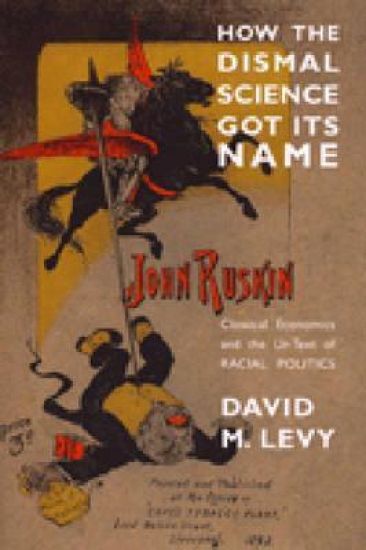
How the Dismal Science Got Its Name

How the Dismal Science Got Its Name

David M. Levy

The University of Michigan Press
2002
nidottu
It is widely asserted that the Victorian sages attacked classical economics from a humanistic or egalitarian perspective, calling it "the dismal science," and that their attack is relevant to modern discussions of market society. David M. Levy here demonstrates that these assertions are simply false: political economy became "dismal" because Carlyle, Ruskin, and Dickens were horrified at the idea that systems of slavery were being replaced by systems in which individuals were allowed to choose their own paths in life. At a minimum, they argued, "we" white people ought to be directing the lives of "them," people of color. Economists of the time argued, on the other hand, that people of color were to be protected by the rule of law--hence the moniker "the dismal science." A startling image from 1893, which is reproduced in full color on this book's jacket, shows Ruskin killing someone who appears to be nonwhite. A close look reveals that the victim is reading "The Dismal Science." Levy discusses this image at length and also includes in his text weblinks to Carlyle's "Occasional Discourse on the Negro Question" and to Mill's response, demonstrating that these are central documents in British classical economics. He explains Adam Smith's egalitarian foundations, contrasting Smith's approach to the hierarchical alternative proposed by Carlyle. Levy also examines various visual representations of this debate and provides an illuminating discussion of Smith's "katallactics," the science of exchange, comparing it with the foundations of modern neoclassical economics. How the Dismal Science Got Its Name also introduces the notion of "rational choice scholarship" to explain how attacks on market economics from a context in which racial slavery was idealized have been interpreted as attacks on market economics from a humanistic or egalitarian context. Thus it will greatly appeal to economists, political scientists, philosophers, students of Victorian literature, and historians. David M. Levy is Associate Professor of Economics and Research Associate, Center for Study of Public Choice, George Mason University.
Manipulating the Market

Manipulating the Market

David M. Rowe

The University of Michigan Press
2001
sidottu
Manipulating the Market provides a new, more fruitful way to study economic sanctions. Instead of asking the traditional question "Do sanctions work?," it uses neoclassical economic theory, the insights of new institutional economics, and an intensive analysis of sanctions in five major Rhodesian markets to explain the more important problem of how target governments and private actors respond to the imposition of economic sanctions. The Rhodesian crisis was one of Britain's thorniest and most important foreign policy issues in the 1960s and 1970s. The oil embargo caused a major political scandal. Yet the sanctions era, and especially the motives and performance of the white Rhodesian regime, are almost entirely unexplored in the historiography of southern Africa. Manipulating the Market contributes to the study of this period while addressing the broader theoretical question of the utility of economic sanctions.Economicsanctions are an extremely important but poorly understood instrument of state craft. Without the aid of strong causal theories that explain how and why economic sanctions influence the behavior of target actors, policy makers cannot accurately forecast how these actors will respond to sanctions, assess the tradeoffs that arise from imposing sanctions, or improve their ability to use economic sanctions wisely. Manipulating the Market redresses this shortcoming by showing how economic sanctions generate strong societal demands for new institutions to regulate the market, and how the target government can then exploit these institutions to capture the political loyalty of powerful domestic groups. Without dismissing economic sanctions as a foreign policy tool, the author explains why devastating economic sanctions often strengthen rather than weaken target regimes.David Rowe is Assistant Professor of Political Science, The Ohio State University.
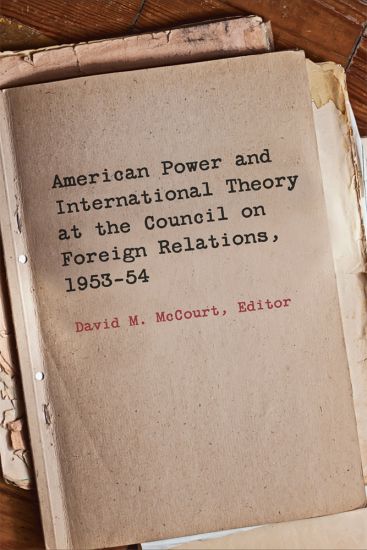
American Power and International Theory at the Council on Foreign Relations, 1953-54
Between December 1953 and June 1954, the elite think-tank the Council on Foreign Relations (CFR) joined prominent figures in International Relations, including Pennsylvania’s Robert Strausz-Hupé, Yale’s Arnold Wolfers, the Rockefeller Foundation’s William Thompson, government adviser Dorothy Fosdick, and nuclear strategist William Kaufmann. They spent seven meetings assessing approaches to world politics—from the “realist” theory of Hans Morgenthau to theories of imperialism of Karl Marx and V.I. Lenin—to discern basic elements of a theory of international relations.The study group’s materials are an indispensable window to the development of IR theory, illuminating the seeds of the theory-practice nexus in Cold War U.S. foreign policy. Historians of International Relations recently revised the standard narrative of the field’s origins, showing that IR witnessed a sharp turn to theoretical consideration of international politics beginning around 1950, and remained preoccupied with theory. Taking place in 1953–54, the CFR study group represents a vital snapshot of this shift.This book situates the CFR study group in its historical and historiographical contexts, and offers a biographical analysis of the participants. It includes seven preparatory papers on diverse theoretical approaches, penned by former Berkeley political scientist George A. Lipsky, followed by the digest of discussions from the study group meetings. American Power and International Theory at the Council on Foreign Relations, 1953–54 offers new insights into the early development of IR as well as the thinking of prominent elites in the early years of the Cold War.
Group Theory and Chemistry

Group Theory and Chemistry

David M. Bishop

Dover Publications Inc.
2003
nidottu
Concise, self-contained introduction to group theory and its applications to chemical problems. Symmetry, symmetry operations, point groups, matrices, matrix representations, equivalent and reducible representations, irreducible representations and character tables, representations and quantum mechanics, molecular vibrations, molecular orbital theory, hybrid orbitals, and transition metal chemistry. Advanced-undergraduate/graduate level. 1973 edition.
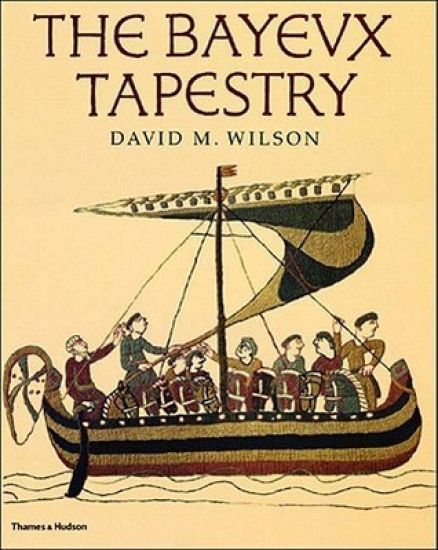
Bayeux Tapestry

Bayeux Tapestry

David M. Wilson; Jean Le Carpentier

Thames Hudson Ltd
2004
sidottu
One of the most unique objects in the world, the Bayeux Tapestry, which depicts the invasion of England by William the Conqueror on a single length of linen, is reproduced here in full color, with annotations explaining the incredible details it contains.
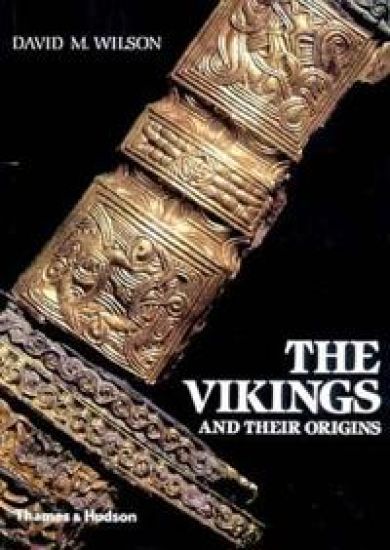
The Vikings and their Origins

The Vikings and their Origins

David M. Wilson

Thames Hudson Ltd
1989
nidottu
This book is intended not only to portray an image of the Vikings but to show something of the culture of the Scandinavian countries in which they were settled in the four centuries before they burst on the European scene.
Bank Control of Large Corporations in the United States

Bank Control of Large Corporations in the United States

David M. Kotz

University of California Press
1980
pokkari
"Truly a distinguished piece of work, based on new data that had not been analyzed before. There is an excellent combination of historical perspective, conscientious examination of a great mass of data, and penetrating analysis." --Robert Aaron Gordon, Charter Member of the Brookings Panel on Economic Activity "Contends that since the Second World War, a small number of 'giant, well-established' banks in a few major cities have re-emerged as the major group that controls large corporations. Places the financial control thesis in historical perspective from the Civil War to the present and then examines the control of the two hundred largest U.S. corporations in 1967-69 in terms of owner control, financial control, and no identified center of control. Also comments on the means of exercising control...the author finds that a substantial portion of the largest nonfinancial corporations in 1967-69 were under the control of financial institutions; the control is exercised through the ownership of stock and the role of the bankers as creditors of the corporations." --Journal of Economic Literature "Recent empirical evidence, made available through congressional hearings, reveals that large banking groups are exercising substantial influence over nonfinancial corporations. This is accomplished through stockholdings, creditor relationships, and directorship ties. In this excellent historical statistical analysis, Katz assesses the extent and impact of such control in a competitive economy." --Library Journal
To Weave and Sing

To Weave and Sing

David M. Guss

University of California Press
1990
pokkari
"To Weave and Sing" is the first in-depth analysis of the rich spiritual and artistic traditions of the Carib-speaking Yekuana Indians of Venezuela, who live in the dense rain forest of the upper Orinoco. Within their homeland of Ihuruna, the Yekuana have succeeded in maintaining the integrity and unity of their culture, resisting the devastating effects of acculturation that have befallen so many neighboring groups. Yet their success must be attributed to more than natural barriers of rapids and waterfalls, to more than lack of 'contact' with our 'modern' world. The ethnographic history recounted here includes not only the Spanish discovery of the Yekuana but detailed indigenous accounts of the entire history of Yekuana contact with Western culture, revealing an adaptive technique of mythopoesis by which the symbols of a new and hostile European ideology have been consistently defused through their incorporation into traditional indigenous structures. The author's initial point of departure is the Watunna, the Yekuana creation epic, but he finds his principal entrance into this mythic world through basketry, focusing on the elaborate kinetic designs of the round waja baskets and the stories told about them. Guss argues that the problem of understanding Yekuana basketry is the problem of understanding all traditional art forms within a tribal context, and critiques the cultural assumptions inherent in our systems of classification. He demonstrates that the symbols woven into the baskets function not in isolation but collectively, as a powerful system cutting across the entire culture. "To Weave and Sing" addresses all Yekuana material culture and the greater reality it both incorporates and masks, discerning a unifying configuration of symbols in chapters on architectural forms, the geography of the body, and the use of herbs, face paints, and chants. A narrow view of slash-and-burn gardens as places of mere subsistence is challenged by Guss' portrait of these exclusively female spaces as systematic inversions of the male world, 'the sacred turned on its head'. Throughout, a wealth of narrative and ritual materials provides us with the closest approximation we have to a native exegesis of these phenomena. What we are offered here is a new Poetics of Culture, ethnography not as a static given but as a series of shifting fields, wherein culture (and our image of it) is constantly recreated in all of its parts, by all of its members.
The Festive State

The Festive State

David M. Guss

University of California Press
2001
pokkari
If, as David Guss argues, culture is a contested terrain with constantly changing contours, then festivals are its battlegrounds, where people come to fight and dispute in large acts of public display. Festive behavior, long seen by anthropologists and folklorists as the "uniform expression of a collective consciousness, is contentious and often subversive," and The Festive State is an eye-opening guide to its workings. Guss investigates "the ideology of tradition," combining four case studies in a radical multisite ethnography to demonstrate how in each instance concepts of race, ethnicity, history, gender, and nationhood are challenged and redefined. In a narrative as colorful as the events themselves, Guss presents the Afro-Venezuelan celebration of San Juan, the "neo-Indian" Day of the Monkey, the mestizo ritual of Tamunangue, and the cultural policies and products of a British multinational tobacco corporation. All these illustrate the remarkable fluidity of festive behavior as well as its importance in articulating different cultural interests.