Kirjojen hintavertailu. Mukana 11 717 486 kirjaa ja 12 kauppaa.

Kirjahaku

Etsi kirjoja tekijän nimen, kirjan nimen tai ISBN:n perusteella.

1000 tulosta hakusanalla Dmitri Mereschkowski

Expert SQL Server Transactions and Locking
Master SQL Server’s Concurrency Model so you can implement high-throughput systems that deliver transactional consistency to your application customers. This book explains how to troubleshoot and address blocking problems and deadlocks, and write code and design database schemas to minimize concurrency issues in the systems you develop.SQL Server’s Concurrency Model is one of the least understood parts of the SQL Server Database Engine. Almost every SQL Server system experiences hard-to-explain concurrency and blocking issues, and it can be extremely confusing to solve those issues without a base of knowledge in the internals of the Engine. While confusing from the outside, the SQL Server Concurrency Model is based on several well-defined principles that are covered in this book.Understanding the internals surrounding SQL Server’s Concurrency Model helps you build high-throughput systems in multi-user environments. This book guides you through the Concurrency Model and elaborates how SQL Server supports transactional consistency in the databases. The book covers all versions of SQL Server, including Microsoft Azure SQL Database, and it includes coverage of new technologies such as In-Memory OLTP and Columnstore Indexes.What You'll LearnKnow how transaction isolation levels affect locking behavior and concurrencyTroubleshoot and address blocking issues and deadlocksProvide required data consistency while minimizing concurrency issuesDesign efficient transaction strategies that lead to scalable codeReduce concurrency problems through good schema designUnderstand concurrency models for In-Memory OLTP and Columnstore IndexesReduce blocking during index maintenance, batch data load, and similar tasksWho This Book Is ForSQL Server developers, database administrators, and application architects who are developing highly-concurrent applications. The book is for anyone interested in the technical aspects of creating and troubleshooting high-throughput systems that respond swiftly to user requests.
Design Patterns in Modern C++20

Design Patterns in Modern C++20

Dmitri Nesteruk

APRESS
2021
nidottu
Apply the latest editions of the C++ standard to the implementation of design patterns. As well as covering traditional design patterns, this book fleshes out new design patterns and approaches that will be useful to modern C++ developers. Author Dmitri Nesteruk presents concepts as a fun investigation of how problems can be solved in different ways, along the way using varying degrees of technical sophistication and explaining different sorts of trade-offs. Design Patterns in Modern C++20, Second Edition also provides a technology demo for modern C++, showcasing how some of its latest features (e.g., coroutines, modules and more) make difficult problems a lot easier to solve. The examples in this book are all suitable for putting into production, with only a few simplifications made in order to aid readability. What You Will LearnUse creational patterns such as builder, factories, prototype and singletonImplement structural patterns such as adapter, bridge, decorator, facade and moreWork with the behavioral patterns such as chain of responsibility, command, iterator, mediator and moreApply functional design patterns such as the Maybe Monad Who This Book Is For This book is for both beginner and experienced C++ developers.
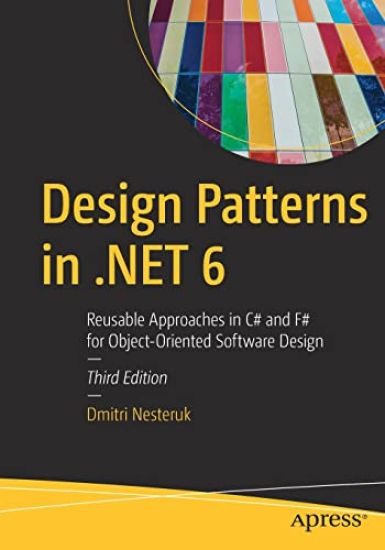
Design Patterns in .NET 6

Design Patterns in .NET 6

Dmitri Nesteruk

APRESS
2022
nidottu
Implement design patterns in .NET 6 using the latest versions of the C# and F# languages. This book provides a comprehensive overview of the field of design patterns as they are used in today’s developer toolbox. In addition to the functional builder, asynchronous factory method, generic value adapter, and composite proxies, this new edition introduces topics such as Decorator Cycle Policies Functional Commands, a Transformer variation of the Visitor pattern, and factories that can perform Object Tracking and Bulk Replacement.Using the C# and F# programming languages, Design Patterns in .NET 6 explores the classic design pattern implementations and discusses the applicability and relevance of specific language features for implementing patterns. You will learn by example, reviewing scenarios where patterns are applicable. Former C# MVP and patterns expert Dmitri Nesteruk demonstrates possible implementations of patterns,discusses alternatives and pattern relationships, and illustrates the way that a dedicated refactoring tool (JetBrains Rider) can be used to implement design patterns with ease.What You Will LearnBecome familiar with the latest pattern implementations available in C# 10 and F# 6Know how to better reason about software architectureUnderstand the process of refactoring code to patternsRefer to researched and proven variations of patternsStudy complete, self-contained examples, including many that cover advanced scenariosUse the latest versions of C# and Visual Studio/Rider/ReSharperWho This Book Is ForDevelopers who have some experience in the C# language and want to expand their comprehension of the art of programming by leveraging design approaches to solve modern problems
The Fall of Icarus: Stories

The Fall of Icarus: Stories

Dmitri Lee

Createspace Independent Publishing Platform
2015
nidottu
A boy's brother and father go off to war; a man purchases items from a hardware store; some kids continuously ring a doorbell; and a young boy recounts his time in a small cottage with his uncle. These, amongst other stories, aim to tell accounts of youthfulness, innocence, naivet , and even revenge.
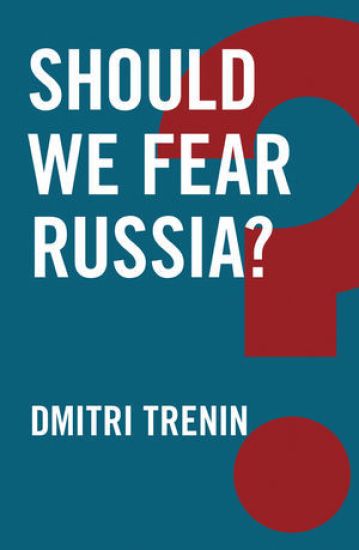
Should We Fear Russia?

Should We Fear Russia?

Dmitri Trenin

Polity Press
2016
sidottu
Since the outbreak of the Ukraine crisis, there has been much talk of a new Cold War between the West and Russia. Under Putin’s authoritarian leadership, Moscow is widely seen as volatile, belligerent and bent on using military force to get its way. In this incisive analysis, top Russian foreign and security policy analyst Dmitri Trenin explains why the Cold War analogy is misleading. Relations between the West and Russia are certainly bad and dangerous but - he argues - they are bad and dangerous in new ways; crucial differences which make the current rivalry between Russia, the EU and the US all the more fluid and unpredictable. Unpacking the dynamics of this increasingly strained relationship, Trenin makes a compelling case for handling Russia with pragmatism and care rather than simply giving into fear.
Should We Fear Russia?

Should We Fear Russia?

Dmitri Trenin

Polity Press
2016
nidottu
Since the outbreak of the Ukraine crisis, there has been much talk of a new Cold War between the West and Russia. Under Putin’s authoritarian leadership, Moscow is widely seen as volatile, belligerent and bent on using military force to get its way. In this incisive analysis, top Russian foreign and security policy analyst Dmitri Trenin explains why the Cold War analogy is misleading. Relations between the West and Russia are certainly bad and dangerous but - he argues - they are bad and dangerous in new ways; crucial differences which make the current rivalry between Russia, the EU and the US all the more fluid and unpredictable. Unpacking the dynamics of this increasingly strained relationship, Trenin makes a compelling case for handling Russia with pragmatism and care rather than simply giving into fear.
What Is Russia Up To in the Middle East?
The eyes of the world are on the Middle East. Today, more than ever, this deeply-troubled region is the focus of power games between major global players vying for international influence. Absent from this scene for the past quarter century, Russia is now back with gusto. Yet its motivations, decision-making processes and strategic objectives remain hard to pin down. So just what is Russia up to in the Middle East? In this hard-hitting essay, leading analyst of Russian affairs Dmitri Trenin cuts through the hyperbole to offer a clear and nuanced analysis of Russia's involvement in the Middle East and its regional and global ramifications. Russia, he argues, cannot and will not supplant the U.S. as the leading external power in the region, but its actions are accelerating changes which will fundamentally remake the international system in the next two decades.
What Is Russia Up To in the Middle East?
The eyes of the world are on the Middle East. Today, more than ever, this deeply-troubled region is the focus of power games between major global players vying for international influence. Absent from this scene for the past quarter century, Russia is now back with gusto. Yet its motivations, decision-making processes and strategic objectives remain hard to pin down. So just what is Russia up to in the Middle East? In this hard-hitting essay, leading analyst of Russian affairs Dmitri Trenin cuts through the hyperbole to offer a clear and nuanced analysis of Russia's involvement in the Middle East and its regional and global ramifications. Russia, he argues, cannot and will not supplant the U.S. as the leading external power in the region, but its actions are accelerating changes which will fundamentally remake the international system in the next two decades.
Russia

Russia

Dmitri Trenin

Polity Press
2019
sidottu
Over the past century alone, Russia has lived through great achievements and deepest misery; mass heroism and mass crime; over-blown ambition and near-hopeless despair – always emerging with its sovereignty and its fiercely independent spirit intact. In this book, leading Russia scholar Dmitri Trenin accompanies readers on Russia’s rollercoaster journey from revolution to post-war devastation, perestroika to Putin’s stabilization of post-Communist Russia. Explaining the causes and the meaning of the numerous twists and turns in contemporary Russian history, he offers a vivid insider’s view of a country through one of its most trying and often tragic periods. Today, he cautions, Russia stands at a turning point – politically, economically and socially – its situation strikingly reminiscent of the Russian Empire in its final years. For the Russian Federation to avoid a similar demise, it must learn the lessons of its own history.