

Kirjahaku
Etsi kirjoja tekijän nimen, kirjan nimen tai ISBN:n perusteella.
1000 tulosta hakusanalla Edward M. Stack



Shankman & O'Neill have done it again, this time on the shores of a beautiful lake. In their newest romp, a young family spends joyful summers lakeside surrounded by nature .Dive in and just picture the fishes that called that lake home - that would wriggle and dive, blow their bubbles, and roam. Listen to the nighttime critters: The beat was just so, when the volume would grow, and the fireflies added some light to the show. And the daytime animals? They ran and they sat and they ate and they hid; they did all the same things that the rest of us did.A true celebration of spending summer days outdoors, em>The Lake I Love is a beautiful, rhyming adventure that you'll love sharing with your family and friends.

Dive into the heart of wartime innovation and manufacturing through this groundbreaking book, unveiling a riveting narrative of technological mastery and organizational ingenuity. This meticulously researched work challenges conventional views of wartime production, offering a fresh perspective on the incredible efforts that drove the Allies to victory.Young's insightful analyses illuminate the strategic collaboration between the aerospace and automotive industries, showcasing their collective adaptation that created the engines powering victory. Spanning continents, Young examines the transformation of aircraft engine manufacturing during World War II. Unearthing the operations of key players such as the Bristol Aeroplane Company, Pratt & Whitney, and Wright Aeronautical, he sheds light on the monumental shift from traditional batch production to revolutionary quantity production.Readers will witness the birth of new factories, the development of advanced machine tools, and the innovation required to produce engines of unparalleled complexity and precision. Through Young's fresh perspective, the book unveils the intricate interplay of crisis techno-politics, engineering resilience, and the pivotal role of innovation in shaping the tides of history.This book is not just a study of the past; it is a critical foundation for understanding the dynamics of wartime production that continue to influence our world today."Edward Young's reconstruction and analysis of the Allies' massive World War II aircraft engine programs is priceless, unique, thorough and critical - all at once." Philip Scranton - Professor Emeritus, History of Industry and Technology, Rutgers University


An illustrated account of the combats in the closing months of World War II between one of America's premier fighter aeroplanes and the product of Japan's effort to introduce fighters that could match American qualitative superiority.The Vought Corsair was the first American single-engined fighter to exceed 400 mph and establish dominance over the legendary Mitsubishi Type Zero-sen. The Ki-84 Hayate was introduced by the Japanese specifically to counter this growing American dominance of the skies over the Pacific. Built in greater numbers than any other late war Japanese fighter, nearly 3000 were completed between 1944 and 1945.This volume examines the clashes between the Corsair and Ki-84 in the closing stages of the war, revealing how Corsair pilots had to adapt their techniques and combat strategies to adapt to these newer types. It also reveals how the kill rate was largely driven by the reduced quality of fighter pilots after the high casualty rates inflicted on the Japanese air force during the air battles over the Solomon Islands.

Flying from and between bases in China and India, the B-25s bombed every type of Japanese target during World War 2 in the China-Burma-India (CBI) Theatre, ultimately dropping more ordinance than their larger four-engined B-24 Liberator brethren.Mitchell bombers took on the task of disrupting the flow of Japanese supplies to the frontlines at medium ranges, bombing Japanese supply centres, railway depots and bridges. It was in this last capacity that the B-25 established a unique role as a ‘bridge-buster’. This provided significant support for the British Fourteenth Army as they advanced into Burma.Fully illustrated with detailed cutaway artwork, this book tells the important, yet forgotten story of B-25 operations in the CBI Theatre and the important role that this aircraft played on the road to victory.
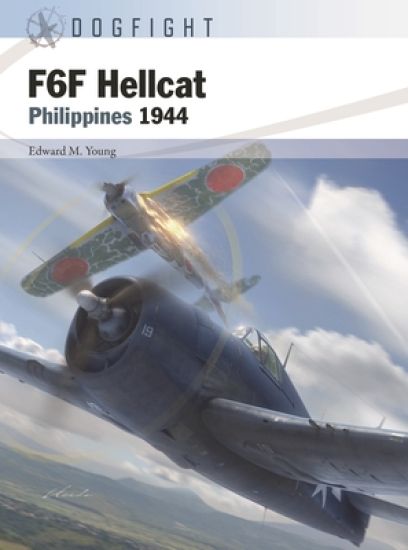
Using maps, contemporary photographs, and new artwork, this book examines the Hellcat and the naval aviators who flew them.Joining combat in the Pacific in late 1943, the Hellcat squadrons soon demonstrated their ascendency over their Japanese opponents, culminating in the great "Marianas Turkey Shoot" during the Battle of the Philippine Sea in June 1944. The fighter proved to be a dream for pilots to fly, allowing both novice and veteran Naval Aviators alike to prevail in largescale aerial combats. From October 1944 to January 1945, the Fast Carriers supported General MacArthur’s invasion of the Philippines.Featuring specially commissioned armament views and battlescenes, this book covers the key role played by Naval Aviators flying the Hellcat into action during the Fast Carrier Task Force’s strikes against the Philippines in September and October 1944. Using maps, contemporary photographs, and technical diagrams, the volume examines the highly effective tactics used to prevail against large enemy formations, and reveals the training that underpinned the success enjoyed by the Naval Aviators and their Hellcats. The key combat actions are vividly described through 3D ribbon diagrams providing a step-by-step depiction of the main dogfights featured in the book, as well as action reports, both from previously unknown pilots and from more famous Hellcat aces.
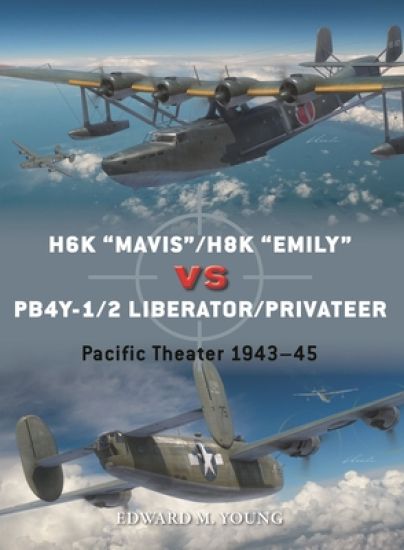
H6K “Mavis”/H8K “Emily” vs PB4Y-1/2 Liberator/Privateer
Edward M. Young
BLOOMSBURY PUBLISHING PLC
2023
nidottu
An illustrated exploration of the dramatic aerial combats between the US Navy's long-range bomber and Japanese flying boats in the Pacific War.Edward Young explores these rarely written about combats, examining the aggressive and strategic tactics deployed by both US Navy and Imperial Japanese Navy Air Force and analyzing the technical improvements installed throughout the war.The PB4Y-1/2 Liberator/Privateer was the US Navy’s first four-engined, land-based bomber, adapted and allocated to fight the U-boat menace in the Atlantic and protect the vast reaches of the Pacific Ocean. The long range, speed, armament and bomb load of the PB4Y-1 enabled the US Navy’s Pacific squadrons to adopt more aggressive tactics. The PB4Y-1, and its follow-on PB4Y-2, engaged in dangerous bombing missions against Japanese installations, shipping strikes, and air combat. On the other side, with its doctrine of making the first strike against an enemy fleet, the Imperial Japanese Navy recognized the vital importance of maritime reconnaissance, relying on carrier-based reconnaissance aircraft, ship-borne floatplanes and, for long-range maritime patrol, flying boats. The Japanese would continue to develop their aircraft throughout the war, resulting, among others, in the H6K ‘Mavis’ and the H8K2 ‘Emily’, which despite never achieving a victory, was regarded by the Allied pilots as the most difficult Japanese aircraft to destroy. Enriched with specially commissioned artwork, including armament and cockpit views, battlescenes and technical diagrams, this title analyses technical specifications in detail. By including first-hand accounts, aviation expert Edward Young provides a detailed account of these one-sided yet dramatic and aggressive combats.
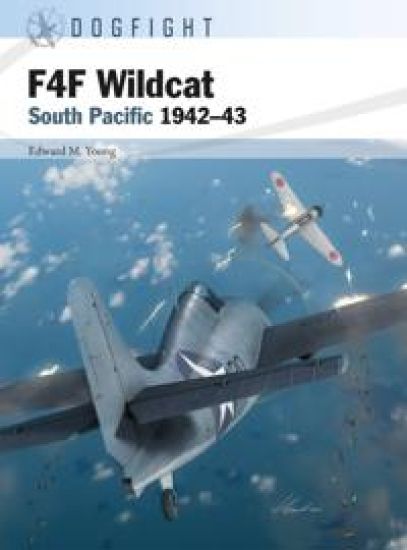
This book examines the role of the Grumman F4F Wildcat, the US Navy’s standard carrier fighter at the start of the Pacific War, and its clashes against the Imperial Japanese Naval Air Force’s Mitsubishi A6M Zero-sen.The US Navy went to war in December 1941 with the tubby Wildcat, the first of Grumman’s famed ‘cats’, as its principal carrier fighter. Ruggedly built and well armed, the F4F’s performance was inferior to the Japanese Zero-sen, yet in the carrier battles of 1942 between the US Navy and the IJN the Wildcat pilots more than held their own against some of the finest naval aviators in the world. Many of the Wildcat pilots that saw action in the South Pacific comprised what respected naval historian John Lundstrom has called the ‘First Team’ – the small group of highly trained prewar pilots who manned the bulk of the US Navy’s carrier fighter squadrons. Illustrated with specially commissioned artwork, including armament views and ribbon diagrams, the book examines the carrier battles that took place in August and October in the South Pacific around the first American offensive of the war – the amphibious assault on the island of Guadalcanal, and the actions of the Wildcat in combat with IJN carrier aircraft. The key combat actions are described and accompanied with rare and original photographs and diagrams, as are the training and tactics that contributed to the Wildcat’s success.

An exciting account of the aerial battles fought by the USAAF's P38 Lightnings and the Jagdflieger's Bf 109Gs for dominance over North Africa and the Mediterranean.USAAF fighter pilots experienced a baptism of fire when flying the technically advanced but fragile P-38 Lightning over North Africa in the wake of 1942's Operation Torch. Their opponents were battle-hardened jagdflieger of the Jadgwaffe, flying the tried and tested Bf 109 in its very lastest Gustav iteration. Responsible primarily for escorting USAAF bombers attacking Afrika Korps installations in Tunisia, the P-38 units in North Africa had to develop effective tactics to defend the bombers against Luftwaffe fighter attacks. For several months the Lightning squadrons had to also cope with shortages of aircraft and spare parts, steady losses and a lack of replacement pilots. To survive, American aviators had to learn quickly. While it is difficult to definitively attribute victories in air combat, in the air battles over Tunisia and later over Sicily and Italy, the claims made by Lightning pilots were comparable to Luftwaffe claims for P-38s destroyed. Edward M. Young turns his attention to the bitterly fought air war in North Africa and the Mediterranean in 1942–43. Using original archival sources, official records and first-hand accounts from both USAAF and Luftwaffe veterans, as well as newly commissioned artwork and 50 carefully selected photographs from official and personal archives, this book sees two of the most iconic piston-engined fighters of their era pitted head-to-head for control of the skies in a key theatre of World War II.
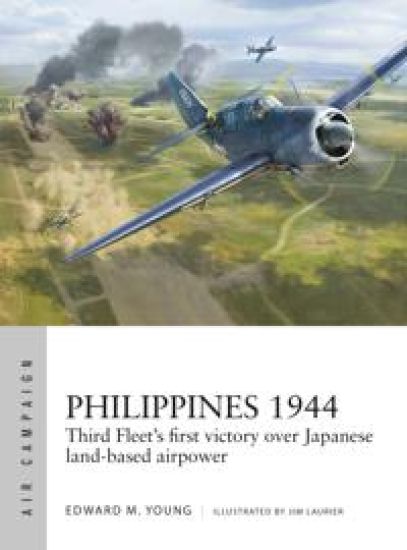
The US Navy’s 1944 Philippines raids were the first time naval aircraft had challenged and beaten a land-based air force. With artwork and rare photos, this is the first book to study them. During September 1944, the US Navy’s Task Force 38 launched a series of huge airstrikes against Japanese forces in the Philippines. Seventeen carriers, wielding over 1,000 combat aircraft, made up the most powerful naval fleet assembled to date. It was the first time aircraft carriers had dared to confront a major land-based air force. Over a period of two weeks, TF 38 demonstrated the power and mobility of the Fast Carrier Task Force. The strike forces claimed 368 Japanese aircraft shot down and 446 destroyed on the ground, with over a hundred ships destroyed and significant damage to ground installations.This book is the first to focus on the campaign, and is illustrated with archive photos, original artwork, maps and 3D diagrams. Renowned Pacific War historian Edward M. Young draws upon after-action reports and other primary sources to explain how these September strikes impacted the reeling forces of Imperial Japan. Soon overshadowed by the invasion of Leyte and the enormous Battle of Leyte Gulf, few detailed accounts of this campaign exist. But it was an important stage in the Pacific War, for the relative ease of these raids prompted the planned invasion of Leyte to be brought forwards by two months.
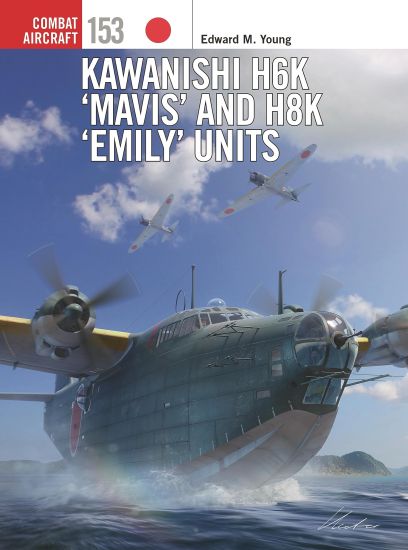
An illustrated account of the little-known operations of the Imperial Japanese Naval Air Force’s flying boat units during World War 2.Respectively codenamed the ‘Mavis’ and ‘Emily’ by the Allies, Japan’s H6K and H8K flying boats outstripped their RAF and US Navy counterparts. The 1941 outbreak of war in the Pacific and Southeast Asia saw these remarkable aircraft carry out offensive missions across vast tracts of ocean and employ their unique capabilities to escort convoys and serve as transports between Japan’s island bases. However, while the technical details of the H6K and H8K are well known in the West, this important new study marks the first English-language account of their wartime operations.Utilizing newly translated Japanese war diaries, as well as Allied intelligence and combat reports, celebrated Pacific War expert Edward M. Young reveals the full story behind the Imperial Japanese Naval Air Force’s flying boat units. Contemporary photos and 22 colour profiles bring new dimensions to this fascinating area of Japanese military history, vividly illustrating the pivotal roles of ‘Emily’ and ‘Mavis’ in events including the Battle of the Coral Sea, the Battle of Midway and the fighting in the Aleutians and the Bismarck and Solomon Islands.

After four years traveling through Europe and a yearlong romance with Giulia Persiani in Rome, Henry Wadsworth Longfellow came back home in 1829 and fell in love again, this time with Mary Storer Potter, whom he married in 1831. They traveled together to England and Scandinavia in 1834 but their happiness was cut short when she died in 1835. In 1836, traveling in Switzerland, he met the woman who would become the grand passion of his life, 18-year old Fanny Appleton of Boston. But she, a wealthy textile heiress, was not interested in settling down with a Harvard professor. She rebuffed his advances for six years--then suddenly changed her mind and married him on July 13, 1843. For the next 18 years they were "America's couple," and Longfellow became America's poet--and then tragedy struck once again.


The Great Heinlein Mystery: Science Fiction, Innovation and Naval Technology
Edward M. Wysocki Jr
Createspace Independent Publishing Platform
2012
nidottu
Many people may feel that science fiction has little if any connection with the real world. A careful examination of works of science fiction, however, will reveal connections with science and technology. An author makes use of current scientific facts and theories and the accomplishments of technology. From such a starting point, the author is then free to extrapolate in a multitude of different directions. A connection that operates in the opposite direction may also be explored. Is it possible that certain concepts presented in works of science fiction have affected real-world inventions or scientific discoveries?The Great Heinlein Mystery looks at this question by considering statements made by science fiction author Robert A. Heinlein at various points in his life. Heinlein claimed that a system used by the U.S. Navy during World War 2 was based on the content of one of his early stories. He consistently refused to identify the system or to provide key details such as the story or the person who was inspired to create the naval system, giving as his reason the secrecy of the naval system.The investigation of the Mystery begins by examining both the statements made by Heinlein and the content of the stories published before the entry of the U.S. into the war. Heinlein's statements required that a close look also be taken at his classmates at the United States Naval Academy. Other topics which arose during the investigation are the connection of the process of invention with science fiction authors and their stories, the sub-genre of true naval science fiction and the more general role of science fiction in technological innovation.

America's Lost Plays, Vol. VIII
Edward M Alfriend; A C Wheeler; Clarence Bennett
Wildside Press
2024
pokkari