

Kirjahaku
Etsi kirjoja tekijän nimen, kirjan nimen tai ISBN:n perusteella.
1000 tulosta hakusanalla Elizabeth M. Butler


How Come We No Fall Off? - Tutoring Refugee Children in an American School
Elizabeth M. Stratford
Lulu.com
2011
pokkari
Refugees are a new challenge to our American schools. One educator and one middle school in North Carolina has developed a volunteer tutoring program to help refugee students learn our language, succeed in school and integrate into our American society.

A History of Ogden
Elizabeth M. Tillotson; Merle E. Allen; E. L. Carlsen
Literary Licensing, LLC
2012
nidottu

Rehabilitation Program on the Cheyenne River Sioux Reservation
Elizabeth M. Clark; David W. Clark
Literary Licensing, LLC
2013
nidottu

Within the context of current US government efforts to integrate, synchronize and unify actions to secure US national interests against current threats, this paper will assess the current capability of the Department of Defense to plan for Phase 0 at the strategic and operational levels. Specifically, the purpose of this paper is to answer whether DoD has a method or methods for integrating, both horizontally and vertically, all US national elements of power, policy and planning into a combatant commander's Phase 0 activities, as required by joint doctrine. This paper uses the Capabilities Based Assessment (CBA) process to evaluate the DoD capability for integrated Phase 0 planning in four simplified steps: identify the military problem, determine the current military capability to address it, evaluate the capability, and recommend solutions for capability shortfalls. Using a previous study as a baseline, this paper provides an update on the existing guidance for the US government, determines the specific requirements and methods available for planning Phase 0, shaping operations, identifies the current DoD capability to plan integrated Phase 0 or shaping activities using recent examples, evaluates the capability using criteria developed in the prior study, updated by current research: common problem identification; clear national policy and strategic objectives, identifiable actors at the strategic and operational levels; recognized and practiced tools for planning; and common assessment mechanisms, identifies vital shortfalls in the military capability, and makes recommendations for addressing the gaps. By using the process above, this paper finds that despite the unprecedented levels of transformation by each agency, DoD does not yet have methods for integrating all US elements of power, policy and planning into a combatant commander's Phase 0 activities. In order for a military output of unified planning for phase 0 the US government must provide the unified in This work has been selected by scholars as being culturally important, and is part of the knowledge base of civilization as we know it. This work was reproduced from the original artifact, and remains as true to the original work as possible. Therefore, you will see the original copyright references, library stamps (as most of these works have been housed in our most important libraries around the world), and other notations in the work. This work is in the public domain in the United States of America, and possibly other nations. Within the United States, you may freely copy and distribute this work, as no entity (individual or corporate) has a copyright on the body of the work. As a reproduction of a historical artifact, this work may contain missing or blurred pages, poor pictures, errant marks, etc. Scholars believe, and we concur, that this work is important enough to be preserved, reproduced, and made generally available to the public. We appreciate your support of the preservation process, and thank you for being an important part of keeping this knowledge alive and relevant.

This work has been selected by scholars as being culturally important, and is part of the knowledge base of civilization as we know it. This work was reproduced from the original artifact, and remains as true to the original work as possible. Therefore, you will see the original copyright references, library stamps (as most of these works have been housed in our most important libraries around the world), and other notations in the work.This work is in the public domain in the United States of America, and possibly other nations. Within the United States, you may freely copy and distribute this work, as no entity (individual or corporate) has a copyright on the body of the work.As a reproduction of a historical artifact, this work may contain missing or blurred pages, poor pictures, errant marks, etc. Scholars believe, and we concur, that this work is important enough to be preserved, reproduced, and made generally available to the public. We appreciate your support of the preservation process, and thank you for being an important part of keeping this knowledge alive and relevant.
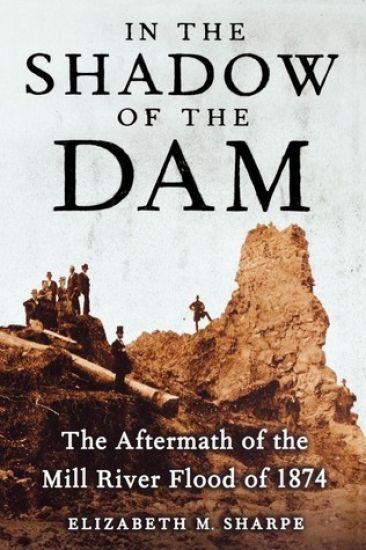
In the Shadow of the Dam, The Aftermath of the Mill River Flood of 1874
Elizabeth M. Sharpe
The Free Press
2007
pokkari
Early one May morning in 1874, in the hills above Williamsburg, Massachusetts, a reservoir dam suddenly burst, sending an avalanche of water down a narrow river valley lined with factories and farms. In just thirty minutes, the Mill River flood left 139 people dead and 740 homeless -- and a nation wondering how this terrible calamity had happened. In this compelling tale of a man-made disaster peopled with everyday heroes and arrogant scoundrels, Elizabeth Sharpe opens a rare window into industry and village life in nineteenth-century New England, a time when dam failures and other industrial accidents were widespread and laws favored factory owners rather than factory workers. In the Mill Valley, the townsfolk depended upon generally benevolent patriarchs who assured them that the dam was safe, when most people could see that it was not. The story of the Mill River flood is the story of those townsfolk: of George Cheney, the dam keeper whose repeated warnings about leaks in the dam had been ignored by the mill owners; of his wife, Elizabeth, who watched in disbelief as the dam burst open from the bottom; of Isabell Hayden, the mother who saw her young son swept away in the river's torrent; and of Fred Howard, a box maker who spent the days after the flood searching for bodies, burying friends, and waiting to see if the button factory he relied upon for his livelihood would be rebuilt. It is also the story of the well-meaning but overconfident businessmen who built the dam: of Onslow Spelman, the manufacturer who dismissed the dam keeper's flood warning, irrationally insisting that the dam could not break; of Lucius Fenn and Joel Bassett, the engineer and contractor whose roles in the construction of the dam would be questioned during the public inquest into the causes of the flood; of William Skinner, the factory owner who struggled to decide whether or not to rebuild his silk factory in the village that bore his name; and of many others. The flood highlighted class divisions between worker and owner, as well as the disorganized state of professional engineering, then still in its infancy. As the flood exposed the dangers of allowing mill owners -- who were not trained engineers -- to design their own dam, legislation to regulate the building of reservoir dams in Massachusetts was enacted for the first time. Engineers, politicians, and business owners battled over control of the reform measures to prevent similar tragedies, yet saw them continually repeated. "In the Shadow of the Dam" is the story of an event that reshaped a society. Told through the eyes of villagers like Collins Graves, lauded as a hero for his desperate ride through the valley to warn people of the impending flood, and industrialists like Joel Hayden Jr., entrusted with the responsibility of disaster relief despite his culpability in failing to maintain the leaking dam, "In the Shadow of the Dam" is a history of our uneasy relationship with industrial progress and a riveting narrative of a tragic disaster in small-town Massachusetts.


Living with Lymphoma
Elizabeth M. Adler; W. Jeffrey Baker
Johns Hopkins University Press
2016
sidottu
When neurobiologist Elizabeth M Adler was diagnosed with non-Hodgkin lymphoma almost twenty years ago, she learned everything she could about the disease, both to cope with the emotional stress of her diagnosis and to make the best possible decisions for her treatment. In Living with Lymphoma, she combines her scientific expertise and personal knowledge with a desire to help other people who have lymphoma manage this complex and often baffling disease. With the availability of more effective treatment regimens, many people with lymphoma are living longer; in fact, there are more than 700,000 lymphoma survivors in the United States alone. Given this change in the lymphoma landscape, the second edition of this book places a greater emphasis on survivorship. The new edition includes the latest information on lymphoma diagnosis, treatment, and incidence, and describes the most recent update to the WHO system of lymphoma classification and staging. Adler discusses new targeted therapies like ibrutinib and idelalisib and describes how other treatments, including radiation therapy and stem cell transplants, have been modified, while others have been discontinued. She also addresses new developments, such as the possible role of lack of sunlight and vitamin D in the pathogenesis of lymphoma, and the use of medical marijuana. The book includes suggestions for further reading, including the latest material available online.

Living with Lymphoma
Elizabeth M. Adler; W. Jeffrey Baker
Johns Hopkins University Press
2016
pokkari
When neurobiologist Elizabeth M Adler was diagnosed with non-Hodgkin lymphoma almost twenty years ago, she learned everything she could about the disease, both to cope with the emotional stress of her diagnosis and to make the best possible decisions for her treatment. In Living with Lymphoma, she combines her scientific expertise and personal knowledge with a desire to help other people who have lymphoma manage this complex and often baffling disease. With the availability of more effective treatment regimens, many people with lymphoma are living longer; in fact, there are more than 700,000 lymphoma survivors in the United States alone. Given this change in the lymphoma landscape, the second edition of this book places a greater emphasis on survivorship. The new edition includes the latest information on lymphoma diagnosis, treatment, and incidence, and describes the most recent update to the WHO system of lymphoma classification and staging. Adler discusses new targeted therapies like ibrutinib and idelalisib and describes how other treatments, including radiation therapy and stem cell transplants, have been modified, while others have been discontinued. She also addresses new developments, such as the possible role of lack of sunlight and vitamin D in the pathogenesis of lymphoma, and the use of medical marijuana. The book includes suggestions for further reading, including the latest material available online.

A Dubious Science tells the story of nineteenth-century French political economy, an academic discipline that aspired to the status and authority of a «hard» science alongside such disciplines as physics and chemistry. It chronicles political economists’ encounter with «the social question» – all those unexpected social consequences of nineteenth-century industrialization – which offered concrete evidence that industrial capitalism showed few signs of guaranteeing happiness and economic success to all productive members of society. The social question forced economists to admit that their theoretical assumptions were not working in practice the way they were supposed to in theory and to confront the possibility that their science might be less certain than they had believed. This book explores the relationship between the unexpected socio-economic realities of an industrializing society and the disciplinary formation and self-protection of an aspiring human science, and it links political economy’s aspirations to governmentality, that peculiarly modern type of power explored by Michel Foucault. Like other «dubious» human sciences during the nineteenth century, French political economy was embroiled in a network of interventionist strategies, administered both from inside and outside the state, designed to produce docile bodies, obedient souls, and a content and productive population. A Dubious Science should prove valuable in courses on economic thought and its history; the history of the human sciences; the history and sociology of the professions; as well as the broader history of European industrialization and its consequences.

This book helps survivors find the road to recovery and learn healthy practices that will lead to thriving, not just surviving. Survivors of childhood sexual abuse can begin a recovery journey informed by accurate understandings, not myths, and empowered by processes that help them thrive. Written for men and women by an author who is herself a survivor, this guide tells the truth about what complex trauma means for your physical and mental health. Readers will learn how to build key recovery processes into their lives, including grieving, meaning-making, forging healthy connections with others, and finding hope. This guidance is scientifically-based, in findings from positive psychology. With self-assessments, journaling prompts, and suggested action steps to help you leave your darkness behind, this book is your essential interactive guide through the recovery journey. References and an extensive index are also included.
Principles Of Education: Drawn From Nature And Revelation And Applied To Female Education In The Upper Classes (1865)
Elizabeth M. Sewell
KESSINGER PUBLISHING, LLC
2008
sidottu

Cloister Legends: Or Convents And Monasteries, In The Olden Time (1871)
Elizabeth M. Stewart
KESSINGER PUBLISHING, LLC
2008
nidottu

Fitz Alwyn, The First Lord Mayor, And The Queen's Knight: A Tale Of The Drapers Company (1848)
Elizabeth M. Stewart
KESSINGER PUBLISHING, LLC
2008
nidottu



The Sunbeam: A Sequel To Georgy King And His Pets (1863)
Elizabeth M. Bruce
KESSINGER PUBLISHING, LLC
2008
nidottu