Kirjojen hintavertailu. Mukana 11 244 527 kirjaa ja 12 kauppaa.

Kirjahaku

Etsi kirjoja tekijän nimen, kirjan nimen tai ISBN:n perusteella.

1000 tulosta hakusanalla Elizabeth Singer Hunt

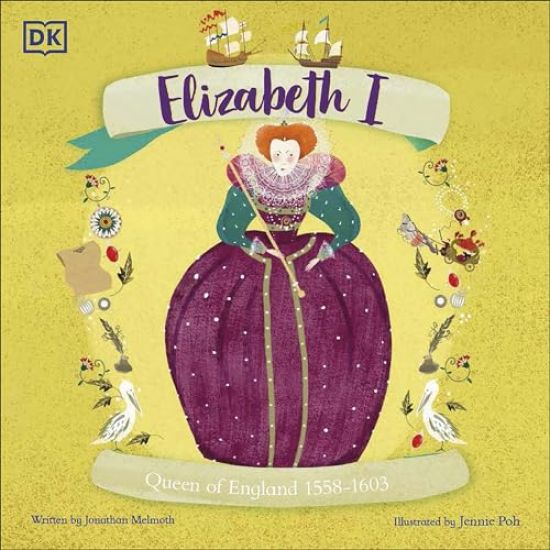
Elizabeth I

Elizabeth I

Jonathan Melmoth

DORLING KINDERSLEY LTD
2024
nidottu
Delve into the past and explore the life of Elizabeth I and the hidden truth of Britain's last Tudor monarch.The fourth book in this captivating series on British monarchs for kids aged 5-11, Elizabeth I reveals the life and struggles of one of Britain's first queens.Bright, playful illustrations and simple, age-appropriate text makes this book the perfect introduction to the last Tudor queen. From defeating the Spanish Armada to encouraging the arts in the age of Shakespeare, Elizabeth's 45-year reign is thought to be one of the most glorious in British history.This children’s book on Elizabeth I offers:- New information about Elizabeth I’s life on every page.- The fourth book, after Queen Elizabeth II and King Charles III, in the popular History’s Greatest Leaders series.- Educational information about the British monarchy for young historians.This biography for children is brought to you by the publisher of Queen Elizabeth: A Platinum Jubilee Celebration and King Charles III. It will supplement your child's learning, featuring one of the monarchs from history included in the KS2 curriculum and reveals the buried secrets of a queen from long ago.More in the seriesAt DK, we believe in the power of discovery. So why stop here? If you enjoyed learning about one of Britain’s last Tudor monarch, then why not try other books in the History’s Greatest Leaders series, Queen Elizabeth: A Platinum Jubilee Celebration, King Charles III and Henry VIII?
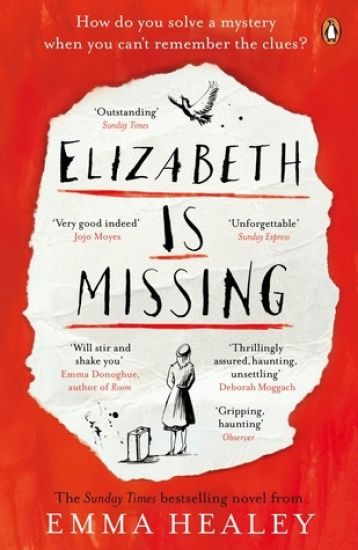
Elizabeth is Missing

Elizabeth is Missing

Emma Healey

Penguin Books Ltd
2015
pokkari
THE BOOK THAT INSPIRED THE MAJOR BBC DRAMA STARRING BAFTA AWARD-WINNING ACTRESS GLENDA JACKSON How do you solve a mystery when you can't remember the clues?Maud is forgetful. She makes a cup of tea and doesn't remember to drink it. She goes to the shops and forgets why she went. Sometimes her home is unrecognizable - or her daughter Helen seems a total stranger.But there's one thing Maud is sure of: her friend Elizabeth is missing. The note in her pocket tells her so. And no matter who tells her to stop going on about it, to leave it alone, to shut up, Maud will get to the bottom of it.Because somewhere in Maud's damaged mind lies the answer to an unsolved seventy-year-old mystery. One everyone has forgotten about.Everyone, except Maud . . .'A thrillingly assured, haunting and unsettling novel, I read it at a gulp' Deborah Moggach, author of The Best Exotic Marigold Hotel'Elizabeth Is Missing will stir and shake you: the most likeably unreliable of narrators, real mystery at its compassionate core...' Emma Donoghue, author of Room'Resembling a version of Memento written by Alan Bennett' Daily Telegraph'One of those mythical beasts, the book you cannot put down' Jonathan Coe, author of The Rotters Club'Every bit as compelling as the frenzied hype suggests. Gripping, haunting' Observer
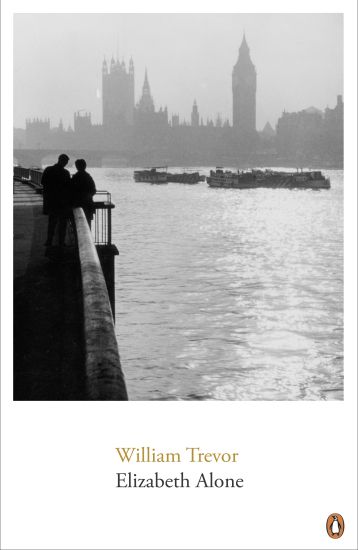
Elizabeth Alone

Elizabeth Alone

William Trevor

Penguin Books Ltd
2015
pokkari
Elizabeth Alone by William Trevor - a powerful and moving novel from one of the world's finest writersAfter nineteen years of marriage, three children and a brief but passionate affair followed by a quick divorce, Elizabeth Aidallbery has to go to hospital for an emergency operation. From her hospital bed she has the leisure to take stock of her life, and frankly it doesn't look very edifying: there's the 17 year old daughter who's run off to a commune with her boyfriend; an old hopeless suitor who continues to press his claims; and of course the memory of the havoc she caused by the affair. No doubt she could put her life back in order. But need that involve all those people who cause her so much heartache?Readers of Love and Summer and Felicia's Journey will be delighted by Elizabeth Alone. It will also be enjoyed by readers of Colm Toibin and William Boyd.'A finely observed, gently sensitive comedy, delightful to read' Daily Telegraph'Trevor is a master of both language and storytelling' Hilary MantelWilliam Trevor was born in Mitchelstown, County Cork, in 1928, and was educated at Trinity College, Dublin. He has lived in England for many years. The author of numerous acclaimed collections of short stories and novels, he has won many awards including the Whitbread Book of the Year, The James Tait Black Memorial Prize and the Sunday Times Award for Literary Excellence. He has been shortlisted three times for the Booker Prize: in 1976 with his novel The Children of Dynmouth, in 1991 with Reading Turgenev and in 2002 with The Story of Lucy Gault. He recently received the prestigious David Cohen Literature Prize in recognition of a lifetime's literary achievement.
Elizabeth's Struggles

Elizabeth's Struggles

Samantha Jocelynne-Hope Bos

Lulu.com
2019
nidottu
In the fight of her life, Elizabeth is desperate to become a mother before her medical condition takes that chance from her permanently. Stone ended up with a broken heart and offered everything he had to a pretty blonde in a bar to give her what she was so desperate for. Does love blossom even though it's not what they were looking for?
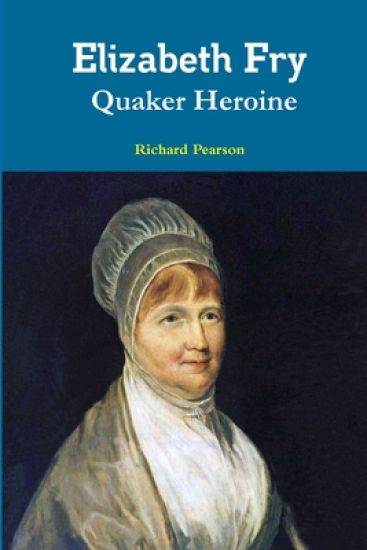
Elizabeth Fry Quaker Heroine

Elizabeth Fry Quaker Heroine

Richard Pearson

Lulu Press
2019
pokkari
Elizabeth Fry often referred to as Betsy, was an English prison reformer. Fry was a major driving force behind new legislation to make the treatment of prisoners more humane, and she was supported in her efforts by Queen Victoria. Fry kept extensive and revealing diaries. Elizabeth Fry also helped the homeless, establishing a "nightly shelter" in London after seeing the body of a young boy in the winter of 1819/1820. In 1824, during a visit to Brighton, she instituted the Brighton District Visiting Society. 6] The society arranged for volunteers to visit the homes of the poor and provide help and comfort to them. The plan was successful and was duplicated in other districts and towns across Britain.
Elizabeth Saint

Elizabeth Saint

Mila Hasan

Lulu.com
2017
pokkari
A fun colouring book for everyone's favourite paranormal investigator, Elizabeth Saint. Also known as The Dark Saint. Something in which everyone can get involved in without having to be a talented colour-er or painter or sketcher. Drawing doesn't need to be your forte
Elizabeth Baker's Diary 1778 - 1786
This diary is a wonderful source for eighteenth century women's history and for life in a small town in rural Wales recorded by an English exile. It is rare for anyone described as abjectly poor by her contemporaries to keep a diary but Elizabeth Baker's excellent education gave her status and value in her community. She has been described as a snob who had, as she liked to recall, dined with aristocrats in her London life, but living as she did on a level with the poor, she wrote of them with immense sympathy and understood how circumstances beyond their control could lead them to fall into the pit of poverty. Her pen could be occasionally malicious, recording the foibles of her neighbours in Dolgellau, and it is invaluable for anyone researching their family history in Merioneth.
Elizabeth I

Elizabeth I

Clark Hulse

University of Illinois Press
2003
sidottu
Commemorating the 400th Anniversary of Elizabeth I 's reign this history tells the story of her life and reign using artifacts from her life- books, pamphlets, letters, paintings, maps and more. It is a compliment catalog to the exhibit of Queen Eliazbeth I traveling through out the United States over the next three years.
Elizabeth Packard

Elizabeth Packard

Linda V. Carlisle

University of Illinois Press
2010
sidottu
Elizabeth Packard's story is one of courage and accomplishment in the face of injustice and heartbreak. In 1860, her husband, a strong-willed Calvinist minister, committed her to an Illinois insane asylum in an effort to protect their six children and his church from what he considered her heretical religious ideas. Upon her release three years later (as her husband sought to return her to an asylum), Packard obtained a jury trial and was declared sane. Before the trial ended, however, her husband sold their home and left for Massachusetts with their young children and her personal property. His actions were perfectly legal under Illinois and Massachusetts law; Packard had no legal recourse by which to recover her children and property. This experience in the legal system, along with her experience as an asylum patient, launched Packard into a career as an advocate for the civil rights of married women and the mentally ill. She wrote numerous books and lobbied legislatures literally from coast to coast advocating more stringent commitment laws, protections for the rights of asylum patients, and laws to give married women equal rights in matters of child custody, property, and earnings. Despite strong opposition from the psychiatric community, Packard's laws were passed in state after state, with lasting impact on commitment and care of the mentally ill in the United States. Packard's life demonstrates how dissonant streams of American social and intellectual history led to conflict between the freethinking Packard, her Calvinist husband, her asylum doctor, and America's fledgling psychiatric profession. It is this conflict--along with her personal battle to transcend the stigma of insanity and regain custody of her children--that makes Elizabeth Packard's story both forceful and compelling.
Elizabeth I

Elizabeth I

Clark Hulse

University of Illinois Press
2003
nidottu
Making history from the moment of her birth, England's Queen Elizabeth I (1533-1603) was a legend within her own lifetime. To her supporters, Elizabeth I was Gloriana, the Faerie Queene, a dignified and powerful woman who ruled with cunning and skill for forty-four years. To her detractors she was the ruthless supporter of a false religion; the murderer of her cousin Mary Queen of Scots; a wanton woman, herself illegitimate, who sullied the crown with her licentious behavior. The legends that have grown up around Elizabeth are fascinating, but as this book shows, the truth is just as remarkable. In Elizabeth I: Ruler and Legend, Clark Hulse brings Elizabeth to life, combining text and images to tell her story through the objects handed down by history. Commemorating the four hundredth anniversary of Elizabeth's death, this handsome volume contains over one hundred photographs of books, manuscripts, maps, letters, paintings, clothing, furniture, and many more artifacts dating from her reign. Each of these objects tells a story, and Hulse uses them as a starting point for a broad and thorough examination of Elizabeth and the society in which she lived. Beginning with an analysis of the political events surrounding her birth, the book describes Elizabeth's relationship with her father, Henry VIII, and the maneuvering that led to her eventual coronation upon the death of her half-sister Mary Tudor in 1558. As queen, Elizabeth oversaw a period of breathtaking cultural achievement. She kept England from being torn apart by the religious wars raging across Europe, and she withstood both an assassination plot and the massive military threat of the Spanish Armada. This book addresses all these major events, as well as a whole host of lesser-known aspects of Elizabeth's reign. Hulse includes discussions of topics such as the education of Tudor women; markers of identity; portraits of Elizabeth; the queen's speaking style; her interest in America; music at the Tudor court; and literary depictions of Elizabeth by Shakespeare, Spenser, and other poets.
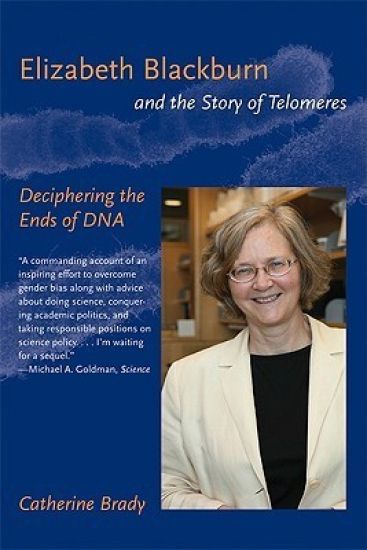
Elizabeth Blackburn and the Story of Telomeres
The story of molecular biologist Elizabeth Blackburn and her groundbreaking research on telomeres and what it reveals about the resourceful opportunism that characterizes the best scientific thinking.Molecular biologist Elizabeth Blackburn-one of Time magazine's 100 "Most Influential People in the World" in 2007-made headlines in 2004 when she was dismissed from the President's Council on Bioethics after objecting to the council's call for a moratorium on stem cell research and protesting the suppression of relevant scientific evidence in its final report. But it is Blackburn's groundbreaking work on telomeric DNA, which launched the field of telomere research, that will have the more profound and long-lasting effect on science and society. In this compelling biography, Catherine Brady tells the story of Elizabeth Blackburn's life and work and the emergence of a new field of scientific research on the specialized ends of chromosomes and the enzyme, telomerase, that extends them. In the early stages of telomere research, telomerase, heralded as a potential cure for cancer and diseases related to aging, attracted the voracious interest of biotech companies. The surrounding hype succeeded in confusing the role of telemorase in extending the life of a cell with a mechanism that might extend the lifespan of an entire organism. In Brady's hands, Blackburn's story reveals much about the tension between pure and applied science, the politicking that makes research science such a competitive field, and the resourceful opportunism that characterizes the best scientific thinking.Brady describes the science accessibly and compellingly. She explores Blackburn's struggle to break down barriers in an elite, male-dominated profession, her role as a mentor to other women scientists (many of whom have made their mark in telomere research), and the collaborative nature of scientific work. This book gives us a vivid portrait of an exceptional woman and a new understanding of the combination of curiosity, imaginative speculation, and aesthetic delight that powers scientific discovery.
Elizabeth Bishop

Elizabeth Bishop

McCabe Susan

Pennsylvania State University Press
1994
sidottu
Elizabeth Bishop represents a full-scale examination of Bishop's work—poetry, prose, and selected unpublished material—to reveal how personal loss becomes implicated in her vision of self as fluid and unfixed and, at the same time, how gender and sexual identity inform the experience of loss in the act of writing. Susan McCabe argues that Bishop counters modernist claims for an autonomous art object and an impersonal artist; Bishop's writing never represents an escape into perfected forms, but instead calls attention to the processes of language that construct identity. McCabe emphasizes how personal experience is deeply enmeshed with Bishop's poetics. Bishop's project returns to her early losses—the death of her father and her mother's madness—and uses them to disclose the instability of the concepts of self or place through a rhetoric of indeterminacy and uncertainty. Although Bishop has recently begun to receive the critical attention she deserves, this book uniquely brings loss to the foreground in connection with identity, gender, and the fashioning of a feminist poetics.
Elizabeth Bishop

Elizabeth Bishop

McCabe Susan

Pennsylvania State University Press
1994
pokkari
Elizabeth Bishop represents a full-scale examination of Bishop's work—poetry, prose, and selected unpublished material—to reveal how personal loss becomes implicated in her vision of self as fluid and unfixed and, at the same time, how gender and sexual identity inform the experience of loss in the act of writing. Susan McCabe argues that Bishop counters modernist claims for an autonomous art object and an impersonal artist; Bishop's writing never represents an escape into perfected forms, but instead calls attention to the processes of language that construct identity. McCabe emphasizes how personal experience is deeply enmeshed with Bishop's poetics. Bishop's project returns to her early losses—the death of her father and her mother's madness—and uses them to disclose the instability of the concepts of self or place through a rhetoric of indeterminacy and uncertainty. Although Bishop has recently begun to receive the critical attention she deserves, this book uniquely brings loss to the foreground in connection with identity, gender, and the fashioning of a feminist poetics.
Elizabeth Bishop

Elizabeth Bishop

Susan McCabe

Pennsylvania State University Press
1994
pokkari
Elizabeth Bishop represents a full-scale examination of Bishop's work—poetry, prose, and selected unpublished material—to reveal how personal loss becomes implicated in her vision of self as fluid and unfixed and, at the same time, how gender and sexual identity inform the experience of loss in the act of writing. Susan McCabe argues that Bishop counters modernist claims for an autonomous art object and an impersonal artist; Bishop's writing never represents an escape into perfected forms, but instead calls attention to the processes of language that construct identity. McCabe emphasizes how personal experience is deeply enmeshed with Bishop's poetics. Bishop's project returns to her early losses—the death of her father and her mother's madness—and uses them to disclose the instability of the concepts of self or place through a rhetoric of indeterminacy and uncertainty. Although Bishop has recently begun to receive the critical attention she deserves, this book uniquely brings loss to the foreground in connection with identity, gender, and the fashioning of a feminist poetics.
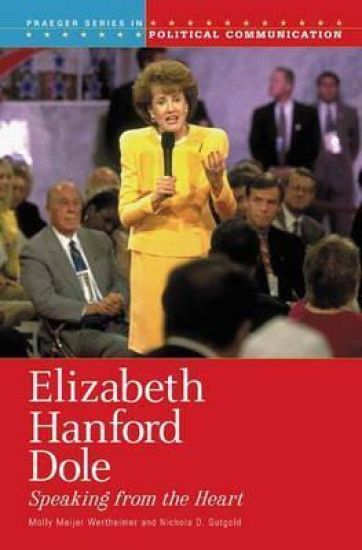
Elizabeth Hanford Dole

Elizabeth Hanford Dole

Molly M. Wertheimer; Nichola D. Gutgold

Praeger Publishers Inc
2004
sidottu
As a politician, what you say and how you say it is almost as important as what you do. Political careers are made based not only on substantive achievements, but also on style, presentation, speeches, and debates. Dole's is no exception. After a career in government service spanning six presidents, from Lyndon B. Johnson to George H. W. Bush, she became widely recognized as a leading Republican politician in her own right after her 1996 speech at the GOP convention. In 1999 she spent six months campaigning for president before dropping out of the race due to a lack of adequate funds, and in 2002 she was elected U.S. Senator from North Carolina. In this biography of Dole, the authors show how she has been able to advance the causes she cares about, as well as her political career, through her consummate skills as a public speaker.Dole's career included service in two cabinets, as Secretary of Transportation (Reagan) and Secretary of Labor (Bush), and she also served as president of the American Red Cross. The authors quote liberally from her speeches and interviews to illustrate the events of her political career and to place her choices—personal, career, and political—in the context of the times and places in which she grew up and came of age. Her trajectory—from Southern belle debutante to Harvard Law School student and from political wife to presidential candidate and U.S. senator—is fascinating, and the deftness with which she has been able to deflect the criticisms thrown her way is instructive for women of both political parties and for politicians of both genders.
The Civil War Memories of Elizabeth Bacon Custer

The Civil War Memories of Elizabeth Bacon Custer

Elizabeth Bacon Custer

University of Texas Press
1994
pokkari
In her first year of marriage (1864-1865) to General George Armstrong Custer, Libbie Custer witnessed the Civil War firsthand. Her experiences of danger, hardship, and excitement made ideal material for a book, one that she worked on for years in later life but ultimately never published.In this volume, Arlene Reynolds has produced a readable narrative of Libbie Custer's life during the war years by chronologically reconstructing Libbie's original, unpublished notes and diaries found in the archives of the Little Big Horn Battlefield National Monument. In these reminiscences, Libbie Custer adds striking, eloquent details to the Civil War story as she describes her life both in camp and in Washington. Her stories of incidents such as fording a swollen river sidesaddle on horseback, dancing at the Inaugural Ball near President Lincoln, and watching the massive review of the Army of the Potomac after the surrender have the engrossing quality of a well-written novel.For general readers and students of women's history, this book tells a fascinating story of a sheltered girl's maturation into a courageous woman in the crucible of war. And for both devotees and detractors of her husband, it offers an intimate glimpse into his youth, West Point years, and early military service.
Elizabeth I

Elizabeth I

Simon Adams

YALE UNIVERSITY PRESS
2027
sidottu
No one thought that Elizabeth would live to become Queen of England. Her father, Henry VIII, beheaded her mother, Anne Bolyn, for treason in 1536. He then disowned his daughter, declaring her illegitimate. But in 1544, Parliament reestablished the young princess in the line of succession after her half brother and her half sister. Endowed with immense personal courage and a keen awareness of her responsibility as a ruler, Elizabeth commanded throughout her reign the unwavering respect and allegiance of her subjects. National Geographic supports K-12 educators with ELA Common Core Resources.Visit www.natgeoed.org/commoncore for more information.
Elizabeth Fry

Elizabeth Fry

Gil Skidmore

Yale University Press
2010
pokkari
From her picture on the British 5 pound note to the numerous Elizabeth Fry Societies worldwide, Elizabeth Fry (1780-1845) is well known for her work for prison reform. But less well known is how her Quaker faith inspired that work, leading her to see the light within the impoverished and imprisoned. With Elizabeth Fry: A Quaker Life, noted Quaker historian Gil Skidmore has brought together Fry's essential writings-some previously unpublished-from her journals,letters, and more general works. The result is a rich portrait of the struggles and anxieties behind the public persona of this "Quaker saint." Gil Skidmore, herself a Quaker, has spent many years researching the lives and writings of the early Quakers. She is currently research collections coordinator at the the library of the University of Reading.
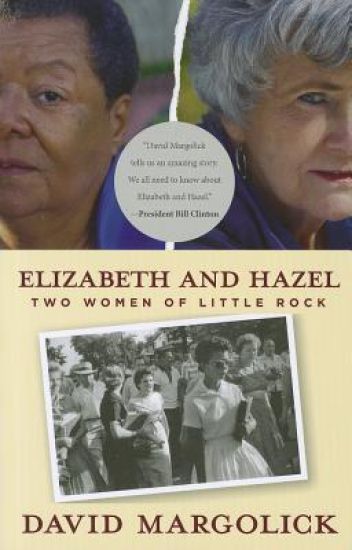
Elizabeth and Hazel

Elizabeth and Hazel

David Margolick

Yale University Press
2012
pokkari
Who were the two fifteen-year-old girls from Little Rock—one black, one white—in one of the most unforgettable photographs of the civil rights era?"Through Eckford and Bryan’s tangled lives, [Margolick] hopes to capture the complexity of race, forgiveness, and reconciliation in modern America."—Kevin Boyle, Washington Post"Margolick . . . tells us the amazing story of how Elizabeth and Hazel, as adults, struggled to find each other across the racial divide and in so doing, end their pain and find a measure of peace. We all need to know about Elizabeth and Hazel."—President Bill Clinton The names Elizabeth Eckford and Hazel Bryan Massery may not be well known, but the image of them from September 1957 surely is: a Black high school girl, dressed in white, walking stoically in front of Little Rock Central High School, and a white girl standing directly behind her, face twisted in hate, screaming racial epithets. This famous photograph captures the full anguish of desegregation—in Little Rock and throughout the South—and an epic moment in the civil rights movement.In this gripping book, David Margolick tells the remarkable story of two separate lives unexpectedly braided together. He explores how the haunting picture of Elizabeth and Hazel came to be taken, its significance in the wider world, and why, for the next half-century, neither woman has ever escaped from its long shadow. He recounts Elizabeth’s struggle to overcome the trauma of her hate-filled school experience, and Hazel’s long efforts to atone for a fateful, horrible mistake. The book follows the painful journey of the two as they progress from apology to forgiveness to reconciliation and, amazingly, to friendship. This friendship foundered, then collapsed—perhaps inevitably—over the same fissures and misunderstandings that continue to permeate American race relations more than half a century after the unforgettable photograph at Little Rock. And yet, as Margolick explains, a bond between Elizabeth and Hazel, silent but complex, endures.
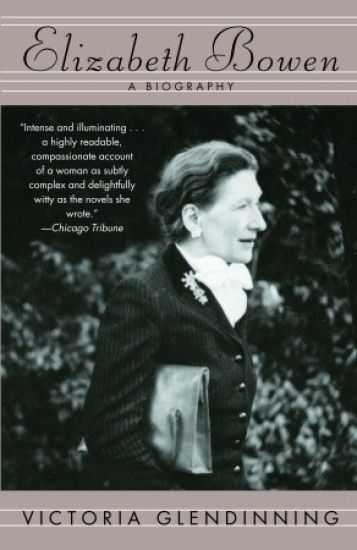
Elizabeth Bowen: A Biography

Elizabeth Bowen: A Biography

Victoria Glendinning

ANCHOR BOOKS
2006
nidottu
A biography of the acclaimed Anglo-Irish novelist follows the formation of her character and the growth of her art from her childhood in a great ancestral manor in Ireland to her discovery of America and international fame. Reprint.