Kirjojen hintavertailu. Mukana 11 717 486 kirjaa ja 12 kauppaa.

Kirjahaku

Etsi kirjoja tekijän nimen, kirjan nimen tai ISBN:n perusteella.

1000 tulosta hakusanalla Evripides

Euripides and Quotation Culture

Euripides and Quotation Culture

Matthew Wright

BLOOMSBURY PUBLISHING PLC
2024
sidottu
Presenting a new approach to Euripides’ plays, this book explores the playwright’s ancient tragedies in relation to quotation culture. Treating extant works and lost works side-by-side, Matthew Wright presents a selective survey of ways in which Euripidean tragedy was quoted within antiquity, both in social contexts (on the comic stage, at symposia, in law courts, in education) and in different literary genres (drama, biography, oratory, philosophy, literary scholarship, history and anthologies). There is also a discussion of the connection between quotability and classic status, where Wright asks what quotations can tell us about ancient reading habits. The implication is that Euripides actively participated in quotation culture by deliberately making certain portions of his plays stand out as especially quotable. Within classical antiquity, Euripides was the most widely quoted author apart from Homer. His plays are full of ‘quotable quotes’, which were repeated so often that they acquired a life of their own. Hundreds of famous verses from Euripidean drama circulated widely within the ancient world, even after the plays in which they originally featured became forgotten or vanished completely. Indeed, the majority of Euripides’ tragedies now survive only in the form of scattered quotations, otherwise known to us as ‘fragments’. It is this corpus of fragmentary quotations, along with his extant plays, that makes Euripides such an interesting case study in the world of quotation culture. This book is the first of its kind to understand Euripides’ work through this lens, as well as opening up quotation culture as a major theme of interest within classical scholarship.
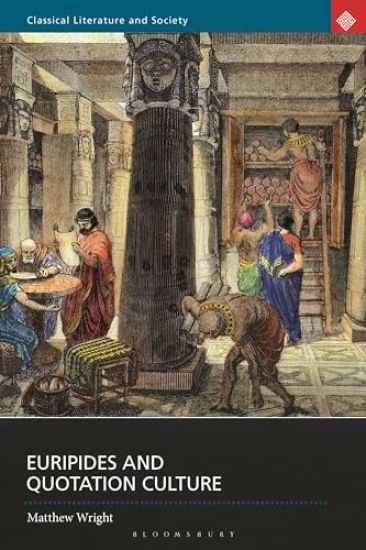
Euripides and Quotation Culture

Euripides and Quotation Culture

Matthew Wright

BLOOMSBURY PUBLISHING PLC
2026
nidottu
Presenting a new approach to Euripides’ plays, this book explores the playwright’s ancient tragedies in relation to quotation culture. Treating extant works and lost works side-by-side, Matthew Wright presents a selective survey of ways in which Euripidean tragedy was quoted within antiquity, both in social contexts (on the comic stage, at symposia, in law courts, in education) and in different literary genres (drama, biography, oratory, philosophy, literary scholarship, history and anthologies). There is also a discussion of the connection between quotability and classic status, where Wright asks what quotations can tell us about ancient reading habits. The implication is that Euripides actively participated in quotation culture by deliberately making certain portions of his plays stand out as especially quotable. Within classical antiquity, Euripides was the most widely quoted author apart from Homer. His plays are full of ‘quotable quotes’, which were repeated so often that they acquired a life of their own. Hundreds of famous verses from Euripidean drama circulated widely within the ancient world, even after the plays in which they originally featured became forgotten or vanished completely. Indeed, the majority of Euripides’ tragedies now survive only in the form of scattered quotations, otherwise known to us as ‘fragments’. It is this corpus of fragmentary quotations, along with his extant plays, that makes Euripides such an interesting case study in the world of quotation culture. This book is the first of its kind to understand Euripides’ work through this lens, as well as opening up quotation culture as a major theme of interest within classical scholarship.

A Literal Translation of Euripides's Hippolytus and Iphigenia. By Martin Tuomy,
The 18th century was a wealth of knowledge, exploration and rapidly growing technology and expanding record-keeping made possible by advances in the printing press. In its determination to preserve the century of revolution, Gale initiated a revolution of its own: digitization of epic proportions to preserve these invaluable works in the largest archive of its kind. Now for the first time these high-quality digital copies of original 18th century manuscripts are available in print, making them highly accessible to libraries, undergraduate students, and independent scholars.Western literary study flows out of eighteenth-century works by Alexander Pope, Daniel Defoe, Henry Fielding, Frances Burney, Denis Diderot, Johann Gottfried Herder, Johann Wolfgang von Goethe, and others. Experience the birth of the modern novel, or compare the development of language using dictionaries and grammar discourses. ++++The below data was compiled from various identification fields in the bibliographic record of this title. This data is provided as an additional tool in helping to insure edition identification: ++++British LibraryT147001Dublin: printed by W. M'Kenzie, 1790. iv,129, 1]p.; 12
The Nineteen Tragedies and Fragments of Euripides. Translated by Michael Wodhull, Esq; In Four Volumes. ... of 4; Volume 1
The 18th century was a wealth of knowledge, exploration and rapidly growing technology and expanding record-keeping made possible by advances in the printing press. In its determination to preserve the century of revolution, Gale initiated a revolution of its own: digitization of epic proportions to preserve these invaluable works in the largest archive of its kind. Now for the first time these high-quality digital copies of original 18th century manuscripts are available in print, making them highly accessible to libraries, undergraduate students, and independent scholars.Western literary study flows out of eighteenth-century works by Alexander Pope, Daniel Defoe, Henry Fielding, Frances Burney, Denis Diderot, Johann Gottfried Herder, Johann Wolfgang von Goethe, and others. Experience the birth of the modern novel, or compare the development of language using dictionaries and grammar discourses. ++++The below data was compiled from various identification fields in the bibliographic record of this title. This data is provided as an additional tool in helping to insure edition identification: ++++British LibraryT145697London: printed by John Nichols: and sold by Thomas Payne and Son, 1782. 4v.; 8
The Nineteen Tragedies and Fragments of Euripides. Translated by Michael Wodhull, Esq; In Four Volumes. ... of 4; Volume 2
The 18th century was a wealth of knowledge, exploration and rapidly growing technology and expanding record-keeping made possible by advances in the printing press. In its determination to preserve the century of revolution, Gale initiated a revolution of its own: digitization of epic proportions to preserve these invaluable works in the largest archive of its kind. Now for the first time these high-quality digital copies of original 18th century manuscripts are available in print, making them highly accessible to libraries, undergraduate students, and independent scholars.Western literary study flows out of eighteenth-century works by Alexander Pope, Daniel Defoe, Henry Fielding, Frances Burney, Denis Diderot, Johann Gottfried Herder, Johann Wolfgang von Goethe, and others. Experience the birth of the modern novel, or compare the development of language using dictionaries and grammar discourses. ++++The below data was compiled from various identification fields in the bibliographic record of this title. This data is provided as an additional tool in helping to insure edition identification: ++++British LibraryT145697London: printed by John Nichols: and sold by Thomas Payne and Son, 1782. 4v.; 8
The Nineteen Tragedies and Fragments of Euripides. Translated by Michael Wodhull, Esq; In Four Volumes. ... of 4; Volume 3
The 18th century was a wealth of knowledge, exploration and rapidly growing technology and expanding record-keeping made possible by advances in the printing press. In its determination to preserve the century of revolution, Gale initiated a revolution of its own: digitization of epic proportions to preserve these invaluable works in the largest archive of its kind. Now for the first time these high-quality digital copies of original 18th century manuscripts are available in print, making them highly accessible to libraries, undergraduate students, and independent scholars.Western literary study flows out of eighteenth-century works by Alexander Pope, Daniel Defoe, Henry Fielding, Frances Burney, Denis Diderot, Johann Gottfried Herder, Johann Wolfgang von Goethe, and others. Experience the birth of the modern novel, or compare the development of language using dictionaries and grammar discourses. ++++The below data was compiled from various identification fields in the bibliographic record of this title. This data is provided as an additional tool in helping to insure edition identification: ++++British LibraryT145697London: printed by John Nichols: and sold by Thomas Payne and Son, 1782. 4v.; 8
The Nineteen Tragedies and Fragments of Euripides. Translated by Michael Wodhull, Esq; In Four Volumes. ... of 4; Volume 4
The 18th century was a wealth of knowledge, exploration and rapidly growing technology and expanding record-keeping made possible by advances in the printing press. In its determination to preserve the century of revolution, Gale initiated a revolution of its own: digitization of epic proportions to preserve these invaluable works in the largest archive of its kind. Now for the first time these high-quality digital copies of original 18th century manuscripts are available in print, making them highly accessible to libraries, undergraduate students, and independent scholars.Western literary study flows out of eighteenth-century works by Alexander Pope, Daniel Defoe, Henry Fielding, Frances Burney, Denis Diderot, Johann Gottfried Herder, Johann Wolfgang von Goethe, and others. Experience the birth of the modern novel, or compare the development of language using dictionaries and grammar discourses. ++++The below data was compiled from various identification fields in the bibliographic record of this title. This data is provided as an additional tool in helping to insure edition identification: ++++British LibraryT145697London: printed by John Nichols: and sold by Thomas Payne and Son, 1782. 4v.; 8
The Bacchae of Euripides (Hardcover)

The Bacchae of Euripides (Hardcover)

Euripides; Gilbert Murray

Lulu.com
2018
sidottu
Authoritatively translated by scholar and academic Gilbert Murray, this edition of Bacchae by Euripides is of high quality, allowing the reader ease of interpretation. Famously premiered at the Theatre of Dionysus in 405 B.C., this play is concerned with displaying two sides of human nature. One side is embodied by Pentheus - the King of Thebes - who employs reason, logic and forethought in his behaviour. The impulsive and rash side to man, operating on hunches and instinct, finds its embodiment in Dionysus. With this as his basis, Euripides offers us a tragic plotline which explores the connections between man and beast in highlighting that completely ignoring Dionysus' approach is perilous, for its denies the soul a kind of spiritualism which all living beings experience and live among.
The Bacchae of Euripides

The Bacchae of Euripides

Euripides; Gilbert Murray

Lulu.com
2018
pokkari
Authoritatively translated by scholar and academic Gilbert Murray, this edition of Bacchae by Euripides is of high quality, allowing the reader ease of interpretation. Famously premiered at the Theatre of Dionysus in 405 B.C., this play is concerned with displaying two sides of human nature. One side is embodied by Pentheus - the King of Thebes - who employs reason, logic and forethought in his behaviour. The impulsive and rash side to man, operating on hunches and instinct, finds its embodiment in Dionysus. With this as his basis, Euripides offers us a tragic plotline which explores the connections between man and beast in highlighting that completely ignoring Dionysus' approach is perilous, for its denies the soul a kind of spiritualism which all living beings experience and live among.
Euripides Our Contemporary

Euripides Our Contemporary

J. Michael Walton

Methuen Drama
2009
nidottu
'In this masterful reevaluation of Euripides, Michael Walton recasts the playwright in light of his resonance for today's translators and directors. Springing from the rehearsal room rather than the page, Walton shows us not only why we are ready for Euripides, but why we so desperately need him.' Mary Louise Hart, Associate Curator of Antiquities, J. Paul Getty Museum 'A useful, reader-friendly introduction aimed at non-specialists, [it] offers detailed summaries of Euripides' plays, along with keen observations on their relevance for today's theater.' Rush Rehm, author of Radical Theatre Euripides Our Contemporary is a major new study of the work of the great classical tragedian that illuminates his work and demonstrates both its vitality and how it continues to speak to us today. Taking a thematic approach to Euripides' plays it provides the reader with a wide-ranging and thorough appreciation of the writer's entire canon. For students, teachers and practitioners this is the best single-volume treatment of the writer's work, considering the plays for their accessibility and for their focus on issues and concerns which are as significant as ever in the modern world. Divided into three sections, the book first examines 'Domesticating Tragedy', the manner in which Euripides gave the world of myth an application to ordinary life. The second section tackles the 'Grand Passions': characters under extraordinary pressure and the extent to which personal responsibility can be absolved through various aspects of circumstance. The third looks at the nature of Euripides' theatre and his acknowledgment of it, the great roles and the playwrights of the last hundred years whose craft seems most influenced by his work. An Appendix at the end of the book provides a short summary of the plots of all nineteen plays.
Euripides And The Spirit Of His Dramas
This book, "Euripides And The Spirit Of His Dramas", by Paul Decharme, is a replication of a book originally published before 1906. It has been restored by human beings, page by page, so that you may enjoy it in a form as close to the original as possible. This book was created using print-on-demand technology. Thank you for supporting classic literature.