Kirjojen hintavertailu. Mukana 12 002 957 kirjaa ja 12 kauppaa.

Kirjahaku

Etsi kirjoja tekijän nimen, kirjan nimen tai ISBN:n perusteella.

1000 tulosta hakusanalla FREEDOM DIVIDEND

Freedom and Necessity in Modern Trinitarian Theology

Freedom and Necessity in Modern Trinitarian Theology

Brandon Gallaher

Oxford University Press
2016
sidottu
Freedom and Necessity in Modern Trinitarian Theology examines the tension between God and the world through a constructive reading of the Trinitarian theologies and Christologies of Sergii Bulgakov (1871-1944), Karl Barth (1886-1968), and Hans Urs von Balthasar (1905-1988). It focuses on what is called 'the problematic of divine freedom and necessity' and the response of the writers. 'Problematic' refers to God being simultaneously radically free and utterly bound to creation. God did not need to create and redeem the world in Christ. It is a contingent free gift. Yet, on the other side of a dialectic, he also has eternally determined himself to be God as Jesus Christ. He must create and redeem the world to be God as he has so determined. In this way the world is given a certain 'free necessity' by him because if there were no world then there would be no Christ. A spectrum of different concepts of freedom and necessity and a theological ideal of a balance between the same are outlined and then used to illumine the writers and to articulate a constructive response to the problematic. Brandon Gallaher shows that the classical Christian understanding of God having a non-necessary relationship to the world and divine freedom being a sheer assertion of God's will must be completely rethought. Gallaher proposes a Trinitarian, Christocentric, and cruciform vision of divine freedom. God is free as eternally self-giving, self-emptying and self-receiving love. The work concludes with a contemporary theology of divine freedom founded on divine election.
Freedom of Religion, Secularism, and Human Rights
This interdisciplinary volume examines the relationship between secularism, freedom of religion and human rights in legal, theoretical, historical and political perspective. It brings together chapters from leading scholars of human rights, law and religion, political theory, religious studies and history, and provides insights into the state of the debate about the relationship between these concepts. Comparative in orientation, its chapters draw on constitutional and political discourses and experience not only from Western Europe and the United States, but also from India, the Arab world, and Malaysia.
Freedom of Religion or Belief

Freedom of Religion or Belief

Heiner Bielefeldt; Nazila Ghanea; Michael Wiener

Oxford University Press
2017
nidottu
Violations of religious freedom and violence committed in the name of religion grab our attention on a daily basis. Freedom of religion or belief is a key human right: the International Covenant on Civil and Political Rights, numerous conventions, declarations and soft law standards include specific provisions on freedom of religion or belief. The 1981 Declaration on the Elimination of All Forms of Intolerance and of Discrimination Based on Religion or Belief has been interpreted since 1986 by the mandate of the UN Special Rapporteur on freedom of religion or belief. Special Rapporteurs (for example those on racism, freedom of expression, minority issues and cultural rights) and Treaty Bodies (for example the Human Rights Committee, the Committee on the Elimination of Racial Discrimination and the Committee on the Rights of the Child) have also elaborated on freedom of religion or belief in the context of their respective mandates. Freedom of Religion or Belief: An International Law Commentary is the first commentary to look comprehensively at the international provisions for the protection of freedom of religion or belief, considering how they are interpreted by various United Nations Special Procedures and Treaty Bodies. Structured around the thematic categories of the United Nations Special Rapporteur's framework for communications, the commentary analyses, for example, the limitations on the wearing of religious symbols and vulnerable situations, including those of women, detainees, refugees, children, minorities and migrants, through a combination of scholarly expertise and practical experience.
Freedom and Responsibility in Neoplatonist Thought

Freedom and Responsibility in Neoplatonist Thought

Ursula Coope

Oxford University Press
2020
sidottu
The Neoplatonists have a perfectionist view of freedom: an entity is free to the extent that it succeeds in making itself good. Free entities are wholly in control of themselves--they are self-determining, self-constituting, and self-knowing. Neoplatonist philosophers argue that such freedom is only possible for non-bodily things. The human soul is free insofar as it rises above bodily things and engages in intellection, but when it turns its desires to bodily things, it is drawn under the sway of fate and becomes enslaved. Ursula Coope discusses this notion of freedom and its relation to questions about responsibility. She explains the important role of notions of self-reflexivity in Neoplatonist accounts of both freedom and responsibility. In Part I, Coope sets out the puzzles Neoplatonist philosophers face about freedom and responsibility and explains how these puzzles arise from earlier discussions. Part II explores the metaphysical underpinnings of the Neoplatonist notion of freedom (concentrating especially on the views of Plotinus and Proclus). In what sense, if any, is the ultimate first principle of everything (the One) free? If everything else is under this ultimate first principle, how can anything other than the One be free? What is the connection between freedom and nonbodiliness? Finally, Coope considers in Part III questions about responsibility, arising from this perfectionist view of freedom. Why are human beings responsible for their behaviour, in a way that other animals are not? If we are enslaved when we act viciously, how can we be to blame for our vicious actions and choices?
Freedom of Expression as Self-Restraint

Freedom of Expression as Self-Restraint

Matthew H. Kramer

Oxford University Press
2021
sidottu
Freedom of Expression as Self-Restraint provides a novel justificatory foundation for the principle of freedom of expression. As the book argues, such a principle is absolute in that it is exceptionless; it imposes general duties that are binding always and everywere on every system of governance. In addition to injecting a new level of philosophical sophistication into the debates over freedom of expression, the book ties the principle to an ideal of governmental self-restraint, and it shows how that ideal connects to the paramount moral responsibility of every system of governance: the responsibility to bring about the political, social, and economic conditions under which every member of society can be warranted in harbouring an ample sense of self-respect. In short, compliance by a system of governance with the principle of freedom of expression is integral to the fulfilment of that paramount responsibility.
Freedom of Speech in International Law
Freedom of Speech in International Law charts the minimum protections for speech enshrined in international human rights law. It clarifies what the right to freedom of expression means under international law, identifies conflicts between law and state practice, and provides key recommendations as to how international standards should be interpreted, updated, and enforced. Each of the book's six chapters focusses on an area of the law that is being weaponized to silence the press or curtail freedom of expression. Chapters focus on insulting speech (including defamation and sedition laws), false speech (through misinformation or disinformation laws), hate speech, and speech affecting national security (in form of espionage/official secrets laws and terrorism laws). Each chapter outlines relevant state practice, identifies the conflicts that exist in international human rights law, and highlights areas for reform. Examples throughout the book demonstrate the legislative tools relied on by states to quash dissent - not just sedition, treason, and criminal insult laws that have traditionally targeted speech but, increasingly, terrorism, 'false news', and other vague laws to protect themselves against unflattering press. Recommendations at the end of each chapter aim to bridge the gap between practice and the legal obligations of both states and social media companies that have expressed voluntary adherence to the same standards. These recommendations build on existing standards, and have been endorsed by an esteemed group of experts from across the world, including the Media Freedom Coalition's High Level Panel of Legal Experts on Media Freedom.
Freedom of Contract in the European Financial Sector

Freedom of Contract in the European Financial Sector

Danny Busch

Oxford University Press
2026
sidottu
Freedom of contract is a fundamental principle of European Union law, a necessary condition for exercising the freedom to choose an occupation and the freedom to conduct a business. Since the global financial crisis, a vast body of regulatory rules has been developed, and freedom of contract of banks and other financial institutions is being restricted, often to protect the weaker party or achieve public policy goals. Freedom of Contract in the European Financial Sector provides a robust analysis of freedom of contract and its restrictions in the European financial sector. Covering EU financial supervision law, general EU law, contract law, and consumer law, this book examines how the interplay between freedom of contract and the protection of the weaker party and the promotion of other public interests impacts banks and other financial institutions. Timely and thought-provoking, this book explores fundamental legal principles and their practical implications that will be highly relevant to scholars and practitioners not only in the EU, but also in the UK, the US, Switzerland, Singapore, and Hong Kong.
Freedom of Speech

Freedom of Speech

Eric Barendt

Oxford University Press
2007
nidottu
This is a fully revised and updated new edition of the classic work first published in 1985. There have been many important developments since the first edition, including enactment of the Charter of Rights and Freedoms in Canada in 1982, the impact of the European Human Rights Convention, and the consideration by English courts of Judgments of the European Court of Human Rights. Social and cultural changes mean that free speech claims are being made in novel contexts: to challenge the validity of bans on tobacco advertising, to publish 'kiss and tell' stories about celebrities, and to resist attempts to regulate the Internet. Barendt considers the meaning and scope of freedom of speech. How far do free speech and expression clauses protect pornography, commercial advertising, and public meetings on the streets? Does this freedom cover desecration of a national flag? Does it include nude dancing? Eric Barendt discusses the legal protection of free speech in countries including England, the United States (including recent decisions of the United States Supreme Court), Canada, Germany, and under the European Human Rights Convention. He examines the varied approaches of different legal systems and constitutional traditions to balancing free speech and freedom of the press against rights to reputation and privacy, and to copyright and explores the case law in light of the philosophical and political arguments for free speech guarantees.
Freedom from Poverty as a Human Right
Collected here in one volume are fifteen cutting-edge essays by leading academics which together clarify and defend the claim that freedom from poverty is a human right with corresponding binding obligations on the more affluent to practice effective poverty avoidance. The nature of human rights and their corresponding duties is examined, as is the theoretical standing of the social, economic and cultural rights. The authors largely agree in concluding that there is a human right to be free from poverty and that this right is massively violated by the present world economy which creates huge unfair imbalances in income and wealth among and within countries. This searing indictment of the status quo is all the more powerful as the authors endorsing it exemplify diverse philosophical methods and moral traditions and also highlight different aspects of poverty and global institutional arrangements. This volume will be of great interest and value to academics working in the fields of philosophy, political science and international relations, as well as to undergraduate and graduate students in these disciplines. It will also be a crucial aid and challenge to practitioners in international governmental organizations (such as the UN and its agencies) and NGOs who think of their work in human-rights terms. Indeed, in view of the magnitude of the human rights deficit at issue, any moral citizen has reason to engage with the arguments of this book. And the book makes this possible for most in that, throughout, even the most complex aspects of rights theory is discussed in clear, direct language, making the text accessible to specialists and lay readers alike. Co-published with UNESCO
Freedom from Poverty as a Human Right
Collected here in one volume are fifteen cutting-edge essays by leading academics which together clarify and defend the claim that freedom from poverty is a human right with corresponding binding obligations on the more affluent to practice effective poverty avoidance. The nature of human rights and their corresponding duties is examined, as is the theoretical standing of the social, economic and cultural rights. The authors largely agree in concluding that there is a human right to be free from poverty and that this right is massively violated by the present world economy which creates huge unfair imbalances in income and wealth among and within countries. This searing indictment of the status quo is all the more powerful as the authors endorsing it exemplify diverse philosophical methods and moral traditions and also highlight different aspects of poverty and global institutional arrangements. This volume will be of great interest and value to academics working in the fields of philosophy, political science and international relations, as well as to undergraduate and graduate students in these disciplines. It will also be a crucial aid and challenge to practitioners in international governmental organizations (such as the UN and its agencies) and NGOs who think of their work in human-rights terms. Indeed, in view of the magnitude of the human rights deficit at issue, any moral citizen has reason to engage with the arguments of this book. And the book makes this possible for most in that, throughout, even the most complex aspects of rights theory is discussed in clear, direct language, making the text accessible to specialists and lay readers alike Co-published with UNESCO
Freedom of Speech

Freedom of Speech

Eric Barendt

Oxford University Press
2005
sidottu
This is a fully revised and updated new edition of the classic work first published in 1985. There have been many important developments since the first edition, including enactment of the Charter of Rights and Freedoms in Canada in 1982, the impact of the European Human Rights Convention, and the consideration by English courts of Judgments of the European Court of Human Rights. Social and cultural changes mean that free speech claims are being made in novel contexts: to challenge the validity of bans on tobacco advertising, to publish 'kiss and tell' stories about celebrities, and to resist attempts to regulate the Internet. Barendt considers the meaning and scope of freedom of speech. How far do free speech and expression clauses protect pornography, commercial advertising, and public meetings on the streets? Does this freedom cover desecration of a national flag? Does it include nude dancing? Eric Barendt discusses the legal protection of free speech in countries including England, the United States (including recent decisions of the United States Supreme Court), Canada, Germany, and under the European Human Rights Convention. He examines the varied approaches of different legal systems and constitutional traditions to balancing free speech and freedom of the press against rights to reputation and privacy, and to copyright and explores the case law in light of the philosophical and political arguments for free speech guarantees.
Freedom and Belief

Freedom and Belief

Galen Strawson

Oxford University Press
2010
sidottu
This is a revised and updated edition of Galen Strawson's groundbreaking first book, where he argues that there is a fundamental sense in which there is no such thing as free will or true moral responsibility (as this is ordinarily understood). This conclusion is very hard to accept. On the whole we continue to believe firmly both that we have free will and that we are truly morally responsible for what we do. Strawson devotes much of the book to an attempt to explain why this is so. He examines various aspects of the 'cognitive phenomenology' of freedom - the nature, causes, and consequences of our deep commitment to belief in freedom. In particular, he considers at length a number of problems that are raised by the suggestion that, if freedom were possible, believing oneself to be a free agent would be a necessary condition of being a free agent.
Freedom and Belief

Freedom and Belief

Galen Strawson

Oxford University Press
2010
nidottu
This is a revised and updated edition of Galen Strawson's groundbreaking first book, where he argues that there is a fundamental sense in which there is no such thing as free will or true moral responsibility (as this is ordinarily understood). This conclusion is very hard to accept. On the whole we continue to believe firmly both that we have free will and that we are truly morally responsible for what we do. Strawson devotes much of the book to an attempt to explain why this is so. He examines various aspects of the 'cognitive phenomenology' of freedom - the nature, causes, and consequences of our deep commitment to belief in freedom. In particular, he considers at length a number of problems that are raised by the suggestion that, if freedom were possible, believing oneself to be a free agent would be a necessary condition of being a free agent.
Freedom in Response

Freedom in Response

Oswald Bayer

Oxford University Press
2007
sidottu
The leitmotif of Freedom in Response, as the title suggests, is a reasoned exposition of the nature of freedom, as it is presented in the Bible and developed by such later theologians as Martin Luther. Oswald Bayer considers Luther's teachings on pastoral care, marriage, and the three estates, bringing in Kant and Hegel as conversation partners, together with Kant's friend and critic, the innovative theologian and philosopher Johann Georg Hamann. Oswald Bayer is a major contemporary Lutheran theologian, but so far little of his work has been translated from German into English. This selection of essays indicates the depth and range of his thought on issues relating to theological ethics.
Freedom and Reason in Kant, Schelling, and Kierkegaard
Michelle Kosch's book traces a complex of issues surrounding moral agency - how is moral responsibility consistent with the possibility of theoretical explanation? is moral agency essentially rational agency? can autonomy be the foundation of ethics? - from Kant through Schelling to Kierkegaard. There are two complementary projects here. The first is to clarify the contours of German idealism as a philosophical movement by examining the motivations not only of its beginning, but also of its end. In tracing the motivations for the transition to mid-19th century post-idealism to Schelling's middle and late periods and, ultimately, back to a problem originally presented in Kant, it shows the causes of the demise of that movement to be the same as the causes of its rise. In the process it presents the most detailed discussion to date of the moral psychology and moral epistemology of Schelling's work after 1809. The second project - which is simply the first viewed from a different angle - is to trace the sources of Kierkegaard's theory of agency and his criticism of philosophical ethics to this same complex of issues in Kant and post-Kantian idealism. In the process, Kosch argues that Schelling's influence on Kierkegaard was greater than has been thought, and builds a new understanding of Kierkegaard's project in his pseudonymous works on the basis of this revised picture of their historical background. It is one that uncovers much of interest and relevance to contemporary debates.
Freedom Without Violence

Freedom Without Violence

Dustin Ells Howes

Oxford University Press Inc
2016
sidottu
There is a long tradition in western political thought suggesting that violence is necessary to defend freedom. But nonviolence and civil disobedience have played an equally long and critical role in establishing democratic institutions. Freedom Without Violence explores the long history of political practice and thought that connects freedom to violence in the West, from Athenian democracy and the Roman republic to the Age of Revolutions and the rise of totalitarianism. It is the first comprehensive examination of the idea that violence is necessary to obtain, defend, and exercise freedom. The book also brings to the fore the opposing theme of nonviolent freedom, which can be found both within the Western tradition and among critics of that tradition. Since the plebs first vacated Rome to refuse military service and win concessions from the patricians in 494 B.C., nonviolence and civil disobedience have played a critical role in republics and democracies. Abolitionists, feminists and anti-colonial activists all adopted and innovated the methods of nonviolence. With the advent of the Velvet Revolutions, the end of apartheid in South Africa and, most recently, the Arab Spring, nonviolence has garnered renewed interest in both scholarly publications and the popular imagination. In this book, Dustin Ells Howes traces the intellectual history of freedom as it relates to the concepts and practices of violence and nonviolence. Through a critique and reappraisal of the Western political tradition, Freedom Without Violence constructs a conception of nonviolent freedom. The book argues that cultivating and practicing this brand of freedom is the sine qua non of a vibrant democracy that resists authoritarianism, imperialism and oligarchy.
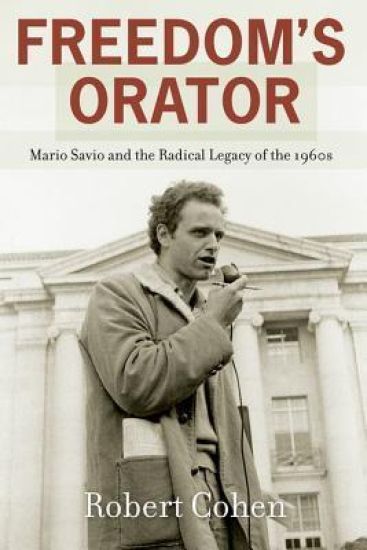
Freedom's Orator

Freedom's Orator

Robert Cohen

Oxford University Press Inc
2014
nidottu
Here is the first biography of Mario Savio, the brilliant leader of Berkeley's Free Speech Movement, the largest and most disruptive student rebellion in American history. Savio risked his life to register black voters in Mississippi in the Freedom Summer of 1964 and did more than anyone to bring daring forms of non-violent protest from the civil rights movement to the struggle for free speech and academic freedom on American campuses. Drawing upon previously unavailable Savio papers, as well as oral histories from friends and fellow movement leaders, Freedom's Orator illuminates Mario's egalitarian leadership style, his remarkable eloquence, and the many ways he embodied the youthful idealism of the 1960s. The book also narrates, for the first time, his second phase of activism against "Reaganite Imperialism" in Central America and the corporatization of higher education. Including a generous selection of Savio's speeches, Freedom's Orator speaks with special relevance to a new generation of activists and to all who cherish the '60s and democratic ideals for which Savio fought so selflessly.
Freedom of the Press

Freedom of the Press

Ahfaz ur Rehman

OUP Pakistan
2018
sidottu
An English translation of the Urdu title Sab Sai Bari Jang, the book is an honest, accurate, and concise account of the days of turmoil and struggle when President General Zia ul-Haq had enacted a series of draconian laws in order to suppress freedom of expression and free press. They left an indelible mark on the history of press in Pakistan. The struggle of some journalists against repressive rule has contributed in revamping the overall nature of movements for the freedom of expression, free media, and a free press in Pakistan. This book can be regarded as a vital historical account for future generations enabling them to learn from the heroic struggles of people of conscience who employed the power of their pens to combat the forces of oppression.