
Kirjahaku
Etsi kirjoja tekijän nimen, kirjan nimen tai ISBN:n perusteella.
1000 tulosta hakusanalla Goethe

Goethe's Mother: Correspondence of Catharine Elizabeth Goethe with Goethe, Lavater, Wieland, Duchess Anna Amalia of Saxe-Weimar, Friedr
Catharine Elizabeth Goethe
Kessinger Publishing
2007
sidottu

Goethe And Schiller's Xenions
Johann Wolfgang Von Goethe; Friedrich Schiller; Paul (TRN) Carus
Kessinger Pub
2008
pokkari

Commissioned by the BBC for the Goethe Centenary in 1949, and originally broadcast in six instalments, Louis MacNeice's translation of Goethe's Faust distills the digressive dimensions of the original - at once a play and an epic poem - into a verse drama for the ear. The translation is almost line for line, following closely and skilfully the varied verse patterns of the original, as well as its radical shifts of mood and momentum. Louis MacNeice joined the BBC in 1941, and for the next twenty years produced programmes for the legendary Features Department, as well as composing a very individual body of work for radio. He wrote in praise of the 'calculated speech' of the radio as a medium, 'divorced from all visual supports or interferences'. His Goethe's Faust remains the most successful adaptation of Goethe's masterpiece for an English audience, but is also an important and neglected contribution to MacNeice's own poetic oeuvre for radio.
Translated by Ellen von Nardroff and Ernest H. von Nardroff The reflections on art and literature that Goethe produced throughout his life are the premise and corollary of his work as poet, novelist, and man of science. This volume contains such important essays as "On Gothic Architecture," "On the Laocoon Group," and "Shakespeare: A Tribute." Several works in this collection appear for the first time unabridged and in fresh translations.
Campaign in France 1792 -Siege of Mainz, Goethe's narrative of the unsuccessful campaign and the siege, has become a classic text for the history of Franco-German relations during the revolutionary period. A product of recollection, historical hindsight, and considerable study of other published sources, it is a fascinating document of the military catastrophe exposing the decline of Prussian power since the death of Frederick II, which eventually culminated in Napoleon's devastating 1806 victory at Jena and Auerstedt.
Wilhelm Meister's Apprenticeship, a novel of self-realization greatly admired by the Romantics, has been called the first Bildungsroman and has had a tremendous influence on the history of the German novel. The story centers on Wilhelm, a young man living in the mid-1700s who strives to break free from the restrictive world of economics and seeks fulfillment as an actor and playwright. Along with Eric Blackall's fresh translation of the work, this edition contains notes and an afterword by the translator that aims to put this novel into historical and artistic perspective for twentieth-century readers while showing how it defies categorization.
Goethe was a master of the short prose form. His two narrative cycles, Conversations of German Refugees and Wilhelm Meister's Journeyman Years, both written during a high point of his career, address various social issues and reveal his experimentation with narrative and perspective. A traditional cycle of novellas, Conversations of German Refugees deals with the impact and significance of the French Revolution and suggests Goethe's ideas on the social function of his art. Goethe's last novel, Wilhelm Meister's Journeyman Years, is a sequel to Wilhelm Meister's Apprenticeship and to Conversations of German Refugees and is considered to be his most remarkable novel in form.
Containing three of Goethe's major prose works, this volume explores a range of themes: unfulfilled love, infidelity, divorce, tragic love, fantasy, and moral rebirth. One of Goethe's best known works, The Sorrows of Young Werther, explores the extremes of the subjective experience through the novel's depiction of a sensitive young man caught up in a love impossible to fulfill. In Elective Affinities, a novel of tragic love, Goethe employs all the requisites of sentimental romance to give a deeply ironic perspective to the idea of love. As the title indicates, Novella examines the possibilities inherent in this genre.
The author reads Goethe's Faust as the first epic written under Spinoza's influence. He shows how its thematic development is governed by Spinoza's pantheistic naturalism. He further contends that Wagner and Nietzsche have tried to surpass their mentor Goethe's work by writing their own Spinozan epics of love and power in The Ring of the Nibelung and Thus Spoke Zarathustra. These Spinozan epics are designed to succeed the Christian epics in the Western literary tradition. Whereas the Christian epics dared to groom human beings for their destiny in the supernatural world, the Spinozan epics try to reinstate humanity as the children of Mother Nature and overcome their alienation from the natural world, which had been dictated by the long reign of Christianity. However, it has been well noted that none of these new epics seems to hang together thematically as a coherent work. By his Spinozan reading, the author not only demonstrates the thematic unity of each of them singly, but further illustrates their thematic relation with each other.
The author reads Goethe's Faust as the first epic written under Spinoza's influence. He shows how its thematic development is governed by Spinoza's pantheistic naturalism. He further contends that Wagner and Nietzsche have tried to surpass their mentor Goethe's work by writing their own Spinozan epics of love and power in The Ring of the Nibelung and Thus Spoke Zarathustra. These Spinozan epics are designed to succeed the Christian epics in the Western literary tradition. Whereas the Christian epics dared to groom human beings for their destiny in the supernatural world, the Spinozan epics try to reinstate humanity as the children of Mother Nature and overcome their alienation from the natural world, which had been dictated by the long reign of Christianity. However, it has been well noted that none of these new epics seems to hang together thematically as a coherent work. By his Spinozan reading, the author not only demonstrates the thematic unity of each of them singly, but further illustrates their thematic relation with each other.
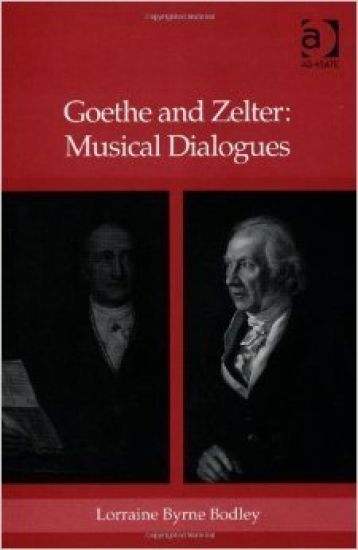
Goethe and Zelter spent a staggering 33 years corresponding or in the case of each artist, over two thirds of their lives. Zelter's position as director of the Sing-Akademie zu Berlin and Goethe's location in Weimar resulted in a wide-ranging correspondence. Goethe's letters offer a chronicle of his musical development, from the time of his journey to Italy to the final months of his life. Zelter's letters retrace his path as stonemason to Professor of Music in Berlin. The 891 letters that passed between these artists provide an important musical record of the music performed in public concerts in Berlin and in the private and semi-public soirées of the Weimar court. Their letters are those of men actively engaged in the musical developments of their time. The legacy contains a wide spectrum of letters, casual and thoughtfully composed, spontaneous and written for publication, rich with the details of Goethe's and Zelter's musical lives. Through Zelter, Goethe gained access to the professional music world he craved and became acquainted with the prodigious talent of Felix Mendelssohn. A single letter from Zelter might bear a letter from Felix Mendelssohn to another recipient of the same family, reflecting a certain community in the Mendelssohn household where letters were not considered private but shared with others in a circle of friends or family. Goethe recognized the value of such correspondence: he complains when his friend is slow to send letters in return for those written to him by the poet, a complaint common in this written culture where letters provided news, introductions, literary and musical works. This famous correspondence contains a medley of many issues in literature, art, and science; but the main focus of this translation is the music dialogues of these artists.