In zijn eerste essay "My Thoughts, experiences, history and values" richt Jan Ruijgrok zich op de jongste maatschappelijke ontwikkelingen in de context van zijn persoonlijke levensloop. Hij spiegelt daarin ervaringen uit verschillende fasen van zijn eigen leven met huidige ontwikkelingen in de maatschappij. In "Echt Waar !" pakt Jan Ruijgrok de pen op om herinneringen uit zijn jeugd specifiek voor zijn kleinkinderen op te schrijven. Het is bedoeld als voorleesboek, maar ook om kinderen in de lagereschoolleeftijd inzicht te geven in de belevingswereld van leeftijdgenoten van een halve eeuw geleden. De lezers zijn kinderen, maar het thema is ook hier het spiegelen tussen verschillende tijdgeesten.
Jan Patocka’s contribution to phenomenology and the philosophy of history mean that he is considered one of the most important philosophers of the 20th century. Yet, his writing is not widely available in English and the Anglophone world remains rather unfamiliar with his work. In this new book of essential Patocka texts, of which the majority have been translated from the original Czech for the first time, readers will experience a general introduction to the key tenets of his philosophy. This includes his thoughts on the relationship between philosophy and political engagement which strike at the heart of contemporary debates about freedom, political participation and responsibility and a truly pressing issue for modern Europe, what exactly constitutes a European identity? In this important collection, Patocka provides an original vision of the relationship between self, world, and history that will benefit students, philosophers and those who are interested in the ideals that underpin our democracies.
Jan Patocka’s contribution to phenomenology and the philosophy of history mean that he is considered one of the most important philosophers of the 20th century. Yet, his writing is not widely available in English and the Anglophone world remains rather unfamiliar with his work. In this new book of essential Patocka texts, of which the majority have been translated from the original Czech for the first time, readers will experience a general introduction to the key tenets of his philosophy. This includes his thoughts on the relationship between philosophy and political engagement which strike at the heart of contemporary debates about freedom, political participation and responsibility and a truly pressing issue for modern Europe, what exactly constitutes a European identity? In this important collection, Patocka provides an original vision of the relationship between self, world, and history that will benefit students, philosophers and those who are interested in the ideals that underpin our democracies.
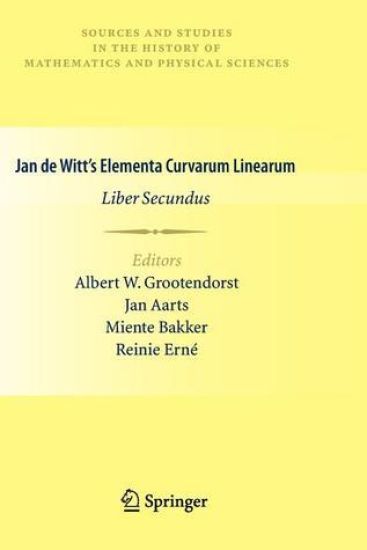
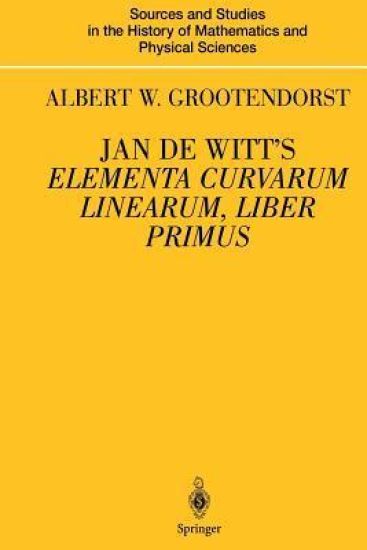
- Following on from the 2000 edition of Jan De Witt’s Elementa Curvarum Linearum, Liber Primus, this book provides the accompanying translation of the second volume of Elementa Curvarum Linearum (Foundations of Curved Lines). One of the first books to be published on Analytic Geometry, it was originally written in Latin by the Dutch statesman and mathematician Jan de Witt, soon after Descartes’ invention of the subject. - Born in 1625, Jan de Witt served with distinction as Grand Pensionary of Holland for much of his adult life. In mathematics, he is best known for his work in actuarial mathematics as well as extensive contributions to analytic geometry. - Elementa Curvarum Linearum, Liber Secondus moves forward from the construction of the familiar conic sections covered in the Liber Primus, with a discussion of problems connected with their classification; given an equation, it covers how one can recover the standard form, and additionally how one can find the equation's geometric properties. - This volume, begun by Albert Grootendorst (1924-2004) and completed after his death by Jan Aarts, Reinie Erné and Miente Bakker, is supplemented by: - annotation explaining finer points of the translation; - extensive commentary on the mathematics These features make the work of Jan de Witt broadly accessible to today’s mathematicians.
The present book is a translation into English of Elernenta CU'f'Varurn Linearurn-Liber Prirnus, written in Latin, by the Dutch statesman and mathematician Jan de Witt (1625-1672). Together with its sequel, Ele- rnenta CU'f'Varurn Linearurn-Liber Secundus, it constitutes the first text- book on Analytic Geometry, based on the ideas of Descartes, as laid down in his Geornetrie of 1637. The first edition of de Witt's work appeared in 1659 and this translation is its first translation into English. For more details the reader is referred to the Introduction. Apart from this translation and this introduction, the present work con- tains an extensive summary, annotations to the translation, and two ap- pendices on the role of the conics in Greek mathematics. The translation has been made from the second edition, printed by the Blaeu Company in Amsterdam in 1684. In 1997 the translator published a translation into Dutch of the same work, likewise supplied with an introduction, a summary, notes, and two appendices. This edition appeared as a publication of the Stichting Mathe- matisch Centrum Amsterdam. The present translation, however, is a direct translation of the Latin text. The rest of this work is an English version of the introduction, the summary, the notes, and the appendices, based on the Dutch original.