Kirjojen hintavertailu. Mukana 12 016 292 kirjaa ja 12 kauppaa.

Kirjahaku

Etsi kirjoja tekijän nimen, kirjan nimen tai ISBN:n perusteella.

1000 tulosta hakusanalla Kaye Michelle

Ocean Travel and Cruising

Ocean Travel and Cruising

Kaye Sung Chon; Arthur Asa Berger

Routledge Member of the Taylor and Francis Group
2004
nidottu
A one-of-a-kind analysis of ocean cruising! In Ocean Travel and Cruising: A Cultural Analysis, noted author Arthur Asa Berger turns his critical eye to the phenomenon of ocean cruising. This academically solid yet reader-friendly book brings a multidisciplinary cultural studies approach to the subject, examining ocean cruising from economic, semiotic, sociological, psychoanalytic, and marketing perspectives, and offering insights not provided by the more traditional sociological approaches to the subject. You'll explore cruise demographics, the relationship between cruising and gender, the sociology of dining on cruise ships, hedonism and pleasure seeking, the compulsion to cruise, consolidation in the industry, the exploitation of workers on cruise ships, and a great deal more. Here's a section-by-section rundown of what's in store for you and your students in this one-of-a-kind new text: The Economics of Cruising examines cruise categories, industry consolidation, worker exploitation, and ways that cruise lines make money aside from ticket sales. This section also compares the costs of cruises vs. land-based vacations and fills you in on the typical weekly food and beverage consumption of the Carnival line's complement of ships, which sheds light on how a cruise line can, for a mere $10, provide a food array that would cost a restaurant or hotel $33 to $40. Signs at SeaThe Semiotics of Cruising provides you with a quick primer on semiotics and then discusses the cruise ship as a sign system and then breaks the system down to its component parts, discussing dining rooms, cabins/staterooms, dress codes, spatiality, luxury signifiers, the perceived elitism of the cruise experience, the role of photography, and more. A Sociological Analysis of Cruising explores cruise demographics and their meaning, time budgeting on cruises, the sociology of dining, new trends in cruising, and the meaning of gender in relation to ocean cruising. A particularly intriguing chapter is A Psychoanalytic Interpretation of Cruising. Beginning with a look at the compulsion to cruise, this section explores cruising's relationship with the unconscious, the paradise myth, hedonism and pleasure seeking, the desire for unconditional love, psychological regression, and more. In Selling Smooth Sailing: Advertising and Marketing Cruises, you'll examine print advertisements from eight major cruise lines, look at what they have in common and what the differences are between the messages each cruise line hopes to convey via the style and content of their ads and brochures. Cruising (on) the Internet looks at the intersection of the information superhighway with the world of cruising. You'll learn about the cruise lines' own Web sites, travel agency sites, Internet sites designed to rate and review cruises and cruise ships, and more. Notes from a Cruise Journal shares the author’s on-site reflections and impressions of a weeklong cruise from Los Angeles to Puerto Vallarta, Mexico, and back. Written in accessible, jargon-free language that will appeal to students at all levels, Ocean Travel and Cruising: A Cultural Analysis is the most recent of a very small selection of scholarly studies of ocean cruising available in English. Make it a part of your cultural studies, leisure studies, sociology, travel/tourism/hospitality, popular culture, or American studies course this semester!
Casino Industry in Asia Pacific

Casino Industry in Asia Pacific

Kaye Sung Chon; Cathy Hc Hsu

Routledge Member of the Taylor and Francis Group
2006
sidottu
This single volume gives you comprehensive information on Asia-Pacific gaming!Casino Industry in Asia Pacific: Development, Operation, and Impact is a one-of-a-kind comprehensive review of the gaming industry in various countries in the Asia-Pacific region. This valuable resource thoroughly details the history, the operational issues, and the impact of casino gaming in Australia, Korea, Macao, and Southeast Asiaand the Pachinko phenomenon in Japan. International authorities discuss crucial issues that involve policy makers and casino developers, allowing industry players a global perspective as they consider various important viewpoints in their long-range planning. Casino Industry in Asia Pacific is organized into three sections: Development, Operation, and Impact. Chapters in the Development section provide a thorough history of gaming for Australia, Japan, Korea, Macao, and Southeast Asia. Laws and regulations are also reviewed for each location. In the Operation section, each chapter analyzes an important casino operational issue, including regulations, licensing and due diligence, internal control and auditing, and rolling commissions. The last section reviews the economic and social impacts for various regions. Chinese culture and gaming are also examined in detail to illustrate the intertwined relationship between gaming and people’s daily life. Extensive bibliographies, helpful tables, and fascinating photographs are also included.Casino Industry in Asia Pacific discusses: casino history and gaming legislation in Australia, Korea, and Macao Japan’s form of gamblingPachinko gaming in Southeast Asia suggestions for Asian gaming jurisdictions casino licensing investigations accounting, internal controls, and casino auditing the use of non-negotiable chips the societal and economic impacts of gaming in Australia the impacts of casinos in Korea gaming and Chinese culture Casino Industry in Asia Pacific: Development, Operation, and Impact is an essential resource for graduate students, advanced undergraduate students, educators, researchers, gaming policymakers and lobbyists, concerned civic organization leaders and members, casino developers and executives, hotel professionals, travel and tourism professionals, and anyone interested in the gaming industry.
Casino Industry in Asia Pacific

Casino Industry in Asia Pacific

Kaye Sung Chon; Cathy Hc Hsu

Routledge Member of the Taylor and Francis Group
2006
nidottu
This single volume gives you comprehensive information on Asia-Pacific gaming!Casino Industry in Asia Pacific: Development, Operation, and Impact is a one-of-a-kind comprehensive review of the gaming industry in various countries in the Asia-Pacific region. This valuable resource thoroughly details the history, the operational issues, and the impact of casino gaming in Australia, Korea, Macao, and Southeast Asiaand the Pachinko phenomenon in Japan. International authorities discuss crucial issues that involve policy makers and casino developers, allowing industry players a global perspective as they consider various important viewpoints in their long-range planning. Casino Industry in Asia Pacific is organized into three sections: Development, Operation, and Impact. Chapters in the Development section provide a thorough history of gaming for Australia, Japan, Korea, Macao, and Southeast Asia. Laws and regulations are also reviewed for each location. In the Operation section, each chapter analyzes an important casino operational issue, including regulations, licensing and due diligence, internal control and auditing, and rolling commissions. The last section reviews the economic and social impacts for various regions. Chinese culture and gaming are also examined in detail to illustrate the intertwined relationship between gaming and people’s daily life. Extensive bibliographies, helpful tables, and fascinating photographs are also included.Casino Industry in Asia Pacific discusses: casino history and gaming legislation in Australia, Korea, and Macao Japan’s form of gamblingPachinko gaming in Southeast Asia suggestions for Asian gaming jurisdictions casino licensing investigations accounting, internal controls, and casino auditing the use of non-negotiable chips the societal and economic impacts of gaming in Australia the impacts of casinos in Korea gaming and Chinese culture Casino Industry in Asia Pacific: Development, Operation, and Impact is an essential resource for graduate students, advanced undergraduate students, educators, researchers, gaming policymakers and lobbyists, concerned civic organization leaders and members, casino developers and executives, hotel professionals, travel and tourism professionals, and anyone interested in the gaming industry.
Community Destination Management in Developing Economies

Community Destination Management in Developing Economies

Kaye Chon Sung

Routledge Member of the Taylor and Francis Group
2006
sidottu
The practical, user-friendly guide to creating a sustainable future for destinations in developing economiesCommunity Destination Management in Developing Economies is a user-friendly guide that provides a comprehensive view of the issues facing planners, policymakers, and destination managers who attempt to ensure a sustainable future for community destinations in developing economies. Travel and tourism experts from a wide range of disciplines discuss illustrative case studies and effective practical approaches for various facets of destination management. This book explains in detail the complex task of destination management, making the needed basic knowledge and skills understandable to all readers. Community Destination Management in Developing Economies is divided into three sections. The first section provides a basic introduction to community tourism destination management with a special emphasis on community participation and practical case studies. The second section reviews the basic tools essential for managing destinations, such as Environmental Impact Assessments (EIA), Geographic Information Systems (GIS), remote sensing technologies, good governance, and carrying capacity. The final section provides a wide range of illuminating case studies designed to illustrate both the conceptual issues discussed in the first part along with the tools developed in the second part. The book is extensively referenced and has several helpful figures, tables, and photographs to clarify concepts and topics.Community Destination Management in Developing Economies topics include: the principles of sustainable tourism product marketing and development financing destination planning organizational structure and management destination site management and operations the nature of tourism participation of the community in development projects Environmental Impact Assessments (EIA) Geographic Information Systems (GIS) remote sensing technology historic resource management the concept and application of good governance carrying capacity as a destination management tool preservation of heritage in tourism computer visualization technology festival and event tourism and more! Community Destination Management in Developing Economies is essential reading for urban planners and managers, tourism planners, economic development officials, politicians and policymakers working at the local level, consultants working in developing economies, officials from aid agencies and development banks responsible for developing and approving development projects for tourism purposes, educators and students, and those without tourism planning and development training who need this specialized information.
Community Destination Management in Developing Economies

Community Destination Management in Developing Economies

Kaye Chon Sung

Routledge Member of the Taylor and Francis Group
2006
nidottu
The practical, user-friendly guide to creating a sustainable future for destinations in developing economiesCommunity Destination Management in Developing Economies is a user-friendly guide that provides a comprehensive view of the issues facing planners, policymakers, and destination managers who attempt to ensure a sustainable future for community destinations in developing economies. Travel and tourism experts from a wide range of disciplines discuss illustrative case studies and effective practical approaches for various facets of destination management. This book explains in detail the complex task of destination management, making the needed basic knowledge and skills understandable to all readers. Community Destination Management in Developing Economies is divided into three sections. The first section provides a basic introduction to community tourism destination management with a special emphasis on community participation and practical case studies. The second section reviews the basic tools essential for managing destinations, such as Environmental Impact Assessments (EIA), Geographic Information Systems (GIS), remote sensing technologies, good governance, and carrying capacity. The final section provides a wide range of illuminating case studies designed to illustrate both the conceptual issues discussed in the first part along with the tools developed in the second part. The book is extensively referenced and has several helpful figures, tables, and photographs to clarify concepts and topics.Community Destination Management in Developing Economies topics include: the principles of sustainable tourism product marketing and development financing destination planning organizational structure and management destination site management and operations the nature of tourism participation of the community in development projects Environmental Impact Assessments (EIA) Geographic Information Systems (GIS) remote sensing technology historic resource management the concept and application of good governance carrying capacity as a destination management tool preservation of heritage in tourism computer visualization technology festival and event tourism and more! Community Destination Management in Developing Economies is essential reading for urban planners and managers, tourism planners, economic development officials, politicians and policymakers working at the local level, consultants working in developing economies, officials from aid agencies and development banks responsible for developing and approving development projects for tourism purposes, educators and students, and those without tourism planning and development training who need this specialized information.
Vietnam Tourism

Vietnam Tourism

Kaye Sung Chon; Arthur Asa Berger

Routledge Member of the Taylor and Francis Group
2005
sidottu
Explore the travel/tourism possibilities of this exotic yet tourist-friendly countryVietnam Tourism presents a unique ethnographic-semiotic analysis of some of the most important touristic icons in Vietnamese culture. In addition, it offers a firsthand analysis of many aspects of daily life in Vietnam and a semiotic analysis of Vietnam’s dominant cultural symbols. A twelve-page photo section brings vibrant images of this unique country to life.Vietnam Tourism also presents an essential overview of what Vietnam has to offer tourists, looking at the exciting possibilitiesand the potential pitfallsof visiting this extraordinary country. Although Vietnam is a Third World country, it has excellent tourism companies and many wonderful sitesfrom Halong Bay and Hue to extraordinary temples and beautiful beaches. The book paints a vivid portrait of this country’s hidden gems and popular tourist destinations, exploring the problems and possibilities Vietnam faces in developing its tourism industry.In Vietnam Tourism, you’ll find information that is essential for anyone who needs to be in the know about this increasingly popular tourist destination. This reader-friendly book will leave you better informed about: the rapid construction of hotels in important tourist sites: there are now hotels of all kindsfrom super luxurious ones to middle-range, three-star hotels, down to very primitive hotelsin most of the country’s important tourist venues daily life in Vietnam’s teeming cities, in its religious enclaves, and in its unique rural areas the meaning and relevance (semiotics) of commonplace objects in Vietnam, including Pho (a traditional soup that is often eaten for breakfast and is found everywhere in the country), conical straw hats, spring rolls, pith helmets, dong (Vietnamese currency), water puppetry, etc. important sites that tourists often visit, including the Ho Chi Minh museum, Ha Noi, the Cu Chi Tunnels, the unforgettable Cao Dai Cathedral at Tay Ninh, the Mekong Delta, and Ho Chi Minh City (Saigon) images of Vietnam created by travel writerswhat the tourist guidebooks have to say, and how they relate to the reality of the author’s personal experience in VietnamAfter reading Vietnam Tourism, you (and your students) will have a wealth of knowledge to draw upon. This is an ideal book to read before visiting Vietnam yourselfor recommending/planning a trip for others. The fresh insights it presents will help make any trip to the region more rewarding for the traveler.
Vietnam Tourism

Vietnam Tourism

Kaye Sung Chon; Arthur Asa Berger

Routledge Member of the Taylor and Francis Group
2005
nidottu
Explore the travel/tourism possibilities of this exotic yet tourist-friendly countryVietnam Tourism presents a unique ethnographic-semiotic analysis of some of the most important touristic icons in Vietnamese culture. In addition, it offers a firsthand analysis of many aspects of daily life in Vietnam and a semiotic analysis of Vietnam’s dominant cultural symbols. A twelve-page photo section brings vibrant images of this unique country to life.Vietnam Tourism also presents an essential overview of what Vietnam has to offer tourists, looking at the exciting possibilitiesand the potential pitfallsof visiting this extraordinary country. Although Vietnam is a Third World country, it has excellent tourism companies and many wonderful sitesfrom Halong Bay and Hue to extraordinary temples and beautiful beaches. The book paints a vivid portrait of this country’s hidden gems and popular tourist destinations, exploring the problems and possibilities Vietnam faces in developing its tourism industry.In Vietnam Tourism, you’ll find information that is essential for anyone who needs to be in the know about this increasingly popular tourist destination. This reader-friendly book will leave you better informed about: the rapid construction of hotels in important tourist sites: there are now hotels of all kindsfrom super luxurious ones to middle-range, three-star hotels, down to very primitive hotelsin most of the country’s important tourist venues daily life in Vietnam’s teeming cities, in its religious enclaves, and in its unique rural areas the meaning and relevance (semiotics) of commonplace objects in Vietnam, including Pho (a traditional soup that is often eaten for breakfast and is found everywhere in the country), conical straw hats, spring rolls, pith helmets, dong (Vietnamese currency), water puppetry, etc. important sites that tourists often visit, including the Ho Chi Minh museum, Ha Noi, the Cu Chi Tunnels, the unforgettable Cao Dai Cathedral at Tay Ninh, the Mekong Delta, and Ho Chi Minh City (Saigon) images of Vietnam created by travel writerswhat the tourist guidebooks have to say, and how they relate to the reality of the author’s personal experience in VietnamAfter reading Vietnam Tourism, you (and your students) will have a wealth of knowledge to draw upon. This is an ideal book to read before visiting Vietnam yourselfor recommending/planning a trip for others. The fresh insights it presents will help make any trip to the region more rewarding for the traveler.
The Growth Strategies of Hotel Chains

The Growth Strategies of Hotel Chains

Kaye Sung Chon

Routledge Member of the Taylor and Francis Group
2006
sidottu
How did Accor, Cendant, Choice Hotels International, Marriott, and Hilton become the largest hotel chains in the worldand what strategies will they use to continue their growth?This first-of-its-kind textbook presents a balanced overview of the theory and practice of hotel chains’ growth strategies. It explains in-depth how and why the largest worldwide hotel chains achieved dominant international status and shows how to forecast future developments. Authentic international examples in every chapter bring theoretical concepts into sharp focus. The Growth Strategies of Hotel Chains: Best Practices by Leading Companies is comprised of thirteen chapters, each divided into two parts. The first part sets forth the theory behind an important aspect of growth strategy. The second part of each chapter brings these theoretical arguments to life with specific case examples. For example, in the chapter on franchising, the ten largest hotel franchise businesses in the world are discussed in detailincluding their actual fees and how they function, with helpful commentary on each. This format, designed with educators’ needs in mind, is consistent throughout the text. Charts, tables, and figures make complex information easy to access and understand.The Growth Strategies of Hotel Chains: Best Practices by Leading Companies examines: the question of diversification vs. specialization vertical, horizontal, and diagonal integration acquisitions, mergers, and strategic alliances franchise contracts, management contracts, leaseholds, and ownership branding and globalization why European chains usually expand via property acquisitions and rentals while most American chains prefer management contracts and franchisingPacked with information yet written in language that students and hospitality executives can understand, this unique, comprehensive textbook deserves a place in every teaching/training/professional library.
The Growth Strategies of Hotel Chains

The Growth Strategies of Hotel Chains

Kaye Sung Chon

Routledge Member of the Taylor and Francis Group
2006
nidottu
How did Accor, Cendant, Choice Hotels International, Marriott, and Hilton become the largest hotel chains in the worldand what strategies will they use to continue their growth?This first-of-its-kind textbook presents a balanced overview of the theory and practice of hotel chains’ growth strategies. It explains in-depth how and why the largest worldwide hotel chains achieved dominant international status and shows how to forecast future developments. Authentic international examples in every chapter bring theoretical concepts into sharp focus. The Growth Strategies of Hotel Chains: Best Practices by Leading Companies is comprised of thirteen chapters, each divided into two parts. The first part sets forth the theory behind an important aspect of growth strategy. The second part of each chapter brings these theoretical arguments to life with specific case examples. For example, in the chapter on franchising, the ten largest hotel franchise businesses in the world are discussed in detailincluding their actual fees and how they function, with helpful commentary on each. This format, designed with educators’ needs in mind, is consistent throughout the text. Charts, tables, and figures make complex information easy to access and understand.The Growth Strategies of Hotel Chains: Best Practices by Leading Companies examines: the question of diversification vs. specialization vertical, horizontal, and diagonal integration acquisitions, mergers, and strategic alliances franchise contracts, management contracts, leaseholds, and ownership branding and globalization why European chains usually expand via property acquisitions and rentals while most American chains prefer management contracts and franchisingPacked with information yet written in language that students and hospitality executives can understand, this unique, comprehensive textbook deserves a place in every teaching/training/professional library.
Hospitality in Asia

Hospitality in Asia

Kaye Chon

CRC Press Inc
2019
sidottu
In a rapidly advancing era, a fresh look at the concept of hospitality from socio-cultural perspectives is needed. This book proposes that a new paradigm in hospitality has been developed in Asia due to its unique culture, social values and traditions. Based on Kaye Chon’s extensive field research and experience teaching in hospitality over three decades, this book provides a historical review of the hospitality industry. In order to continue the sustained growth of the hospitality industry and improve quality, it is vital for the industry to create new business models. A flexible approach should be adopted, using new, and different, ways to enhance business instead of traditional methods which may now be outdated. It is vital that new business models embrace innovation and, at the present time, this means finding ways to implement new technology. The eight chapters in the book are richly detailed with case studies and insights from the author's own experiences, providing cutting-edge perspectives on understanding a new paradigm of hospitality embraced in Asia. Written in an accessible style, this book will be valuable reading to students and practitioners who wish to further understand the rapidly developing hospitality and tourism industries in Asia. It will be a useful resource for those studying hospitality, tourism development, leisure studies, business studies management and the service industries.
A President in Our Midst

A President in Our Midst

Kaye Lanning Minchew

University of Georgia Press
2017
nidottu
Franklin Delano Roosevelt visited Georgia forty-one times between 1924 and 1945. This rich gathering of photographs and remembrances documents the vital role of Georgia’s people and places in FDR’s rise from his position as a despairing politician daunted by disease to his role as a revered leader who guided the country through its worst depression and a world war.A native New Yorker, FDR called Georgia his “other state.” Seeking relief from the devastating effects of polio, he was first drawn there by the reputed healing powers of the waters at Warm Springs. FDR immediately took to Georgia, and the attraction was mutual. Nearly two hundred photos show him working and convalescing at the Little White House, addressing crowds, sparring with reporters, visiting fellow polio patients, and touring the countryside. Quotes by Georgians from a variety of backgrounds hint at the countless lives he touched during his time in the state.In Georgia, away from the limelight, FDR became skilled at projecting strength while masking polio’s symptoms. Georgia was also his social laboratory, where he floated new ideas to the press and populace and tested economic recovery projects that were later rolled out nationally. Most important, FDR learned to love and respect common Americans—beginning with the farmers, teachers, maids, railroad workers, and others he met in Georgia.
Jimmy Carter

Jimmy Carter

Kaye Lanning Minchew

University of Georgia Press
2021
sidottu
Jimmy Carter: Citizen of the South uses oral histories and more than 215 photographs to look at the life of the former president and how the South nurtured him, provided a launching pad for his political career, and supported the various activities of his post-presidency. Even people very familiar with Carter will gain a greater appreciation for the breadth of civic, religious, and charitable ventures the president has engaged in since leaving office. Georgia and the South have shaped much of his life and beliefs. Jimmy Carter and his wife, Rosalynn, grew up in Plains. Although military service led him to leave the area for eleven years, upon returning, he farmed and ran a peanut warehouse while he and Rosalynn raised their family. In 1962, he won election to the Georgia Senate and became governor eight years later. With the assistance of many Georgians, he became president of the United States in 1977.After losing his bid for reelection, Carter returned home to Plains, where southerners welcomed him and his wife back and supported their new endeavors. Carter established the Carter Presidential Library and the Carter Center in Atlanta and became a professor at Emory University. He has occasionally commented about world events and periodically meets with fellow presidents and governors. He taught Sunday school at the Maranatha Baptist Church in Plains for four decades and has engaged in humanitarian programs such as Habitat for Humanity around the country and the world, continuing to educate and inspire generations of philanthropic activists. With this informative history, Kaye Lanning Minchew illuminates Carter’s past, present, and his enduring legacy, adding to our understanding of his impact on both national and international concerns.
Rachel Takes the Lead

Rachel Takes the Lead

Kaye Marilyn

Holiday House Inc
2021
sidottu
There's nothing four best friends with a magical spyglass can't handle...well, except maybe a lost dog, a school election, and overprotective parents. Book Two of the Spyglass Sisterhood finds Ellie, Rachel, Kiara, and Alyssa back for another adventure. When the spyglass reveals an image of Rachel walking a dog, she knows it's pure fantasy. Her overprotective moms would never let her walk a dog alone, much less own one To the dismay of her Spyglass Sisters, Rachel would rather avoid the whole thing all together. However, she can't avoid it for long when a lost dog follows her home. Meanwhile, Kiara has secretly nominated Rachel to run for class president. In order to win, Rachel must find her voice to advocate for the change her classmates deserve--and maybe even the changes at home she deserves. The New York Times best-selling author behind the Gifted series and the Replica books, Marilyn Kaye delivers a story filled with light magic and heart in this first book in the Spyglass Sisterhood series. Each girl will take a turn at the spyglass, confronting fears and sticking up for her peers.
Graphical Analysis of Multi-Response Data

Graphical Analysis of Multi-Response Data

Kaye Enid Basford; John Wilder Tukey

Chapman Hall/CRC
1998
sidottu
A comprehensive summary of new and existing approaches to analyzing multiresponse data, Graphical Analysis of Multiresponse Data emphasizes graphical procedures. These procedures are then used, in various ways, to analyze, summarize, and present data from a specific, well-known plant breeding trial.These procedures result in overlap plots, their corresponding semigraphical tables, scatter plot matrices, profiles across environments and attributes for individual genotypes and groups of genotypes, and principal components.The interpretation of these displays, as an aid to understanding, is illustrated and discussed. Techniques for choosing expressions for the observed quantities are also emphasized.Graphical Analysis of Multiresponse Data is arranged into three parts:What can usefully be done Consequences for the example Approaches and choices in more detailThat structure enables the reader to obtain an overview of what can be found, and to then delve into various aspects more deeply if desired. Statisticians, data analysts, biometricians, plant breeders, behavioral scientists, social scientists, and engineering scientists will find Graphical Analysis of Multiresponse Data offers invaluable assistance. Its details are also of interest to scientists in private firms, government institutions, and research organizations who are concerned with the analysis and interpretation of experimental multiresponse data.
A to Z Picture Activities for Literacy

A to Z Picture Activities for Literacy

Kaye Wiley

Pro Lingua Learning
2012
nidottu
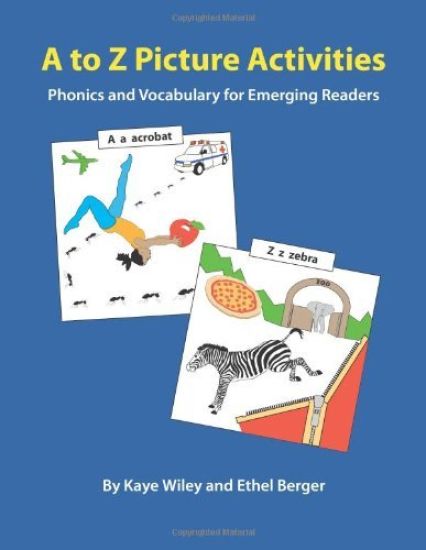
This beginning literacy practice book gives students an enjoyable way to improve phonics and vocabulary skills from A to Z. Whimsical illustrations highlight simple sentences, beginning grammar, and 888 high-frequency words in exercises that appeal to emerging readers of all ages. The labeled drawings on each A to Z scene are similar to those in a picture dictionary that students can use as a daily reference for writing and spelling. Each unit begins with facing pages that show words beginning with the letter and explore their meanings. Then the unit explores the phonics of the letter – the sounds it makes. Next, each alphabetic unit presents vocabulary in topic areas (lexical sets) which begin with that particular letter – Animals, the Body, Colors, Days, Eating, Fruit, Groceries, Holidays, I&/BJobs, the Kitchen, and so on. Applications of these units can be useful for helping to meet Common Core Standards, including instruction that develops foundational skills in English, opportunities for classroom discourse and interaction, and ongoing assessment and feedback. There is also a Pronunciation Index for all the words in the picture activities.