Kirjojen hintavertailu. Mukana 11 244 527 kirjaa ja 12 kauppaa.

Kirjahaku

Etsi kirjoja tekijän nimen, kirjan nimen tai ISBN:n perusteella.

1000 tulosta hakusanalla Luke Pitcher

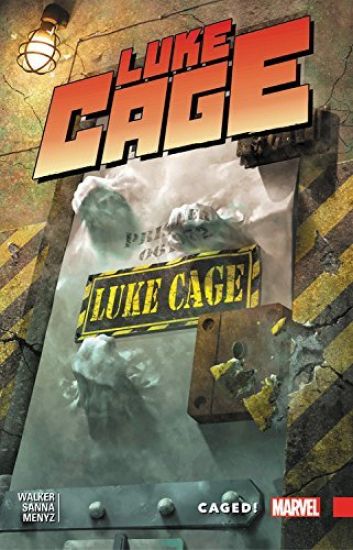
Luke Cage Vol. 2: Caged

Luke Cage Vol. 2: Caged

David F. Walker

Marvel Comics
2018
nidottu
Carl Lucas went to jail for a crime that he didn't commit, and came out a new man: the unbreakable hero named Luke Cage But now, he finds himself on the wrong side of the law and thrown in prison once again. What dark power has caged Luke once more? And when the entire world is threatened, how can he save everyone from the inside of a prison cell? With his mind mangled, Luke grasps for any foothold he can find. Which will be difficult, since this is no ordinary prison...and the chain gang he's on isn't doing road work. What horrors await in the dreaded mine? COLLECTING: LUKE CAGE 166-170
Luke Cage Epic Collection: Retribution

Luke Cage Epic Collection: Retribution

Archie Goodwin; Steve Englehart; Tony Isabella

Marvel Comics
2021
nidottu
Luke Cage burst onto the comics scene in 1972 as the "Hero for Hire." Equal parts Marvel Method and Blaxploitation boldness, he was a new kind of hero for a new era, the historic first African-American character to headline his own series. Cage's adventures depicted New York City's 1970s grit and the plight of its people with a realism that was gripping in its time, all while incorporating larger-than-life villains including Black Mariah and Doctor Doom. This Epic Collection present page after page of classic Luke Cage adventures: Including his origin, his growing relationship with Clare Temple, the first appearance of Cottonmouth, a battle with Iron Man and a fight to the finish for the name Power Man. Vol. 1: Hero for Hire (1972) 1-16, Power Man (1974) 17-23
Luke Cage Omnibus

Luke Cage Omnibus

Marvel Comics

MARVEL COMICS
2022
sidottu
Luke Cage burst onto the comics scene as a new kind of hero for a new era, a hero for hire. His exploits were set against 1970s New York's grit and the plight of the city's people, all while incorporating larger-than-life villains and even the occasional Avenger. As the first African-American super hero to headline in his own series, Luke Cage's adventures were as historic as they were exciting. Now, his complete solo series is collected in one massive Omnibus edition. Experience first appearance of Cottonmouth, Cage's evolving relationship with Claire Temple and the debut of Bill Foster as Giant-Man. Uncover the secrets of Security City and witness Cage battle for the title "Power Man." COLLECTING: Hero for Hire (1972) 1-16, Power Man (1974) 17-47, Power Man Annual (1977) 1
Luke Cage Epic Collection: The Fire This Time
Luke Cage defends the streets of New York City, and even takes the fight to the outer boroughs, in this Epic Collection completing his solo adventures He'll face menaces as tough as Moses Magnum, as bizarre as the Mace...and as infuriating as the Gem Theater's always-unpredictable vending machine It's all set against the gritty streets of 1970s Times Square, a location as colorful as anything Marvel's minds have ever conjured up. Cage will also face an all-new and amped-up Chemistro; the Spear, who seeks to settle a score with the man who made Luke Cage bulletproof; and an adversary as unstoppable as death itself: the IRS Also featuring the debut of Bill Foster as Giant-Man - and the one and only Piranha Jones Collecting POWER MAN #24-47 and ANNUAL #1.
Luke Cage: Gang War

Luke Cage: Gang War

Rodney Barnes

MARVEL COMICS
2024
nidottu
Luke Cage stars in the street-level crossover you've been waiting for In the wake of the Anti-Vigilante Act, New York's new mayor has been trying to save the city from behind a desk. But when the Big Apple descends into a full-on Gang War, Luke must use every power he has to protect the innocent and save his city Cage goes undercover, dons a mask and takes his battle to the streets to track down a new generation of Spider-Slayers, bigger and deadlier than ever But he won't be alone: Danny Rand, Jessica Jones and Cloak & Dagger join the fight for the soul of New York But after breaking the anti-vigilante law, can Luke still be mayor? And more important, will he even want to be? Collecting LUKE CAGE: GANG WAR #1-4.
A Sermon Preached in the Parish Church of St. Thomas; at Dudley, on Friday the 19th of April, 1793; and an Address to the Common People, &c. on the Subject of Riots. By the Rev. Luke Booker,
The 18th century was a wealth of knowledge, exploration and rapidly growing technology and expanding record-keeping made possible by advances in the printing press. In its determination to preserve the century of revolution, Gale initiated a revolution of its own: digitization of epic proportions to preserve these invaluable works in the largest archive of its kind. Now for the first time these high-quality digital copies of original 18th century manuscripts are available in print, making them highly accessible to libraries, undergraduate students, and independent scholars.The Age of Enlightenment profoundly enriched religious and philosophical understanding and continues to influence present-day thinking. Works collected here include masterpieces by David Hume, Immanuel Kant, and Jean-Jacques Rousseau, as well as religious sermons and moral debates on the issues of the day, such as the slave trade. The Age of Reason saw conflict between Protestantism and Catholicism transformed into one between faith and logic -- a debate that continues in the twenty-first century.++++The below data was compiled from various identification fields in the bibliographic record of this title. This data is provided as an additional tool in helping to insure edition identification: ++++British LibraryT080379Dudley: printed by J. Rann. For Rivingtons, and Bew, London, 1793]. 2],46p.; 8
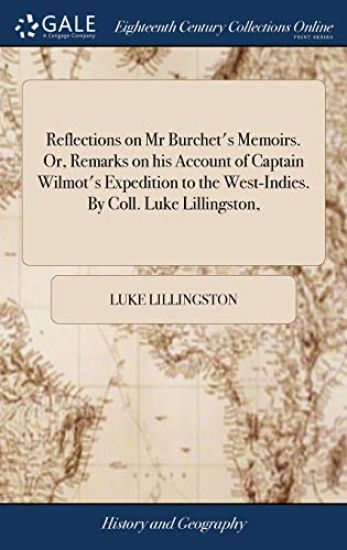
Reflections on Mr Burchet's Memoirs. Or, Remarks on his Account of Captain Wilmot's Expedition to the West-Indies. By Coll. Luke Lillingston,
The 18th century was a wealth of knowledge, exploration and rapidly growing technology and expanding record-keeping made possible by advances in the printing press. In its determination to preserve the century of revolution, Gale initiated a revolution of its own: digitization of epic proportions to preserve these invaluable works in the largest archive of its kind. Now for the first time these high-quality digital copies of original 18th century manuscripts are available in print, making them highly accessible to libraries, undergraduate students, and independent scholars.Rich in titles on English life and social history, this collection spans the world as it was known to eighteenth-century historians and explorers. Titles include a wealth of travel accounts and diaries, histories of nations from throughout the world, and maps and charts of a world that was still being discovered. Students of the War of American Independence will find fascinating accounts from the British side of conflict. ++++The below data was compiled from various identification fields in the bibliographic record of this title. This data is provided as an additional tool in helping to insure edition identification: ++++British LibraryT116103Text is continuous despite the pagination. Another issue of the same year bears the imprint "printed, and sold by the booksellers of London and Westminster.."London: printed, and sold by John Nutt, 1704. 18],90,95-171, 1]p.; 8
The Hop-garden, a Didactic Poem. By Luke Booker, LL.D

The Hop-garden, a Didactic Poem. By Luke Booker, LL.D

Luke Booker

Gale Ecco, Print Editions
2018
sidottu
The 18th century was a wealth of knowledge, exploration and rapidly growing technology and expanding record-keeping made possible by advances in the printing press. In its determination to preserve the century of revolution, Gale initiated a revolution of its own: digitization of epic proportions to preserve these invaluable works in the largest archive of its kind. Now for the first time these high-quality digital copies of original 18th century manuscripts are available in print, making them highly accessible to libraries, undergraduate students, and independent scholars.Western literary study flows out of eighteenth-century works by Alexander Pope, Daniel Defoe, Henry Fielding, Frances Burney, Denis Diderot, Johann Gottfried Herder, Johann Wolfgang von Goethe, and others. Experience the birth of the modern novel, or compare the development of language using dictionaries and grammar discourses. ++++The below data was compiled from various identification fields in the bibliographic record of this title. This data is provided as an additional tool in helping to insure edition identification: ++++British LibraryT002164Dedication dated: Dudley, 14th May, 1799. Includes, with continuous pagination: 'A sequel-poem to The hop-garden'. With a final advertisement leaf. In this octavo edition the title is not printed within a decorative surround and there is at foot: "PricNewport: printed by H. P. Silvester, for Messrs. Rivingtons, London, 1799]. 8],118, 2]p.; 8
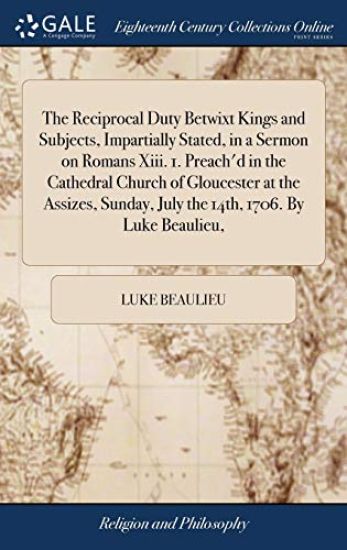
The Reciprocal Duty Betwixt Kings and Subjects, Impartially Stated, in a Sermon on Romans Xiii. 1. Preach'd in the Cathedral Church of Gloucester at the Assizes, Sunday, July the 14th, 1706. By Luke Beaulieu,
The 18th century was a wealth of knowledge, exploration and rapidly growing technology and expanding record-keeping made possible by advances in the printing press. In its determination to preserve the century of revolution, Gale initiated a revolution of its own: digitization of epic proportions to preserve these invaluable works in the largest archive of its kind. Now for the first time these high-quality digital copies of original 18th century manuscripts are available in print, making them highly accessible to libraries, undergraduate students, and independent scholars.The Age of Enlightenment profoundly enriched religious and philosophical understanding and continues to influence present-day thinking. Works collected here include masterpieces by David Hume, Immanuel Kant, and Jean-Jacques Rousseau, as well as religious sermons and moral debates on the issues of the day, such as the slave trade. The Age of Reason saw conflict between Protestantism and Catholicism transformed into one between faith and logic -- a debate that continues in the twenty-first century.++++The below data was compiled from various identification fields in the bibliographic record of this title. This data is provided as an additional tool in helping to insure edition identification: ++++British LibraryT046496Pp.17-20 misnumbered 21-24.London: printed by R. Janeway, for R. Clavell, 1706. 4],23, 1]p.; 4
Luke & Bella

Luke & Bella

Pandora Spocks

Bratty Ginger Books
2015
pokkari
Strong-willed ginger Bella Grant is a take-charge television journalist with an appetite for adventure. Handsome and sexy Luke McGillicutty is a world-weary photographer coaxed out of premature retirement with the promise of traveling the world with a smart, spunky redhead. They've been paired up to create a new brand of television travel program.Traveling to romantic destinations, staying in first-class hotels, finding adventure at every turn, it's not surprising that the two fall in love. Luke is stunned to realize that Bella is the woman he's looked for his whole life. She's beautiful, smart, funny, and courageous.The only thing is, Luke hasn't been completely up front with her. He hasn't told her that he's into BDSM. He could play it safe, keep the relationship going exactly the way it is. But Luke wants more. As a Dominant, he craves the intimacy that a Dom/sub relationship provides. And he knows without a doubt that Bella is the perfect submissive. How will she react if he approaches her about submitting to him as a Dominant? Maybe she'd be intrigued by the idea. On the other hand, he could lose her forever.Life on the road working with Bella is great. Nights spent in Bella's arms are amazing. Should Luke just be satisfied with the way things are? Or should he risk everything on the chance that they could have it all?
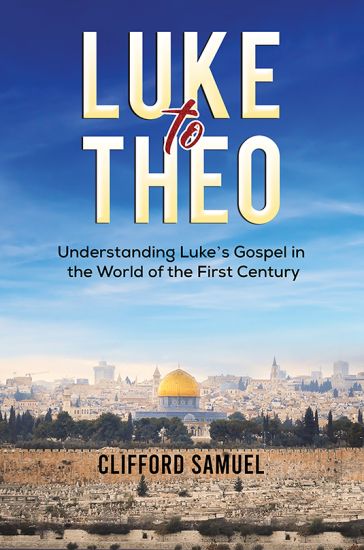
Luke to Theo

Luke to Theo

Clifford Samuel

Austin Macauley Publishers
2024
nidottu
Luke's remarkable work has moved beyond its original audience. Over time it has become a means of nourishing countless individuals on their spiritual and religious journeys. Luke's gospel is valuable not only in its religious context, for it offers a captivating window into the intricacies of the first century world, its history, literature, its sacred as well as its secular beliefs. This book will be useful not only for those with a religious worldview but for undergraduate students as well as the general reader. Luke to Theo considers many thought-provoking questions. Who is this enigmatic figure we call Luke? What does he have to say about Jesus? What role does Theo play in this narrative? And just how does the author manage to engage diverse audiences from the first century right up to the present day? For both believer and sceptic alike, this book provides a framework to understand the nuances of many a biblical text. Drawing upon the latest scholarly research, the author enables readers to embark on a thought-provoking journey as literary forms and historical context enrich Luke's remarkable work.
Luke's Light: The Goddess-Queen in the Bible

Luke's Light: The Goddess-Queen in the Bible

Paula Gott

Booksurge Publishing
2007
nidottu
There are two words that are repeated over and over throughout Luke's Light: masculine and feminine. They are repeated because they kept showing up in Luke's two texts. I set out with just one goal: find and decipher the coded messages. But Luke put a lot of effort into revealing Jesus' message of gender equity. And even more surprising was finding the same message of gender balance in the Old Testament texts that Luke used to send his message to Theophilus. Luke's Light illuminates the darkest corners of the Church's darkest secret, closely held and fiercely protected for nearly two thousand years. Tens of millions of people who suspected or discovered the secret were labeled heretics, tortured into recanting, and then murdered. Only in the past two hundred years could this secret be revealed with any hope of physical survival, thanks to the edicts that came out of Rome centuries ago that were designed to protect and preserve the deception. This is a story of new discoveries about Jesus, his life, his work, and his family. The hidden stories confirm many ancient Christian traditions, while it dispels others. The big question is 'Why coded messages' Why wouldn't Luke just write openly and clearly so that anyone could read the information he wanted to impart? Perhaps that question is best answered by trying to put ourselves in Luke's place in the religious politics of his time. Consider what you might do if your church should be invaded by a larger and more powerful religion, a group that is destroying all evidence of your chosen religious doctrine. Consider what you might do to preserve the information about you, your family, and your religion. Assume that you are aware of other cultures from history that had experienced a similar fate. And assume that you believe that records of that culture would remain but records of your religion would all be destroyed. Assume that you are permitted to write about what is happening, but only if your story supports the new religion's version and doctrine. What might you do to tell the real story of what happened to you? I believe you might write a story that appears to support the invaders' story. But you might name people who lived in that 'other culture' whose records you thought would survive. You might tell similar stories, hoping that someone would recognize the similarities and understand that you could not write about what was really happening but had to refer to that other culture's history in order to preserve your own. Luke did exactly what any of us would do under similar circumstances. He found a way to leave a coded message that could be found at some future time as long as historians and religious leaders preserved the documents he used to relay the story. He had before him Paul's letters to the Churches; Mark's gospel; Q gospel; Matthew's gospel; the Greek Septuagint; Plutarch's Moralia and Parallel Lives; classics by Homer, Euripides, Aratus, Epimenides, and others. Perhaps the most important document on that table was Philo's guidelines for Allegory. Every chapter in Luke's Gospel contains Pythagorean Sacred Numbers. Why would Luke go to such lengths to leave Sacred Numbers in his gospel? The answer is quite simple: Regardless of the language spoken, everyone who reads his gospels has the same understanding of numbers and the various functions applied to numbers. Numbers are the One Universal Language. A Pythagorean Master Teacher inserted the numbers into Luke's Gospel to attract attention and to send a numeric message-using the One Universal Language-that there is a coded, written message. That's the real story. And that's where Philo's Rules for Allegory are needed. Perhaps the most important of Philo's guidelines is to watch for something unusual in the text. The first obviously 'unusual' occurrence in Luke's gospel is the appearance of the Angel, Gabriel: Luke 1:19: 'The angel replied, 'I am Gabriel. I stand in the presence of God, and I have been