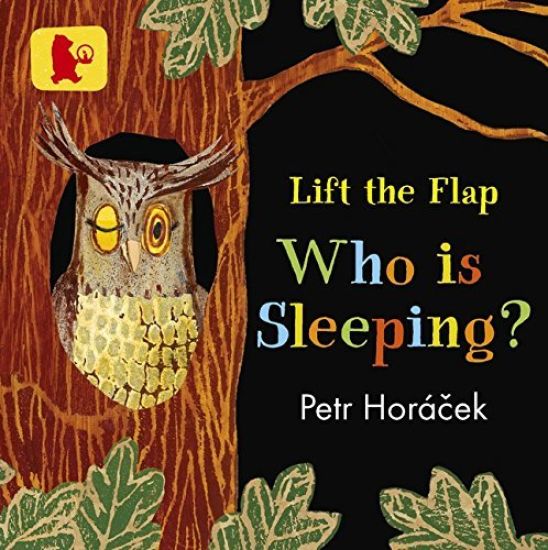
A colourful lift-the-flap guessing game perfect for sharing at bedtime.Who is sleeping in the river, under the leaf and in the tree? Lift the flaps to find out and discover a sleepy surprise at the end, in this colourful bedtime board book from acclaimed author/illustrator Petr Horacek.
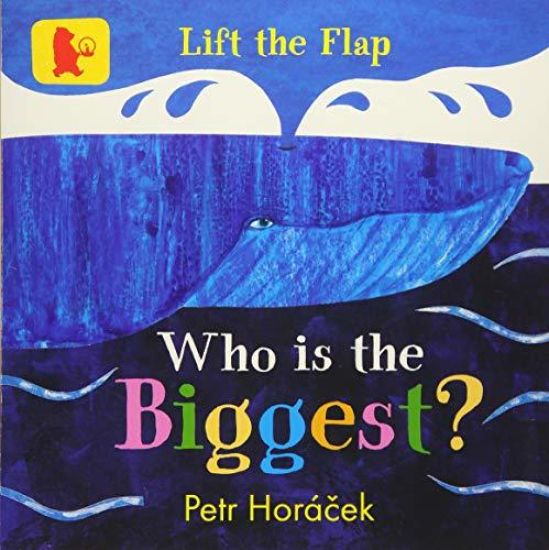
A colourful lift-the-flap book of opposites to share with your baby.Who is the biggest, who is the tallest and who is the noisiest? Lift the flaps and find out in this colourful board book from acclaimed author/illustrator Petr Horacek.
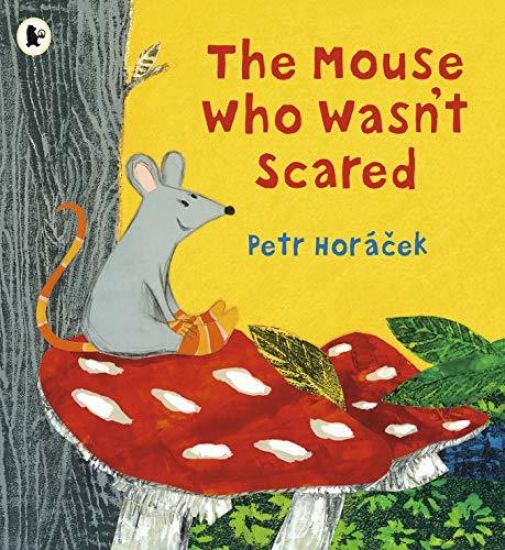
A charming story about bravery, perfect for fans of Eric Carle.Little Mouse wants to play in the woods. They are dark and full of big scary animals. But Little Mouse isn't afraid of anything – or is she? A charming story about bravery – with a hilarious surprise – from a Kate Greenaway Medal-shortlisted illustrator, who has been described by The Washington Post as "the thinking tot's Eric Carle".
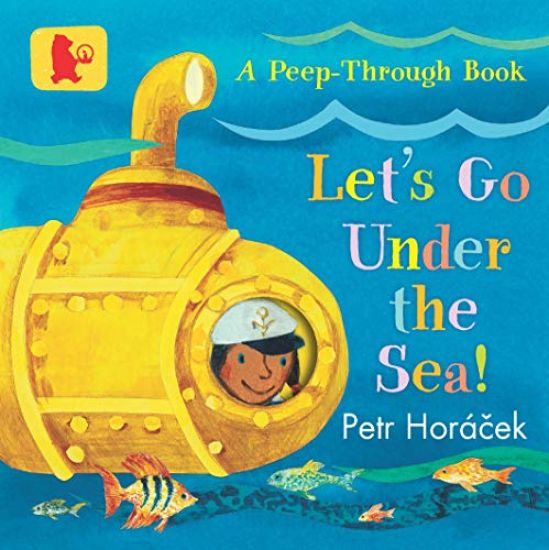
A peep-through underwater adventure to share with your baby.What can you find under the sea? Peep-through the submarine window to find out in this colourful board book from award-winning author-illustrator Petr Horacek.
A heart-warming picture book following an inquisitive hare as he discovers that the best place in the world is always with the people you love."Do you think this is the best place in the world?" Hare asks his friends, Rabbit, Bear, Duck and Owl. Certain there must be somewhere better out there, Hare sets out on an adventure that takes him to mountains higher than the clouds, sun-kissed beaches and starlit deserts. But even the most beautiful place isn't perfect without friends to share it with, and perhaps the best place in the world is actually closer than Hare thinks.With gorgeous artwork in a stunning summer palette, this is a beautiful picture book from the Kate Greenaway Medal-shortlisted illustrator Petr Horacek, who has been described by The Washington Post as "the thinking tot's Eric Carle".
A heart-warming picture book following an inquisitive hare as he discovers that the best place in the world is always with the people you love."Do you think this is the best place in the world?" Hare asks his friends, Rabbit, Bear, Duck and Owl. Certain there must be somewhere better out there, Hare sets out on an adventure that takes him to mountains higher than the clouds, sun-kissed beaches and starlit deserts. But even the most beautiful place isn't perfect without friends to share it with, and perhaps the best place in the world is actually closer than Hare thinks. Petr Horácek's artwork shines with a gorgeous summer palette in this charming bedtime read."The artwork is stunning. Each spread is bursting with colour and life, depicting wonderful places and warm relationships. The Best Place in the World is a complete delight." North Somerset Teachers' Book Award
One of the fundamental questions of Banach space theory is whether every Banach space has a basis. A space with a basis gives us a sense of familiarity and concreteness, and perhaps a chance to attempt the classification of all Banach spaces and other problems. The main goals of this book are to: -introduce the reader to some of the basic concepts, results and applications of biorthogonal systems in infinite dimensional geometry of Banach spaces, and in topology and nonlinear analysis in Banach spaces, -aim the text at graduate students and researchers who have a foundation in Banach space theory, - expose the reader to some current avenues of research in biorthogonal systems in Banach spaces, -provide notes and exercises related to the topic, suggest open problems and possible new directions of research. Numerous exercises are included, and the only prerequisites are a basic background in functional analysis.
Neuropsychological research on the neural basis of behavior generally asserts that brain mechanisms ultimately suffice to explain all psychologically described phenomena. This assumption stems from the idea that the brain consists entirely of material particles and fields, and that all causal mechanisms relevant to neuroscience can be formulated solely in terms of properties of these elements. Contemporary basic physical theory differs from classic physics on the important matter of how consciousness of human agents enters into the structure of empirical phenomena. The new principles contradict the older idea that local mechanical processes alone account for the structure of all empirical data. Contemporary physical theory brings directly into the overall causal structure certain psychologically described choices made by human agents about how they will act. This key development in basic physical theory is applicable to neuroscience. This book explores this new framework.