Kirjojen hintavertailu. Mukana 11 699 587 kirjaa ja 12 kauppaa.

Kirjahaku

Etsi kirjoja tekijän nimen, kirjan nimen tai ISBN:n perusteella.

1000 tulosta hakusanalla Philip W. Cook

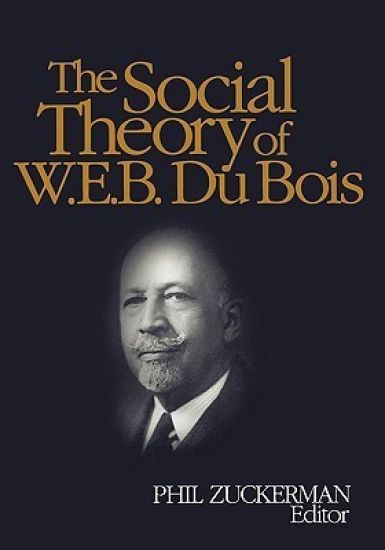
The Social Theory of W.E.B. Du Bois

The Social Theory of W.E.B. Du Bois

Philip Zuckerman

SAGE Publications Inc
2004
nidottu
Karl Marx, Max Weber, and Emile Durkheim are widely recognized as the trinity of sociological theory. While these three sociologists were trailblazing social theorists who enhanced the study of human behavior and its relationship to social institutions, other, more contemporary scholars were just as innovative - one of those scholars being W. E. B. Du Bois. W. E. B. Du Bois was a political and literary giant of the 20th century, publishing over twenty books and thousand of essays and articles throughout his life. In The Social Theory of W. E. B. Du Bois, editor Phil Zuckerman assembles Du Bois's work from a wide variety of sources, including articles Du Bois published in newspapers, speeches he delivered, selections from well-known classics such as The Souls of Black Folk and Darkwater, and lesser-known, hard-to-find material written by this revolutionary social theorist. W. E. B Du Bois is arguably one of the most imaginative, perceptive, and prolific founders of the sociological discipline. In addition to leading the Pan-African movement and being an activist for civil rights for African Americans, Du Bois was a pioneer of urban sociology, an innovator of rural sociology, a leader in criminology, the first American sociologist of religion, and most notably the first great social theorist of race. The Social Theory of W. E. B. Du Bois is the first book to examine Du Bois's writings from a sociological perspective and emphasize his theoretical contributions. This volume covers topics such as the meaning of race, race relations, international relations, economics, labor, politics, religion, crime, gender, and education.The Social Theory of W. E. B. Du Bois offers an excellent introduction to the sociological theory of one of the 20th century's intellectual beacons. It is a dynamic text for undergraduate and graduate students studying sociological theory, African American studies, and race and ethnicity.
The Helmer Family: Philip Helmer (the Pioneer) and His Descendants

The Helmer Family: Philip Helmer (the Pioneer) and His Descendants

Pascoe W. 1880- Williams

Hassell Street Press
2021
sidottu
This work has been selected by scholars as being culturally important and is part of the knowledge base of civilization as we know it.This work is in the public domain in the United States of America, and possibly other nations. Within the United States, you may freely copy and distribute this work, as no entity (individual or corporate) has a copyright on the body of the work.Scholars believe, and we concur, that this work is important enough to be preserved, reproduced, and made generally available to the public. To ensure a quality reading experience, this work has been proofread and republished using a format that seamlessly blends the original graphical elements with text in an easy-to-read typeface.We appreciate your support of the preservation process, and thank you for being an important part of keeping this knowledge alive and relevant.
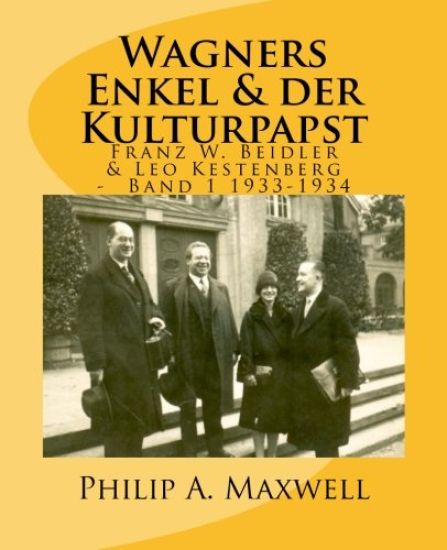
Wagners Enkel & der Kulturpapst: Franz W. Beidler & Leo Kestenberg Band1 1933-1934

Wagners Enkel & der Kulturpapst: Franz W. Beidler & Leo Kestenberg Band1 1933-1934

Philip A. Maxwell

Createspace Independent Publishing Platform
2016
nidottu
Dieses Buch beinhaltet die noch existierenden Briefe, 1933-1934, von zwei M nnern, die w hrend der Weimarer Republik viel f r die Demokratie und f r die deutsche Kultur leisteten. Es geht um den Briefverkehr zwischen Leo Kestenberg und Franz W. (Wilhelm) Beidler. Leo Kestenberg war eine Schl sselfigur in der kulturellen Landschaft der Weimarer Republik (1918-1932). Franz W. Beidler, von 1927 bis 1932 Kestenberg's rechte Hand, war der erstgeborene Enkel von Richard und Cosima Wagner und der Urenkel von Franz Liszt. Dadurch, dass er ein Sozialist und mit einer J din verheiratet war und dass er Hitler total ablehnte, wurde er zum schwarzen Schaf der Familie Wagner. Leo Kestenberg (geb. 1882) war ein Klaviervirtuose, aber auch ein Reformen vorantreibender P dagoge, Organisator und Impresario. Er war ein Proteg von Feruccio Busoni1 und ein Apostel Franz Liszts. Wie Kestenberg war auch Beidler ein begeistertes Mitglied der Sozialdemokratischen Partei. Diese gemeinsame Parteienmitgliedschaft erfreute Kestenberg ebenso sehr, wie es die ultrakonservativen Bayreuther Verwandten Beidlers entsetzte. Beidlers Verwandten, die von Wagner abstammten betrachteten Isoldes Sohn. Franz W., als das schwarze Schaf der Familie. Der "Edelkommunist", wie sie untereinander den Sozi Franz bezeichneten, hatte die noch unverzeihlichere S nde begangen, eine j dische Frau zu lieben und, schlimmer noch, zu heiraten. F r die Wagners z hlte es gar nicht, dass Ellen einer prominenten Berliner Familie angeh rte. Ihr Vater, Prof. Dr. Sigmund Gottschalk, war ein renommierter gyn kologischer Forscher, Lehrer, Autor und Berliner Krankenhausverwalter. F r die Wagners waren hohe akademische und gesellschaftliche Stellungen, bemerkenswerterweise nur unter Ariern zu finden. Im Jahre 1927, nachdem Franz Beidler in Berlin promoviert hatte, arbeiteten er und Ellen bei Kestenberg im preu ischen Ministerium f r Kultur. Nach einer gro en Forschung, verfertigten sie ein Jahrbuch, in dem jeder Aspekt des musikalischen Lebens in ganz Deutschland in beeindruckenden Details aufgenommen und geschildert wurde. Die Beidlers bildeten ein ideales Duo Ihr Wissen als politischer konom und seine Kenntnisse als Schriftsteller, Forscher und Statistiker pa ten gut zusammen und verst rkten ihre individuellen Begabungen.
The life of J.M.W. Turner, R.A

The life of J.M.W. Turner, R.A

Philip G Hamerton

Hansebooks
2020
pokkari
The life of J.M.W. Turner, R.A is an unchanged, high-quality reprint of the original edition of 1879. Hansebooks is editor of the literature on different topic areas such as research and science, travel and expeditions, cooking and nutrition, medicine, and other genres. As a publisher we focus on the preservation of historical literature. Many works of historical writers and scientists are available today as antiques only. Hansebooks newly publishes these books and contributes to the preservation of literature which has become rare and historical knowledge for the future.
Philip V of Macedon

Philip V of Macedon

F. W. Walbank

Cambridge University Press
2013
pokkari
Frank William Walbank (1909–2008) was a renowned ancient historian and classicist. In this book, which was formed from The Hare Prize Essay for 1939 and first published in 1940, Walbank presents a detailed discussion of the reign of Philip V of Macedon. The text was intended to break fresh ground 'with a study of Philip, not solely as a figure in the history of Roman imperialism, but, as far as is feasible, from the aspect of Macedon itself'. Illustrative figures, a comprehensive bibliography and appendices are also included. This book will be of value to anyone with an interest in the writings of Walbank and the Hellenistic period.
The Spirit and Genius of St Philip Neri, Founder of the Oratory: Large Print Edition

The Spirit and Genius of St Philip Neri, Founder of the Oratory: Large Print Edition

Frederick W. Faber

Createspace Independent Publishing Platform
2018
nidottu
Excerpt: A YEAR has gone round, my dear Brethren, since St. Philip first began to teach, to preach, to give spiritual graces, and to make his home here. You have connected yourselves with him; you have let yourselves be drawn within the sphere of his influence; you have gladly drunk of his peculiar spirit; you are conscious to yourselves of many secret favours which you have received through him; in a word, you have of your own accord made yourselves his children, and St. Philip has lovingly adopted you. In asking you then to set aside these three days as a solemn preparation for his feast, I am only asking what you will be forward to grant; and in speaking to you about St. Philip, I may speak to you, not as strangers, but as children of our dear and holy Patriarch, who will not harshly criticise what may seem the affectionate exaggerations of an Oratorian. I cannot of course say to you in three Lectures all I think or feel about St. Philip; like other Saints who have left the impress of their character upon the Church of God, he may be looked at from many points of view. I wish, if he will please to help me, to put one view of him before you in this Triduo, so that you may be able to have a true idea of St. Philip, and his peculiar spirit and genius, and therefore of the work which he comes to do in England at this present day. The fact with which we start is this: Here in a Protestant country, the genius of whose nationality may be said to be most eminently Protestant, a number of men, thoroughly English in education, ways, habits, feelings, and tone of thought, some in one place, some in another, some for one reason, some for another, have been mercifully drawn by the power of grace to abjure their false religion and save their souls in the Church of God. The Church receives them, and vouchsafes to use whatever they may have of energy or usefulness for her own purposes. In remarkable ways (which it would be out of place to detail here), not only without forethought, but quite contrary to it, and without being agreed among themselves, a Roman Saint, but little known in England, and with a very special genius of his own, attracts them to himself. They are drawn almost Without knowing it, some abroad, others at home, some earlier, others later, some attracted by one feature of the Saint, others by another, and some with little or no distinct perception of what it was which was so palpably alluring them. The Vicar of Christ, the holy Father at Rome, gives not a bare but a cordial approval to their deed. They become the children of St. Philip, embrace his Institute, and place themselves beneath the yoke of his rule. Experience shews them it was no blind leading which guided them to the Apostle of Rome; they find his Institute as if it had been expressly made for them and their peculiar circumstances; it fulfils more than words can tell every desire of their hearts, they find in it all they need, and more than they expected; and what seems stranger still, its ideas, sympathies, tastes, instincts, yearnings, seem to be a simple intellectual expression of their own. When you consider the varieties of character and disposition, of education, taste, circumstances and wants, of a score of men, you will admit that there is something remarkable in this fact.
The Spirit and Genius of St Philip Neri, Founder of the Oratory

The Spirit and Genius of St Philip Neri, Founder of the Oratory

Frederick W. Faber

Createspace Independent Publishing Platform
2018
nidottu
Excerpt: A YEAR has gone round, my dear Brethren, since St. Philip first began to teach, to preach, to give spiritual graces, and to make his home here. You have connected yourselves with him; you have let yourselves be drawn within the sphere of his influence; you have gladly drunk of his peculiar spirit; you are conscious to yourselves of many secret favours which you have received through him; in a word, you have of your own accord made yourselves his children, and St. Philip has lovingly adopted you. In asking you then to set aside these three days as a solemn preparation for his feast, I am only asking what you will be forward to grant; and in speaking to you about St. Philip, I may speak to you, not as strangers, but as children of our dear and holy Patriarch, who will not harshly criticise what may seem the affectionate exaggerations of an Oratorian. I cannot of course say to you in three Lectures all I think or feel about St. Philip; like other Saints who have left the impress of their character upon the Church of God, he may be looked at from many points of view. I wish, if he will please to help me, to put one view of him before you in this Triduo, so that you may be able to have a true idea of St. Philip, and his peculiar spirit and genius, and therefore of the work which he comes to do in England at this present day. The fact with which we start is this: Here in a Protestant country, the genius of whose nationality may be said to be most eminently Protestant, a number of men, thoroughly English in education, ways, habits, feelings, and tone of thought, some in one place, some in another, some for one reason, some for another, have been mercifully drawn by the power of grace to abjure their false religion and save their souls in the Church of God. The Church receives them, and vouchsafes to use whatever they may have of energy or usefulness for her own purposes. In remarkable ways (which it would be out of place to detail here), not only without forethought, but quite contrary to it, and without being agreed among themselves, a Roman Saint, but little known in England, and with a very special genius of his own, attracts them to himself. They are drawn almost Without knowing it, some abroad, others at home, some earlier, others later, some attracted by one feature of the Saint, others by another, and some with little or no distinct perception of what it was which was so palpably alluring them. The Vicar of Christ, the holy Father at Rome, gives not a bare but a cordial approval to their deed. They become the children of St. Philip, embrace his Institute, and place themselves beneath the yoke of his rule. Experience shews them it was no blind leading which guided them to the Apostle of Rome; they find his Institute as if it had been expressly made for them and their peculiar circumstances; it fulfils more than words can tell every desire of their hearts, they find in it all they need, and more than they expected; and what seems stranger still, its ideas, sympathies, tastes, instincts, yearnings, seem to be a simple intellectual expression of their own. When you consider the varieties of character and disposition, of education, taste, circumstances and wants, of a score of men, you will admit that there is something remarkable in this fact.