Kirjojen hintavertailu. Mukana 12 595 353 kirjaa ja 12 kauppaa.

Kirjahaku

Etsi kirjoja tekijän nimen, kirjan nimen tai ISBN:n perusteella.

1000 tulosta hakusanalla Philo

Philomena (Movie Tie-In): A Mother, Her Son, and a Fifty-Year Search
New York Times Bestseller The heartbreaking true story of an Irishwoman and the secret she kept for 50 years and the basis for the major motion picture starring Judi Dench and Steve Coogan When she became pregnant as a teenager in Ireland in 1952, Philomena Lee was sent to a convent to be looked after as a "fallen woman." Then the nuns took her baby from her and sold him, like thousands of others, to America for adoption. Fifty years later, Philomena decided to find him. Meanwhile, on the other side of the Atlantic, Philomena's son was trying to find her. Renamed Michael Hess, he had become a leading lawyer in the first Bush administration, and he struggled to hide secrets that would jeopardize his career in the Republican Party and endanger his quest to find his mother. A gripping expos told with novelistic intrigue, Philomena pulls back the curtain on the role of the Catholic Church in forced adoptions and on the love between a mother and son who endured a lifelong separation.
Philosophers at Work

Philosophers at Work

Elliot Cohen

Wadsworth Publishing Co Inc
1999
nidottu
Now more than ever before institutions of higher education are being called upon to provide students with information in the classroom that can contribute to the success of students in the workplace. Unlike any other philosophy text, PHILOSOPHERS AT WORK contains "Practice" sections written by philosopher practitioners who demonstrate how their knowledge of the problems, methods, and theories of philosophy provide powerful tools for addressing the dilemmas that arise in diverse work settings. Through the "Issues and Practice" sections, students are able to gain an understanding of the practical value of philosophy.
Philosophy for Girls

Philosophy for Girls

Oxford University Press Inc
2020
sidottu
This revolutionary book empowers its readers by exploring enduring, challenging, and timely philosophical issues in new essays written by expert women philosophers. The book will inspire and entice these philosophers' younger counterparts, curious readers of all genders, and all who support equity in philosophy. If asked to envision a philosopher, people might imagine a bearded man, probably Greek, perhaps in a toga, pontificating about abstract ideas. Or they might think of that same man in the Enlightenment, gripping a quill pen and pouring universal truths onto a page. They may even call to mind a much more modern man, wearing a black sweater and smoking a cigarette in a Paris café, expressing existential angst in a new novel or essay. What people are unlikely to picture, though, is a woman. Women have historically been excluded from the discipline of philosophy and remain largely marginalized in contemporary textbooks and anthologies. The under-representation of women in secondary and post-secondary curricula makes it harder for young women to see themselves as future philosophers. In fact, it makes it harder for all people to engage the valuable contributions that women have made and continue to make to intellectual thought. While some progress has been made in building a more inclusive world of philosophy, especially in the last fifty years, important work remains to be done. Philosophy for Girls helps correct the pervasive and problematic omission of women from philosophy. Divided into four sections that connect to major, primary fields in philosophy (metaphysics, epistemology, social and political philosophy, and ethics), this anthology is unique: chapters are all written by women, and each chapter opens with an anecdote about a girl or woman from mythology, history, art, literature, or science to introduce chapter topics. Further, nearly all primary and secondary sources used in the chapters are written by women philosophers. The book is written in a rigorous, academic spirit but in lively and engaging prose, making serious philosophical insights accessible to readers who are new to philosophy. This book appeals to a wide audience. Individual readers will find value in these pages--especially girls and women ages 16-24, as well as university and high school educators and students who want a change from standard anthologies that include few or no women. The book's contributors both represent and map the diverse landscape of philosophy, highlighting its engagement with themes of gender and equity. In doing so, they encourage philosophers current and future philosophers to explore new territory and further develop the topography of the field. Philosophy for Girls is a rigorous yet accessible entry-point to philosophical contemplation designed to inspire a new generation of philosophers.
Philosophy for Girls

Philosophy for Girls

Oxford University Press Inc
2020
nidottu
This revolutionary book empowers its readers by exploring enduring, challenging, and timely philosophical issues in new essays written by expert women philosophers. The book will inspire and entice these philosophers' younger counterparts, curious readers of all genders, and all who support equity in philosophy. If asked to envision a philosopher, people might imagine a bearded man, probably Greek, perhaps in a toga, pontificating about abstract ideas. Or they might think of that same man in the Enlightenment, gripping a quill pen and pouring universal truths onto a page. They may even call to mind a much more modern man, wearing a black sweater and smoking a cigarette in a Paris café, expressing existential angst in a new novel or essay. What people are unlikely to picture, though, is a woman. Women have historically been excluded from the discipline of philosophy and remain largely marginalized in contemporary textbooks and anthologies. The under-representation of women in secondary and post-secondary curricula makes it harder for young women to see themselves as future philosophers. In fact, it makes it harder for all people to engage the valuable contributions that women have made and continue to make to intellectual thought. While some progress has been made in building a more inclusive world of philosophy, especially in the last fifty years, important work remains to be done. Philosophy for Girls helps correct the pervasive and problematic omission of women from philosophy. Divided into four sections that connect to major, primary fields in philosophy (metaphysics, epistemology, social and political philosophy, and ethics), this anthology is unique: chapters are all written by women, and each chapter opens with an anecdote about a girl or woman from mythology, history, art, literature, or science to introduce chapter topics. Further, nearly all primary and secondary sources used in the chapters are written by women philosophers. The book is written in a rigorous, academic spirit but in lively and engaging prose, making serious philosophical insights accessible to readers who are new to philosophy. This book appeals to a wide audience. Individual readers will find value in these pages--especially girls and women ages 16-24, as well as university and high school educators and students who want a change from standard anthologies that include few or no women. The book's contributors both represent and map the diverse landscape of philosophy, highlighting its engagement with themes of gender and equity. In doing so, they encourage philosophers current and future philosophers to explore new territory and further develop the topography of the field. Philosophy for Girls is a rigorous yet accessible entry-point to philosophical contemplation designed to inspire a new generation of philosophers.

Philosophy Illustrated

Philosophy Illustrated

Helen de Cruz

Oxford University Press
2021
nidottu
Thought experiments are tools philosophers and scientists use to investigate how things are, without actually having to go out and experiment in the real world. This book presents forty-two philosophical thought experiments. Each thought experiment is illustrated by De Cruz (who is an illustrator as well as a philosopher), and is summarized in one or two paragraphs, which is followed by a brief exploration of its significance. Each thought experiment also includes a longer (approximately 2-page) reflection, written by a philosopher who is a specialist in the field. De Cruz's unique illustrations serve as visual and accessible starting points for classroom discussions in Intro to Philosophy courses.
Philosophy Politics Economics P

Philosophy Politics Economics P

Anomaly; Geoffrey Brennan; Michael C. Munger

OUP Us
2015
nidottu
The only book on the market to include classical and contemporary readings from key authors in Philosophy, Politics, and Economics (PPE), this unique anthology provides a comprehensive overview of the central topics in this rapidly expanding field. Each chapter opens with an introduction that helps students understand the central arguments and key concepts in the readings. The selections encourage students to think about the extent to which the three disciplines offer complementary or contradictory ways of approaching the relevant issues. Philosophy, Politics, and Economics: An Anthology is ideal for undergraduate PPE programs and courses in political philosophy and political economy.
Philosophies of Qualitative Research

Philosophies of Qualitative Research

Svend Brinkmann

Oxford University Press Inc
2017
nidottu
In Philosophies of Qualitative Research, Svend Brinkmann explores the different philosophical paradigms and ideas that influence qualitative research today. Adopting a historical perspective, the book shows readers exactly how philosophical ideas have evolved and influenced qualitative research in both the past and present. Today, qualitative researchers tend to report on their philosophical commitments in an altogether separate section of their research papers. However, as Philosophies of Qualitative Research asserts, the researcher's philosophical ideas influence everything from the conception of the topic to the final reporting of its results. Therefore, philosophy should not be thought of as a purely abstract discipline, disconnected from the practicalities of research, but rather as a concrete and pervasive aspect of all qualitative research practices. In this book, Brinkmann offers readers an important introduction and discussion of the philosophical issues that are relevant today, regardless of the specific methods employed by qualitative researchers in the field.
Philosophy and the Human Condition: An Anthology

Philosophy and the Human Condition: An Anthology

Brian R. Clack; Tyler Hower

Oxford University Press
2017
nidottu
Philosophy and the Human Condition: An Anthology brings together a rich collection of historically arranged readings on the crucial philosophical problems related to the human condition and human nature. Its contents are drawn from a wide range of sources, including the traditional works of Western philosophers from Plato to the present day; relevant extracts from religious texts; and contributions by women, traditions outside of the western philosophical canon, and other disciplines. Each reading selection is accompanied by an introduction. An extended introduction to philosophy at the beginning of the text addresses each of six principal issues that will be prominent in the reading selections drawn from the history of philosophy--the relation of mind and body; personal immortality; freedom of the will; the question of whether humans are naturally benevolent or naturally brutal; the nature and possibility of human happiness; and philosophical issues relating to race and gender--making the text an ideal all-in-one resource for introductory courses in philosophy.
Philosophy of Emerging Media

Philosophy of Emerging Media

Oxford University Press Inc
2016
sidottu
The term "emerging media " responds to the "big data " now available as a result of the larger role digital media play in everyday life, as well as the notion of "emergence " that has grown across the architecture of science and technology over the last two decades with increasing imbrication. The permeation of everyday life by emerging media is evident, ubiquitous, and destined to accelerate. No longer are images, institutions, social networks, thoughts, acts of communication, emotions and speech-the "media " by means of which we express ourselves in daily life-linked to clearly demarcated, stable entities and contexts. Instead, the loci of meaning within which these occur shift and evolve quickly, emerging in far-reaching ways we are only beginning to learn and bring about. This volume's purpose is to develop, broaden and spark future philosophical discussion of emerging media and their ways of shaping and reshaping the habitus within which everyday lives are to be understood. Drawing from the history of philosophy ideas of influential thinkers in the past, intellectual path makers on the contemporary scene offer new philosophical perspectives, laying the groundwork for future work in philosophy and in media studies. On diverse topics such as identity, agency, reality, mentality, time, aesthetics, representation, consciousness, materiality, emergence, and human nature, the questions addressed here consider the extent to which philosophy should or should not take us to be facing a fundamental transformation.
Philosophy of Emerging Media

Philosophy of Emerging Media

Oxford University Press Inc
2016
nidottu
The term "emerging media " responds to the "big data " now available as a result of the larger role digital media play in everyday life, as well as the notion of "emergence " that has grown across the architecture of science and technology over the last two decades with increasing imbrication. The permeation of everyday life by emerging media is evident, ubiquitous, and destined to accelerate. No longer are images, institutions, social networks, thoughts, acts of communication, emotions and speech-the "media " by means of which we express ourselves in daily life-linked to clearly demarcated, stable entities and contexts. Instead, the loci of meaning within which these occur shift and evolve quickly, emerging in far-reaching ways we are only beginning to learn and bring about. This volume's purpose is to develop, broaden and spark future philosophical discussion of emerging media and their ways of shaping and reshaping the habitus within which everyday lives are to be understood. Drawing from the history of philosophy ideas of influential thinkers in the past, intellectual path makers on the contemporary scene offer new philosophical perspectives, laying the groundwork for future work in philosophy and in media studies. On diverse topics such as identity, agency, reality, mentality, time, aesthetics, representation, consciousness, materiality, emergence, and human nature, the questions addressed here consider the extent to which philosophy should or should not take us to be facing a fundamental transformation.
Philosophy and Community in Seneca's Prose

Philosophy and Community in Seneca's Prose

Carey Seal

Oxford University Press Inc
2021
sidottu
The Roman philosopher Seneca addressed himself to the question of how we ought to live in letters and treatises that have engaged the attention of readers from his own day to the present. A committed, if critical and eccentric, adherent of Stoicism, he gives us a set of reflections on the good life that are rich both in philosophical subtlety and in vivid engagement with day-to-day life in ancient Rome. Philosophy and Community in Seneca's Prose proposes a new understanding of the relationship between these two facets of Seneca's achievement, examining how he balances the Socratic imperative to subject one's life to rational scrutiny, on the one hand, with the claims of Roman moral tradition on the other. Carey Seal argues that we should think of Seneca neither as a spokesman for Stoicism who seizes opportunistically upon the data of Roman social life to make his case, nor as an expositor of the inherited values of the Roman elite in the language of Stoic philosophy. Rather, Seneca should be understood as someone intensely interested in the question of philosophy's social entanglements and presuppositions. Seneca's use of Roman politics and of the institution of slavery in elaborating his ideal of a life guided by reason is carefully examined in the book.
Philosophy of Medicine

Philosophy of Medicine

Alex Broadbent

Oxford University Press Inc
2019
sidottu
Philosophy of Medicine asks two central questions about medicine: what is it, and what should we think of it? Philosophy of medicine itself has evolved in response to developments in the philosophy of science, especially with regard to epistemology, positioning it to make contributions that are medically useful. This book locates these developments within a larger framework, suggesting that much philosophical thinking about medicine contributes to answering one or both of these two guiding questions. Taking stock of philosophy of medicine's present place in the landscape and its potential to illuminate a wide range of areas, from public health to policy, Alex Broadbent introduces various key topics in the philosophy of medicine. The first part of the book argues for a novel view of the nature of medicine, arguing that medicine should be understood as an inquiry into the nature and causes of health and disease. Medicine excels at achieving understanding, but not at translating this understanding into cure, a frustration that has dogged the history of medicine and continues to the present day. The second part of the book explores how we ought to consider medicine. Contemporary responses, such as evidence-based medicine and medical nihilism, tend to respond by fixing high standards of evidence. Broadbent rejects these approaches in favor of Medical Cosmopolitanism, or a rejection of epistemic relativism and pluralism about medicine that encourages conversations between medical traditions. From this standpoint, Broadbent opens the way to embracing alternative medicine. An accessible and user-friendly guide, Philosophy of Medicine puts these different debates into perspective and identifies areas that demand further exploration.
Philosophy of Medicine

Philosophy of Medicine

Alex Broadbent

Oxford University Press Inc
2019
nidottu
Philosophy of Medicine asks two central questions about medicine: what is it, and what should we think of it? Philosophy of medicine itself has evolved in response to developments in the philosophy of science, especially with regard to epistemology, positioning it to make contributions that are medically useful. This book locates these developments within a larger framework, suggesting that much philosophical thinking about medicine contributes to answering one or both of these two guiding questions. Taking stock of philosophy of medicine's present place in the landscape and its potential to illuminate a wide range of areas, from public health to policy, Alex Broadbent introduces various key topics in the philosophy of medicine. The first part of the book argues for a novel view of the nature of medicine, arguing that medicine should be understood as an inquiry into the nature and causes of health and disease. Medicine excels at achieving understanding, but not at translating this understanding into cure, a frustration that has dogged the history of medicine and continues to the present day. The second part of the book explores how we ought to consider medicine. Contemporary responses, such as evidence-based medicine and medical nihilism, tend to respond by fixing high standards of evidence. Broadbent rejects these approaches in favor of Medical Cosmopolitanism, or a rejection of epistemic relativism and pluralism about medicine that encourages conversations between medical traditions. From this standpoint, Broadbent opens the way to embracing alternative medicine. An accessible and user-friendly guide, Philosophy of Medicine puts these different debates into perspective and identifies areas that demand further exploration.
Philosophy of Mind

Philosophy of Mind

David J. Chalmers

Oxford University Press Inc
2021
nidottu
Philosophy of Mind: Classical and Contemporary Readings is a grand tour of writings on the perplexing questions about the nature of the mind. The most comprehensive and best-selling collection of its kind, the book includes selections that range from the classical contributions of Descartes to the leading edge of contemporary debates. Extensive sections cover foundational issues, the nature of consciousness, and the nature of mental content. Three of the selections are published for the first time, while many other articles have been revised especially for this volume. Each section opens with an introduction by the editor.
Philosophy and the Moving Image

Philosophy and the Moving Image

Noël Carroll

Oxford University Press Inc
2021
sidottu
A wide-ranging, eclectic collection of essays on philosophy and the moving image by a pre-eminent philosopher of art This volume presents a selection of philosopher Noël Carroll's essays-several of which appear in print here for the first time-at the intersection of philosophy, film, and television. The volume begins with broad, foundational issues-what the moving image is, the nature of the medium of film and how we should evaluate it-engaging critically with the most essential problems and puzzles in the field. Carroll then moves to more focused issues in the philosophy of film and television. He reflects on whether ethical defects in fictional characters such as Tony Soprano have an impact on artistic excellence; the role of films in political debates (using the examples of Star Trek and Planet of the Apes); the question of whether film can do philosophy in its own way; and philosophical themes in avant-garde cinema. His analysis touches on a broad range of areas in philosophy including metaphysics, epistemology, ethics, politics, and aesthetics. The book then concludes with philosophical re-assessments of key figures in the philosophy of the moving image-Sergei Eisenstein, Arthur Danto, Bela Balasz, and Stanley Cavell. A wide-ranging and eclectic collection of work by a major figure in aesthetics and the philosophy of film and television, this volume will appeal to scholars, students, and cinephiles alike.
Philosophical Papers

Philosophical Papers

J. L. Austin

Clarendon Press
1979
nidottu
The influence of J. L. Austin on contemporary philosophy was substantial during his lifetime, and has grown greatly since his death, at the height of his powers, in 1960. Philosophical Papers, first published in 1961, was the first of three volumes of Austin's work to be edited by J. O. Urmson and G. J. Warnock. Together with Sense and Sensibilia and How to do things with Words (both first published in 1962 and both still available), it has extended Austin's influence far beyond the circle who knew him or read the handful of papers he published in journals.
Philosophy for Public Health and Public Policy

Philosophy for Public Health and Public Policy

James Wilson

Oxford University Press
2021
sidottu
Public health has never been more important, or more controversial. What states do, and fail to do, makes a significant difference to the lives we are able to lead. Putting public health first would allow improvements to the health of everyone, especially the worst off. Yet many citizens actively oppose state interference to improve population health, complaining that it encroaches on personal liberty. How should policymakers reconcile these conflicting priorities? This groundbreaking book argues that philosophy is not just useful, but vital, for thinking coherently about priorities in health policy and public policy. Novel, theoretically rigorous, yet practical, Philosophy for Public Health and Public Policy examines why it is so common for public policies to fail in practice to improve the problems they aim to solve, and what to do about this. It argues that a shift to complex systems approaches to policymaking is overdue. Philosophers need to become much more attuned to the contingency and messiness of real world policymaking, and to the ways in which philosophical tools such as thought experiments are frequently unreliable. This book also provides an ethical framework for public health policy. It argues that public health is a right of citizens, alongside more familiar rights such as liberty and security. Public health should not be thought of merely as interference with the rights that individuals have, but as necessary to protect these rights. Chapters explore implications for resource allocation, personal responsibility, health equity, and the control of communicable disease.
Philosophical Foundations of the Law of Express Trusts
The trust is a highly popular mode of property-holding and one of the most important innovations in the law of equity. It presents the jurist with numerous conceptual, doctrinal, and ethical challenges. In addition to being used towards the pursuit of good, trusts have also been used for ill, and the interaction of trust law with other laws agitates received principles of justice, efficiency, and coherence in the law. Trust law remains, nevertheless, under-theorized. While its technical and doctrinal aspects have been studied intensively, the foundational questions to which they give rise have remained largely unexamined. This volume takes an important step towards filling this gap. The chapters in this book explore some of these quandaries with a view to initiating and encouraging further engagement and learning. They identify different challenges and adopt a variety of methodological approaches and perspectives towards their resolution, ranging from conceptual questions about what is 'the trust' and 'trusts law', chapters analysing the legal and/or moral statuses of each of the settlor, trustee, and beneficiary, to chapters questioning the moral foundations of different trusts and range of pursuits towards which parties have deployed them.
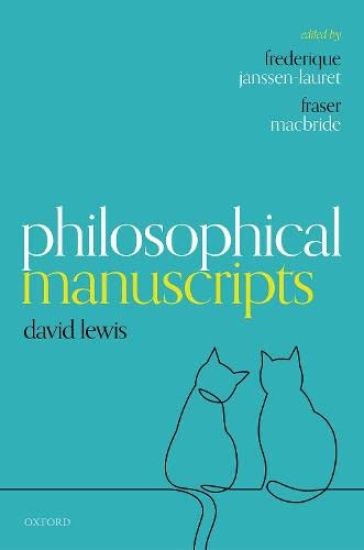
Philosophical Manuscripts

Philosophical Manuscripts

David Lewis

Oxford University Press
2023
sidottu
David Lewis (1941-2001) was a celebrated and influential figure in analytic philosophy. When Lewis died, he left behind a large body of unpublished notes, manuscripts, and letters. This volume contains two longer manuscripts which Lewis had originally intended to turn into books, and thirty-one shorter items. The longer manuscripts are 'The Paradoxes of Time Travel', his David Gavin Young Lectures at the University of Adelaide, and 'Confirmation Theory', which is based on a graduate course on probability and logic that he gave at UCLA. Lewis's described his purposes in 'The Paradoxes of Time Travel' as being, `(1) to solve a philosophical problem hitherto largely ignored or casually mis-solved by philosophers […]; (2) to introduce the layman to various topics in metaphysics, since our problem turns out to connect with many more familiar ones; and (3) to show of several of my favorite doctrines and methods in metaphysics'. By contrast, 'Confirmation Theory' is a technical work in which Lewis aimed to present in a unified fashion what he considered to be the best from competing theories of confirmation. Lewis described the work as 'Mathematically self-contained, with proofs for the major theorems; but the mathematics is kept down to hairy high-school algebra'. The thirty-one shorter items cover such topics as causation, freedom of the will, probability, counterparts, reference, logic, value, and divine evil. They are included here both for their intrinsic philosophical interest and their historical value. This volume also contains an intellectual biography of the young David Lewis by the editors.
Philosophy for an Ending World

Philosophy for an Ending World

Tim Mulgan

Oxford University Press
2024
sidottu
Tim Mulgan introduces a new thought experiment: the world will end in two hundred years, and humanity faces imminent and unavoidable (but not immediate) extinction. This book presents imaginary philosophical debates and lectures within this slowly ending world. The Ending World is both a provocative thought experiment and a challenging possible future. Exploring it from within - adopting the perspective of philosophers living in that ending world - helps us to imagine this world from the inside, to evaluate it as a possible future, to discover what we owe to future people who might inhabit such a future, and to explore how we might justify ourselves to them. The book explores contemporary debates about pessimism, the meaning of life, the existence of God, the purpose of the universe, the permissibility of creating new people, the need to connect with past and future people, the rectification of historical injustice, the design of utopias, and the desirability of escaping into virtual realities. It draws on a wide range of work in contemporary philosophy - including Samuel Scheffler's discussions of human extinction, Jonathan Lear's exploration of radical hope, David Benatar's anti-natalism, work on procreative ethics by Rivka Weinberg, Melinda Roberts, and Elizabeth Harman, and the author's own previous work on collective consequentialism, future ethics, and alternative conceptions of divine purpose. A central question throughout the book is whether we could equip our descendants to flourish in an ending world, even if we cannot imagine flourishing there ourselves. The book defends an innovative account of our obligations to future people, based on the need to launch multigenerational projects to transform our inherited traditions and values so that they will still make sense even at humanity's end.