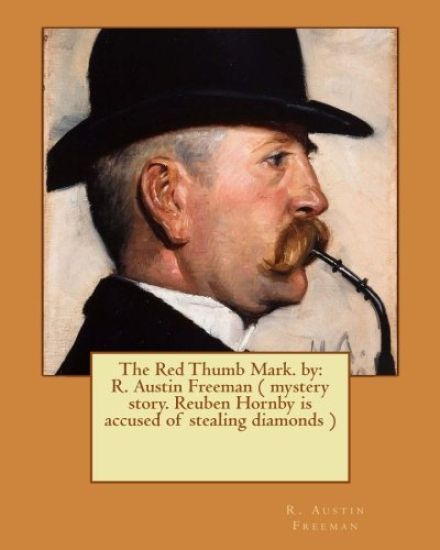
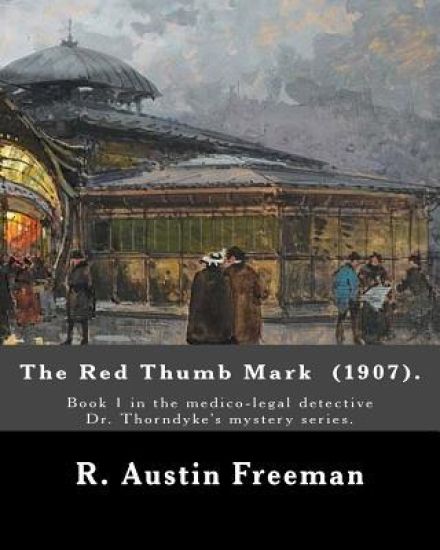
Book 1 in the medico-legal detective Dr. Thorndyke's mystery series. Reuben Hornby is accused of stealing diamonds from the safe of his uncle-his employer and benefactor. The sole evidence, but a damning one, is a paper, dropped in the safe in hurry, by the robber, bearing a fresh and bloody thumbprint. The thumbprint of Reuben ............ Richard Austin Freeman (11 April 1862 - 28 September 1943) was a British writer of detective stories, mostly featuring the medico-legal forensic investigator Dr. Thorndyke. He claimed to have invented the inverted detective story (a crime fiction in which the commission of the crime is described at the beginning, usually including the identity of the perpetrator, with the story then describing the detective's attempt to solve the mystery). Freeman used some of his early experiences as a colonial surgeon in his novels. Many of the Dr. Thorndyke stories involve genuine, but often quite arcane, points of scientific knowledge, from areas such as tropical medicine, metallurgy and toxicology. Early life: Austin Freeman was the youngest of the five children of tailor Richard Freeman and Ann Maria Dunn. He first trained as an apothecary and then studied medicine at Middlesex Hospital, qualifying in 1887. The same year he married Annie Elizabeth, with whom he had two sons. He entered the Colonial Service and was sent to Accra on the Gold Coast. Career: In 1891 he returned to London after suffering from blackwater fever but was unable to find a permanent medical position, and so decided to settle down in Gravesend and earn money from writing fiction, while continuing to practise medicine. His first stories were written in collaboration with John James Pitcairn (1860-1936), medical officer at Holloway Prison, and published under the nom de plume "Clifford Ashdown". His first Thorndyke story, The Red Thumb Mark, was published in 1907, and shortly afterwards he pioneered the inverted detective story, in which the identity of the criminal is shown from the beginning. Some short stories with this feature were collected in The Singing Bone in 1912. During the First World War he served as a captain in the Royal Army Medical Corps and afterwards produced a Thorndyke novel almost every year until his death in 1943. Freeman claimed to have invented the inverted detective story in his 1912 collection of short stories The Singing Bone. "Some years ago I devised, as an experiment, an inverted detective story in two parts. The first part was a minute and detailed description of a crime, setting forth the antecedents, motives, and all attendant circumstances. The reader had seen the crime committed, knew all about the criminal, and was in possession of all the facts. It would have seemed that there was nothing left to tell, but I calculated that the reader would be so occupied with the crime that he would overlook the evidence. And so it turned out. The second part, which described the investigation of the crime, had to most readers the effect of new matter."
This collection of literature attempts to compile many of the classic works that have stood the test of time and offer them at a reduced, affordable price, in an attractive volume so that everyone can enjoy them.
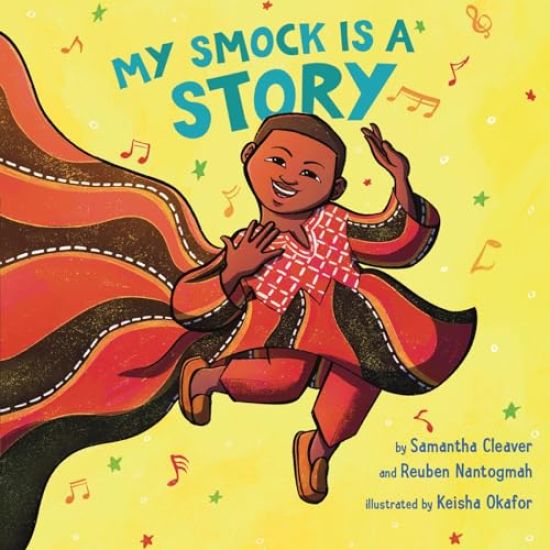
When a young boy receives his first smock as a gift, his Dada tells him that every smock has a special story. Will his smock make him as joyful as a harvest dancer?Or as powerful as his royal elders, the Dagomba?In his smock, what will his story be?From Reuben Nantogmah, Samantha Cleaver, and Keisha Okafor comes a joyful and lyrical picture book that celebrates what weaves us and our stories together--past, present, and future.
`All Is Well' is a collection of songs written over the past 25 years by the Blues - Folk musician, Reuben Augustine. Two songs in this book feature in his first album, `Let It Heal'. Some of the remaining songs enclosed will appear in his following albums The narrative running through his songs have been greatly influenced by `The Great War', its aftermath and the struggle for social justice.
Worldwide in scope and covering the second half of the 20th century, this work provides biographies and discographies of some 500 conductors and composers in many aspects of light and popular orchestral music, including film, show, theatre, and mood music. This is the first time the lives and recordings of such artists as Kostelanetz, Faith, Gould, as well as the orchestral recordings of such great popular composers as Gershwin, Kern, Porter, Rodgers, Berlin, and Coward, have been adequately documented and consolidated in an encyclopedic fashion. Almost 5,000 records and CDs are listed. Of interest to scholars, students, disc jockeys, record and CD collectors, film music buffs, and mood and production music enthusiasts. Popular orchestral music has been a neglected and often erroneously perceived and misunderstood genre in the 20th century. It has certainly not received the attention that it deserves and seems to be viewed as a Cinderella in relation to classical music and jazz. The genre, especially in the last 50 years, has been graced by exceptionally fine and highly esteemed conductors and arrangers, and also by a large number of highly regarded composers.
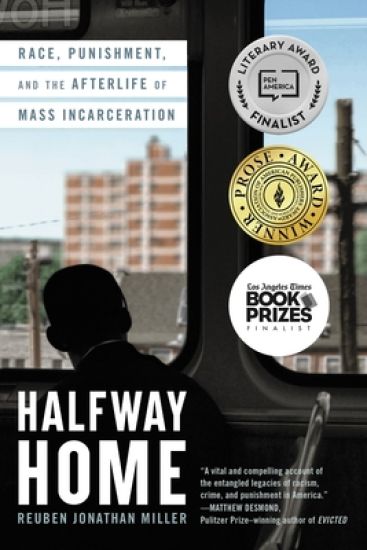
Each year, more than half a million Americans are released from prison and join a population of twenty million people who live with a felony record.Reuben Miller, a chaplain at the Cook County Jail in Chicago and now a sociologist studying mass incarceration, spent years alongside prisoners, ex-prisoners, their friends, and their families to understand the lifelong burden that even a single arrest can entail. What his work revealed is a simple, if overlooked truth: life after incarceration is its own form of prison. The idea that one can serve their debt and return to life as a full-fledge member of society is one of America's most nefarious myths. Recently released individuals are faced with jobs that are off-limits, apartments that cannot be occupied and votes that cannot be cast.As The Color of Law exposed about our understanding of housing segregation, Halfway Home shows that the American justice system was not created to rehabilitate. Parole is structured to keep classes of Americans impoverished, unstable, and disenfranchised long after they've paid their debt to society.Informed by Miller's experience as the son and brother of incarcerated men, captures the stories of the men, women, and communities fighting against a system that is designed for them to fail. It is a poignant and eye-opening call to arms that reveals how laws, rules, and regulations extract a tangible cost not only from those working to rebuild their lives, but also our democracy. As Miller searchingly explores, America must acknowledge and value the lives of its formerly imprisoned citizens.PEN America 2022 John Kenneth Galbraith Award for Nonfiction FinalistWinner of the 2022 PROSE Award for Excellence in Social Sciences2022 PROSE Awards Finalist2022 PROSE Awards Category Winner for Cultural Anthropology and SociologyAn NPR Selected 2021 Books We LoveAs heard on NPR's Fresh Air
This book investigates the drivers, tactics, and strategy that propel the Trump administration’s foreign policy.The key objective of this book is to look beyond the ‘noise’ of the Trump presidency in order to elucidate and make sense of contemporary US foreign policy. It examines the long-standing convictions of the president and the brutal worldview that he applies to US foreign policy; and his hard-line negotiation tactics and employment of unpredictability to keep America’s major foreign interlocutors off-guard, such as NATO members, China, Mexico, Canada, North Korea, and Iran – each of which are considered here. In strategy terms, the book explains that the president is responding to a new multipolar structure of power by engaging a Kissingerian strategy that eschews liberal values and seeks to adjust great power relations in Washington’s favor. By drawing upon a range of evidence and case studies, this book makes a number of compelling and provocative points to offer a new vector for debate about the workings, successes and failures, and ultimately the long-term implications for the world, of the Trump presidency.This book will be of much interest to students of US foreign policy, security studies, and IR in general.
This book investigates the drivers, tactics, and strategy that propel the Trump administration’s foreign policy.The key objective of this book is to look beyond the ‘noise’ of the Trump presidency in order to elucidate and make sense of contemporary US foreign policy. It examines the long-standing convictions of the president and the brutal worldview that he applies to US foreign policy; and his hard-line negotiation tactics and employment of unpredictability to keep America’s major foreign interlocutors off-guard, such as NATO members, China, Mexico, Canada, North Korea, and Iran – each of which are considered here. In strategy terms, the book explains that the president is responding to a new multipolar structure of power by engaging a Kissingerian strategy that eschews liberal values and seeks to adjust great power relations in Washington’s favor. By drawing upon a range of evidence and case studies, this book makes a number of compelling and provocative points to offer a new vector for debate about the workings, successes and failures, and ultimately the long-term implications for the world, of the Trump presidency.This book will be of much interest to students of US foreign policy, security studies, and IR in general.

![The Autobiography of Mark Rutherford and Mark Rutherford's Deliverance. Edited by His Friend, Reuben Shapcott. [By William Hale White.] Second Edition](/covers/9781241197926.jpg)
![The Autobiography of Mark Rutherford and Mark Rutherford's Deliverance. Edited by His Friend, Reuben Shapcott. [By William Hale White.] Second Edition](/covers/9781241461805.jpg)