Kirjojen hintavertailu. Mukana 12 016 292 kirjaa ja 12 kauppaa.

Kirjahaku

Etsi kirjoja tekijän nimen, kirjan nimen tai ISBN:n perusteella.

1000 tulosta hakusanalla William D. Howells

When the Steam Railroads Electrified, Revised Second Edition

When the Steam Railroads Electrified, Revised Second Edition

William D. Middleton

Indiana University Press
2002
sidottu
This comprehensive history of North American railroad electrification has been out of print for many years. Now, Indiana University Press is proud to announce its return in an new, updated second edition. For most of the first half of the 20th century the United States led the way in railroad electrification. Before the outbreak of World War II, the country had some 2,400 route-miles and more than 6,300 track-miles operating under electric power, far more than any other nation and more than 20 percent of the world's total. In almost every instance, electrification was a huge success. Running times were reduced. Tonnage capacities were increased. Fuel and maintenance costs were lowered, and the service lives of electric locomotives promised to be twice as long as those of steam locomotives. Yet despite its many triumphs, electrification of U.S. railroads failed to achieve the wide application that once was so confidently predicted. By the 1970s, it was the Soviet Union, with almost 22,000 electrified route-miles, that led the way, and the U.S. had declined to 17th place. Today, electric operation of U.S. railroads is back in the limelight. The federally funded Northeast Corridor Improvement Program has provided an expanded Northeast Corridor electrification, with high-speed trains that are giving the fastest rail passenger service ever seen in North America, while still other high-speed corridors are planned for other parts of the country. And with U.S. rail freight tonnage at its highest levels in history, the ability of electric locomotives to expand capacity promises to bring renewed consideration of freight railroad electrification. Middleton begins his ambitious chronicle of the ups and downs of railway electrification with the history of its early days, and brings it right up to the present—which is surely not the end of this complex and mercurial story.
Metropolitan Railways

Metropolitan Railways

William D. Middleton

Indiana University Press
2003
sidottu
Early in the 19th century, growing American cities began to experience transportation problems. One solution was the horse-drawn streetcar, developed in 1832, but it soon proved inadequate. The first elevated train was transporting passengers above the streets of Manhattan by 1871; the first subway opened 25 years later in Boston; and similar systems soon followed in Philadelphia and Chicago. Rapid transit was confined to these few cities until after World War II, when a new generation of systems began to appear. In the 1970s, light rail became an economical alternative to conventional rapid transit. By century's end, some three dozen cities in the U.S., Canada, and Mexico operated metropolitan rapid transit or light rail systems that transported five billion urban passengers annually, and still more were under construction or planned. These diverse systems include elevated lines ranging from Chicago's "L" to the fully automatic Skytrain metro of Vancouver, B.C.; subways from New York City's thundering tunnels—the world's largest underground system—to the thoroughly modern metro of Guadalajara; and light rail from lovingly restored New Orleans streetcars to the sleek, articulated vehicles of Silicon Valley. Metropolitan Railways is a large-scale, extensively illustrated volume that deals with the growth and development of urban rail transit systems in North America. It traces the history of rail transit technology from such impractical early schemes as a proposed steam-powered "arcade railway" under New York's Broadway through today's sophisticated systems. Rapid transit enthusiasts as well as residents of cities that are potential candidates for rapid transit or light rail systems will find this book indispensable.
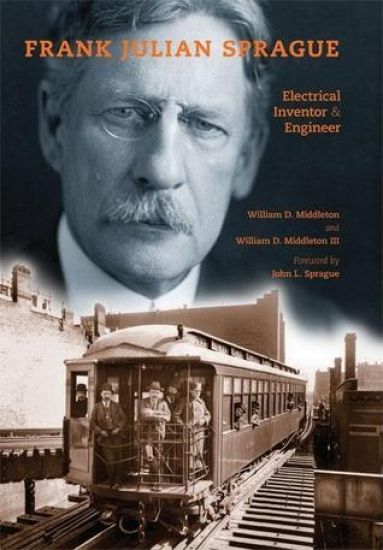
Frank Julian Sprague

Frank Julian Sprague

William D. Middleton

Indiana University Press
2009
sidottu
Frank Julian Sprague invented a system for distributing electricity to streetcars from overhead wires. Within a year, electric streetcars had begun to replace horsecars, sparking a revolution in urban transportation. Sprague (1857–1934) was an American naval officer turned inventor who worked briefly for Thomas Edison before striking out on his own. Sprague contributed to the development of the electric motor, electric railways, and electric elevators. His innovations would help transform the urban space of the 20th century, enabling cities to grow larger and skyscrapers taller. The Middletons' generously illustrated biography is an engrossing study of the life and times of a maverick innovator.
Warming the World

Warming the World

William D. Nordhaus; Joseph Boyer

MIT Press
2003
pokkari
This book presents in detail a pair of models of the economics of climate change. The models, called RICE-99 (for the Regional Dynamic Integrated model of Climate and the Economy) and DICE-99 (for the Dynamic Integrated Model of Climate and the Economy) build on the authors' earlier work, particularly their RICE and DICE models of the early 1990s.Humanity is risking the health of the natural environment through a myriad of interventions, including the atmospheric emission of trace gases such as carbon dioxide, the use of ozone-depleting chemicals, the engineering of massive land-use changes, and the destruction of the habitats of many species. It is imperative that we learn to protect our common geophysical and biological resources. Although scientists have studied greenhouse warming for decades, it is only recently that society has begun to consider the economic, political, and institutional aspects of environmental intervention. To do so raises formidable challenges of data modeling, uncertainty, international coordination, and institutional design.Attempts to deal with complex scientific and economic issues have increasingly involved the use of models to help analysts and decision makers understand likely future outcomes as well as the implications of alternative policies. This book presents in detail a pair of models of the economics of climate change. The models, called RICE-99 (for the Regional Dynamic Integrated model of Climate and the Economy) and DICE-99 (for the Dynamic Integrated Model of Climate and the Economy) build on the authors' earlier work, particularly their RICE and DICE models of the early 1990s. They can help policy makers design better economic and environmental policies.
Black Intellectuals, Black Cognition, and a Black Aesthetic

Black Intellectuals, Black Cognition, and a Black Aesthetic

William D. Wright

Praeger Publishers Inc
1997
sidottu
Neither American history nor American society anticipated, sanctioned, or encouraged the development of either Black intellectuals or a Black middle class. Both emerged and developed against horrendous obstacles and both are great achievements. Both were sanctioned and given moral direction by the American Negro Academy, an organization founded in 1897 by Alexander Crummell, W.E.B. Du Bois, Francis Grimke, and others for the purpose of organizing Black intellectuals to defend and redeem Blacks, through intellectual, artistic, and scientific achievements in the face of racist detractors, and to help the Black middle class develop as the leadership class of Black America. Black intellectuals have had a difficult time fulfilling a leadership role, partly because they have failed to remember the three cultural heritages of Black people: Black, African, and Euro-American. The times demand that Black intellectuals approach themselves and their world from all three cultural perspectives, for the sake of Black people and for the sake of America, both of which desperately need their leadership.
FDR and the Modern Presidency

FDR and the Modern Presidency

William D. Pederson; Mark J. Rozell

Praeger Publishers Inc
1997
sidottu
In this volume Rozell and Peterson bring together a collection of new essays exploring the unparalleled impact of Franklin D. Roosevelt on the modern presidency. Of all the modern presidents, FDR looms largest. Indeed, most scholars date the origins of the modern presidency to FDR, and many assert that no one since has achieved his level of greatness in office.The essays are organized into two broad sections: The first examines FDR's impact on the creation and development of the administrative presidency and the legacy of the New Deal; the second looks at FDR's legacy to presidential leadership and the exercise of presidential powers. An important volume for scholars and other researchers of the FDR era and the modern American presidency.
Racism Matters

Racism Matters

William D. Wright

Praeger Publishers Inc
1998
sidottu
This work offers a new discussion of racism in America that focuses on how White people have been affected by their own racism and how it impacts upon relations between Blacks and Whites. This study draws attention to how racism is distinctly different from race, and it shows how, since the late 17th century, most Whites have been afflicted by their own racism, as evidenced by considerable delusional thinking, dehumanization, alienation from America, and psychological and social pathology. White people have created and maintained a White racist America, which is the antithesis of liberty, equality, justice, and freedom; Black people continue to be the primary victims of this culture.Although racism in America has changed since the 1950s and 1960s from a blatant and violent White racist America to a less violent and more subtle White racist America, racism still severely hampers the ability of most Blacks to develop and be free. The continuing racist context in which Blacks live requires that they organize and use effective group power, or Black Power, to help themselves. One obstacle to Black achievement is the use of intelligence tests, which are wholly unscientific and represent a manifestation of subtle White racism. A challenge to the writing on race in this country, this work focuses on the victims and not the perpetrators.
George Washington and the Origins of the American Presidency

George Washington and the Origins of the American Presidency

William D. Pederson; Mark J. Rozell; Frank J. Williams

Praeger Publishers Inc
2000
sidottu
This essay collection is a retrospective analysis of the Washington administration's importance to the understanding of the modern presidency. Contemporary presidential scholarship gives little attention to the enormous impact that Washington's actions had on establishing the presidency. Most contemporary literature starts with 1933 and, although FDR's impact on the development of the modern institution of the presidency is undeniable, Washington's actions in office also established standards for practices that continue to this day.This analysis of the Washington presidency begins with an examination of Washington's leadership and its relevance to the modern presidency. The second group of essays looks at different aspects of presidential powers and the precedents established by the Washington administration. The third section examines Washington's press coverage, looking at the origins of Washington's image and the various myths in the press as well as the president's difficult relations with his contemporary press. A thoughtful and important corrective that will be of interest to scholars, students, and researchers involved with the American presidency and its history.
Black History and Black Identity

Black History and Black Identity

William D. Wright

Praeger Publishers Inc
2002
sidottu
This study contends that historians and intellectuals failed to understand the difference between race and ethnicity, which has in turn impaired their ability to understand who Black people are in America. The author argues that Black Americans are to be distinguished from other categories of black people in the country: black Africans, West Indians, or Hispanics. While Black people are members of the black race, as are other groups of people, they are a distinct ethnic group of that race. This conceptual failure has hampered the ability of historians to define Black experience in America and to study it in the most accurate, authentic, and realistic manner possible.This confusing situation is aggravated further by the fact that many scholars tend to describe Black people in an arbitrary manner, as Africans, African Americans, Afro-Americans, black or Black, which is insufficient for precision. They sometimes downplay the historical evidence regarding African identity, and the identity of Blacks in America. Wright offers a new methodological basis for undertaking Black history: namely, the framework of historical sociology. He argues that this approach will produce a more useful history for Black people and others in America.
Critical Reflections on Black History

Critical Reflections on Black History

William D. Wright

Praeger Publishers Inc
2002
sidottu
Wright presents this collection of six essays on aspects of black history. Each essay is based upon a critical historical methodology that is comprised of, among other things, a racial analysis, an intersectional analysis, rigorous logic, conceptual integrity, and a critical analysis of ideas, words, and images. Critical of the romantic approach to the subject, Wright seeks to uncover a deeper analysis, knowledge, and truth regarding aspects of black history, even when it involves the presentation of material and viewpoints that some might find objectionable. He predicates these pieces on the idea that history is still a valuable subject, firmly rejecting the postmodern view that it has lost its validity.Wright demonstrates that black history is a vital and necessary subject, not only for black people, but for all Americans. A critical black history is itself, Wright contends, a device to evaluate American history in a critical manner, to get into the subject more deeply, and to adduce deeper knowledge and truths about it. These essays show the author's interest in strengthening that critical capacity of black historical writing and his belief that this is a primary and necessary means to maintain the viability and productivity of the academic discipline and to ward off its detractors.
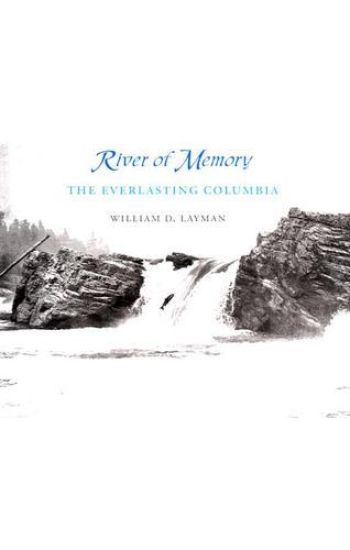
River of Memory

River of Memory

William D. Layman

University of Washington Press
2006
sidottu
Winner of the 2007 Washington State Book Award for General NonfictionFinalist in the Western Writers of America 2007 Spur Award competition for the Best Western Nonfiction - Contemporary categoryThe Columbia River of today bears little resemblance to the river Native peoples and settlers knew in the early twentieth century. Between 1933 and 1984, an unparalleled fervor of engineering transformed much of the river into a series of large reservoirs contained by fourteen hydroelectric dams. While many mourned the loss of the freeflowing river, others embraced a newly tamed waterway that could control floods, irrigate desert lands, and supply electrical power for the growing region.River of Memory honors a place and time now gone from view. It restores an unfettered Columbia through more than ninety historical photographs that capture the river as it once appeared. This extraordinary visual record is complemented with the words of early explorers, surveyors, and naturalists who wrote about specific places along the river and with new works by contemporary American and Canadian writers and poets.Organized to carry the reader from the mouth of the Columbia where it enters the ocean to its source in eastern British Columbia, the narrative follows the natural history of the river through the archetypal journey of salmon returning to the river's headwaters in Columbia Lake. Introducing each section are illustrations of salmon and other indigenous fish by artists Joseph Tomelleri and Dan McConnell.River of Memory encourages readers to linger along the river's shores and spend time reflecting on its dramatic mountain and plateau landscapes. It fosters connections between the river's natural and human histories through the words of the distinguished writers represented throughout, including Jeannette Armstrong, Gloria Bird, Peter Christensen, Tim McNulty, Kathleen Dean Moore, Eileen Delehanty Pearkes, Theodore Roethke, Kim Stafford, William Stafford, Robert Sund, David Wagoner, Elizabeth Woody, and many more.
A Question of Balance

A Question of Balance

William D. Nordhaus

Yale University Press
2015
pokkari
The 2018 Nobel laureate for economics shows how economic analysis can help us design economic policies to address the looming challenges of global warming As scientific and observational evidence on global warming piles up every day, questions of economic policy in this central environmental topic have taken center stage. But as author and prominent Yale economist William Nordhaus observes, the issues involved in understanding global warming and slowing its harmful effects are complex and cross disciplinary boundaries. For example, ecologists see global warming as a threat to ecosystems, utilities as a debit to their balance sheets, and farmers as a hazard to their livelihoods.In this important work, William Nordhaus integrates the entire spectrum of economic and scientific research to weigh the costs of reducing emissions against the benefits of reducing the long-run damages from global warming. The book offers one of the most extensive analyses of the economic and environmental dynamics of greenhouse-gas emissions and climate change and provides the tools to evaluate alternative approaches to slowing global warming. The author emphasizes the need to establish effective mechanisms, such as carbon taxes, to harness markets and harmonize the efforts of different countries. This book not only will shape discussion of one the world’s most pressing problems but will provide the rationales and methods for achieving widespread agreement on our next best move in alleviating global warming.
The Climate Casino

The Climate Casino

William D. Nordhaus

Yale University Press
2015
pokkari
The 2018 Nobel laureate for economics analyzes the politics and economics of the central environmental issue of today and points the way to real solutions “A one-stop source on global warming, seen through the prism of a brilliant economist.”—Fred Andrews, New York Times Selected as one of the year’s best books by the Financial Times Climate change is profoundly altering our world in ways that pose major risks to human societies and natural systems. We have entered the Climate Casino and are rolling the global-warming dice, warns economist William Nordhaus. But there is still time to turn around and walk back out of the casino, and in this essential book the author explains how. Bringing together all the important issues surrounding the climate debate, Nordhaus describes the science, economics, and politics involved—and the steps necessary to reduce the perils of global warming. Using language accessible to any concerned citizen and taking care to present different points of view fairly, he discusses the problem from start to finish: from the beginning, where warming originates in our personal energy use, to the end, where societies employ regulations or taxes or subsidies to slow the emissions of gases responsible for climate change. Nordhaus offers a new analysis of why earlier policies, such as the Kyoto Protocol, failed to slow carbon dioxide emissions, how new approaches can succeed, and which policy tools will most effectively reduce emissions. In short, he clarifies a defining problem of our times and lays out the next critical steps for slowing the trajectory of global warming.
Sensory Mechanisms of the Spinal Cord

Sensory Mechanisms of the Spinal Cord

William D. Willis Jr.

Kluwer Academic/Plenum Publishers
1991
sidottu
As stated in the preface to the first edition, the goal of this monograph is to provide an overview of current thought about the spinal cord mechanisms responsible for sensory processing. We hope that the book will be of value to both basic neuroscientists and clinicians. The organization of the monograph has followed the original plan in most respects, although the emphasis has changed with respect to many topics because of recent advances. In particular, a substantial increase in the number of investigations of the dorsal root ganglion has led us to devote a chapter to this topic. The treatment of chemical neuroanatomy in the dorsal horn, as well as the relevant neuropharmacology, has also been expanded considerably. Another major emphasis is on the results of experiments employing microneurography in human subjects. We thank Margie Watson and Lyn Schilling for their assistance with the typing and Griselda Gonzales for preparing the illustrations.
Sensory Mechanisms of the Spinal Cord

Sensory Mechanisms of the Spinal Cord

William D. Willis Jr.; Richard E. Coggeshall

Kluwer Academic/Plenum Publishers
2003
sidottu
This text provides an historical and contemporary overview of an active field of neuroscience research on somato-visceral sensation. Medical (and indirectly veterinary) implications are emphasized. Extensive revisions have been made since the last edition, including the addition of two chapters. Many significant literature citations have been added for the period since the last edition. The illustrations have been substantially expanded, including a number that emphasize newly applied techniques.
Sensory Mechanisms of the Spinal Cord

Sensory Mechanisms of the Spinal Cord

William D. Willis Jr.; Richard E. Coggeshall

Kluwer Academic/Plenum Publishers
2004
sidottu
The third edition of this monograph continues to have the goal of providing an overview of current thought about the spinal cord mechanisms that are responsible for sensory processing. We hope that the book is of value to both basic and clinical neuroscientists. Several changes have been made in the presentation, as well as additions because of the research advances that have been made during the past decade. Chapters 3 and 4 in the previous edition have been subdivided, and now the morphology of primary afferent neu­ rons of the dorsal root ganglia is described in Chapter 3 and the chemical neuroanatomy 4. The description of the dorsal hom in the previous Chapter 4 of these neurons in Chapter is now included in Chapter 5, and the chemical neuroanatomy of the dorsal hom in Chapter 6. Furthermore, discussions of the descending control systems have now been of Chapter 12. consolidated at the end The authors would like to express their appreciation for the help provided by several individuals. R.E.C. wishes to acknowledge the many things he learned about primary afferent neurons from conversations with Dr S. N. Lawson. He also thanks Lyn Shilling for her assistance with the typing. WDW thanks Dr Nada Lawand for her critical reading of parts of the manuscript, Rosaline Leigh for help with the manuscript, and Griselda Gonzales for preparing the illustrations.
Sensory Mechanisms of the Spinal Cord

Sensory Mechanisms of the Spinal Cord

William D. Willis Jr.; Richard E. Coggeshall

Kluwer Academic/Plenum Publishers
2004
sidottu
The third edition of this monograph continues to have the goal of providing an overview of current thought about the spinal cord mechanisms that are responsible for sensory processing. We hope that the book is of value to both basic and clinical neuroscientists. Several changes have been made in the presentation, as well as additions because of the research advances that have been made during the past decade. Chapters 3 and 4 in the previous edition have been subdivided, and now the morphology of primary afferent neu­ rons of the dorsal root ganglia is described in Chapter 3 and the chemical neuroanatomy of these neurons in Chapter 4. The description of the dorsal horn in the previous Chapter 4 is now included in Chapter 5, and the chemical neuroanatomy of the dorsal horn in Chapter 6. Furthermore, discussions of the descending control systems have now been consolidated at the end of Chapter 12. The authors would like to express their appreciation for the help provided by several individuals. R.E.C. wishes to acknowledge the many things he learned about primary afferent neurons from conversations with Dr S. N. Lawson. He also thanks Lyn Shilling for her assistance with the typing. WDW thanks Dr Nada Lawand for her critical reading of parts of the manuscript, Rosaline Leigh for help with the manuscript, and Griselda Gonzales for preparing the illustrations.
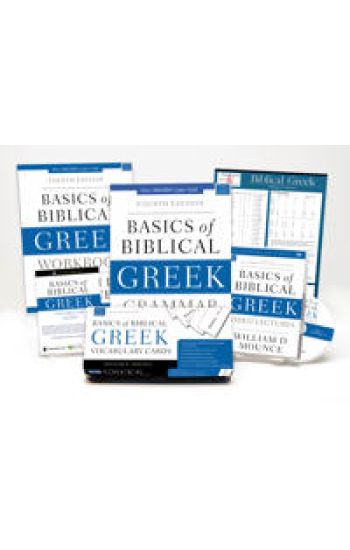
Learn Biblical Greek Pack 2.0

Learn Biblical Greek Pack 2.0

William D. Mounce

Zondervan
2019
muu
This pack contains everything you need to learn the original language of the New Testament, no matter if you are enrolled in a class or learning on your own. It includes today’s most popular introductory Greek grammar today (Basics of Biblical Greek), along with the corresponding workbook, 36 video lessons on six DVDs, audio, and other important learning tools.First published in 1993, William Mounce's Basics of Biblical Greek Grammar, now in its fourth edition, has consistently been rated as the most helpful introduction to the field, and a collection of complementary tools provides readers with a holistic learning experience. In addition to the textbook, the pack includes:Basics of Biblical Greek Workbook, with study exercises and passages for translation practice.Basics of Biblical Greek Video Lectures, featuring 36 video lessons accompanying the passages in the textbook.Biblical Greek: A Compact Guide, a handy, at-a-glance reference offering summaries of Greek grammar, paradigms, a lexicon, and more.Basics of Biblical Greek Vocabulary Cards, including 1,000 vocabulary flashcards for studying.Basics of Biblical Greek Vocabulary Audio, a digital download from Olive Tree Bible Software, available through an access code, of audio pronunciations of the vocabulary from the grammar to help with memorization and acquisition.Biblical Greek Laminated Sheet, for a quick reference guide to common language questions.The Learn Biblical Greek Pack 2.0 includes everything you need to start learning Greek today and find new depth reading God's Word in the language it was originally written.
Biblical Greek Survival Kit 2.0

Biblical Greek Survival Kit 2.0

William D. Mounce

Zondervan
2019
muu
Be equipped for success in first year Greek, and save money! The Biblical Greek Survival Kit 2.0 gives you the tools you need to succeed and it is a great value ($10 less than items purchased separately) The kit includes:Basics of Biblical Greek Vocabulary Cards, including 1,000 vocabulary flashcards for studying.Basics of Biblical Greek Vocabulary Audio, a digital download from Olive Tree Bible Software, available through an access code, of audio pronunciations of the vocabulary from the grammar to help with vocabulary memorization and acquisition.Biblical Greek Laminated Sheet, for a quick reference guide to common language questions.
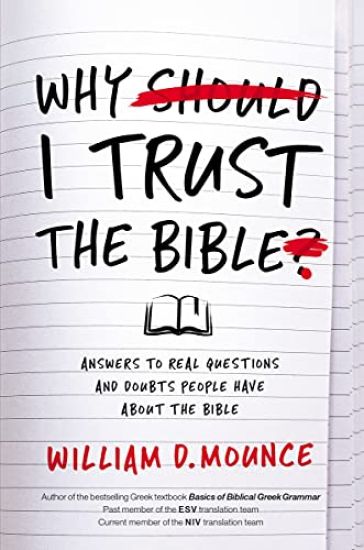
Why I Trust the Bible

Why I Trust the Bible

William D. Mounce

Zondervan
2021
nidottu
A Clear Guide to Help Readers Understand Why They Can Trust the BibleWe are often told we can no longer assume that the Bible is trustworthy. From social media memes to popular scholarship, so many attacks have been launched on the believability of Scripture that many have serious questions about the Bible, such as:Did Jesus actually live?Did the biblical writers invent their message?How can we trust the gospels since they were written so long after Jesus lived?How can we believe a Bible that is full of internal contradictions with itself and external contradictions with science?Aren't the biblical manuscripts we have just copies of copies that are so corrupted they don't represent what the original authors wrote?Why should we believe the books that are in the Bible, since many good ones were left out, like the Gospel of Thomas?Why trust the Bible when there are so many contradictory translations of it?If you find yourself unable to answer questions such as these, but wanting to, Why I Trust the Bible by eminent Bible scholar and translator William Mounce is for you. These questions and more are discussed and answered in a reasoned, definitive, and winsome way.The truth is that the Bible is better attested and more defensible today than it ever has been. Questions about the Bible are perhaps the most significant challenge confronting Christian faith today, but they can be answered well and in a way which will lead to a deeper appreciation for the truth and ongoing relevance of the Bible.