Kirjahaku
Etsi kirjoja tekijän nimen, kirjan nimen tai ISBN:n perusteella.
1000 tulosta hakusanalla Al Olinde


Voyage Aux RÃ(c)gions Equinoxiales De Nouveau Continent Fait En 1799, 1800, 1801, 1802, 1803 Et 1804 Por Al. De Homboldt Et A. Bonpland, 8...
Al De Humboldt
Hutson Street Press
2025
sidottu

Voyage Aux RÃ(c)gions Equinoxiales De Nouveau Continent Fait En 1799, 1800, 1801, 1802, 1803 Et 1804 Por Al. De Homboldt Et A. Bonpland, 8...
Al De Humboldt
Hutson Street Press
2025
pokkari


Al-Futuhat al-Makkiyah
Hutson Street Press
2025
sidottu

Al-Futuhat al-Makkiyah
Hutson Street Press
2025
pokkari
Al-Khia al-Tawfiqiyah al-jadidah
Hutson Street Press
2025
sidottu

Al-Khia al-Tawfiqiyah al-jadidah
Hutson Street Press
2025
pokkari

Al-Muwafaqat fi usul al-shari'ah
Hutson Street Press
2025
sidottu

Al-Qur'an ma'a tafsir al-kashshaf 'an haqa'iq al-tanzil
Hutson Street Press
2025
sidottu
Al-Muwafaqat fi usul al-shari'ah
Hutson Street Press
2025
pokkari

Al-Qur'an ma'a tafsir al-kashshaf 'an haqa'iq al-tanzil
Mamd Ibn Umar 1075-1144 Zamakhshar; W. Nassau (William Nassau) 182 Lees
Hutson Street Press
2025
nidottu

This work has been selected by scholars as being culturally important, and is part of the knowledge base of civilization as we know it. This work was reproduced from the original artifact, and remains as true to the original work as possible. Therefore, you will see the original copyright references, library stamps (as most of these works have been housed in our most important libraries around the world), and other notations in the work. This work is in the public domain in the United States of America, and possibly other nations. Within the United States, you may freely copy and distribute this work, as no entity (individual or corporate) has a copyright on the body of the work. As a reproduction of a historical artifact, this work may contain missing or blurred pages, poor pictures, errant marks, etc. Scholars believe, and we concur, that this work is important enough to be preserved, reproduced, and made generally available to the public. We appreciate your support of the preservation process, and thank you for being an important part of keeping this knowledge alive and relevant.

al-Umm
Hutson Street Press
2025
pokkari

Al-Ghazali and the Idea of Moral Beauty rethinks the relationship between the good and the beautiful by considering the work of eleventh-century Muslim theologian Abu ?amid al-Ghazali (d. 1111). A giant of Islamic intellectual history, al-Ghazali is celebrated for his achievements in a wide range of disciplines. One of his greatest intellectual contributions lies in the sphere of ethics, where he presided over an ambitious attempt to integrate philosophical and scriptural ideas into a seamless ethical vision. The connection between ethics and aesthetics turns out to be a signature feature of this account. Virtue is one of the forms of beauty, and human beings are naturally disposed to respond to it with love. The universal human response to beauty in turn provides the central paradigm for thinking about the love commanded by God. While al-Ghazali’s account of divine love has received ample attention, his special way of drawing the good into relation with the beautiful has oddly escaped remark. In this book Sophia Vasalou addresses this gap by offering a philosophical and contextual study of this aspect of al-Ghazali’s ethics and of the conception of moral beauty that emerges from it. This book will be of interest to scholars and students in Islamic ethics, Islamic intellectual history, and the history of ethics.

Al-Ghazali and the Idea of Moral Beauty rethinks the relationship between the good and the beautiful by considering the work of eleventh-century Muslim theologian Abu ?amid al-Ghazali (d. 1111). A giant of Islamic intellectual history, al-Ghazali is celebrated for his achievements in a wide range of disciplines. One of his greatest intellectual contributions lies in the sphere of ethics, where he presided over an ambitious attempt to integrate philosophical and scriptural ideas into a seamless ethical vision. The connection between ethics and aesthetics turns out to be a signature feature of this account. Virtue is one of the forms of beauty, and human beings are naturally disposed to respond to it with love. The universal human response to beauty in turn provides the central paradigm for thinking about the love commanded by God. While al-Ghazali’s account of divine love has received ample attention, his special way of drawing the good into relation with the beautiful has oddly escaped remark. In this book Sophia Vasalou addresses this gap by offering a philosophical and contextual study of this aspect of al-Ghazali’s ethics and of the conception of moral beauty that emerges from it. This book will be of interest to scholars and students in Islamic ethics, Islamic intellectual history, and the history of ethics.
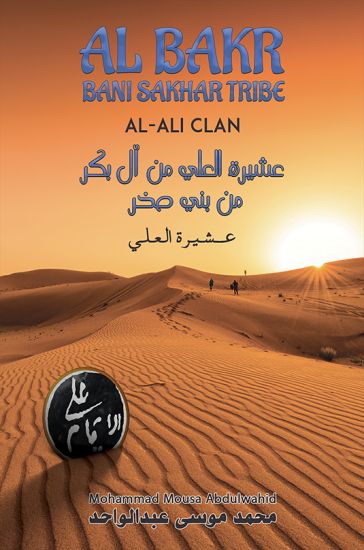
Al Bakr Bani Sakhar Tribe ????? ????? ?? ?? ??? ?? ??? ???
Mohammad Mousa Abdulwahid
Austin Macauley Publishers
2024
nidottu