Kirjojen hintavertailu. Mukana 11 717 486 kirjaa ja 12 kauppaa.

Kirjahaku

Etsi kirjoja tekijän nimen, kirjan nimen tai ISBN:n perusteella.

1000 tulosta hakusanalla Alessandro Filadelfeo

The Black Prince of Florence: The Spectacular Life and Treacherous World of Alessandro De' Medici
Born to a dark-skinned maid and Lorenzo II de' Medici, the illegitimate Alessandro was groomed for power. In 1532, at the age of nineteen, backed by the Holy Roman Emperor--his future father-in-law--and the Pope, he became Duke of Florence, facing down family rivals and oligarchs and inheriting the grandest dynasty of the Italian Renaissance. Catherine Fletcher's The Black Prince of Florence is the first complete account of the real-life counterpart to Machiavelli's Prince. After ruling for a turbulent six years, Alessandro was murdered in 1537 during a late-night tryst arranged by a scheming cousin. As Fletcher puts it, he was assassinated twice: "first with a sword, then with a pen." Following his death, Alessandro's reign was dismissed by his enemies--of which every Medici prince had many, and Alessandro more than his share--and his death painted as tyrannicide. It was in the years and centuries that followed that his racial origin became a focus, first by those seeking to emphasize his "savagery" and thus to justify his murder, and later to argue his case as the first ruler of color in the Western world. In 1931, Arturo Alfonso Schomburg, founder of the famous collection of African history in Harlem, wrote an article about Alessandro in the magazine The Crisis, then edited by W.E.B. Du Bois, calling him the "Negro Medici." Defined by intrigue, opulence, sexual conquest, and an endless struggle to retain power, Alessandro's life and afterlife reveal how racial identity has played out over the centuries, and to what degree it remains in the eye of the beholder. In this captivating biography of an intriguing and forgotten figure, Fletcher does full justice to his remarkable story, unraveling centuries-old mysteries, exposing forgeries, and bringing to life the epic personalities--artists, popes, queens, and pimps--of one of the most colorful periods in history.
Saggio sull'uomo del Sig. Alessandro Pope tradotto dall'inglese dal Sig. Gio. Castiglioni ...
The 18th century was a wealth of knowledge, exploration and rapidly growing technology and expanding record-keeping made possible by advances in the printing press. In its determination to preserve the century of revolution, Gale initiated a revolution of its own: digitization of epic proportions to preserve these invaluable works in the largest archive of its kind. Now for the first time these high-quality digital copies of original 18th century manuscripts are available in print, making them highly accessible to libraries, undergraduate students, and independent scholars.Western literary study flows out of eighteenth-century works by Alexander Pope, Daniel Defoe, Henry Fielding, Frances Burney, Denis Diderot, Johann Gottfried Herder, Johann Wolfgang von Goethe, and others. Experience the birth of the modern novel, or compare the development of language using dictionaries and grammar discourses. ++++The below data was compiled from various identification fields in the bibliographic record of this title. This data is provided as an additional tool in helping to insure edition identification: ++++British LibraryT005659Parallel English text and Italian verse translation. Includes 'Alcune traduzioni di Petronio' and 'Poesie diverse del traduttore'. Translator's dedication dated: Utrecht 8. Gennajo 1759.Berna: a spese della Soc. Letter. appreso Abr. Wagner figlio, 1760. LXXXVIII,192p.; 8
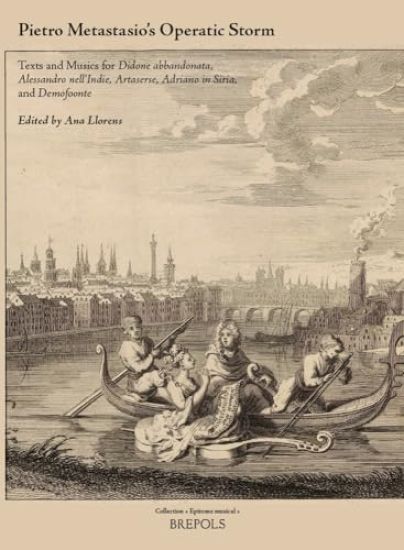
Pietro Metastasio's Operatic Storm: Texts and Musics for Didone Abbandonata, Alessandro Nell'indie, Artaserse, Adriano in Siria, and Demofoonte
Pietro Metastasio (1698-1782) can be considered as the most renowned operatic dramatist of eighteenth-century Europe. His drammi per musica travelled all around Europe - and beyond - throughout the eighteenth century and the early years of the nineteenth. Courts, palaces, and public theatres were eager to perform his dramas, and so hundreds of composers set them to music, sometimes on more than one occasion. This volume lets the surviving textual and musical traces speak for themselves. As a catalogue of the sources of five of Metastasio's most successful titles - Didone abbandonata, Alessandro nell'Indie, Artaserse, Adriano in Siria, and Demofoonte -, it offers their most complete chronology up to date, as well as a detailed presentation of the printers and the theatres in which these texts became alive. In the case of the majority of these works, thousands of manuscripts and copies attest to more than one hundred complete musical versions and over two hundred and fifty productions. They may thus rightly be considered witnesses to the operatic fever that took Europe by storm in the Enlightenment.