Kirjojen hintavertailu. Mukana 11 699 587 kirjaa ja 12 kauppaa.

Kirjahaku

Etsi kirjoja tekijän nimen, kirjan nimen tai ISBN:n perusteella.

1000 tulosta hakusanalla Barnett Singer

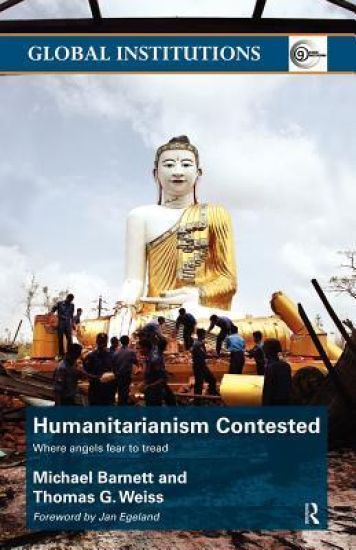
Humanitarianism Contested

Humanitarianism Contested

Michael Barnett; Thomas G. Weiss

Routledge
2011
sidottu
This book provides a succinct but sophisticated understanding of humanitarianism and insight into the on-going dilemmas and tensions that have accompanied it since its origins in the early nineteenth century. Combining theoretical and historical exposition with a broad range of contemporary case studies, the book: provides a brief survey of the history of humanitarianism, beginning with the anti-slavery movement in the early nineteenth century and continuing to today’s challenge of post-conflict reconstruction and saving failed states explains the evolution of humanitarianism. Not only has it evolved over the decades, but since the end of the Cold War, humanitarianism has exploded in scope, scale, and significance presents an overview of the contemporary humanitarian sector, including briefly who the key actors are, how they are funded and what they do with their money analyses the ethical dilemmas confronted by humanitarian organization, not only in the abstract but also, and most importantly, in real situations and when lives are at stake examines how humanitarianism poses fundamental ethical questions regarding the kind of world we want to live in, what kind of world is possible, and how we might get there. An accessible and engaging work by two of the leading scholars in the field, Humanitarianism Contested is essential reading for all those concerned with the future of human rights and international relations.
Humanitarianism Contested

Humanitarianism Contested

Michael Barnett; Thomas G. Weiss

Routledge
2011
nidottu
This book provides a succinct but sophisticated understanding of humanitarianism and insight into the on-going dilemmas and tensions that have accompanied it since its origins in the early nineteenth century. Combining theoretical and historical exposition with a broad range of contemporary case studies, the book: provides a brief survey of the history of humanitarianism, beginning with the anti-slavery movement in the early nineteenth century and continuing to today’s challenge of post-conflict reconstruction and saving failed states explains the evolution of humanitarianism. Not only has it evolved over the decades, but since the end of the Cold War, humanitarianism has exploded in scope, scale, and significance presents an overview of the contemporary humanitarian sector, including briefly who the key actors are, how they are funded and what they do with their money analyses the ethical dilemmas confronted by humanitarian organization, not only in the abstract but also, and most importantly, in real situations and when lives are at stake examines how humanitarianism poses fundamental ethical questions regarding the kind of world we want to live in, what kind of world is possible, and how we might get there. An accessible and engaging work by two of the leading scholars in the field, Humanitarianism Contested is essential reading for all those concerned with the future of human rights and international relations.
Emergence in Landscape Architecture
All landscapes are complex systems which are continually changing as a result of relatively simple interactions. This condition of adaption and evolution is called emergence. Related to chaos theory and self-organising systems, emergence highlights the ever changing and developing urban and natural world – and the need to work flexibly within this.Just as an aborist must understand the development and functions of a tree in order to fully understand his actions in relation to it, so must a landscape architect understand the ecological functions of a specific terrain in order to appreciate how the landscape will respond to the conditions he establishes. This bottom-up approach is essential when dealing with the natural environment – and, as Barnett argues, the urban environment. Covering critically the theory behind emergence in landscape architecture, the author also uses practical examples from international landscapes as a key tool in his mission to explain the basis of emergence and how it is essential to our understanding of both urban and natural systems. Ideal for students and educators in landscape architecture, landscape urbanism and architectural theory, this book provides a full discourse on the theory and practice behind emergence in landscape and features full colour images.
Emergence in Landscape Architecture
All landscapes are complex systems which are continually changing as a result of relatively simple interactions. This condition of adaption and evolution is called emergence. Related to chaos theory and self-organising systems, emergence highlights the ever changing and developing urban and natural world – and the need to work flexibly within this.Just as an aborist must understand the development and functions of a tree in order to fully understand his actions in relation to it, so must a landscape architect understand the ecological functions of a specific terrain in order to appreciate how the landscape will respond to the conditions he establishes. This bottom-up approach is essential when dealing with the natural environment – and, as Barnett argues, the urban environment. Covering critically the theory behind emergence in landscape architecture, the author also uses practical examples from international landscapes as a key tool in his mission to explain the basis of emergence and how it is essential to our understanding of both urban and natural systems. Ideal for students and educators in landscape architecture, landscape urbanism and architectural theory, this book provides a full discourse on the theory and practice behind emergence in landscape and features full colour images.
A History of Russian Economic Thought

A History of Russian Economic Thought

Vincent Barnett

Routledge
2009
nidottu
The collapse of the Union of Soviet Socialist Republic at the end of the 1980’s was conceived as a victory for capitalist democracy. Here, Vincent Barnett provides the first comprehensive account of the historical development of Russian and Soviet economic thought across the nineteenth and twentieth centuries, and considers its future in the twenty-first century.Utilizing an extensive range of historical sources, Barnett examines the different strands of thought, including classical, neoclassical, historical, socialist, liberal and Marxian schools. He traces their influence, and the impact their ideas had on shaping policies. An excellent addition to the Routledge History of Economic Thought series, this book covers pre-1870, Tsarist economics, the late Tsarist period, the impact of the war, Bolshevik economics, Stalinist economics, Russian economics after 1940. Incorporating a detailed timeline of the most significant Russian economists work and analyzing the effects of historical discontinuities on the institutional structure of Russian economics as a discipline, Barnett delivers an essential text for postgraduates and professionals interested in economic history and the evolution of Russian economic thought.
E.E. Slutsky as Economist and Mathematician
E.E. Slutsky is perhaps the Russian/Ukrainian economist most quoted by mainstream economists today. This is the first research monograph to examine the life and work of the internationally-renowned economist and mathematician. It does so from both a ‘history of economics’ perspective and a ‘history of science’ perspective, bringing these two strands together in order to demonstrate Slutsky’s enduring legacy as an innovative researcher and an influential intellectual. It also presents some of Slutsky’s lesser-known (and hitherto-unavailable) works in English translation.
Understanding Public Law

Understanding Public Law

Hilaire Barnett

Routledge Cavendish
2009
sidottu
Public Law is concerned with the law governing the institutions of the state and the relationship between the state and the individual, and is a core subject for all students reading for a qualifying law degree. This concise, student-friendly guide will help equip students with an understanding of the key aspects of the UK’s political and legal systems as well as building an understanding of the relationship between the different branches of the state such as the executive, legislature and judiciary.Understanding Public Law provides a consideration of the main themes in a logical, progressive manner, highlighting the broader political and social contexts, and focusing on how and why the law has developed as it has.Throughout the text, key terms are identified and explained from the outset, helping students new to the subject familiarize themselves with the vocabulary of public law; chapter outlines and summaries help to focus the reader on the key topics; and a set of self-test questions at the end of each chapter encourage students to consider and reflect on what has been learnt. Understanding Public Law is the ideal introduction to this essential subject.
Understanding Public Law

Understanding Public Law

Hilaire Barnett

Routledge Cavendish
2009
nidottu
Public Law is concerned with the law governing the institutions of the state and the relationship between the state and the individual, and is a core subject for all students reading for a qualifying law degree. This concise, student-friendly guide will help equip students with an understanding of the key aspects of the UK’s political and legal systems as well as building an understanding of the relationship between the different branches of the state such as the executive, legislature and judiciary.Understanding Public Law provides a consideration of the main themes in a logical, progressive manner, highlighting the broader political and social contexts, and focusing on how and why the law has developed as it has.Throughout the text, key terms are identified and explained from the outset, helping students new to the subject familiarize themselves with the vocabulary of public law; chapter outlines and summaries help to focus the reader on the key topics; and a set of self-test questions at the end of each chapter encourage students to consider and reflect on what has been learnt. Understanding Public Law is the ideal introduction to this essential subject.
Atrocity and American Military Justice in Southeast Asia
This book is an examination of American army legal proceedings that resulted from a series of moments when soldiers in a war zone crossed a line between performing their legitimate functions and committing crimes against civilians, or atrocities.Using individual judicial proceedings held within war-time Southeast Asia, Louise Barnett analyses how the American military legal system handled crimes against civilians and determines what these cases reveal about the way that war produces atrocity against civilians. Presenting these atrocities and subsequent trials in a way that considers both the personal and the institutional the author considers how and why atrocity happens, the terrain of justification, and the degree to which the army and American society have been willing to take military crimes against civilians seriously. Atrocity and American Military Justice in Southeast Asia will be of interest to students, scholars and professionals interested in Military Justice, Military history and Southeast Asian History more generally.
John Maynard Keynes

John Maynard Keynes

Vincent Barnett

Routledge
2012
sidottu
John Maynard Keynes is arguably the most important and influential economist of the twentieth century, and stands alongside Adam Smith and Karl Marx as one of the most famous economic thinkers of all time. Keynes’s radical reassessment of the accepted principles of economics led to new ways of thinking about how to deal with financial crises and economic depressions, and encouraged governments to increase levels of state investment to create economic growth.This historical biography shows how Keynes was more than an academic theorist and how his policy proposals had a significant impact on the economic and financial architecture of many Western countries from the 1920s onward, and on the post-war international financial system. It also tells the story of his colourful private life - Keynes was an active member of the Bloomsbury group of artists and intellectuals, he entertained various ‘secret’ male lovers in his youth, he married a famous Russian ballerina in 1925 and he was also an astute collector of fine art and antiquarian books. Vincent Barnett emphasizes the relationship between the personal and professional by presenting the book chapters in pairs, examining first the central features of Keynes’s life, personal development and policy ideas over the period in question, and then the theoretical content of his major writings from the same period.Barnett argues controversially that allowing psychology a much greater role within economics was a main but often-neglected feature of The General Theory of Employment, Interest and Money, and that Keynes’s policy writings were more concerned with the Britain’s national interest than is sometimes recognised. The result is a concise new biography that is both intellectually rigorous and easily accessible to students and anyone else seeking to understand the life and work of England‘s foremost economist.
John Maynard Keynes

John Maynard Keynes

Vincent Barnett

Routledge
2012
nidottu
John Maynard Keynes is arguably the most important and influential economist of the twentieth century, and stands alongside Adam Smith and Karl Marx as one of the most famous economic thinkers of all time. Keynes’s radical reassessment of the accepted principles of economics led to new ways of thinking about how to deal with financial crises and economic depressions, and encouraged governments to increase levels of state investment to create economic growth.This historical biography shows how Keynes was more than an academic theorist and how his policy proposals had a significant impact on the economic and financial architecture of many Western countries from the 1920s onward, and on the post-war international financial system. It also tells the story of his colourful private life - Keynes was an active member of the Bloomsbury group of artists and intellectuals, he entertained various ‘secret’ male lovers in his youth, he married a famous Russian ballerina in 1925 and he was also an astute collector of fine art and antiquarian books. Vincent Barnett emphasizes the relationship between the personal and professional by presenting the book chapters in pairs, examining first the central features of Keynes’s life, personal development and policy ideas over the period in question, and then the theoretical content of his major writings from the same period.Barnett argues controversially that allowing psychology a much greater role within economics was a main but often-neglected feature of The General Theory of Employment, Interest and Money, and that Keynes’s policy writings were more concerned with the Britain’s national interest than is sometimes recognised. The result is a concise new biography that is both intellectually rigorous and easily accessible to students and anyone else seeking to understand the life and work of England‘s foremost economist.
Being a University

Being a University

Ronald Barnett

Routledge
2010
sidottu
There is no single idea of the university. Ever since its medieval origin, the concept of the university has continued to change. The metaphysical university gave way successively to the scientific university, and then to the corporate and the entrepreneurial university. But what, then, might lie ahead?Being a University both charts this conceptual development and examines the future possibilities for the idea of the university. Ronald Barnett pursues this quest through an exploration of pairs of contending concepts that speak to the idea of the university – such as space and time; being and becoming; and culture and anarchy. On this foundation is developed an imaginative exposition of possible ideas of the university, including the liquid university and the authentic university.In the course of this inquiry, it is argued that:Any thought that the idea of the entrepreneurial university represents the end-point of the evolution of the idea of the university has to be abandoned. The entrepreneurial university is excessively parochial and ill-matched to the challenges facing the universityA responsibility of the university is precisely that of working out an imaginative conception of its future possibilities. The boldest and largest thinking is urgently requiredThe fullest expression of the university’s possibilities lies in a reclamation of the universal aspirations that lay in earlier ideas of the university. The ecological university represents just such a universal aspiration, suited to the unfolding demands of the future.Being a University will be of wide interest, to institutional leaders and managers, higher education planners, academics in all disciplines and students of higher education, in educational policy and politics, and the philosophy, sociology and theory of education, and indeed, anyone who believes in the future of the university.
Being a University

Being a University

Ronald Barnett

Routledge
2010
nidottu
There is no single idea of the university. Ever since its medieval origin, the concept of the university has continued to change. The metaphysical university gave way successively to the scientific university, and then to the corporate and the entrepreneurial university. But what, then, might lie ahead?Being a University both charts this conceptual development and examines the future possibilities for the idea of the university. Ronald Barnett pursues this quest through an exploration of pairs of contending concepts that speak to the idea of the university – such as space and time; being and becoming; and culture and anarchy. On this foundation is developed an imaginative exposition of possible ideas of the university, including the liquid university and the authentic university.In the course of this inquiry, it is argued that:Any thought that the idea of the entrepreneurial university represents the end-point of the evolution of the idea of the university has to be abandoned. The entrepreneurial university is excessively parochial and ill-matched to the challenges facing the universityA responsibility of the university is precisely that of working out an imaginative conception of its future possibilities. The boldest and largest thinking is urgently requiredThe fullest expression of the university’s possibilities lies in a reclamation of the universal aspirations that lay in earlier ideas of the university. The ecological university represents just such a universal aspiration, suited to the unfolding demands of the future.Being a University will be of wide interest, to institutional leaders and managers, higher education planners, academics in all disciplines and students of higher education, in educational policy and politics, and the philosophy, sociology and theory of education, and indeed, anyone who believes in the future of the university.
Imagining the University

Imagining the University

Ronald Barnett

Routledge
2012
sidottu
Around the world, what it is to be a university is a matter of much debate. The range of ideas of the university in public circulation is, however, exceedingly narrow and is dominated by the idea of the entrepreneurial university. As a consequence, the debate is hopelessly impoverished. Lurking in the literature, there is a broad and even imaginative array of ideas of the university, but those ideas are seldom heard. We need, consequently, not just more ideas of the university but better ideas. Imagining the University forensically examines this situation, critically interrogating many of the current ideas of the university. Imagining the University argues for imaginative ideas that are critical, sensitive to the deep structures underlying universities and are yet optimistic, in short feasible utopias of the university. The case is pressed for one such idea, that of the ecological university. The book concludes by offering a vision of the imagining university, a university that has the capacity continually to re-imagine itself.
Imagining the University

Imagining the University

Ronald Barnett

Routledge
2012
nidottu
Around the world, what it is to be a university is a matter of much debate. The range of ideas of the university in public circulation is, however, exceedingly narrow and is dominated by the idea of the entrepreneurial university. As a consequence, the debate is hopelessly impoverished. Lurking in the literature, there is a broad and even imaginative array of ideas of the university, but those ideas are seldom heard. We need, consequently, not just more ideas of the university but better ideas. Imagining the University forensically examines this situation, critically interrogating many of the current ideas of the university. Imagining the University argues for imaginative ideas that are critical, sensitive to the deep structures underlying universities and are yet optimistic, in short feasible utopias of the university. The case is pressed for one such idea, that of the ecological university. The book concludes by offering a vision of the imagining university, a university that has the capacity continually to re-imagine itself.
Atrocity and American Military Justice in Southeast Asia
This book is an examination of American army legal proceedings that resulted from a series of moments when soldiers in a war zone crossed a line between performing their legitimate functions and committing crimes against civilians, or atrocities.Using individual judicial proceedings held within war-time Southeast Asia, Louise Barnett analyses how the American military legal system handled crimes against civilians and determines what these cases reveal about the way that war produces atrocity against civilians. Presenting these atrocities and subsequent trials in a way that considers both the personal and the institutional the author considers how and why atrocity happens, the terrain of justification, and the degree to which the army and American society have been willing to take military crimes against civilians seriously. Atrocity and American Military Justice in Southeast Asia will be of interest to students, scholars and professionals interested in Military Justice, Military history and Southeast Asian History more generally.
The International Humanitarian Order

The International Humanitarian Order

Michael Barnett

Routledge
2009
sidottu
One of the genuinely remarkable but relatively unnoticed developments of the last half-century is the blossoming of an international humanitarian order – a complex of norms, informal institutions, laws, and discourses that legitimate and compel various kinds of interventions by state and nonstate actors with the explicit goal of preserving and protecting human life. For those who have sacrificed to build this order, and for those who have come to rely on it, the international humanitarian represents a towering achievement cause for sobriety. What kind of international humanitarian order is being imagined, created and practiced? To what extent are the international agents of this order deliverers of progress or disappointment?Featuring previously published and original essays, this collection offers a critical assessment of the practices and politics of global ethical interventions in the context of the post-cold war transformation of the international humanitarian order. After an introduction that introduces the reader to the concept and the significance of the international humanitarian order, Section I explores the braided relationship between international order and the UN, whiles Section II critically examines international ethics in practice. The Conclusion reflects on these and other themes, asking why the international humanitarian order retains such a loyal following despite its flaws, what is the relationship of this order to power and politics, how such relationships implicate our understanding of moral progress, and how the international humanitarian order challenges both practitioners and scholars to rethink the meaning of their vocations.
The International Humanitarian Order

The International Humanitarian Order

Michael Barnett

Routledge
2009
nidottu
One of the genuinely remarkable but relatively unnoticed developments of the last half-century is the blossoming of an international humanitarian order – a complex of norms, informal institutions, laws, and discourses that legitimate and compel various kinds of interventions by state and nonstate actors with the explicit goal of preserving and protecting human life. For those who have sacrificed to build this order, and for those who have come to rely on it, the international humanitarian represents a towering achievement cause for sobriety. What kind of international humanitarian order is being imagined, created and practiced? To what extent are the international agents of this order deliverers of progress or disappointment?Featuring previously published and original essays, this collection offers a critical assessment of the practices and politics of global ethical interventions in the context of the post-cold war transformation of the international humanitarian order. After an introduction that introduces the reader to the concept and the significance of the international humanitarian order, Section I explores the braided relationship between international order and the UN, whiles Section II critically examines international ethics in practice. The Conclusion reflects on these and other themes, asking why the international humanitarian order retains such a loyal following despite its flaws, what is the relationship of this order to power and politics, how such relationships implicate our understanding of moral progress, and how the international humanitarian order challenges both practitioners and scholars to rethink the meaning of their vocations.
Mendeleev and the Economics of Russian Protectionism
D.I. Mendeleev (1834-1907) is undoubtedly Russia’s most famous scientist and one of the world’s most famous chemists from any period. He is known and respected internationally as the inventor of the periodic table of elements and as a pioneer in the understanding of the nature of chemical periodicity, but what is far less recognised is that he was also a major economist and policy-maker who had a profound influence on Russian development strategy in the latter part of the nineteenth century. A key figure behind the development of the 1891 tariff in Russia, Mendeleev promoted protectionist ideas in many of his economic and political writings, and campaigned actively and successfully for the translation of such sentiment into concrete policies. The author of numerous works in the field of economics, Mendeleev had a significant role in designing government economic policies, and his personal involvement in various aspects of economic and agricultural life in Russia was ongoing and deeply felt. Despite this mass of activity and his body of work, there has so far been no book-length study in English of Mendeleev’s economics both as theory and as policy. Including, for the first time, the the translation from Russian into English of several important segments of Mendeleev’s writings on economics, this volume will break new ground in its exploration of Mendeleev’s economic thought, and of the relationship between this and his work on theoretical chemistry. In doing so, the book will not only illuminate scholarly understanding of this important scientist and the Russia of his time, but also offers insights that are relevant to contemporary debates on free trade.
Course Notes: Equity and Trusts

Course Notes: Equity and Trusts

Simon Barnett

Routledge
2013
nidottu
Course Notes is designed to help you succeed in your law examinations and assessments. Each guide supports revision of an undergraduate and conversion GDL/CPE law degree module by demonstrating good practice in creating and maintaining ideal notes. Course Notes will support you in actively and effectively learning the material by guiding you through the demands of compiling the information you need.• Written by expert lecturers who understand your needs with examination requirements in mind• Covers key cases, legislation and principles clearly and concisely so you can recall information confidently• Contains easy to use diagrams, definition boxes and work points to help you understand difficult concepts• Provides self test opportunities throughout for you to check your understanding• Illustrates how to compile the ideal set of revision notes • Covers the essential modules of study for undergraduate llb and conversion-to-law GDL/CPE courses.