

Kirjahaku
Etsi kirjoja tekijän nimen, kirjan nimen tai ISBN:n perusteella.
1000 tulosta hakusanalla Bertrand




The Collected Papers of Bertrand Russell, Volume 2
Routledge
1990
sidottu
The 1896-1899 papers, few of which were published in Russell's lifetime, concentrate primarily on physics, arithmetic and the concept of quantity. Several views that later became well-known in his The Principles of Mathematics actually originate in his earlier work, and though incomplete,An Analysis of Mathematical Reasoning, forms a centrepiece of the volume.

The Collected Papers of Bertrand Russell, Volume 9
Routledge
1988
sidottu
This volume contains Russell's reviews of and introductions to other philosophical works including his famous introduction to Wittgenstein's Tractatus Logico-Philosophicus.

The Collected Papers of Bertrand Russell, Volume 7
Routledge
1984
sidottu
This volume provides a historical introduction in the writing of the manuscript. Theory of Knowledge: The 1913 Manuscript is the only book-length work on epistemology that Russell left unpublished in its original form, and its publication here is an important addition to knowledge of Russell's thought.

The Collected Papers of Bertrand Russell, Volume 13
Routledge
1988
sidottu
Bertrand Russell's shorter writings against British participation in the First World War from its outbreak until the formation of Lloyd George's coalition. It includes the fullest documentation yet of the continuing government attempts to stifle Russell, then regarded as Britain's most dangerous pacifist.
The Selected Letters of Bertrand Russell, Volume 2
Routledge
2001
sidottu
This long-awaited second volume of Russell's best letters reveals the inner workings of a philosophical genius and an impassioned campaigner for peace and social reform. The letters, only three of which have been published before, cover most of Russell's adult life, a period in which he wrote over thirty books, including his famous History of Western Philosophy. Richly illustrated with photographs from Russell's life, the collection includes letters to Ho Chi Minh, Tito, Jawaharlal Nehru and Albert Einstein.
The Selected Letters of Bertrand Russell, Volume 2
Routledge
2002
nidottu
This long-awaited second volume of Russell's best letters reveals the inner workings of a philosophical genius and an impassioned campaigner for peace and social reform. The letters, only three of which have been published before, cover most of Russell's adult life, a period in which he wrote over thirty books, including his famous History of Western Philosophy. Richly illustrated with photographs from Russell's life, the collection includes letters to Ho Chi Minh, Tito, Jawaharlal Nehru and Albert Einstein.
The Selected Letters of Bertrand Russell, Volume 1
Routledge
2002
nidottu
Those who knew the famous philosopher Bertrand Russell at the turn of the century referred to him as 'the Day of Judgement'. This acclaimed selection of his early letters, available in paperback for the first time, reveals the full scope of Russell's life and innermost thoughts up to the First World War. It includes letters to his first wife, Alys Pearsall Smith, reveals the background to his now famous work in philosophy and the foundations of mathematics and how his mind was stirred by socialism, free trade and votes for women. It also contains letters on his famous affair with Ottoline Morrell, providing yet another insight into one of the great intellectual figures of the twentieth century.
This is Volume XI of twenty-two in a collection on 20th Century Philosophy. Originally published in 1994, this volume of the Muirhead library of philosophy in the author’s words attempts not what is difficult but what is impossible. What it attempts is a critical account of Russell's philosophy-just that-without supposing that every reader is himself a philosopher at the beginning, though he may be at the end. It is written for those who know of Russell's philosophy and wish to know about it, for those who know about it, and wish to know it.

Bertrand Russell’s professional philosophical reputation rests mainly on his mathematical logic and theory of knowledge. In this study, first published in 1985, however, Kenneth Blackwell considers Russell’s writings on ethics and metaethics and uncovers the conceptual unity in Russell’s normative ethic. He traces that unity to the influence of Spinoza’s central ethical concept, the ‘intellectual love of God’, and then evaluates the ethic which he terms ‘impersonal self-enlargement’. The introduction discusses the metaethical background to Russell’s ethic and the difficulties inherent in Russell’s view that ethical knowledge is not possible. The first section then examines Russell’s writings on Spinoza from 1894 to 1964, dividing them into three periods, the second part analyzes Russell’s two interpretations of the main concept, traces 'impersonal self-enlargement' in Russell’s own ethical writings, and evaluates the ethic in relation to other ethical theories and on its own merits as a ‘way of living’.This book provides a foundation for a positive re-evaluation of Russell’s status in the major philosophical field of ethics and will be welcomed by students of moral philosophy as well as those interested in Bertrand Russell’s works.
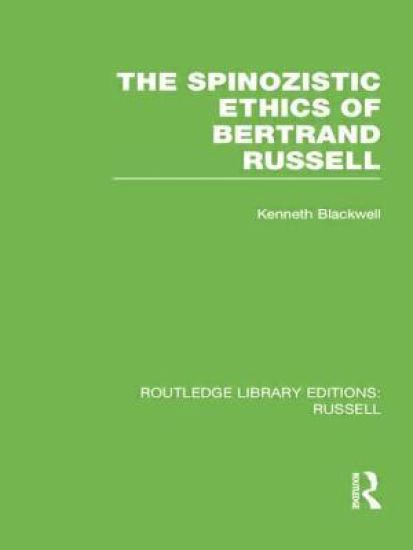
Bertrand Russell’s professional philosophical reputation rests mainly on his mathematical logic and theory of knowledge. In this study, first published in 1985, however, Kenneth Blackwell considers Russell’s writings on ethics and metaethics and uncovers the conceptual unity in Russell’s normative ethic. He traces that unity to the influence of Spinoza’s central ethical concept, the ‘intellectual love of God’, and then evaluates the ethic which he terms ‘impersonal self-enlargement’. The introduction discusses the metaethical background to Russell’s ethic and the difficulties inherent in Russell’s view that ethical knowledge is not possible. The first section then examines Russell’s writings on Spinoza from 1894 to 1964, dividing them into three periods, the second part analyzes Russell’s two interpretations of the main concept, traces 'impersonal self-enlargement' in Russell’s own ethical writings, and evaluates the ethic in relation to other ethical theories and on its own merits as a ‘way of living’.This book provides a foundation for a positive re-evaluation of Russell’s status in the major philosophical field of ethics and will be welcomed by students of moral philosophy as well as those interested in Bertrand Russell’s works.
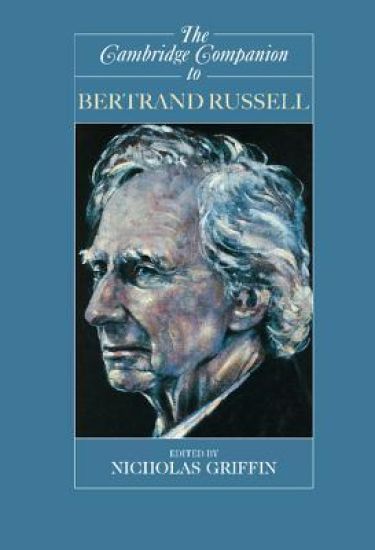
The Cambridge Companion to Bertrand Russell
Cambridge University Press
2003
sidottu
Bertrand Russell ranks as one of the giants of twentieth-century philosophy. Through his books, journalism, correspondence and political activity he exerted a profound influence on modern thought. This companion centers on Russell's contributions to modern philosophy and, therefore, concentrates on the early part of his career. There are chapters on Russell's contributions to the foundations of mathematics, and on his development of logical methods in philosophy and their application to such fields as epistemology, metaphysics and the philosophy of language. The intellectual background to his work is covered, as is his engagement with such contemporaries as Frege and G. E. Moore. The final chapter considers Russell as a moral philosopher. New readers will find this the most convenient and accessible guide to Russell available. Advanced students and specialists will find a conspectus of recent developments in the interpretation of Russell.
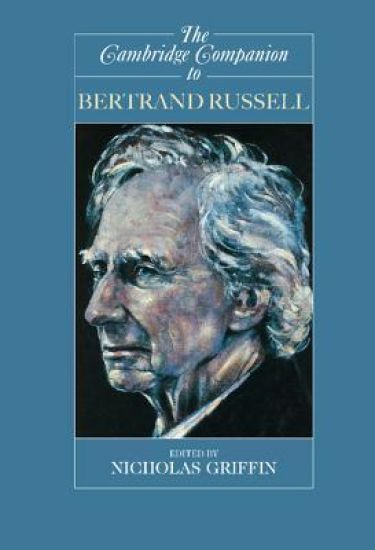
The Cambridge Companion to Bertrand Russell
Cambridge University Press
2003
pokkari
Bertrand Russell ranks as one of the giants of twentieth-century philosophy. Through his books, journalism, correspondence and political activity he exerted a profound influence on modern thought. This companion centers on Russell’s contributions to modern philosophy and, therefore, concentrates on the early part of his career. There are chapters on Russell’s contributions to the foundations of mathematics, and on his development of new logical methods in philosophy and their application to such fields as epistemology, metaphysics and the philosophy of language. The intellectual background to his work is covered, as is his engagement with such contemporaries as Frege and G. E. Moore. The final chapter considers Russell as a moral philosopher. New readers will find this the most convenient and accessible guide to Russell available. Advanced students and specialists will find a conspectus of recent developments in the interpretation of Russell.

The Steamboat Bertrand and Missouri River Commerce
Ronald R. Switzer
University of Oklahoma Press
2015
nidottu
On April 1, 1865, the steamboat Bertrand, a sternwheeler bound from St. Louis to Fort Benton in Montana Territory, hit a snag in the Missouri River and sank twenty miles north of Omaha. The crew removed only a few items before the boat was silted over. For more than a century thereafter, the Bertrand remained buried until it was discovered by treasure hunters, its cargo largely intact. This book categorizes some 300,000 artifacts recovered from the Bertrand in 1968, and also describes the invention, manufacture, marketing, distribution, and sale of these products and traces their route to the frontier mining camps of Montana Territory.The ship and its contents are a time capsule of mid-nineteenth-century America, rich with information about the history of industry, technology, and commerce in the Trans-Missouri West. In addition to enumerating the items the boat was transporting to Montana, and offering a photographic sample of the merchandise, Switzer places the Bertrand itself in historical context, examining its intended use and the technology of light-draft steam-driven river craft. His account of steamboat commerce provides multiple insights into the industrial revolution in the East, the nature and importance of Missouri River commerce in the mid-1800s, and the decline in this trade after the Civil War.Switzer also introduces the people associated with the Bertrand. He has unearthed biographical details illuminating the private and social lives of the officers, crew members, and passengers, as well as the consignees to whom the cargo was being shipped. He offers insight into not only the passengers' reasons for traveling to the frontier mining camps of Montana Territory, but also the careers of some of the entrepreneurs and political movers and shakers of the Upper Missouri in the 1860s. This unique reference for historians of commerce in the American West will also fascinate anyone interested in the technology and history of riverine transport.
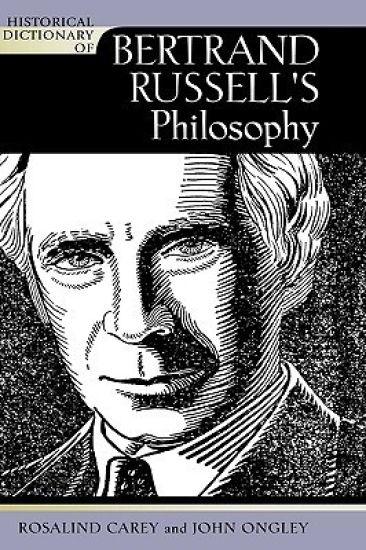
Historical Dictionary of Bertrand Russell's Philosophy
Rosalind Carey; John Ongley
Scarecrow Press
2009
sidottu
Academic philosopher, logician, public intellectual, educator, political activist, and freethinker, Bertrand Russell was and remains a colossus. No other single philosopher in the last 200 years can be said to have created so much and influenced so many. His Principia Mathematica, written with A. N. Whitehead, ranks as one of the greatest books on logic since Aristotle. His philosophical work on language, meaning, logic, mind, and metaphysics formed the basis of 20th-century philosophy. Russell was active in numerous political movements of liberation and peace, and his popular writings, including the best-selling History of Western Philosophy, won the Nobel prize in literature in 1950. Historical Dictionary of Bertrand Russell's Philosophy offers a comprehensive, current guide to the many facets of Russell's work. Through its chronology, introductory essay, bibliography, and hundreds of cross-referenced dictionary entries on concepts, people, works, and technical terms, Russell's impact on philosophy and related fields is made accessible to the reader in this must-have reference.