Kirjahaku
Etsi kirjoja tekijän nimen, kirjan nimen tai ISBN:n perusteella.
1000 tulosta hakusanalla Cristina Contilli
A History of Romanian Theatre from Communism to Capitalism analyses the last three decades of Romanian theatre and connects it to the international stage. Cristina Modreanu questions the relationship between artists and power, both before 1989, behind the Iron Curtain, and in the current global political context, with nationalism manifesting itself in Eastern Europe, as seen in the critical work of Romanian theatre makers. This study covers the complex cases of theatre makers such as Lucian Pintilie, Liviu Ciulei and Andrei ?erban, who built their international careers in exile, and the most innovative Romanian artists of today, such as Silviu Purcarete, Mihai Maniutiu, Gianina Carbunariu, Radu Afrim, and Bogdan Georgescu, who reached the status of transglobal artists.Filling a considerable gap in Romanian theatre discourse, this book will be of a great interest to students and scholars of contemporary theatre and history.
The first edition of Exercises in Programming Style was honored as an ACM Notable Book and praised as "The best programming book of the decade." This new edition retains the same presentation but has been upgraded to Python 3, and there is a new section on neural network styles.Using a simple computational task (term frequency) to illustrate different programming styles, Exercises in Programming Style helps readers understand the various ways of writing programs and designing systems. It is designed to be used in conjunction with code provided on an online repository. The book complements and explains the raw code in a way that is accessible to anyone who regularly practices the art of programming. The book can also be used in advanced programming courses in computer science and software engineering programs.The book contains 40 different styles for writing the term frequency task. The styles are grouped into ten categories: historical, basic, function composition, objects and object interactions, reflection and metaprogramming, adversity, data-centric, concurrency, interactivity, and neural networks. The author states the constraints in each style and explains the example programs. Each chapter first presents the constraints of the style, next shows an example program, and then gives a detailed explanation of the code. Most chapters also have sections focusing on the use of the style in systems design as well as sections describing the historical context in which the programming style emerged.
Cristina Archetti started researching childlessness after being diagnosed with "unexplained infertility". She soon discovered that, although involuntary childlessness affects an increasing number of women and men across the world, this topic is shrouded taboo and shame. This book is both a first-person reflection about the existential questions posed by involuntary childlessness and a readable account of the way the silence surrounding this topic is socially and politically constructed.Revealing the invisible mechanisms that, from the microscopic details of everyday life to policy, make up the structure of silence around childlessness, Archetti demonstrates what it means not to have children in a society that is organized around families. Through a prose that mixes analysis, excerpts of interviews, media fragments, and evocative writing, she develops a new language of feeling-in-the-body fit for the twenty-first century and exposes the devastating effects infertility has on relationships, identity, health and well-being, in societies that fetishize parenthood.Childlessness in the Age of Communication draws upon a range of disciplines and fields including sociology, health, gender and sexuality studies, communication, politics and anthropology. It is a book for all those interested in childlessness and innovative qualitative research methodologies.The Open Access version of this book, available at http://www.taylorfrancis.com, has been made available under a Creative Commons [Attribution-Non Commercial-No Derivatives (CC-BY-NC-ND)] 4.0 license.
This book shows how objects can create new linguistic and cultural orders, spotlighting the ways in which everyday collections help make the world anew by rearranging its materiality and how multilingual speakers make meanings without words.Adopting an innovative approach to intercultural research drawing on work from visual and multisensorial ethnography, Ros i Solé critically reflects on what we know as interculturality by going beyond the verbal and the more-than-human to understand languages and cultures. This book expands the meaning of interculturality by seeing it as the result of the relations between people, places, and materiality. Using everyday multilingual artefacts such as clothes, cookie-cutters, LPs, books, and pens, it presents a new semiotic multilingual landscape where the intercultural is closely connected to the ground, and it is felt, rehearsed, and re-enacted through the stories and the memories contained in multilingual objects.This book will be of particular interest to students and scholars in intercultural communication, multilingualism, language education, and applied linguistics.
ChicaNerds in Chicana Young Adult Literature analyzes novels by the acclaimed Chicana YA writers Jo Ann Yolanda Hernández, Isabel Quintero, Ashley Hope Pérez, Erika Sánchez, Guadalupe García McCall, and Patricia Santana. Combining the term "Chicana" with "nerd," Dr. Herrera coins the term "ChicaNerd" to argue how the young women protagonists in these novels voice astute observations of their identities as nonwhite teenagers, specifically through a lens of nerdiness—a reclamation of brown girl self-love for being a nerd. In analyzing these ChicaNerds, the volume examines the reclamation and powerful acceptance of one’s nerdy Chicana self. While popular culture and mainstream media have shaped the well-known figure of the nerd as synonymous with white maleness, Chicana YA literature subverts the nerd stereotype through its negation of this identity as always white and male. These ChicaNerds unite their burgeoning sociopolitical consciousness as young nonwhite girls with their "nerdy" traits of bookishness, math and literary intelligence, poetic talents, and love of learning. Combining the sociopolitical consciousness of Chicanisma with one aligned to the well-known image of the "nerd," ChicaNerds learn to navigate the many complicated layers of coming to an empowered declaration of themselves as smart Chicanas.
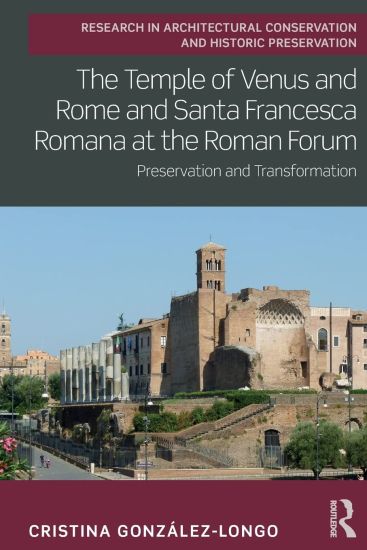
The Temple of Venus and Rome and Santa Francesca Romana at the Roman Forum
Cristina González-Longo
TAYLOR FRANCIS LTD
2023
nidottu
This book examines the influence of architectural design in the conservation of historic buildings by discussing in detail an important building complex in Rome: the Temple of Venus and Rome, the monastery of Santa Maria Nova and the church of Santa Francesca Romana. As the most complete site in the Roman Forum that has reached our times with a rich architectural stratification almost intact, it is a clear product of continuous preservation and transformation and it has not been studied in its complexity until now. The Temple of Venus and Rome and Santa Francesca Romana at the Roman Forum unravels the original designs and the subsequent interventions, including Giacomo Boni’s pioneering conservation of the monastery, carried out while excavating the Roman Forum in the early twentieth century. The projects are discussed in context to show their significance and the relationships between architects and patrons. Through its interdisciplinary focus on architectural design, conservation, archaeology, history and construction, this study is an ideal example for scholars, students and architects of how to carry out research in architectural conservation.
Audiovisual and Digital Ethnography
Cristina Grasseni; Bart Barendregt; Erik de Maaker; Federico De Musso; Andrew Littlejohn; Marianne Maeckelbergh; Metje Postma; Mark R. Westmoreland
Routledge
2021
sidottu
Audiovisual and Digital Ethnography is a state-of-the-art introduction to this dynamic and growing subject. The authors explain its fundamental aspects in a clear and systematic way. The chapters cover topics including: learning to see and listen in the field and the role of sensory attention the mediation of the senses doing anthropological fieldwork with video observational filmmaking ethnographic drawing multimodal anthropology digital ethnography interactive documentary the ethics and management of audiovisual and digital data. The result is a much-needed, up-to-date and concise guide to both the fundamental skills required for audiovisual and digital ethnographic production and the essential theoretical knowledge relating to this. It will be particularly useful for students and scholars in the fields of Anthropology, Sociology, Cultural Studies, Social Sciences, Media, Design, Art Practice and Sound Studies.
Audiovisual and Digital Ethnography
Cristina Grasseni; Bart Barendregt; Erik de Maaker; Federico De Musso; Andrew Littlejohn; Marianne Maeckelbergh; Metje Postma; Mark R. Westmoreland
Routledge
2021
nidottu
Audiovisual and Digital Ethnography is a state-of-the-art introduction to this dynamic and growing subject. The authors explain its fundamental aspects in a clear and systematic way. The chapters cover topics including: learning to see and listen in the field and the role of sensory attention the mediation of the senses doing anthropological fieldwork with video observational filmmaking ethnographic drawing multimodal anthropology digital ethnography interactive documentary the ethics and management of audiovisual and digital data. The result is a much-needed, up-to-date and concise guide to both the fundamental skills required for audiovisual and digital ethnographic production and the essential theoretical knowledge relating to this. It will be particularly useful for students and scholars in the fields of Anthropology, Sociology, Cultural Studies, Social Sciences, Media, Design, Art Practice and Sound Studies.
The documents contained in Reading Mistress Elizabeth Bourne: Marriage, Separation, and Legal Controversies tell a story of Mistress Bourne’s petition for divorce, its resolution, and the ongoing dispute between Mistress Bourne and her husband about their marriage and separation, and subsequently between Mistress Bourne and Sir John Conway both for custody of her daughters and her financial security. The letters capture the contradiction between married women’s official legal limitations and the often messy and complicated avenues of redress available to them. Elizabeth’s narratives and desire for divorce challenge literary representations of patient endurance where appropriate feminine behavior restores a husband’s devotion. The Bourne case offers a unique set of documents heretofore unavailable except through the British Library, National Archives’ State Papers, and Hatfield House. Reading Mistress Elizabeth Bourne is tremendously important to early modern scholars and our knowledge about and view of women’s negotiations for legal autonomy in the sixteenth century.
Winner of the ASTR Translation Prize 2023. Winner of CAMWS' 2024 Bolchazy Pedagogy Award.This book brings to English readers, in its entirety for the first time, a translation of José Watanabe’s Antígona, accompanied by the original Spanish text and critical essays.The lack of availability in English has resulted in the absence of Antígona from important Anglophone studies devoted specifically to the reception of ancient Greek tragedy in the Americas. Pérez Díaz's translation fills this gap. The introduction provides the performative, political, and historical contexts in which the text was written in collaboration with the actress Teresa Ralli, from the Peruvian theater group Yuyachkani, who also originally performed it. Following the bilingual text, a critical essay provides an analysis of textual aspects of Antígona that have been disregarded, situating it in relation to Sophocles' Antigone and in conversation with relevant moments of the vast traditions of reception of the Greek tragedy. An appendix briefly surveys some notable productions of the play throughout Latin America.This comprehensive volume provides an invaluable resource for readers interested in José Watanabe's work, students and scholars working on classical reception and Latin American literature and theatre, as well as theatre practitioners.
ChicaNerds in Chicana Young Adult Literature analyzes novels by the acclaimed Chicana YA writers Jo Ann Yolanda Hernández, Isabel Quintero, Ashley Hope Pérez, Erika Sánchez, Guadalupe García McCall, and Patricia Santana. Combining the term "Chicana" with "nerd," Dr. Herrera coins the term "ChicaNerd" to argue how the young women protagonists in these novels voice astute observations of their identities as nonwhite teenagers, specifically through a lens of nerdiness—a reclamation of brown girl self-love for being a nerd. In analyzing these ChicaNerds, the volume examines the reclamation and powerful acceptance of one’s nerdy Chicana self. While popular culture and mainstream media have shaped the well-known figure of the nerd as synonymous with white maleness, Chicana YA literature subverts the nerd stereotype through its negation of this identity as always white and male. These ChicaNerds unite their burgeoning sociopolitical consciousness as young nonwhite girls with their "nerdy" traits of bookishness, math and literary intelligence, poetic talents, and love of learning. Combining the sociopolitical consciousness of Chicanisma with one aligned to the well-known image of the "nerd," ChicaNerds learn to navigate the many complicated layers of coming to an empowered declaration of themselves as smart Chicanas.
How does a woman become a whore? What are the discursive dynamics making a woman a whore? And, more importantly, what are the discursive mechanics of unmaking? In Women and Shakespeare’s Cuckoldry Plays: Shifting Narratives of Marital Betrayal, Cristina León Alfar pursues these questions to tease out familiar cultural stories about female sexuality that recur in the form of a slander narrative throughout William Shakespeare’s work. She argues that the plays stage a structure of accusation and defense that unravels the authority of husbands to make and unmake wives. While men’s accusations are built on a foundation of political, religious, legal, and domestic discourses about men’s superiority to, and rule over, women, whose weaker natures render them perpetually suspect, women’s bonds with other women animate defenses of virtue and obedience, fidelity and love, work loose the fabric of patrilineal power that undergirds masculine privileges in marriage, and signify a discursive shift that constitutes the site of agency within a system of oppression that ought to prohibit such agency. That women’s agency in the early modern period must be tied to the formations of power that officially demand their subjection need not undermine their acts. In what Alfar calls Shakespeare’s cuckoldry plays, women’s rhetoric of defense is both subject to the discourse of sexual honor and finds a ground on which to “shift it” as women take control of and replace sexual slander with their own narratives of marital betrayal.
An enthralling historical novel of immigration, courage and first love from an award-winning New Zealand author. Eloise and her family must leave Cornwall on a treacherous sea journey to start a new life in 1870s colonial New Zealand. On the ship across, Eloise meets Lars, a Norwegian labourer travelling below decks, and their lives begin to intertwine. When her brother disappears, her father leaves and the family are left to fend for themselves in their new home, Eloise must find the strength to stand up for what she believes in and the people she loves.
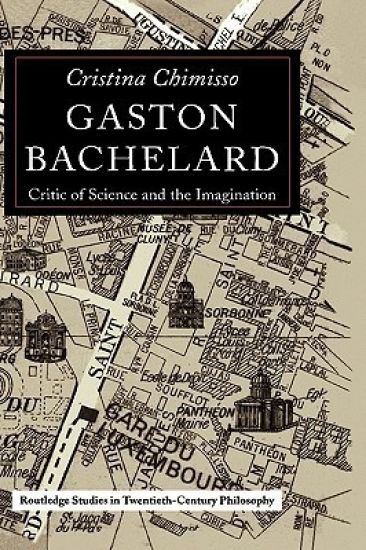
In this new study, Cristina Chimisso explores the work of the French Philosopher of Science, Gaston Bachelard (1884-1962) by situating it within French cultural life of the first half of the century. The book is introduced by a study - based on an analysis of portraits and literary representations - of how Bachelard's admirers transformed him into the mythical image of the Philosopher, the Patriarch and the 'Teacher of Happiness'. Such a projected image is contrasted with Bachelard's own conception of philosophy and his personal pedagogical and moral ideas.This pedagogical orientation is a major feature of Bachelard's texts, and one which deepens our understanding of the main philosophical arguments. The primary thesis of the book is based on the examination of the French educational system of the time and of French philosophy taught in schools and conceived by contemporary philosophers. This approach also helps to explain Bachelard's reception of psychoanalysis and his mastery of modern literature. Gaston Bachelard: Critic of Science and the Imagination thus allows for a new reading of Bachelard's body of work, whilst at the same time providing an insight into twentieth century French culture.
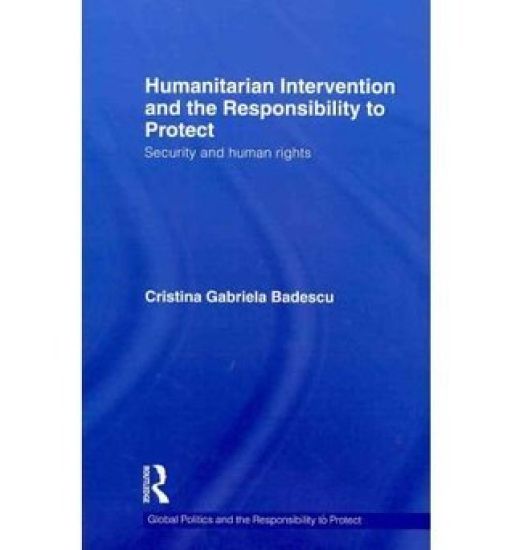
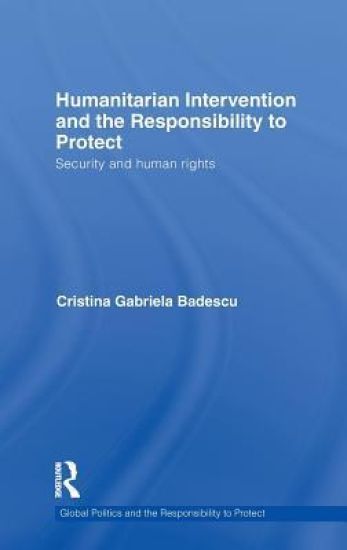
This book explores attempts to develop a more acceptable account of the principles and mechanisms associated with humanitarian intervention, which has become known as the ‘Responsibility to Protect’ (R2P). Cases of genocide and mass violence have raised endless debates about the theory and practice of humanitarian intervention to save innocent lives. Since the humanitarian tragedies in Rwanda, Burundi, Bosnia, Kosovo and elsewhere, states have begun advocating a right to undertake interventions to stop mass violations of human rights from occurring. Their central concern rests with whether the UN’s current regulations on the use of force meet the challenges of the post-Cold War world, and in particular the demands of addressing humanitarian emergencies. International actors tend to agree that killing civilians as a necessary part of state formation is no longer acceptable, nor is standing by idly in the face of massive violations of human rights. And yet, respect for the sovereign rights of states remains central among the ordering principles of the international community. How can populations affected by egregious human rights violations be protected? How can the legal constraints on the use of force and respect for state sovereignty be reconciled with the international community’s willingness and readiness to take action in such instances? And more importantly, how can protection be offered when the Security Council, which is responsible for authorizing the use of force when threats to international peace and security occur, is paralyzed? The author addresses these issues, arguing that R2P is the best framework available at present to move the humanitarian intervention debate forward.This book will be of interest to students of the responsibility to protect, war and conflict studies, human security, international organisations, security studies and IR in general.
Basic Portuguese: A Grammar and Workbook comprises an accessible reference grammar and related exercises in a single volume.Twenty units cover the core material which students can expect to encounter in their first year of learning Portuguese. Grammar points are followed by examples and exercises which allow students to reinforce and consolidate their learning.Clearly presented and user-friendly, Basic Portuguese provides readers with a thorough grounding in the fundamentals of Portuguese grammar.