Kirjojen hintavertailu. Mukana 11 342 296 kirjaa ja 12 kauppaa.

Kirjahaku

Etsi kirjoja tekijän nimen, kirjan nimen tai ISBN:n perusteella.

1000 tulosta hakusanalla Darrell Line

Sekenre

Sekenre

Darrell Schweitzer

Wildside Press
2004
sidottu
A self-standing companion to Darrell Schweitzer's British Fantasy Award-nominated The Mask of the Sorcerer, the present volume collects all the Sekenre stories, which proved very popular when originally published in Weird Tales, Interzone, Adventures in Sword & Sorcery, and elsewhere.
Sekenre

Sekenre

Darrell Schweitzer

Wildside Press
2004
pokkari
A self-standing companion to Darrell Schweitzer's British Fantasy Award-nominated The Mask of the Sorcerer, the present volume collects all the Sekenre stories, which proved very popular when originally published in Weird Tales, Interzone, Adventures in Sword & Sorcery, and elsewhere.
Weird Tales 300 (Spring 1991)

Weird Tales 300 (Spring 1991)

Darrell Schweitzer; Robert Bloch; Henry Kuttner

Wildside Press
1991
pokkari
The special 300th issue of Weird Tales honors grandmaster Robert Bloch with a special issue dedicated to him. Includes a previously unpublished collaboration between Bloch and Henry Kuttner, plus contributions from Ray Bradbury, Lawrence Watt-Evans. All artwork is by Featured Artist Gahan Wilson.
Sukie Sticky Notes

Sukie Sticky Notes

Darrell Gibbs; Julia Harding

Chronicle Books
2007
muu
This is a set of sticky note pads (25 sheets each of eight designs) adorned with the fresh and playful illustrations from the innovative design team Sukie. Other "S07 Sukie" titles include a stationery box and an address book.
Digital Medicine

Digital Medicine

Darrell M. West; Edward Alan Miller

Brookings Institution
2010
nidottu
Information technology has dramatically changed our lives in areas ranging from commerce and entertainment to voting. Now, policy advocates and government officials hope to bring the benefits of enhanced information technology to health care. Already, consumers can access a tremendous amount of medical information online. Some physicians encourage patients to use email or web messaging to manage simple medical issues. Increasingly, health care products can be purchased electronically.Yet the promise of e-health remains largely unfulfilled. Digital Medicine investigates the factors limiting digital technology's ability to remake health care. It explores the political, social, and ethical challenges presented by online health care, as well as the impact that racial, ethnic, and other disparities are having on the e-health revolution. It examines the accessibility of health-related websites for different populations and asks how we can close access gaps and ensure the reliability and trustworthiness of the information presented online.Darrell West and Edward Miller use multiple sources, including original survey research and website analysis, to study the content, sponsorship status, and public usage of health care-related websites, as well as the relationship between e-health utilization and attitudes about health care in the United States. They also explore the use of health information technology in other countries. The result is an important contribution to our understanding of health information innovation in America and around the world.
Brain Gain

Brain Gain

Darrell M. West

Brookings Institution
2011
nidottu
"Many of America's greatest artists, scientists, investors, educators, and entrepreneurs have come from abroad. Rather than suffering from the ""brain drain"" of talented and educated individuals emigrating, the United States has benefited greatly over the years from the ""brain gain"" of immigration. These gifted immigrants have engineered advances in energy, information technology, international commerce, sports, arts, and culture. To stay competitive, the United States must institute more of an open-door policy to attract unique talents from other nations. Yet Americans resist such a policy despite their own immigrant histories and the substantial social, economic, intellectual, and cultural benefits of welcoming newcomers. Why?In Brain Gain, Darrell West asserts that perception or ""vision"" is one reason reform in immigration policy is so politically difficult. Public discourse tends to emphasize the perceived negatives. Fear too often trumps optimism and reason. And democracy is messy, with policy principles that are often difficult to reconcile.The seeming irrationality of U.S. immigration policy arises from a variety of thorny and interrelated factors: particularistic politics and fragmented institutions, public concern regarding education and employment, anger over taxes and social services, and ambivalence about national identity, culture, and language. Add to that stew a myopic (or worse) press, persistent fears of terrorism, and the difficulties of implementing border enforcement and legal justice.West prescribes a series of reforms that will put America on a better course and enhance its long-term social and economic prosperity. Reconceptualizing immigration as a way to enhance innovation and competitiveness, the author notes, will help us find the next Sergey Brin, the next Andrew Grove, or even the next Albert Einstein."
Digital Schools

Digital Schools

Darrell M. West

Brookings Institution
2012
sidottu
"Nearly a century ago, famed educator John Dewey said that ""if we teach today's students as we taught yesterday's, we rob them of tomorrow."" That wisdom resonates more strongly than ever today, and that maxim underlies this insightful look at the present and future of education in the digital age.As Darrell West makes clear, today's educational institutions must reinvent themselves to engage students successfully and provide them with the skills needed to compete in an increasingly global, technological, and online world. Otherwise the American education system will continue to fall woefully short in its mission to prepare the population to survive and thrive in a rapidly changing world.West examines new models of education made possible by enhanced information technology, new approaches that will make public education in the post-industrial age more relevant, efficient, and ultimately more productive. Innovative pilot programs are popping up all over the nation, experimenting with different forms of organization and delivery systems. Digital Schools surveys this promising new landscape, examining in particular personalized learning; realtime student assessment; ways to enhance teacher evaluation; the untapped potential of distance learning; and the ways in which technology can improve the effectiveness of special education and foreign language instruction. West illustrates the potential contributions of blogs, wikis, social media, and video games and augmented reality in K–12 and higher education.Technology by itself will not remake education. But if today's schools combine increased digitization with needed improvements in organization, operations, and culture, we can overcome current barriers, produce better results, and improve the manner in which schools function. And we can get back to teaching for tomorrow, rather than for yesterday."
The Next Wave

The Next Wave

Darrell M. West

Brookings Institution
2011
nidottu
"The digital revolution is in full force but many public and private sector leaders are stymied: How can they maximize the full potential of digital technology? This hesitancy puts a brake on the transformational power of digital technology and means private companies and governmental bodies fall well behind other digital pioneers.Darrell West focuses on the next wave of technologies and how they can further enhance U.S. social and political innovation. West champions exploiting technological advances to help organizations become faster, smarter, and more efficient. Consumers can deploy new digital technology to improve health care, gain access to education, learn from the news media, and check public sector performance. New storage platforms such as high-speed broadband, mobile communications, and cloud computing enable and improve both social and economic development. However, to gain these benefits, policymakers must recognize the legitimacy of public fears about technology and the privacy and security dangers posed by the Internet. Their goal must be to further innovation and investment while also protecting basic social and individual values.West argues that digital technology innovation is consistent in many ways with personal and social values; people can deploy digital technology to improve participation and collaboration, and political leaders can work with the private sector to stimulate a flowering of innovation in a variety of policy areas."
Digital Schools

Digital Schools

Darrell M. West

Brookings Institution
2013
nidottu
"Nearly a century ago, famed educator John Dewey said that ""if we teach today's students as we taught yesterday's, we rob them of tomorrow."" That wisdom resonates more strongly than ever today, and that maxim underlies this insightful look at the present and future of education in the digital age.As Darrell West makes clear, today's educational institutions must reinvent themselves to engage students successfully and provide them with the skills needed to compete in an increasingly global, technological, and online world. Otherwise the American education system will continue to fall woefully short in its mission to prepare the population to survive and thrive in a rapidly changing world.West examines new models of education made possible by enhanced information technology, new approaches that will make public education in the post-industrial age more relevant, efficient, and ultimately more productive. Innovative pilot programs are popping up all over the nation, experimenting with different forms of organization and delivery systems. Digital Schools surveys this promising new landscape, examining in particular personalized learning; realtime student assessment; ways to enhance teacher evaluation; the untapped potential of distance learning; and the ways in which technology can improve the effectiveness of special education and foreign language instruction. West illustrates the potential contributions of blogs, wikis, social media, and video games and augmented reality in K–12 and higher education.Technology by itself will not remake education. But if today's schools combine increased digitization with needed improvements in organization, operations, and culture, we can overcome current barriers, produce better results, and improve the manner in which schools function. And we can get back to teaching for tomorrow, rather than for yesterday."
Billionaires

Billionaires

Darrell M. West

Brookings Institution
2014
sidottu
The top one percent own about one-third of the assets in America and 40 percent of assets around the world. This concentration of financial resources in many countries gives the ultra-rich extraordinary influence over elections, public policy, and governance.In his new book, Darrell M. West analyzes the growing political activism of billionaires and how they have created more activist forms of politics and philanthropy based on their net worth. With this “wealthification” of politics and society, it is important to understand how this concentration of wealth affects system performance as well as social and economic opportunity.Through personal interactions and rich anecdotes, West takes us inside the world of the super-wealthy through a balanced and insightful analysis of U.S. billionaires such as Sheldon Adelson, David and Charles Koch, George Soros, Michael Bloomberg, Bill Gates, Peter Thiel, Donald Trump and Tom Steyer. And looking abroad, West analyzes the billionaires who have run for office in nations such as Austria, Australia, France, Georgia, India, Italy, Russia, Thailand, and the Ukraine. From oligarchs in Russia and Eastern Europe to princelings in China, tycoons raise important questions about political influence, transparency, accountability, and government performance. This book argues that countries need policies that promote better transparency, governance, and opportunity.
Billionaires

Billionaires

Darrell M. West

Brookings Institution
2014
nidottu
"Meet the Billionaires: the 1,645 men and women who control a massive share of global assets worth $6.5 trillion. Darrell West reveals what the other 99.99998% of us need to know.With rich anecdotes and personal narratives, West goes inside the world of the ultra wealthy. Meet U.S. billionaires such as Sheldon Adelson, Michael Bloomberg, David and Charles Koch, George Soros, Tom Steyer, and Donald Trump—as well as international billionaires from around the globe.The growing political engagement of this small supra-wealthy group raises important questions about influence, transparency, and government performance, and West lays bare the wealthification of politics, including:• How billionaires can block appointments and legislation they don't like• Why the supra-wealthy moved into policy advocacy and referenda at the state level• Why billionaires run for office in more than a dozen countries around the world"
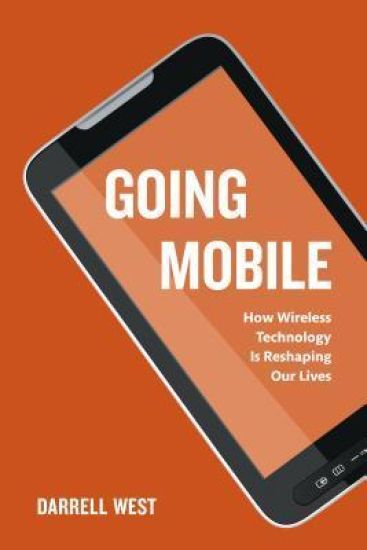
Going Mobile

Going Mobile

Darrell M. West

Brookings Institution
2014
nidottu
"The world is going mobile at an astounding pace. Estimates show 80 percent of global Internet access will take place through mobile devices by 2016. Smartphones, tablets, and handheld devices have reshaped communications, the global economy, and the very way in which we live. The revolution is an electronic nirvana: for the first time in human history we have sophisticated digital applications to help us learn, access financial and health care records, connect with others, and build businesses. But the one trillion dollar mobile industry is still relatively young. Leaders in both the public and private sectors need to figure out how to apply mobile technologies or mobile devices to optimize education, health care, public safety, disaster preparedness, and economic development. And the ever-expanding mobile frontier presents new challenges to law, policy, and regulations and introduces new tensions; one person's idea of cautious deliberation can be another's idea of a barrier to innovation.In Going Mobile, Darrell M. West breaks down the mobile revolution and shows how to maximize its overall benefits in both developed and emerging markets.Contents1. The Emergence of Mobile Technology2. Driving Global Entrepreneurship3. Alleviating Poverty4. Invention and the Mobile Economy5. Mobile Learning6. Improving Health Care7. Medical Devices and Sensors8. Shaping Campaigns and Public Outreach9. Disaster Relief and Public Safety10. Looking Ahead"
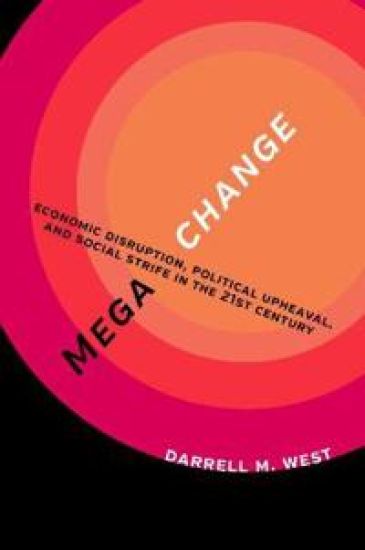
MegaChange

MegaChange

Darrell M. West

Brookings Institution
2016
nidottu
Big, unexpected changes are here to staySlow, incremental change has become a relic of the past. Today's shifts come fast and big. They are what Darrell West calls megachanges, in which dramatic disruptions in trends and policies occur on a regular basis.Domestically, we can see megachange at work in the new attitudes and policies toward same-sex marriage, health care, smoking, and even the widespread legalization of marijuana use. Globally, we have seen the extraordinary rise and then collapse of the Arab Spring, the emergence of religious zealotry, the growing influence of non-state actors, the spread of ISIS-fomented terrorism, the rise of new economic and political powers in Asia, and the fracturing of once-stable international alliances.Long-held assumptions have been shattered, and the proliferation of unexpected events is confounding experts in the United States and around the globe. Many of the social and political institutions that used to anchor domestic and international politics have grown weak or are in need to dramatic reform. What to do? West says that we should alter our expectations about the speed and magnitude of political and social change. We also need to recognize that many of our current governing processes are geared to slow deliberation and promote incremental change, not large-scale transformation. With megachange becoming the new normal, our domestic and global institutions must develop the ability to tackle the massive economic, political, and social shifts that we face.
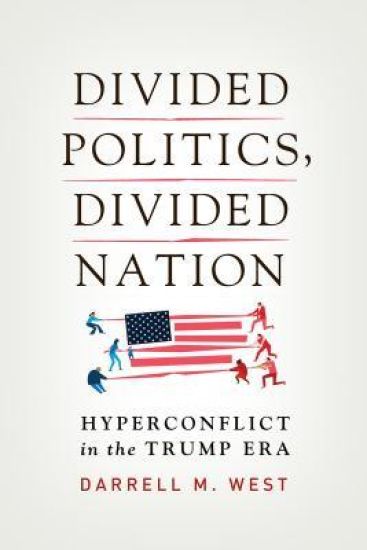
Divided Politics, Divided Nation

Divided Politics, Divided Nation

Darrell M. West

Brookings Institution
2019
sidottu
Why are Americans so angry with each other?The United States is caught in a partisan hyperconflict that divides politicians, communities—and even families. Politicians from the president to state and local office-holders play to strongly-held beliefs and sometimes even pour fuel on the resulting inferno. This polarization has become so intense that many people no longer trust anyone from a differing perspective.Drawing on his personal story of growing up as a fundamentalist Christian on a dairy farm in rural Ohio, then as an academic in the heart of the liberal East Coast establishment, Darrell West analyzes the economic, cultural, and political aspects of polarization. He takes advantage of his experiences inside both conservative and liberal camps to explain the views of each side and offer insights into why each is angry with the other.West argues that societal tensions have metastasized into a dangerous tribalism that seriously threatens U.S. democracy. Unless people can bridge these divisions and forge a new path forward, it will be impossible to work together, maintain a functioning democracy, and solve the country's pressing policy problems.
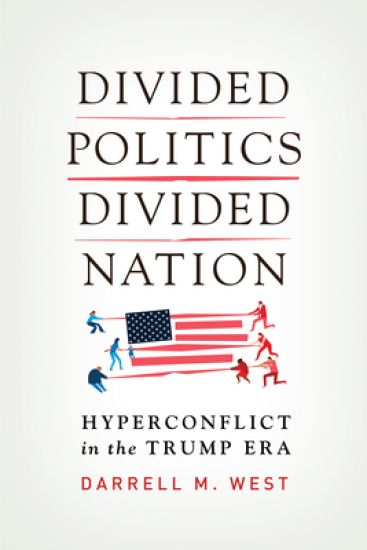
Divided Politics, Divided Nation

Divided Politics, Divided Nation

Darrell M. West

Brookings Institution
2020
nidottu
Why are Americans so angry with each other?The United States is caught in a partisan hyperconflict that divides politicians, communities—and even families. Politicians from the president to state and local office-holders play to strongly-held beliefs and sometimes even pour fuel on the resulting inferno. This polarization has become so intense that many people no longer trust anyone from a differing perspective.Drawing on his personal story of growing up as a fundamentalist Christian on a dairy farm in rural Ohio, then as an academic in the heart of the liberal East Coast establishment, Darrell West analyzes the economic, cultural, and political aspects of polarization. He takes advantage of his experiences inside both conservative and liberal camps to explain the views of each side and offer insights into why each is angry with the other.West argues that societal tensions have metastasized into a dangerous tribalism that seriously threatens U.S. democracy. Unless people can bridge these divisions and forge a new path forward, it will be impossible to work together, maintain a functioning democracy, and solve the country's pressing policy problems.
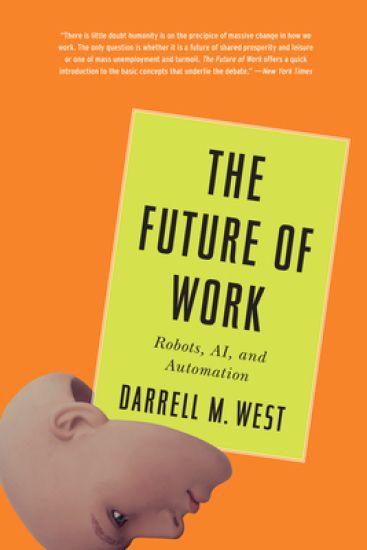
The Future of Work

The Future of Work

Darrell M. West

Brookings Institution
2019
pokkari
Looking for ways to handle the transition to a digital economy.Robots, artificial intelligence, and driverless cars are no longer things of the distant future. They are with us today and will become increasingly common in coming years, along with virtual reality and digital personal assistants.As these tools advance deeper into everyday use, they raise the question—how will they transform society, the economy, and politics? If companies need fewer workers due to automation and robotics, what happens to those who once held those jobs and don't have the skills for new jobs? And since many social benefits are delivered through jobs, how are people outside the workforce for a lengthy period of time going to earn a living and get health care and social benefits?Looking past today's headlines, political scientist and cultural observer Darrell M. West argues that society needs to rethink the concept of jobs, reconfigure the social contract, move toward a system of lifetime learning, and develop a new kind of politics that can deal with economic dislocations. With the U.S. governance system in shambles because of political polarization and hyper-partisanship, dealing creatively with the transition to a fully digital economy will vex political leaders and complicate the adoption of remedies that could ease the transition pain. It is imperative that we make major adjustments in how we think about work and the social contract in order to prevent society from spiraling out of control.This book presents a number of proposals to help people deal with the transition from an industrial to a digital economy. We must broaden the concept of employment to include volunteering and parenting and pay greater attention to the opportunities for leisure time. New forms of identity will be possible when the "job" no longer defines people's sense of personal meaning, and they engage in a broader range of activities. Workers will need help throughout their lifetimes to acquire new skills and develop new job capabilities. Political reforms will be necessary to reduce polarization and restore civility so there can be open and healthy debate about where responsibility lies for economic well-being.This book is an important contribution to a discussion about tomorrow—one that needs to take place today.
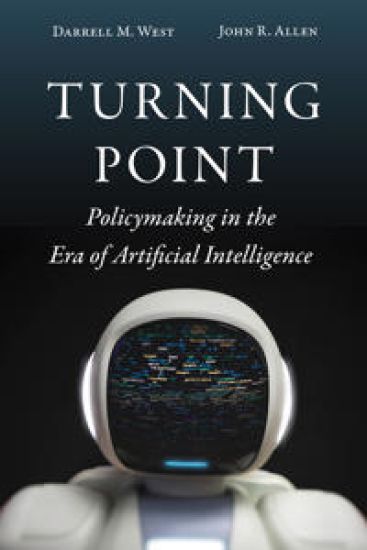
Turning Point

Turning Point

Darrell M. West; John R. Allen

Brookings Institution
2020
sidottu
Artificial Intelligence is here, today. How can society make the best use of it?Until recently, “artificial intelligence” sounded like something out of science fiction. But the technology of artificial intelligence, AI, is becoming increasingly common, from self-driving cars to e-commerce algorithms that seem to know what you want to buy before you do. Throughout the economy and many aspects of daily life, artificial intelligence has become the transformative technology of our time.Despite its current and potential benefits, AI is little understood by the larger public and widely feared. The rapid growth of artificial intelligence has given rise to concerns that hidden technology will create a dystopian world of increased income inequality, a total lack of privacy, and perhaps a broad threat to humanity itself.In their compelling and readable book, two experts at Brookings discuss both the opportunities and risks posed by artificial intelligence—and how near-term policy decisions could determine whether the technology leads to utopia or dystopia.Drawing on in-depth studies of major uses of AI, the authors detail how the technology actually works. They outline a policy and governance blueprint for gaining the benefits of artificial intelligence while minimizing its potential downsides.The book offers major recommendations for actions that governments, businesses, and individuals can take to promote trustworthy and responsible artificial intelligence. Their recommendations include: creation of ethical principles, strengthening government oversight, defining corporate culpability, establishment of advisory boards at federal agencies, using third-party audits to reduce biases inherent in algorithms, tightening personal privacy requirements, using insurance to mitigate exposure to AI risks, broadening decision-making about AI uses and procedures, penalizing malicious uses of new technologies, and taking pro-active steps to address how artificial intelligence affects the workforce.Turning Point is essential reading for anyone concerned about how artificial intelligence works and what can be done to ensure its benefits outweigh its harm.