

Kirjahaku
Etsi kirjoja tekijän nimen, kirjan nimen tai ISBN:n perusteella.
1000 tulosta hakusanalla Eric C. Wat
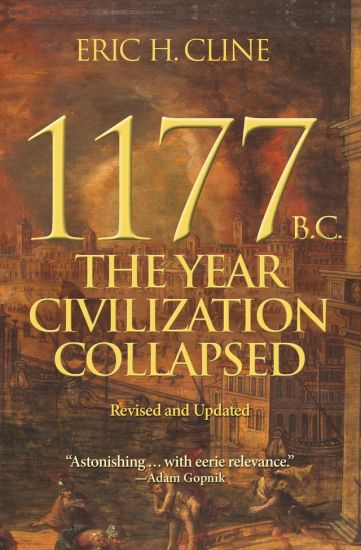
A bold reassessment of what caused the Late Bronze Age collapseIn 1177 B.C., marauding groups known only as the "Sea Peoples" invaded Egypt. The pharaoh's army and navy managed to defeat them, but the victory so weakened Egypt that it soon slid into decline, as did most of the surrounding civilizations. After centuries of brilliance, the civilized world of the Bronze Age came to an abrupt and cataclysmic end. Kingdoms fell like dominoes over the course of just a few decades. No more Minoans or Mycenaeans. No more Trojans, Hittites, or Babylonians. The thriving economy and cultures of the late second millennium B.C., which had stretched from Greece to Egypt and Mesopotamia, suddenly ceased to exist, along with writing systems, technology, and monumental architecture. But the Sea Peoples alone could not have caused such widespread breakdown. How did it happen?In this major new account of the causes of this "First Dark Ages," Eric Cline tells the gripping story of how the end was brought about by multiple interconnected failures, ranging from invasion and revolt to earthquakes, drought, and the cutting of international trade routes. Bringing to life the vibrant multicultural world of these great civilizations, he draws a sweeping panorama of the empires and globalized peoples of the Late Bronze Age and shows that it was their very interdependence that hastened their dramatic collapse and ushered in a dark age that lasted centuries.A compelling combination of narrative and the latest scholarship, 1177 B.C. sheds new light on the complex ties that gave rise to, and ultimately destroyed, the flourishing civilizations of the Late Bronze Age—and that set the stage for the emergence of classical Greece.
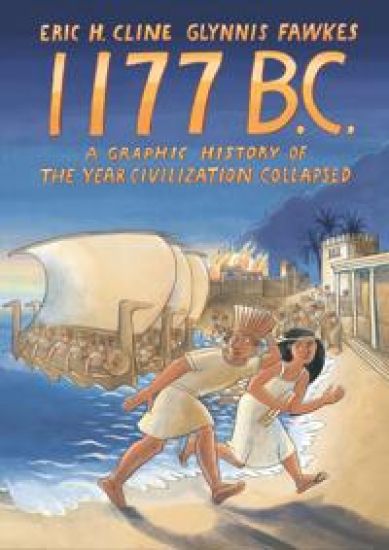
“1177 B.C. is a spectacular achievement—deftly adapted, beautifully drawn, and captivatingly colored by Glynnis Fawkes. . . . [She] doesn’t just bring history alive, she propels it across the page in an accessible, gripping way.”—Alison Bechdel, New York Times bestselling author of Fun HomeA beautiful, full-color graphic version of Eric Cline’s bestselling 1177 B.C., adapted by award-winning author-illustrator Glynnis FawkesEric Cline’s 1177 B.C. tells the story of one of history’s greatest mysteries: what caused the ancient civilizations of the Aegean and Eastern Mediterranean to collapse more than three thousand years ago, bringing the Late Bronze Age to an abrupt end? In this vivid and captivating full-color graphic adaptation of the landmark book, author-illustrator Glynnis Fawkes invites us to follow two young friends living in the aftermath of the cataclysm as they unravel why it happened—and reveal important lessons for today’s interconnected and vulnerable world.Pel, a member of the marauding Sea Peoples, and Shesha, an Egyptian scribe, visit the kingdoms of the Minoans, Mycenaeans, Hittites, Canaanites, Assyrians, and Egyptians to explore the calamities that brought them down. This graphic history depicts the people, events, art, architecture, and lands that Pel and Shesha encounter. We witness the Sea Peoples’ battles on land and sea, earthquakes on the Greek mainland, droughts and famine in Anatolia, invasions in north Syria, and possible rebellions in Canaan. Along the way, we also learn about the assassination of a Hittite prince traveling to marry an Egyptian queen, the sinking of a merchant ship laden with international goods, and the return of a pair of sandals to Crete by the Babylonian king Hammurabi.An entertaining adventure story, this dazzling comic is also historically accurate and enlightening, inviting readers of all ages to think about the surprising factors and theories that explain why societies, whether ancient or modern, die or survive when struck by catastrophes.

"I view this publication as essential reading for not only the C level executive but also anyone in the live events industry " Ken Sanders - President - FreemanIn Meeting at C-Level, Eric Rozenberg takes you through his twenty years of experience working with corporate management at Fortune 500 companies to help you discover the answer to one question...How can you harness the true power of face-to-face meetings?By discovering WHY you are holding the meeting in the first place Through compelling narrative and real-life examples from events held all over the world, Rozenberg shares his strategic approach and simple 7-step methodology for creating high-impact meetings that increase business performance.Take action to begin hosting face-to-face meetings that align your stakeholders, implement corporate strategy, engage your customers, and fully transform your business."It's just what this industry needed--and what should be required reading in all MBA and leadership programs." Alexandra L. Wagner, CMM - Chief Purpose Ambassador - SunTrust Bank"Through insightful, real-world examples, . . . Eric thoughtfully and repeatedly illustrates the value of not just how, but why to hold a meeting." Aaron Lee - CEO - Illuminati Studios, President of Entrepreneurs' Organization South Florida"Eric's ability to tie basic principles with storytelling is unique and extremely effective.I urge you to invest your time in reading this new book." Deborah Sexton - President and CEO - Professional Convention Management Association"Eric brings a new approach to aligning your meetings with your organization's objectives." Don Welsh - President and CEO - Destination Marketing Association International"This book will become required reading for C-level executives, directors, seasoned event professionals, and those choosing to pursue experiential marketing and event careers." Kevin G. Kirby - 2014-2015 Chairman of International Board of Directors of Meeting Professionals International (MPI), Former Head of Marketing and Sales at Hard Rock International"A must-read for commercial and communication leaders to know how to make meetings and events an investment instead of a cost." Fabrice Chouraqui - President - Novartis Pharmaceuticals USA"A cleverly written piece that uses a common-sense approach to solving important, complex business issues." Cindy D'Aoust - President and CEO - Cruise Lines International Association"I hope it becomes required reading in boardrooms globally." Carl Winston - Director - L. Robert Payne School of Hospitality and Tourism Management at San Diego State University

This work has been selected by scholars as being culturally important and is part of the knowledge base of civilization as we know it.This work is in the public domain in the United States of America, and possibly other nations. Within the United States, you may freely copy and distribute this work, as no entity (individual or corporate) has a copyright on the body of the work.Scholars believe, and we concur, that this work is important enough to be preserved, reproduced, and made generally available to the public. To ensure a quality reading experience, this work has been proofread and republished using a format that seamlessly blends the original graphical elements with text in an easy-to-read typeface.We appreciate your support of the preservation process, and thank you for being an important part of keeping this knowledge alive and relevant.


"Est-ce une maladie grave ?" Soignez rapidement et facilement vos douleurs li

Textes et po mes D'une balade dans la vie, De tous les jours, De toutes mes nuits. Tendres, cruelles, Douces, acides.


Reproduction of the original: Eric by Mrs. S. B. C. Samuels

This book has been considered important throughout the human history, and so that this work is never forgotten Alpha Editions has made efforts in its preservation by republishing this book in a modern format for the present and future generations. This whole book has been re-formatted, re-typed and re-designed. These books are not made of scanned copies of their original work, and hence the text is clear and readable.

He was more than a killer. He was a legacy. Before The Haunting of Aberdeen Manor, there was Eric Stephenson-mechanic by day, butcher by blood. Eric didn't just kill to survive-he killed to build something darker. Something permanent. A twisted empire of control, silence, and loyalty. But behind every broken body and buried secret lies a truth he never outran: family. Now, for the first time, step inside the mind of a man who carved his name into history with a hook, a fedora, and a vow never to be forgotten. Witness how his sons-Alexander Clay Stephenson and Justin Shawn Smith-were shaped into shadows of their father. And how one girl, Maeve Adams, unknowingly became the key to it all. A legacy of blood is never quiet. And the ghosts of Aberdeen never rest. Dark. Brutal. Unforgiving. Eric Stephenson: Bloodlines is the explosive prequel to The Haunting of Aberdeen Manor, where loyalty is tested, killers are born, and the dead never stay buried.
This text is intended for use in the second programming course Programming is a matter of learning by doing. Eric Roberts’ Programming Abstractions in C++ gives students opportunities to practice and learn with engaging graphical assignments. A client-first approach to data structures helps students absorb, and then apply the material. Teaching and Learning Experience This program presents a better teaching and learning experience—for you and your students. It will help: Improve Student Comprehension with a Client-first Approach to Data Structures: To aid in student understanding, this book presents the full set of collection classes early.Defer the Presentation of C++ Features that Require a Detailed Understanding of the Underlying Machine: Introducing collection classes early enables students to master other equally important topics without having to struggle with low-level details at the same time.Engage Students with Exciting Graphical Assignments: An open-source library supports graphics and interactivity in a simple, pedagogically appropriate way.Support Instructors and Students: The companion website provides source code, sample run PDFs, answers to review questions, and more.

In this gripping sequel to his bestselling 1177 B.C., Eric Cline tells the story of what happened after the Bronze Age collapsed—why some civilizations endured, why some gave way to new ones, and why some disappeared forever“A landmark book: lucid, deep, and insightful. . . . You cannot understand human civilization and self-organization without studying what happened on, before, and after 1177 B.C.”—Nassim Nicholas Taleb, bestselling author of The Black SwanAt the end of the acclaimed history 1177 B.C., many of the Late Bronze Age civilizations of the Aegean and Eastern Mediterranean lay in ruins, undone by invasion, revolt, natural disasters, famine, and the demise of international trade. An interconnected world that had boasted major empires and societies, relative peace, robust commerce, and monumental architecture was lost and the so-called First Dark Age had begun. Now, in After 1177 B.C., Eric Cline tells the compelling story of what happened next, over four centuries, across the Aegean and Eastern Mediterranean world. It is a story of resilience, transformation, and success, as well as failures, in an age of chaos and reconfiguration.After 1177 B.C. tells how the collapse of powerful Late Bronze Age civilizations created new circumstances to which people and societies had to adapt. Those that failed to adjust disappeared from the world stage, while others transformed themselves, resulting in a new world order that included Phoenicians, Philistines, Israelites, Neo-Hittites, Neo-Assyrians, and Neo-Babylonians. Taking the story up to the resurgence of Greece marked by the first Olympic Games in 776 B.C., the book also describes how world-changing innovations such as the use of iron and the alphabet emerged amid the chaos.Filled with lessons for today's world about why some societies survive massive shocks while others do not, After 1177 B.C. reveals why this period, far from being the First Dark Age, was a new age with new inventions and new opportunities.
In this gripping sequel to his bestselling 1177 B.C., Eric Cline tells the story of what happened after the Bronze Age collapsed—why some civilizations endured, why some gave way to new ones, and why some disappeared forever “A landmark book: lucid, deep, and insightful. . . . You cannot understand human civilization and self-organization without studying what happened on, before, and after 1177 B.C.”—Nassim Nicholas Taleb, bestselling author of The Black Swan At the end of the acclaimed history 1177 B.C., many of the Late Bronze Age civilizations of the Aegean and Eastern Mediterranean lay in ruins, undone by invasion, revolt, natural disasters, famine, and the demise of international trade. An interconnected world that had boasted major empires and societies, relative peace, robust commerce, and monumental architecture was lost and the so-called First Dark Age had begun. Now, in After 1177 B.C., Eric Cline tells the compelling story of what happened next, over four centuries, across the Aegean and Eastern Mediterranean world. It is a story of resilience, transformation, and success, as well as failures, in an age of chaos and reconfiguration. After 1177 B.C. tells how the collapse of powerful Late Bronze Age civilizations created new circumstances to which people and societies had to adapt. Those that failed to adjust disappeared from the world stage, while others transformed themselves, resulting in a new world order that included Phoenicians, Philistines, Israelites, Neo-Hittites, Neo-Assyrians, and Neo-Babylonians. Taking the story up to the resurgence of Greece marked by the first Olympic Games in 776 B.C., the book also describes how world-changing innovations such as the use of iron and the alphabet emerged amid the chaos. Filled with lessons for today's world about why some societies survive massive shocks while others do not, After 1177 B.C. reveals why this period, far from being the First Dark Age, was a new age with new inventions and new opportunities.