Kirjojen hintavertailu. Mukana 12 016 292 kirjaa ja 12 kauppaa.

Kirjahaku

Etsi kirjoja tekijän nimen, kirjan nimen tai ISBN:n perusteella.

1000 tulosta hakusanalla Erica Howard

Escalation Dynamics in Cyberspace

Escalation Dynamics in Cyberspace

Erica D. Lonergan; Shawn W. Lonergan

OXFORD UNIVERSITY PRESS INC
2023
sidottu
To what extent do cyberspace operations increase the risks of escalation between nation-state rivals? Scholars and practitioners have been concerned about cyber escalation for decades, but the question remains hotly debated. The issue is increasingly important for international politics as more states develop and employ offensive cyber capabilities, and as the international system is increasingly characterized by emergent multipolarity. In Escalation Dynamics in Cyberspace, Erica D. Lonergan and Shawn W. Lonergan tackle this question head-on, presenting a comprehensive theory that explains the conditions under which cyber operations may lead to escalation. In doing so, they challenge long-held assumptions about strategic interactions in cyberspace, arguing that cyberspace is not as dangerous as the conventional wisdom might suggest. In some cases, cyber operations could even facilitate the de-escalation of international crises. To support their claims, Lonergan and Lonergan test their theory against a range of in-depth case studies, including strategic interactions between the United States and key rivals; a series of case studies of the role of cyber operations in international crises; and plausible future scenarios involving cyber operations during conflict. They then apply their analytical insights to policymaking, making the case that skepticism is warranted about the overall efficacy of employing cyber power for strategic ends. By exploring the role of cyber operations in routine competition, crises, and warfighting, Escalation Dynamics in Cyberspace presents nuanced insights about how cyberspace affects international politics.
Escalation Dynamics in Cyberspace

Escalation Dynamics in Cyberspace

Erica D. Lonergan; Shawn W. Lonergan

OXFORD UNIVERSITY PRESS INC
2023
nidottu
To what extent do cyberspace operations increase the risks of escalation between nation-state rivals? Scholars and practitioners have been concerned about cyber escalation for decades, but the question remains hotly debated. The issue is increasingly important for international politics as more states develop and employ offensive cyber capabilities, and as the international system is increasingly characterized by emergent multipolarity. In Escalation Dynamics in Cyberspace, Erica D. Lonergan and Shawn W. Lonergan tackle this question head-on, presenting a comprehensive theory that explains the conditions under which cyber operations may lead to escalation. In doing so, they challenge long-held assumptions about strategic interactions in cyberspace, arguing that cyberspace is not as dangerous as the conventional wisdom might suggest. In some cases, cyber operations could even facilitate the de-escalation of international crises. To support their claims, Lonergan and Lonergan test their theory against a range of in-depth case studies, including strategic interactions between the United States and key rivals; a series of case studies of the role of cyber operations in international crises; and plausible future scenarios involving cyber operations during conflict. They then apply their analytical insights to policymaking, making the case that skepticism is warranted about the overall efficacy of employing cyber power for strategic ends. By exploring the role of cyber operations in routine competition, crises, and warfighting, Escalation Dynamics in Cyberspace presents nuanced insights about how cyberspace affects international politics.
Transformative Violence

Transformative Violence

Erica Marat

OXFORD UNIVERSITY PRESS INC
2024
sidottu
In patterns of violence across the world, some victims attract strong public support and propel historic levels of collective action, but the vast majority suffer in silence. Why are some violent acts more galvanizing than others? In Transformative Violence, Erica Marat examines the mobilization following the gang rape of a 23-year-old student in New Delhi in 2012 and the disappearance of 43 students in Mexico in 2014 to explain how certain violent acts can trigger unprecedented levels of mobilization in defense of the victims. While such events--transformative violence--emerge from complex networks of causal mechanisms, they all draw sharp moral contrasts between the typical victims and repressors in a society. More specifically, Marat shows that cases of violence that spark large public reaction share a similar set of traits. They include mobilization of both grassroots and national-level activists, a type of victim that resonates with the broader public, and a visual narrative of the victim's suffering. While all three occur independently, it is the union of these events that captures the attention of the public at large, prompts it to act, and eventually leads to policy changes. If any of these three events are missing, the chances that an act of violence will be transformative diminishes as well. Marat also identifies patterns of violence in societies and incidents of civic activism before and after events of transformative violence. By understanding the factors leading to social mobilization in the name of specific victims, we can explain what social structures, processes, and institutions move the political realm toward more inclusive representation. Transformative Violence thus explores the dynamics of violence in the contemporary world--how a society interconnected by vibrant conversations and instant visuals rises against structural violence.
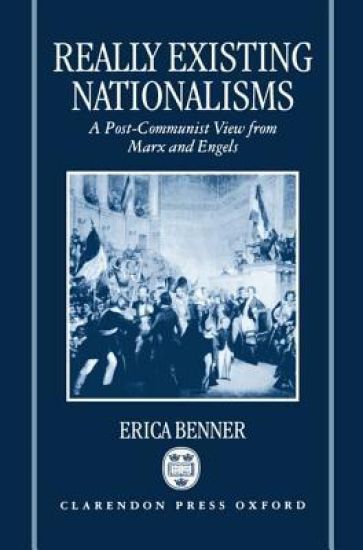
Really Existing Nationalisms

Really Existing Nationalisms

Erica Benner

Clarendon Press
1995
sidottu
This is an impressive re-examination of the theories of Marx and Engels on nationalism. The author challenges the conventional view that Marx and Engels lacked the theoretical resources needed to understand nationalism. It argues that the two men had a much better explanatory grasp of national phenomena than is usually supposed, and that the reasoning behind their policy towards specific national movements was often subtle and sensitive to the ethical issues at stake. Instead of offering an insular `Marxian' account of nationalism, the book identifies arguments in Marx and Engels' writings that can help us to think more clearly about national identity and conflict today. These arguments are located in a distinctive theory of politics, which enabled the authors to analyse the relations between nationalism and other social movements and to discriminate between democratic, outward-looking national programmes and authoritarian, ethnocentric nationalism. The book suggest that this approach improves on accounts which stress the `independent' force of nationality over other concerns, and on thos that fail to analyse the complex motives of nationalist actors. It concludes by criticizing these `methodological nationalist' assumptions and `post-nationalist' views about the future role of nationalism, showing how some of marx and Engles' arguments can yield a better understanding of the national movements that have emerged in the wake of `really existing socialism'.
Machiavelli's Prince

Machiavelli's Prince

Erica Benner

Oxford University Press
2015
nidottu
Why did Machiavelli write the Prince - and why did religious and political authorities find it so threatening? Five hundred years on, this book tries to answer these questions. In the first detailed, chapter-by-chapter reading of the Prince in any language, Erica Benner shows that the book is a masterpiece of ironic writing. Machiavelli's style is deliberately ambiguous: he often seems to say one thing, but gives readers clues that point toward a very different message. Beyond its 'Machiavellian' surface, the Prince has a surprisingly moral purpose. It teaches readers how to recognize hidden dangers in political conduct that merely appears great or praiseworthy - and to mistrust promises of easy solutions to political problems. This highly engaging new interpretation helps readers to see beyond the Prince's deceptive first appearances. Benner sets out Machiavelli's main ironic techniques at the outset, especially his coded use of words to signal praise or blame. Once readers become familiar with these codes, they will find it easier to grasp the Prince's surreptitiously pro-republican message - and its powerful critique of charismatic one-man rule and imperial politics.
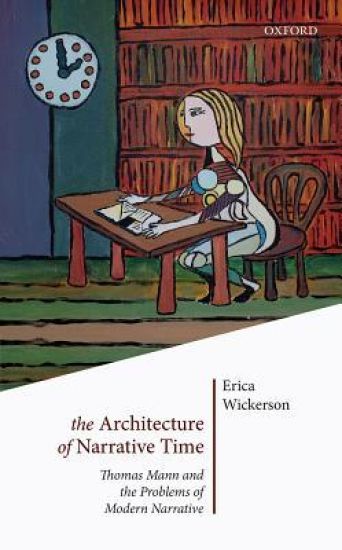
The Architecture of Narrative Time

The Architecture of Narrative Time

Erica Wickerson

Oxford University Press
2017
sidottu
Time matters to all of us. It dominates everyday discourse: diaries, schedules, clocks, working hours, opening times, appointments, weekdays and weekends, national holidays, religious festivals, birthdays, and anniversaries. But how do we, as unique individuals, subjectively experience time? The slowness of an hour in a boring talk, the swiftness of a summer holiday, the fleetingness of childhood, the endless wait for pivotal news: these are experiences to which we all can relate and of which we commonly speak. How can a writer not only report such experiences but also conjure them up in words so that readers share the frustration, the excitement, the anticipation, are on tenterhooks with a narrator or character, or in melancholic mourning for a time long-since passed, which we never experienced ourselves? Erica Wickerson suggests that the evocation of subjective temporal experience occurs in every sentence, on every page, at every plot turn, in any narrative. The Architecture of Narrative Time offers a new template for understanding narrative time that combines close readings with analysis of the structural overview. It enables new ways of reading Thomas Mann; but also new ways of conceptualising narrative time in any literary work, not only in Mann's fiction and not only in texts that foreground the narration of time. The range of Mann's novels, novellas, and short stories is compared with other nineteenth- and twentieth-century works in German and in English to suggest a comprehensive approach to considering time in narrative.
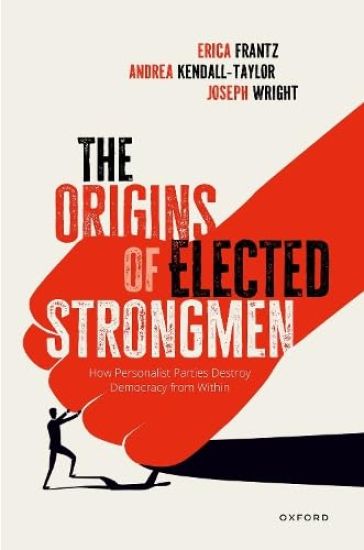
The Origins of Elected Strongmen

The Origins of Elected Strongmen

Erica Frantz; Andrea Kendall-Taylor; Joe Wright

Oxford University Press
2024
sidottu
Since the end of World War II, democracies typically fell apart by coup d'état or through force. Today, however, they are increasingly eroding at the hands of democratically elected incumbents, who seize control by slowly chipping away at democratic institutions. To better understand these developments, this book examines the role of personalist political parties, or parties that exist primarily to further their leader's career as opposed to promote a specific policy platform. Using original data capturing levels of personalism in the parties of democratically elected leaders from 1991 to 2020, The Origins of Elected Strongmen shows that the rise of personalist parties around the globe is facilitating the decline of democracy. Personalist parties lack both the incentive and capacity to push back against a leader's efforts to expand executive power. As such, leaders backed by personalist parties are more likely to succeed in their efforts to dismantle institutional constraints on their rule. Such attacks on state institutions, in turn, reverberate throughout society, deepening political polarization and weakening supporters' commitment to democratic norms of behaviour. In these ways, ruling party personalism erodes horizontal and vertical constraints on a leader, ultimately degrading democracy and raising the risk of democratic failure.
Geopolitical Shakespeare

Geopolitical Shakespeare

Erica Sheen

Oxford University Press
2024
sidottu
Geopolitical Shakespeare: Western Entanglements from Internationalism to Cold War examines the entanglement of Shakespearean culture in the geopolitical dynamics of the post-war West. Taking its cue from a speech given by Albert Einstein in London in 1933, in which Shakespeare is cited as an example of the Western value of personal and intellectual freedom, this book explores a series of events between 1945 and 1955 featuring key historical figures--scientists, international lawyers, diplomats and politicians, writers, actors, and filmmakers--who experienced the tensions of the early Cold War through Shakespeare, or called on him to articulate this new post-war world. Erica Sheen examines political, diplomatic, cultural, and economic interactions within 'core' Western power relations--the USA, UK, and Europe, with particular reference to Germany--in which Shakespeare, or the idea of Shakespeare, was entangled in the struggle for new ideas and social structures. The subjects of this book include John Humphrey and the drafting of the Universal Declaration of Human Rights; the Nuremberg Trials and the foundation of West Germany; Noel Annan and the Berlin Elizabethan Festival; an American production of Hamlet in Elsinore; Laurence Olivier, David Selznick, and the Shakespeare film in post-war Hollywood; Graham Greene and The Third Man; and Carl Schmitt and Salvador de Madariaga on Hamlet in post-war Europe. In each of these case studies, Sheen discovers a Shakespeare for our time: engaged in contestations of territoriality in cultures of international law and human rights, theatre, film, and literature.
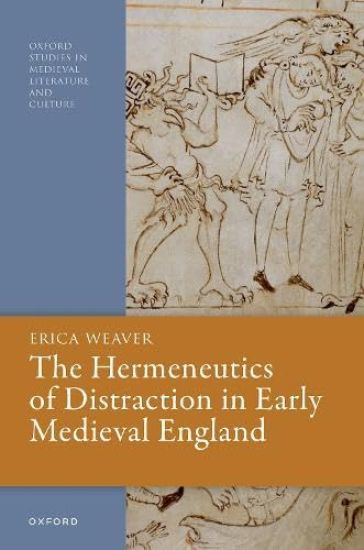
The Hermeneutics of Distraction in Early Medieval England
Distraction is now too easily and often considered a metonym for modern consciousness, but it was also a medieval concern, which posed a particular threat to religious life. Distraction opened the door to all other temptations, and—most disturbingly of all for the monastic communities at the heart of this book—it invalidated central devotional acts like reading, praying, and reciting the Psalms. Far from an innocuous sensation, distraction posed a significant spiritual danger. It also generated powerful countervailing responses in literature, pedagogy, and religious observance, profoundly shaping literary interpretation in the process. The Hermeneutics of Distraction in Early Medieval England writes this cultural and intellectual history. It comes at the topic of distraction through the study of the affective practices of a particular community of writers and readers: the influential circle of Æthelwold (Bishop of Winchester, 963-984). It also explores the implications of this focused study both for a larger historical context (Western monasticism from the fifth century to the twelfth) and for the history of a unifying concept (the experience of distraction). In doing so, this book reveals that the pervasive threat of distraction precipitated the development of several different tactics for reorienting attention, especially in the tenth-century monastic correction movement traditionally known as the Benedictine Reform, which reshaped monastic life across Europe. From the development of the 'hermeneutic style' to new textual and theatrical modes, these correctional projects make visible an enduring problem, present from the beginnings of monasticism and persisting throughout its long history.
Research for Health Policy

Research for Health Policy

Erica Bell

Oxford University Press
2009
nidottu
Individuals working in health research want to be able to use their findings to influence health policy. However, frequently, research evidence remains detached from practice, and there is a divide between research and policy. Research for Health Policy is an introduction to the emerging genre of applied research for policy decision-making, offering new research methods that go far beyond the traditional classical experimental techniques and standard qualitative methods. This highly practical and practice-based book is relevant to researchers in different disciplines and countries, and it will equip the reader with the knowledge, skills and attitudes needed to deliver policy-relevant research in the government, not-for-profit, and private sectors. As a book that helps its reader to develop the blend of strategic people skills, methodological inventiveness, research entrepreneurship, creative design, and policy writing know-how that is critical to delivering useful research evidence for policy, Research for Health Policy is essential reading for anyone doing, studying or teaching health policy advocacy and research. It also has much to offer postgraduate and professional development students and their educators who want to move beyond the common undergraduate focus on policy content areas and policy theory/process, to learn more advanced practical research skills for policy-making.
Machiavelli's Prince

Machiavelli's Prince

Erica Benner

Oxford University Press
2013
sidottu
Why did Machiavelli write the Prince - and why did religious and political authorities find it so threatening? Five hundred years on, this book tries to answer these questions. In the first detailed, chapter-by-chapter reading of the Prince in any language, Erica Benner shows that the book is a masterpiece of ironic writing. Machiavelli's style is deliberately ambiguous: he often seems to say one thing, but gives readers clues that point toward a very different message. Beyond its 'Machiavellian' surface, the Prince has a surprisingly moral purpose. It teaches readers how to recognize hidden dangers in political conduct that merely appears great or praiseworthy - and to mistrust promises of easy solutions to political problems. This highly engaging new interpretation helps readers to see beyond the Prince's deceptive first appearances. Benner sets out Machiavelli's main ironic techniques at the outset, especially his coded use of words to signal praise or blame. Once readers become familiar with these codes, they will find it easier to grasp the Prince's surreptitiously pro-republican message - and its powerful critique of charismatic one-man rule and imperial politics.
The Politics of Terror

The Politics of Terror

Erica Chenoweth; Pauline L. Moore

Oxford University Press Inc
2018
nidottu
Bringing together both classic and contemporary research, The Politics of Terror provides a systematic introduction to the theory, politics, and practice of terrorism. In addition to offering a comprehensive, evidence-based overview of the subject, Chenoweth and Moore challenge readers to think critically. The book is oriented around a set of empirical, theoretical, and methodological puzzles that arise in the study of terrorism. By encouraging students to engage with these puzzles, and equipping them with the resources to do so thoughtfully, the authors present a nuanced introduction to a complex and crucially important field.
Disease, War, and the Imperial State

Disease, War, and the Imperial State

Erica Charters

University of Chicago Press
2014
sidottu
The Seven Years' War, often called the first global war, spanned North America, the West Indies, Europe, and India. In these locations diseases such as scurvy, smallpox, and yellow fever killed far more than combat did, stretching the resources of European states. In Disease, War, and the Imperial State, Erica Charters demonstrates how disease played a vital role in shaping strategy and campaigning, British state policy, and imperial relations during the Seven Years' War. Military medicine was a crucial component of the British war effort; it was central to both eighteenth-century scientific innovation and the moral authority of the British state. Looking beyond the traditional focus on the British state as a fiscal war-making machine, Charters uncovers an imperial state conspicuously attending to the welfare of its armed forces, investing in medical research, and responding to local public opinion. Charters shows military medicine to be a credible scientific endeavor that was similarly responsive to local conditions and demands. Disease, War, and the Imperial State is an engaging study of early modern warfare and statecraft, one focused on the endless and laborious task of managing manpower in the face of virulent disease in the field, political opposition at home, and the clamor of public opinion in both Britain and its colonies.
Suddenly Diverse

Suddenly Diverse

Erica O. Turner

University of Chicago Press
2020
sidottu
For the past five years, American public schools have enrolled more students identified as Black, Latinx, American Indian, and Asian than white. At the same time, more than half of US school children now qualify for federally subsidized meals, a marker of poverty. The makeup of schools is rapidly changing, and many districts and school boards are at a loss as to how they can effectively and equitably handle these shifts.Suddenly Diverse is an ethnographic account of two school districts in the Midwest responding to rapidly changing demographics at their schools. It is based on observations and in-depth interviews with school board members and superintendents, as well as staff, community members, and other stakeholders in each district: one serving “Lakeside,” a predominately working class, conservative community and the other serving “Fairview,” a more affluent, liberal community. Erica O. Turner looks at district leaders’ adoption of business-inspired policy tools and the ultimate successes and failures of such responses. Turner’s findings demonstrate that, despite their intentions to promote “diversity” or eliminate “achievement gaps,” district leaders adopted policies and practices that ultimately perpetuated existing inequalities and advanced new forms of racism. While suggesting some ways forward, Suddenly Diverse shows that, without changes to these managerial policies and practices and larger transformations to the whole system, even district leaders’ best efforts will continue to undermine the promise of educational equity and the realization of more robust public schools.
Suddenly Diverse

Suddenly Diverse

Erica O. Turner

University of Chicago Press
2020
nidottu
For the past five years, American public schools have enrolled more students identified as Black, Latinx, American Indian, and Asian than white. At the same time, more than half of US school children now qualify for federally subsidized meals, a marker of poverty. The makeup of schools is rapidly changing, and many districts and school boards are at a loss as to how they can effectively and equitably handle these shifts.Suddenly Diverse is an ethnographic account of two school districts in the Midwest responding to rapidly changing demographics at their schools. It is based on observations and in-depth interviews with school board members and superintendents, as well as staff, community members, and other stakeholders in each district: one serving “Lakeside,” a predominately working class, conservative community and the other serving “Fairview,” a more affluent, liberal community. Erica O. Turner looks at district leaders’ adoption of business-inspired policy tools and the ultimate successes and failures of such responses. Turner’s findings demonstrate that, despite their intentions to promote “diversity” or eliminate “achievement gaps,” district leaders adopted policies and practices that ultimately perpetuated existing inequalities and advanced new forms of racism. While suggesting some ways forward, Suddenly Diverse shows that, without changes to these managerial policies and practices and larger transformations to the whole system, even district leaders’ best efforts will continue to undermine the promise of educational equity and the realization of more robust public schools.
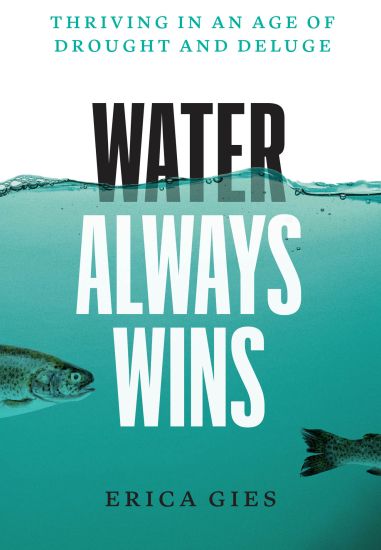
Water Always Wins: Thriving in an Age of Drought and Deluge
Winner of the Rachel Carson Award for Excellence in Environmental Journalism, Water Always Wins is a hopeful journey around the world and across time, illuminating better ways to live with water. Nearly every human endeavor on the planet was conceived and constructed with a relatively stable climate in mind. But as new climate disasters remind us every day, our world is not stable--and it is changing in ways that expose the deep dysfunction of our relationship with water. Increasingly severe and frequent floods and droughts inevitably spur calls for higher levees, bigger drains, and longer aqueducts. But as we grapple with extreme weather, a hard truth is emerging: our development, including concrete infrastructure designed to control water, is actually exacerbating our problems. Because sooner or later, water always wins. In this quietly radical book, science journalist Erica Gies introduces us to innovators in what she calls the Slow Water movement who start by asking a revolutionary question: What does water want? Using close observation, historical research, and cutting-edge science, these experts in hydrology, restoration ecology, engineering, and urban planning are already transforming our relationship with water. Modern civilizations tend to speed water away, erasing its slow phases on the land. Gies reminds us that water's true nature is to flex with the rhythms of the earth: the slow phases absorb floods, store water for droughts, and feed natural systems. Figuring out what water wants--and accommodating its desires within our human landscapes--is now a crucial survival strategy. By putting these new approaches to the test, innovators in the Slow Water movement are reshaping the future.
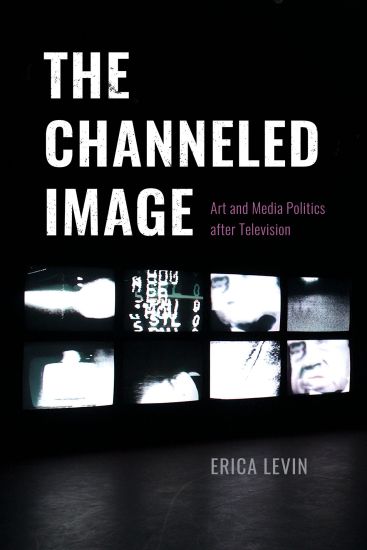
The Channeled Image

The Channeled Image

Erica Levin

THE UNIVERSITY OF CHICAGO PRESS
2022
sidottu
A fascinating look at artistic experiments with televisual forms. Following the integration of television into the fabric of American life in the 1950s, experimental artists of the 1960s began to appropriate this novel medium toward new aesthetic and political ends. As Erica Levin details in The Channeled Image, groundbreaking artists like Carolee Schneemann, Bruce Conner, Stan VanDerBeek, and Aldo Tambellini developed a new formal language that foregrounded television’s mediation of a social order defined by the interests of the state, capital, and cultural elites. The resulting works introduced immersive projection environments, live screening events, videographic distortion, and televised happenings, among other forms. For Levin, “the channeled image” names a constellation of practices that mimic, simulate, or disrupt the appearance of televised images. This formal experimentation influenced new modes of installation, which took shape as multi-channel displays and mobile or split-screen projections, or in some cases, experimental work produced for broadcast. Above all, this book asks how artistic experimentation with televisual forms was shaped by events that challenged television broadcasters’ claims to authority, events that set the stage for struggles over how access to the airwaves would be negotiated in the future.
The Channeled Image

The Channeled Image

Erica Levin

THE UNIVERSITY OF CHICAGO PRESS
2022
nidottu
A fascinating look at artistic experiments with televisual forms. Following the integration of television into the fabric of American life in the 1950s, experimental artists of the 1960s began to appropriate this novel medium toward new aesthetic and political ends. As Erica Levin details in The Channeled Image, groundbreaking artists like Carolee Schneemann, Bruce Conner, Stan VanDerBeek, and Aldo Tambellini developed a new formal language that foregrounded television’s mediation of a social order defined by the interests of the state, capital, and cultural elites. The resulting works introduced immersive projection environments, live screening events, videographic distortion, and televised happenings, among other forms. For Levin, “the channeled image” names a constellation of practices that mimic, simulate, or disrupt the appearance of televised images. This formal experimentation influenced new modes of installation, which took shape as multi-channel displays and mobile or split-screen projections, or in some cases, experimental work produced for broadcast. Above all, this book asks how artistic experimentation with televisual forms was shaped by events that challenged television broadcasters’ claims to authority, events that set the stage for struggles over how access to the airwaves would be negotiated in the future.
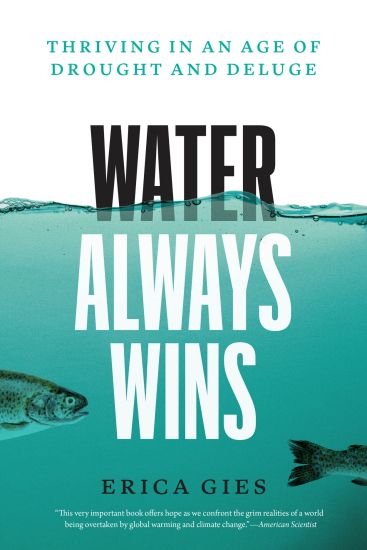
Water Always Wins: Thriving in an Age of Drought and Deluge
Winner of the Rachel Carson Award for Excellence in Environmental Journalism, Water Always Wins is a hopeful journey around the world and across time, illuminating better ways to live with water. Nearly every human endeavor on the planet was conceived and constructed with a relatively stable climate in mind. But as new climate disasters remind us every day, our world is not stable-and it is changing in ways that expose the deep dysfunction of our relationship with water. Increasingly severe and frequent floods and droughts inevitably spur calls for higher levees, bigger drains, and longer aqueducts. But as we grapple with extreme weather, a hard truth is emerging: our development, including concrete infrastructure designed to control water, is actually exacerbating our problems. Because sooner or later, water always wins. In this quietly radical book, science journalist Erica Gies introduces us to innovators in what she calls the Slow Water movement who start by asking a revolutionary question: What does water want? Using close observation, historical research, and cutting-edge science, these experts in hydrology, restoration ecology, engineering, and urban planning are already transforming our relationship with water. Modern civilizations tend to speed water away, erasing its slow phases on the land. Gies reminds us that water's true nature is to flex with the rhythms of the earth: the slow phases absorb floods, store water for droughts, and feed natural systems. Figuring out what water wants-and accommodating its desires within our human landscapes-is now a crucial survival strategy. By putting these new approaches to the test, innovators in the Slow Water movement are reshaping the future.
Divine Council, Ethics, and Resistance in Psalm 82

Divine Council, Ethics, and Resistance in Psalm 82

Erica Mongé-Greer; David G. Firth

JAMES CLARKE CO LTD
2024
nidottu
Psalm 82 can often be overlooked as simplistic, confusing, or out of place. With an understanding of ethical liturgy, Monge-Greer illuminates this mythopoeic psalm as a deeply sophisticated, prophetic summons to actively embrace justice for the poor, marginalised, and disenfranchised in our communities. Monge-Greer's interpretation provides a new opportunity for biblical study of this psalm, offering clarity and relevance to this heavily discussed psalm. Divine Council, Ethics, and Resistance in Psalm 82 explores the origins of the Psalm, its use as liturgy in early Israelite cultic practice, and its reception as resistance literature in the Second Temple period. By examining the historical usage of the psalm, Monge-Greer reveals to the reader how Psalm 82 can be used to inform their own lives and actions. Divine Council, Ethics, and Resistance in Psalm 82 is a new approach for biblical scholars, historians, and those seeking justice in the everyday.