Kirjojen hintavertailu. Mukana 11 342 296 kirjaa ja 12 kauppaa.

Kirjahaku

Etsi kirjoja tekijän nimen, kirjan nimen tai ISBN:n perusteella.

1000 tulosta hakusanalla Gregory

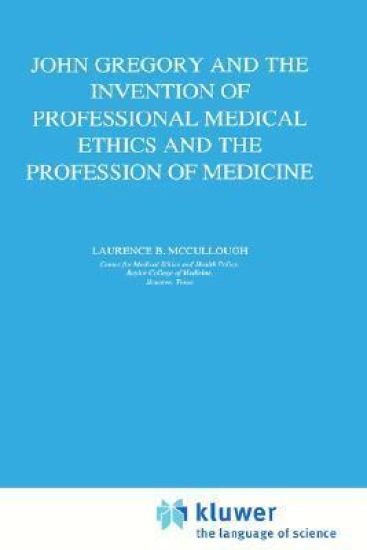
John Gregory and the Invention of Professional Medical Ethics and the Profession of Medicine
The best things in my Ufe have come to me by accident and this book results from one such accident: my having the opportunity, out of the blue, to go to work as H. Tristram Engelhardt, Jr. 's, research assistant at the Institute for the Medical Humanities in the University of Texas Medi­ cal Branch at Galveston, Texas, in 1974, on the recommendation of our teacher at the University of Texas at Austin, Irwin C. Lieb. During that summer Tris "lent" me to Chester Bums, who has done important schol­ arly work over the years on the history of medical ethics. I was just finding out what bioethics was and Chester sent me to the rare book room of the Medical Branch Library to do some work on something called "medical deontology. " I discovered that this new field of bioethics had a history. This string of accidents continued, in 1975, when Warren Reich (who in 1979 made the excellent decisions to hire me to the faculty in bioethics at the Georgetown University School of Medicine and to persuade Andre Hellegers to appoint me to the Kennedy Institute of Ethics) took Tris Engelhardt's word for it that I could write on the history of modem medical ethics for Warren's major new project, the Encyclopedia of Bioethics. Warren then asked me to write on eighteenth-century British medical ethics.
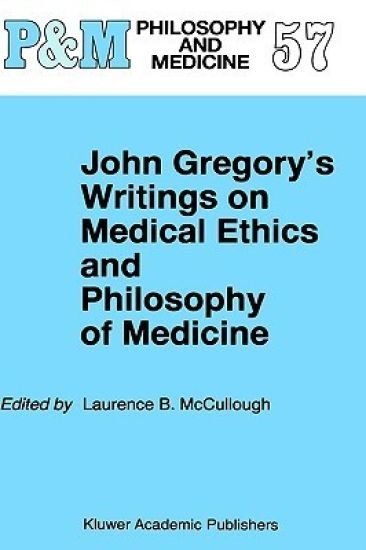
John Gregory's Writings on Medical Ethics and Philosophy of Medicine
This volume introduces a new subseries of Philosophy and Medicine, Classics of Medical Ethics. The purpose of this new subseries is to bring out scholars' editions of major works in the history of medical ethics and philosophy of medicine. This new subseries will target for publication texts that are long out of print and difficult to access. Each volume will contain an introduction to the writings on medical ethics and philosophy of medicine produced by the original author. Each volume will also contain a guide to the primary and major secondary Hterature, to facilitate teaching and scholarship in bioethics, philosophy of medicine, and history of medicine. Texts will be presented in their origi­ nal style and will provide pagination of the original, so that citations can be made either to the original text or to the page numbers in these vol­ umes. Finally, each volume will be well indexed, again to facilitate teaching and research. Bioethics and philosophy of medicine - the former more so than the latter - have an insufficiently developed understanding of themselves as having a history. As a consequence, these fields lack the maturity that critical dialogue of the past with the present provides for other fields and disciplines of the humanities. To the extent that this problem is due to the fact that major primary historical sources are not readily available, this subseries will contribute to the further development and maturation of bioethics and philosophy of medicine as fields of the humanities.
Saint Gregory of Nazianzus ^PB]

Saint Gregory of Nazianzus ^PB]

M John

St Vladimir's Seminary Press,U.S.
2002
nidottu
Saint Gregory of Nazianzus stands as the founding father of the Byzantine religious synthesis, and his own conception of the vision of God as light made him an important figure for Byzantine spiritual writers. This study is a critical analysis of the man, his writings and inner life in the English language. It offers an insight into the mind of one of the greatest protagonists of Nicene theology and opens a window onto the world of late antiquity and the place of the Christian Church in it.
St Gregory Palamas and Orthodox Spi

St Gregory Palamas and Orthodox Spi

M John

St Vladimir's Seminary Press,U.S.
1999
nidottu
This study of Orthodox spirituality traces the development of "Orthodox mysticism" from the desert fathers through the patristic tradition to Byzantine hesychasm and its heritage in Russian monasticism. It shows how the work of Palamas, Archbishop of Thessalonica in the 14th century, trancends the limits of one school of spirituality and renews in its deepest essence the life of the Christian mystery.
Pope Gregory IX (1227-1241)
As Cardinal Hugo and as pope, Gregory was one of the dominant figures in the history of the papacy of the High Middle Ages. Coming to prominence under Pope Innocent III, Hugo played an important political role, particularly as legate on various occasions, as well as being a major promoter of the new religious orders. As pope, his battle with Emperor Frederick II is one of medieval history’s most absorbing conflicts. But he also acted as peacemaker, promoter of the Crusades, instigator of mission for the sake of conversion, refomer of the Curia, patron of arts and liturgy, and as a passionate advocate of Church reform. His decretal collection, the Liber Extra, was the most influential of the Middle Ages. A full examination of Gregory’s pontificate is very long overdue. The current volume brings together a team of international scholars, each of them expert in dealing with a particular aspect of the pontificate, and provides what will be a collection of studies of lasting scholarly value on a central figure of the medieval papacy.