A bold and provocative work from the late preeminent feminist scholar, which challenges men and women alike to free themselves from attachment to gender. At the heart of Buddhism is the notion of egolessness--"forgetting the self"--as the path to awakening. In fact, attachment to views of any kind only leads to more suffering for ourselves and others. And what has a greater hold on people's imaginations or limits them more, asks Rita Gross, than ideas about biological sex and what she calls "the prison of gender roles"? Yet if clinging to gender identity does, indeed, create obstacles for us, why does the prison of gender roles remain so inescapable? Gross uses the lenses of Buddhist philosophy to deconstruct the powerful concept of gender and its impact on our lives. In revealing the inadequacies involved in clinging to gender identity, she illuminates the suffering that results from clinging to any kind of identity at all.
Available in packs of 5, these are the 28-page forms needed to conduct the Teaching Pyramid Infant–Toddler Observation Scale (TPITOS™) for Infant–Toddler Classrooms, observational assessment. A child's early teachers and caregivers play a vital role in supporting social-emotional development—and that's why more and more center-based infant and toddler programs are adopting the evidence-based Pyramid Model for Promoting Social Emotional Competence in Infants and Young Children. If your program is one of them, TPITOS™ is the essential tool you need to ensure that infant–toddler teachers are using the Pyramid Model practices with fidelity.Modeled after the Teaching Pyramid Observation Tool (TPOT™) for Preschool Classrooms, TPITOS is for early childhood settings caring for infants and toddlers from birth to 3 years of age. Focusing on teacher practices and classroom environment variables, TPITOS measures how well your program's staff is fostering responsive, nurturing relationships with children and promoting strong social-emotional development in their earliest years.How It Works :A trained TPITOS administrator conducts a 2-hour classroom observation, followed by an interview with the teacher being observed. The observer completes three types of items: 1) Observational Items (practices and environmental factors noted during the observation), 2) Interview Items (practices scored based on the teacher’s responses during the interview), and 3) Red Flags (practices that are not consistent with the Pyramid Model). Results of TPITOS show your program which Pyramid Model practices are being implemented effectively—and what teachers need to focus on to ensure positive social-emotional outcomes for infants and toddlers.
A child's early teachers and caregivers play a vital role in supporting social-emotional development—and that's why more and more center-based infant and toddler programs are adopting the evidence-based Pyramid Model for Promoting Social Emotional Competence in Infants and Young Children. If your program is one of them, TPITOS™ is the essential tool you need to ensure that infant–toddler teachers are using the Pyramid Model practices with fidelity.Modeled after the Teaching Pyramid Observation Tool (TPOT™) for Preschool Classrooms, TPITOS is for early childhood settings caring for infants and toddlers from birth to 3 years of age. Focusing on teacher practices and classroom environment variables, TPITOS measures how well your program's staff is fostering responsive, nurturing relationships with children and promoting strong social-emotional development in their earliest years.How It Works :A trained TPITOS administrator conducts a 2-hour classroom observation, followed by an interview with the teacher being observed. The observer completes three types of items: 1) Observational Items (practices and environmental factors noted during the observation), 2) Interview Items (practices scored based on the teacher’s responses during the interview), and 3) Red Flags (practices that are not consistent with the Pyramid Model). Results of TPITOS show your program which Pyramid Model practices are being implemented effectively—and what teachers need to focus on to ensure positive social-emotional outcomes for infants and toddlers.
A child's early teachers and caregivers play a vital role in supporting social-emotional development—and that's why more and more center-based infant and toddler programs are adopting the evidence-based Pyramid Model for Promoting Social Emotional Competence in Infants and Young Children. If your program is one of them, TPITOS™ is the essential tool you need to ensure that infant–toddler teachers are using the Pyramid Model practices with fidelity.Modeled after the Teaching Pyramid Observation Tool (TPOT™) for Preschool Classrooms, TPITOS is for early childhood settings caring for infants and toddlers from birth to 3 years of age. Focusing on teacher practices and classroom environment variables, TPITOS measures how well your program's staff is fostering responsive, nurturing relationships with children and promoting strong social-emotional development in their earliest years.How It Works :A trained TPITOS administrator conducts a 2-hour classroom observation, followed by an interview with the teacher being observed. The observer completes three types of items: 1) Observational Items (practices and environmental factors noted during the observation), 2) Interview Items (practices scored based on the teacher’s responses during the interview), and 3) Red Flags (practices that are not consistent with the Pyramid Model). Results of TPITOS show your program which Pyramid Model practices are being implemented effectively—and what teachers need to focus on to ensure positive social-emotional outcomes for infants and toddlers.
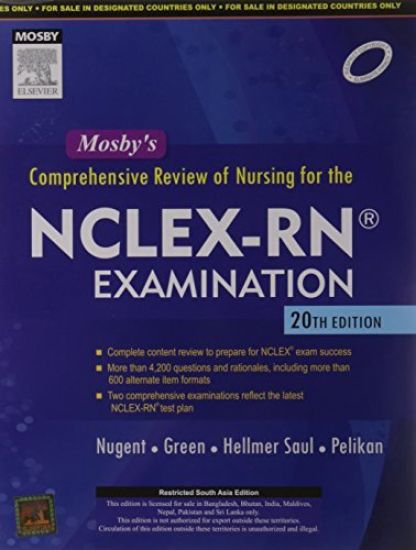
A classic resource that has helped nurses pass the NCLEX exam for over 60 years, Mosby's Comprehensive Review of Nursing for the NCLEX-RN® Examination, 20th Edition is fully updated to reflect the newest NCLEX-RN test plan. Content review is presented in a concise and full-color outline format organized by the core areas of medical-surgical, pediatric, maternity/women's health, and mental health nursing, with a practice test following each unit. More than 4,200 practice questions and rationales -- including more than 600 questions in the newest alternate item formats -- are written by a team of trusted NCLEX experts led by author Patricia M. Nugent. A companion CD enhances your NCLEX review by allowing you to customize quizzes and exams and download audio review summaries of key content. Over 4,200 practice questions in the book and on the companion CD provide ample practice opportunities in both print and electronic testing formats. Review questions are grouped by categories of concern to focus your study on any areas of weakness. Detailed rationales for correct and incorrect answers are provided with every question. Text references are provided with the answer rationales for further study of difficult topics. Two comprehensive exams are coded by clinical area, client need, nursing process, and cognitive level, to help you evaluate your strengths and weaknesses. An overview of the latest NCLEX-RN test plan describes the recent changes and additions to content. Companion CD allows you to create customized quizzes and exams based on clinical area, NCLEX client needs category, nursing process, and cognitive level.
INTRATHECAL DRUG THERAPY FOR SPASTICITY AND PAIN is a practical manual for nurses and physician assistants who use Intrathecal Drug Infusion for treating patients suffering from spasticity and chronic pain. This book supplies users of this new technology with the information they need to utilize it effectively, including pump mechanics and the pharmacology of drug delivery. No other book of its kind exists, and its users at the over 100 facilities that use implanted drug delivery have relied solely on the pump manufacturer's manuals. The authors are from a leading center for research and applied use of these pumps and, working with Dr. Richard Penn, have spent years developing the skills necessary to utilize this system efficiently. Dr. Penn, who writes the Foreword, has personally implanted over 3000 pumps.
When it was first published in 1997, The Course Syllabus became the gold standard reference for both new and experienced college faculty. Like the first edition, this book is based on a learner-centered approach. Because faculty members are now deeply committed to engaging students in learning, the syllabus has evolved into a useful, if lengthy, document. Today's syllabus provides details about course objectives, requirements and expectations, and also includes information about teaching philosophies, specific activities and the rationale for their use, and tools essential to student success.
The Judge's Gavel is a desperate call for reformation of antiquated drug laws and to formally decriminalize addiction and mental health disorders. It is a call for Law Makers and Law Enforcers to recognize the health issues that bring offenders to the courtroom, and to describe the necessary funnel into treatment for a sustainable recovery in order to prevent relapse and recidivism. It is a common understanding that our jails and prisons do not correct addiction, and isolating and shaming an addict does little to prevent future criminal activity. Brain Injury, Traumatic Stress, Anxiety, Depression, and Substance Use Disorders are treatable and manageable illnesses, not crimes deserving punishment. Chaotic detainment environments do not provide the appropriate care for mental health recovery.This publication presents common brain function disorders, along with scientific evidence detailing the requirement for specific care and feeding of the brain. Soaring Hope Recovery introduces a science-based, tried-and-true model of care for sustainable addiction recovery and dual-diagnosis treatment, along with a list of Paradigm Shift Contributors, and excerpts of progress in re-imagining justice for the victims of the failing war on drugs.Included is a comprehensive guide to legal and illegal substances to inform the reader on how they affect the neurological system and lead to criminal behavior. Also listed are the uses and side effects of psychotropic medications in order to illustrate how they relate to exacerbating mental illness, inevitably causing criminal behavior.The provided glossary of terms helps the reader to know and understand the myriad of acronyms. In addition, a thorough reference section presents five decades of scientific advancement, which is related to neurological dysfunctions and evidence-based methods for the care and feeding of the brain.
Between the Civil War and World War II, Catholic charities evolved from volunteer and local origins into a centralized and professionally trained workforce that played a prominent role in the development of American welfare. Dorothy Brown and Elizabeth McKeown document the extraordinary efforts of Catholic volunteers to care for Catholic families and resist Protestant and state intrusions at the local level, and they show how these initiatives provided the foundation for the development of the largest private system of social provision in the United States.It is a story tightly interwoven with local, national, and religious politics that began with the steady influx of poor Catholic immigrants into urban centers. Supported by lay organizations and by sympathetic supporters in city and state politics, religious women operated foundling homes, orphanages, protectories, reformatories, and foster care programs for the children of the Catholic poor in New York City and in urban centers around the country.When pressure from reform campaigns challenged Catholic child care practices in the first decades of the twentieth century, Catholic charities underwent a significant transformation, coming under central diocesan control and growing increasingly reliant on the services of professional social workers. And as the Depression brought nationwide poverty and an overwhelming need for public solutions, Catholic charities faced a staggering challenge to their traditional claim to stewardship of the poor. In their compelling account, Brown and McKeown add an important dimension to our understanding of the transition from private to state social welfare.
International Handbook of Organizational Crisis Management reflects the latest understanding of the field from prominent scholars and practitioners around the globe. Pushing the boundaries of crisis management research and practice, the handbook offers new frameworks and findings that capture insights and guidance for researchers and executives.Key Features· Provides the latest thinking on and encourages growing support of crisis management in today's business environment: Novel and poorly understood technologies, globalization, changing political climates, and a shifting social landscape are just a few of the forces currently changing the ways in which organizations experience crises.· Challenges core assumptions and goes beyond conventional rules: Numerous books touch on the topic, but many lack rigor with untested fear based prescriptions and quick fixes.· Offers a diversity of angles and levels of analysis: Crisis management is analyzed from societal, interorganizational, organizational, and individual perspectives.· Presents international and multicultural perspectives: Crises are not perceived in the same way globally; therefore, international researchers and practitioners expose their views of crisis management from their own cultural angles.Intended AudienceOffering a leading-edge overview of the field of crisis management, this resource is useful for researchers and thoughtful practitioners in business and management, psychology, and sociology. It can also be used in graduate courses such as Strategic Management and Business Policy, Corporate Strategy, Occupational/Industrial Psychology, and Communication Risk Management.
This fourth edition of Art Song in the United States, 1759–2011 covers songs for solo voice and piano by American composers from the mid-18th through the early 21st centuries. The book is structured as an annotated bibliography with approximately 2,850 numbered entries listed alphabetically by composer and title and indexed in various ways to help teachers and singers locate the particular song they require for practice or performance. This edition adds eleven years’ worth of new works, anthologies, and collections (about 450 new entries), reflecting the relatively recent outpouring of song compositions by American composers and a wealth of new song anthologies and collections. This bibliography features information on each song or song cycle or set. Users will find critical data on the poet, publisher and copyright date, key, vocal range, vocal tessitura, meter(s), tempo, length, difficulty of vocal line and piano score, most suitable voice type, mood and subject of the text, and brief description of the vocal line and piano score. It also includes commentary on special difficulties for performers and possible uses of the song in programming. In addition, individual titles of composite works are given, and those that appear in collections are indexed to the list of collections in the front matter. Composer, poet, special characteristics/subject, and title indexes—and even discographic lists recordings where available—all aid researchers in finding songs. The primary audiences for this bibliography are voice teachers and singers in search of appropriate art songs for their students or themselves, as well as libraries with collecting interests in music and American literature.
Although they are making gains, by the time they reach high school, girls lag behind boys in math and science; women are still discouraged from going into professional science, and some from actively participating in nature. From Girls in Their Elements to Women in Science asks: How are these generalizations linked to personal experience? Memory-work as research method offers an innovative approach to understanding women's socialization in the natural world, which leads to insights about their relationship to science. Multiple themes emerge from the analysis, which reveals the centrality of family landscapes, metaphor, power, and creativity in connecting our experiences in nature to our professional lives. This book demonstrates how memory-work can interrupt cultural assumptions about socialization, transforming the meaning of our experiences in the natural world.
Americans spend more than $20 billion annually for weight loss plans and products and yet the average dieter gains almost 5 pounds in a single year. America is on a $20 billion diet that isn't working Like most Americans, Judith McManus M.A. outsourced her weight loss to corporate plans and fad diets without long-term results. When Judith finally took matters into her own hands, researched choices that were right for her, and designed her own plan, she lost 50 pounds. With Dr. Marina MacDonald, the co-authors combine personal experience with over 500 scientific studies to reveal 10 core principles for weight-loss success. You will learn: -Why overeating is a result of our modern food environment, stress, and biology. -Why extreme diets are not the answer. -Why smart dieting does not rely on willpower. -How to break the cycle of overeating and yo-yo dieting for good. -How to create a healthy diet and lifestyle that you will love. If you're tired of being overweight and you're ready to transform your body and your life, The 20 Billion Dollar Diet enables you to finally achieve the goal weight you have wanted for so long.
This update of a previous report provides findings on economic activity supported by total Army spending in congressional districts for fiscal years 2014 through 2017. Using input/output models, researchers estimated that the Army directly spent approximately $80.1 million in the median congressional district and $1.3 billion in the median state in fiscal year 2017, translating into approximately 3,800 jobs per district and 48,000 jobs per state.
Brain diseases can have a large impact on patients and society, and treatment is often not available. A new approach in which somatic cells are reprogrammed into induced pluripotent cells (iPS cells) is a significant breakthrough for regenerative medicine. This promises patient-specific tissue for replacement therapies, as well as disease-specific cells for developmental modeling and drug treatment screening. However, this method faces issues of low reprogramming efficiency, and poorly defined criteria for determining the conversion of one cell type to another. Cells contain epigenetic “memories” of what they were that can affect reprogramming. This book discusses the various methods to reprogram cells, the control and determination of cell identity, the epigenetic models that have emerged and the application of iPS cell therapy for brain diseases, in particular Parkinson’s disease and Vanishing White Matter (VWM).?
Even in the earliest stages of progressive dementia, patients have difficulty evaluating their own needs and engaging in appropriate activities. A therapeutic program of care, including constructive activities and behavior management, is necessary for maximizing patients' functioning and quality of life. The Handbook of Dementia Care and its companion Training Manual and Video for Dementia Care Specialists offer a complete training system for teachers and students providing dementia care in a variety of settings. Developed at the well-known George G. Glenner Alzheimer's Family Centers, the program's instructor's manual and student handbook are organized into six teaching modules: basic information on dementia, positive interaction techniques, supportive physical environment, therapeutic activities, group activities, and family support. Each module is accompanied by a videotaped lecture and demonstration presentation to further illustrate the topic being discussed. This exciting project is a comprehensive instructional tool for dementia care professionals working in adult day centers, long-term care and residential settings, hospitals, nursing homes, and home health care agencies.