Kenneth Vaux advocates an Abrahamic theology as a dynamic and ethical axis for science and technology and argues for its continuing salience for a vital and humane science. He demonstrates a historical correlation between an Abrahamic theological tradition (monotheism and venturism) and the rise of science. Vaux illustrates these developments in the work of six scientists: Avicenna, Boyle, Schweitzer, and Teilhard, as well as contemporaries Amartya Sen and Leon Kass. In the course of his discussion, Vaux engages the contemporary dialogue between religion and science. ""Ken Vaux has shown what a powerful impulse Abrahamic monotheism has been to the rise and ongoing ethical guidance of science."" --John Polkinghorne, Professor of Mathematical Physics, Anglican Priest, Templeton Prize winner Kenneth Vaux is Emeritus Professor of Ethics at the University of Illinois College of Medicine and currently serves as the Professor of Theological Ethics at Garrett-Evangelical Theological Seminary and as a member of the Graduate Faculty at Northwestern University.
America in God's World argues that human injustice in social-policy areas such as security, economy, and ecology can be traced to defective theology/ethics abroad in the land. Renewing biblical theology and ethics, and finding new ways to appropriate this wisdom into public policy, can bring renewal to our national life and help heal and reconcile our troubled world.
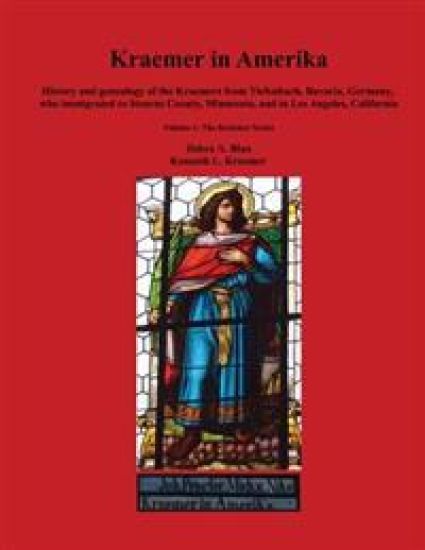
The authors stumbled upon an unsolved mystery far away in the homeland of their ancestors, in a small village named Tiefenbach, set among the beautiful rolling hills in the Oberpfalz region of eastern Bavaria, Germany. The mystery involved a unique stained-glass church window with an intriguing inscription, "Kraemer in Amerika." Setting out to discover the meaning behind the inscription, the authors found themselves faced with many unanswered questions: - Who did "Kraemer in Amerika" represent? - Where in America did this Kraemer live? - Who donated money for the Kraemer window? - In what year was the window inscribed? - Could there be a fascinating story behind the donation? Research in Germany led to the discovery of several Kraemer families who lived in the Catholic parish of Tiefenbach. One of these Kraemers, namely Paul (the great-great-grandfather of author Ken Kraemer), worked as a weaver in the nearby village of Irlach. Paul left Irlach in 1866 and eventually settled on a farm in Wisconsin. Some of his descendants, the "Wisconsin Kraemers," established prosperous construction and road building firms in Sauk County, Wisconsin. The authors were astounded to find out that another Kraemer had ties to America Paul's distant cousin, Michael Kraemer, worked as a tobacco maker in Tiefenbach, and had three married sons who immigrated to America as early as 1852. Could the three brothers in this line of Kraemers provide the missing piece of the puzzle of the stained-glass window? The three brothers were some of the early rugged pioneers in Stearns County, Minnesota. The oldest brother, named after his father, Michael, was a kindhearted Minnesotan whom everyone called "Papa." He created a town, built a Catholic church in the name of his wife, and left a legacy of multiple Century Farms, businesses, and descendants in the state. The middle brother named George experienced the worst kind of grief when he lost three of his children in the 1881 smallpox epidemic, which affected nearly every family in Stearns County, including the family of his brother Michael. George never fully recovered from the tragedy. Nikolaus, the youngest of these brothers, started out as a cigar manufacturer in St. Cloud, Minnesota, in 1862, then later uprooted his family to Los Angeles, California; his eldest child remained in St. Cloud. This distinguished bearded Californian left a legacy through his five beautiful and talented daughters and a son, and became modestly wealthy in the 1890s land boom in LA. In 1900, an unexplainable tragedy befell the family. The daughters survived through successful marriages and bonds of sisterhood on ranches in rural Los Angeles. This book reveals the identity of the "Kraemer in Amerika" mystery, and details the struggles, tragedies, and ultimate triumph in the new world of the "Minnesota Kraemers." The authors have filled the chapters with family history, original documents, and family photos, along with an extensive index of names, places and occupations.
Puppy Montessori is an educational book on how to raise and train a puppy. A must have book for anyone with a new puppy The Puppy Montessori program teaches the reader how to mitigate undesirable behaviors and grow desired behaviors from their puppy. The Puppy Montessori program is a resource that people can go to when they have questions about leadership, feeding, potty training, socialization, vaccinations, obedience, unwanted behaviors, leash walking and much more.The canine Montessori model acknowledges the important link between developmental cycles and behaviors. The book provides a leadership system for puppy owners, delivering reader-friendly guidance on managing puppy-related issues to ensure a well-behaved, engaged dog.
"The service of social work is directed primarily to freeing and helping individuals to find and fulfill themselves-their own unique selves-within the society of which they are a part." This emphasis on "respect for individual personality, for the significance of the individual as such and in his own right" is the keynote of these writings of the late Dean of the Pennsylvania School of Social Work. Chosen for the most part from the work of the last decade, the writings collected here stress his interest in public welfare and penology, the two fields in which his contributions have been most extensive and consistent. The volume is divided into four parts: I. Earlier Formulations of the Philosophy Underlying Social Work Practice II. Public Welfare Ill. Penology IV. Final Statement of the Philosophy Underlying Social Work Practice This sharing of the wisdom and understanding of a lifetime dedicated to professional service in the field of social work will prove helpful and stimulating to administrators, teachers, and social workers everywhere.
Nacho Perez is a retired Marine gunnery sergeant turned private eye. In this short story collection, his cases range from murder to extortion and other crimes. Even a simple vandalism case nearly gets him killed. The stories are "Badger Game," "San Antonio Blues," "In Search of El Dorado," and "Whiskey's for Drinking." As a bonus, the collection ends with a flash-fiction detective story set in a futuristic New York City. The outcome turns on Asimov's First Law of Robotics. Three of the five stories in the collection are prize winners. "Badger Game" won first place in the short-story category in the 2009 San Antonio Writers' Guild annual contest. "Whiskey's for Drinking" won second place in the short-story category in the 2014 San Antonio Writers' Guild annual contest. "The Butler Couldn't Have Done It" won first place in the flash-fiction category in the same contest.