Kirjojen hintavertailu. Mukana 11 348 152 kirjaa ja 12 kauppaa.

Kirjahaku

Etsi kirjoja tekijän nimen, kirjan nimen tai ISBN:n perusteella.

1000 tulosta hakusanalla Lester Bangs

Ultrasonic Nondestructive Evaluation Systems

Ultrasonic Nondestructive Evaluation Systems

Lester W. Schmerr Jr; Jung-Sin Song

Springer-Verlag New York Inc.
2007
sidottu
This book deals with ultrasonic nondestructive evaluation (NDE) inspections where high frequency waves are used to locate and characterize dangerous flaws (such as cracks) in materials. Ultrasonic NDE flaw inspections involve a very complex combination of electrical, electromechanical, and acoustic/elastic components so that it is important to understand the behavior of those components and their interactions in order to make quantitative flaw measurements. It will be shown that through the use of models and measurements it is now possible to characterize all the elements of an ultrasonic NDE flaw inspection system. Those elements include the pulser/receiver, the cabling, the transducers, and the wave propagation and scattering processes present in an ultrasonic NDE flaw measurement. It will also be demonstrated how to combine models and measurements of those elements to form ultrasonic measurement models which can simulate the flaw signals seen in ultrasonic NDE tests. This comprehensive modeling and measurement capability is described for the first time in this book. There are important engineering applications of this new tech- logy. For example, these ultrasonic models and measurements can be used to design new ultrasonic inspections as well as optimize existing ones. This technology can also help one to extract information on the nature of the flaw present from the measured ultrasonic flaw signals that can then be used to evaluate the safety and reliability of the material being inspected.

Queueing Theory

Queueing Theory

Lester Lipsky

Springer-Verlag New York Inc.
2008
sidottu
Queueing Theory deals with systems where there is contention for resources, but the demands are only known probabilistically. This book can be considered to be a monograph or a textbook, and thus is aimed at two audiences: those who already know Queueing Theory but would like to know more of the Linear Algebraic Approach; and as a rst course for students who don't already have a strong background in probability, and feel more comfortable with algebraic arguments. Also, the equations are well suited to easy computation. In fact, there is much discussion on how various properties can be easily computed in any language that has automatic matrix operations (e.g., MATLAB). To help with physical insight, there are over 80 gures, numerous examples and exercises distributed throughout the book. There are, perhaps 50 books on QT that are available today, and most practitioners have several of them on their shelves. This book would be a good addition, as well as a good supplement to another text. This second edition has been updated throughout including a new chapter on Semi Markov Processes and new material on matrix representations of distributions and Power-tailed distribution. Lester Lipsky is a Professor in the Department of Computer Science and Engineering at the University of Connecticut.
Capital, Accumulation, and Money

Capital, Accumulation, and Money

Lester D. Taylor

Springer-Verlag New York Inc.
2010
sidottu
Capital, Accumulation, and Money: An Integration of Capital, Growth, and Monetary Theory is a book about capital and money. A root concept of capital is formulated that allows for most existing concepts of capital to be unified and related to one another in consistent fashion. Capital and monetary theory are integrated in a non-mathematical framework that imposes a number of constraints on the macro behavior of an economy, constraints which make for the straightforward understanding of such concepts as the real stock of money, real-balance effects, and the general price level. New and illuminating insights are also provided into aggregate supply and demand, natural and money rates of interest, the relationship between real and monetary economies, and economic growth and development. This fully expanded, revised, and updated edition features important new material on a variety of timely topics, including: * Factors leading to the financial meltdown and turmoil of 2007-09; * Why bubbles form in asset markets and how these impact on the real economy; * The importance of a lender-of-last-resort in times of financial stress; * Future financing and funding of the U. S. Social Security System. Additionally, the author offers a number of ideas for alleviating the severity, if not the avoidance altogether, of financial crises in the future. This is a book for those -- students (both graduate and undergraduate) and their teachers, investors, and the informed public -- who want an understanding of how economies and financial markets function, without an advanced degree in mathematics.
The Twenty-Ninth Day

The Twenty-Ninth Day

Lester R. Brown

WW NORTON CO
1978
nidottu
The global lily pond in which four billion of us live may already be half full. Although UN projections show world population continuing to grow until it reaches ten to sixteen billion, Lester Brown believes this is unrealistic. In this fascinating analysis of the fisheries, forests, grasslands, and croplands—the author shows that the demands at current levels of population and per capita consumption often exceed the long-term carrying capacity. He documents the overfishing, deforestation, and overgrazing that are gradually undermining human life support systems. He also explains that with energy shortages anticipated in the early eighties and a projected downturn in world oil production in the early eighties and a projected downturn in world oil production in the early nineties, the world must quickly shift to renewable energy resources.
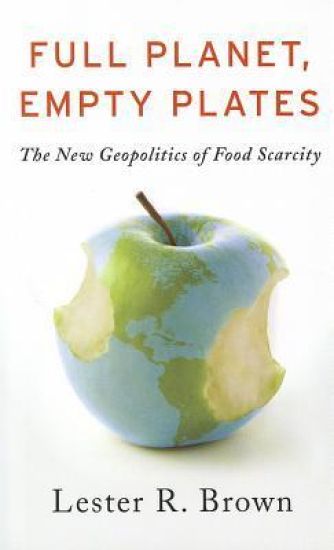
Full Planet, Empty Plates

Full Planet, Empty Plates

Lester R. Brown

WW Norton Co
2012
sidottu
What will the geopolitics of food look like in a new era dominated by scarcity and food nationalism? Brown outlines the political implications of land acquisitions by grain-importing countries in Africa and elsewhere as well as the world's shrinking buffers against poor harvests. With wisdom accumulated over decades of tracking agricultural issues, Brown exposes the increasingly volatile food situation the world is facing.
Breaking New Ground

Breaking New Ground

Lester R. Brown

WW Norton Co
2013
sidottu
Lester R. Brown, whom the Washington Post praised as “one of the world’s most influential thinkers,” built his understanding of global environmental issues from the ground up. Brown spent his childhood working on the family’s small farm. His entrepreneurial skills surfaced early. Even while excelling in school, he launched with his younger brother a tomato-growing operation that by 1958 was producing 1.5 million pounds of tomatoes. Later, at the U.S. Department of Agriculture, Brown emphasized the need for systemic thinking. In 1963 he did the first global food supply and demand projections to the end of the century. While on a brief assignment in India in 1965, he pieced together the clues that led him to sound the alarm on an impending famine there. His urgent warning to the U.S. and Indian governments set in motion the largest food rescue effort in history, helping to save millions of lives. This experience led India to adopt new agricultural practices, which he helped to shape. Brown went on to advise governments internationally and to found the Worldwatch and Earth Policy institutes, two major nonprofit environmental research organizations. Both brilliant and articulate, through his many books he has brought to the fore the interconnections among such issues as overpopulation, climate change, and water shortages and their effect on food security. His 1995 book, Who Will Feed China?, led to a broad restructuring of China’s agricultural policy. Never one to focus only on the problem, Brown always proposes pragmatic, employable solutions to stave off the unfolding ecological crises that endanger our future.
Who Will Feed China?: Wake-Up Call for a Small Planet

Who Will Feed China?: Wake-Up Call for a Small Planet

Lester Russell Brown

W. W. Norton Company
1995
nidottu
To feed its 1.2 billion people, China may soon have to import so much grain that this action could trigger unprecedented rises in world food prices. In Who Will Feed China: Wake-up Call for a Small Planet, Lester Brown shows that even as water becomes more scarce in a land where 80 percent of the grain crop is irrigated, as per-acre yield gains are erased by the loss of cropland to industrialization, and as food production stagnates, China still increases its population by the equivalent of a new Beijing each year. When Japan, a nation of just 125 million, began to import food, world grain markets rejoiced. But when China, a market ten times bigger, starts importing, there may not be enough grain in the world to meet that need - and food prices will rise steeply for everyone. Analysts foresaw that the recent four-year doubling of income for China's 1.2 billion consumers would increase food demand, especially for meat, eggs, and beer. But these analysts assumed that food production would rise to meet those demands. Brown shows that cropland losses are heavy in countries that are densely populated before industrialization, and that these countries quickly become net grain importers. We can see that process now in newspaper accounts from China as the government struggles with this problem.
Beyond Malthus

Beyond Malthus

Lester R. Brown; Gary T. Gardner; Brian Halweil

WW Norton Co
1999
pokkari
Human demands are pressing up against more and more of the Earth's limits. This book from the Worldwatch Institute examines the impacts of population growth on global resources and services, including food, fresh water, fisheries, jobs, education, income, and health. Despite the current hype of a "birth dearth" in parts of Europe and Japan, the fact remains that human numbers are projected to increase by over 3 billion by 2050. Rapidly growing nations are likely to outstrip the carrying capacity of their natural support systems. Governments worn down by several decades of rapid population growth often cannot mobilize the resources necessary to cope with emerging threats such as new diseases, food and water shortages, and mass unemployment. Already, in several African nations, hunger, disease, and social disintegration are leading to rising death rates, checking the rapid growth of population. Either nations with surging populations will quickly shift to smaller families or nature will impose its own, less humane limits to growth. As the world enters the new millennium, no challenge is perhaps so urgent as the need to quickly reduce population growth. Pakistan's population is projected to increase from 148 million to 357 million, surpassing that of the United States before 2050. Zimbabwe, Botswana, Zambia, Namibia, and Swaziland, where over one-fifth of the adult population is infected with HIV, will likely reach population stability shortly after the year 2000, as AIDS-related deaths offset soaring birth rates. A Worldwatch Environmental Alert book. Newsmaking press conference on publication National press and television coverage
State of the World 2000

State of the World 2000

Lester Russell Brown

W. W. Norton Company
2000
nidottu
The newest volume in the annual series that has become the bible of the global environmental movement--and indispensable for anyone concerned with the future of our world. State of the World 2000 provides national leaders and concerned citizens with a comprehensive framework for the global debate about our future in the new century. This annual survey by the award-winning Worldwatch Institute has become an invaluable analysis of negative environmental trends and a guide to emerging solutions. The book shows how our current fossil-fueled, auto-centered, throwaway economy is steadily destroying the very ecosystems that form the foundations of our lives. The great challenge we face in the next century is making the transition to a sustainable economy that reuses and recycles materials, is powered by renewable energy sources, and has a stable population. The authors argue that meeting this challenge will offer some of the greatest investment opportunities in history. Written in clear and concise language, with easy-to-read charts and tables, State of the World 2000 presents a view of our changing world that we, and our leaders, cannot afford to ignore.
Eco-Economy

Eco-Economy

Lester R. Brown

WW Norton Co
2001
pokkari
In 1543, Polish astronomer Nicolaus Copernicus challenged the view that the Sun revolved around the Earth, arguing instead that the Earth revolved around the Sun. His paper led to a revolution in thinking to a new worldview. "Eco-Economy" discusses the need today for a similar shift in our worldview. The issue now is whether the environment is part of the economy or the economy is part of the environment. Lester R. Brown argues the latter, pointing out that treating the environment as part of the economy has produced an economy that is destroying its natural support systems. Brown notes that if China were to have a car in every garage, American style, it would need 80 million barrels of oil a day more than the world currently produces. If paper consumption per person in China were to reach the U.S. level, China would need more paper than the world produces. There go the world's forests. If the fossil fuel-based, automobile-centered, throwaway economic model will not work for China, it will not work for the other 3 billion people in the developing world and it will not work for the rest of the world. But Brown is optimistic as he describes how to restructure the global economy to make it compatible with the Earth's ecosystem so that economic progress can continue. In the new economy, wind farms replace coal mines, hydrogen-powered fuel cells replace internal combustion engines, and cities are designed for people, not cars. Glimpses of the new economy can be seen in the wind farms of Denmark, the solar rooftops of Japan, and the bicycle network of the Netherlands. "Eco-Economy" is a road map of how to get from here to there."
Earth Policy Reader

Earth Policy Reader

Lester R. Brown; Janet Larsen; Bernie Fischlowitz-Roberts

W. W. Norton Company
2002
nidottu
Brown explains, for example, why wind-generated electricity with its abundance and falling cost is emerging as the foundation of the new post-fossil fuel energy economy: now cheaper than electricity from coal, oil, or natural gas, it can be used to electrolyze water and produce hydrogen, the fuel of choice for the new fuel cell engines that every major automobile manufacturer is working on. And since an eco-economy relies heavily on recycling materials already in the system, such as steel and aluminum, we learn how, in this new economy, recycling industries will largely replace mining industries. Bringing together in one volume the essential Eco-Economy Updates that are distributed worldwide over the Internet and published in the world's leading newspapers, The Earth Policy Reader monitors the shift from the old economy to the new.
Outgrowing the Earth: The Food Security Challenge in an Age of Falling Water Tables and Rising Temperatures
Ever since 9/11, many have considered al Queda to be the leading threat to global security, but falling water tables in countries that contain more than half the world's people and rising temperatures worldwide pose a far more serious threat. Spreading water shortages and crop-withering heat waves are shrinking grain harvests in more and more countries, making it difficult for the world's farmers to feed 70 million more people each year. The risk is that tightening food supplies could drive up food prices, destabilizing governments in low-income grain-importing countries and disrupting global economic progress. Future security, Brown says, now depends on raising water productivity, stabilizing climate by moving beyond fossil fuels, and stabilizing population by filling the family planning gap and educating young people everywhere. If Osama bin Laden and his colleagues succeed in diverting our attention from the real threats to our future security, they may reach their goals for reasons that even they have not imagined.
Plan B 4.0

Plan B 4.0

Lester R. Brown

WW Norton Co
2009
nidottu
As fossil fuel prices rise, oil insecurity deepens, and concerns about climate change cast a shadow over the future of coal, a new energy economy is emerging. Wind, solar, and geothermal energy are replacing oil, coal, and natural gas, at a pace and on a scale we could not have imagined even a year ago. For the first time since the Industrial Revolution, we have begun investing in energy sources that can last forever. Plan B 4.0 explores both the nature of this transition to a new energy economy and how it will affect our daily lives.
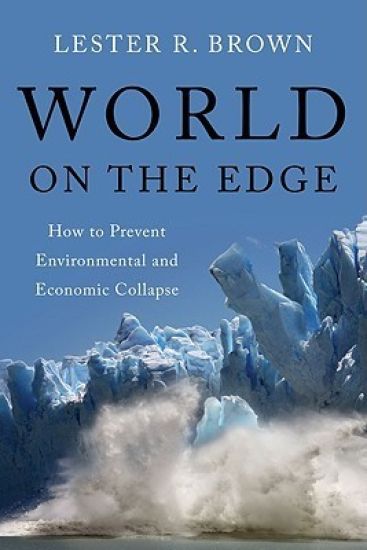
World on the Edge

World on the Edge

Lester R. Brown

WW Norton Co
2011
pokkari
We are in a race between political and natural tipping points. Can we close coal-fired power plants fast enough to save the Greenland ice sheet and avoid catastrophic sea level rise? Can we raise water productivity fast enough to halt the depletion of aquifers and avoid water-driven food shortages? Can we cope with peak water and peak oil at the same time? These are some of the issues Lester R. Brown skillfully distills in World on the Edge. Bringing decades of research and analysis into play, he provides the responses needed to reclaim our future.
Full Planet, Empty Plates

Full Planet, Empty Plates

Lester R. Brown

WW Norton Co
2012
pokkari
With food scarcity driven by falling water tables, eroding soils and rising temperatures, control of arable land and water resources is moving to centre stage in the global struggle for food security. "In this era of tightening world food supplies, the ability to grow food is fast becoming a new form of geopolitical leverage. Food is the new oil.", Lester R. Brown writes. Here, Brown, "One of the world's most influential thinkers" (Washington Post), discusses what the geopolitics of food will look like in a new era dominated by scarcity and food nationalism. He outlines the political implications of land acquisitions by grain-importing countries in Africa and elsewhere as well as the world's shrinking buffers against poor harvests. With wisdom accumulated over decades of tracking agricultural issues, Brown exposes the increasingly volatile food situation the world is facing.