

Kirjahaku
Etsi kirjoja tekijän nimen, kirjan nimen tai ISBN:n perusteella.
1000 tulosta hakusanalla Stephen Drake

Take an intimate tour through the life and works of Stephen King, made vivid with rare photos and ephemera from King’s personal collection.Even if you are a die-hard fan, you will find something new in this beautifully packaged Stephen King reference that you will return to again and again. Timed to celebrate Stephen King’s 75th birthday on September 21, 2022, Stephen King: A Complete Exploration of His Work, Life, and Influences reveals the inspiration behind the prolific author’s brilliant works of horror through a combination of photos and documents from King’s archives and an engaging account of the stories behind how his novels, novellas, short stories, and adaptations came to be.It might sound like a tall tale that Stephen King once met a bartender named Grady in an empty hotel in Colorado, or that the celebrated author helped his young daughter bury her cat in a nearby “pets sematary” after it was killed on a busy roadway. In this book, discover how King drew on these and more real personal experiences and mundane life events, then employed his extraordinary imagination to twist them into something horrific. From impoverished university student to struggling schoolteacher to one of the best-selling—and most recognizable—authors of all time, this engrossing book reveals the evolution and influences of Stephen King’s body of work over his nearly 50-year career, and how the themes of his writing reflect the changing times and events within his life. An expansion of Stephen King expert Bev Vincent’s The Stephen King Illustrated Companion, this fully revised, redesigned, and updated book includes: A review of King’s complete body of work, including Fairy Tale, published in September 2022.A wealth of rare memorabilia from King’s own collection, including personal and professional correspondences, handwritten manuscript pages, book covers, movie stills, and a never-before-seen excerpts from one of his poems.Interludes on specific topics such as real-life settings that inspired King’s writing, the editor who discovered him, his life as a Boston Red Sox fan, and the many awards and honors he has received.Insightful quotes from King from interviews over the decades.Celebrate the beloved King of Horror with this informational and entertaining look inside King’s most iconic titles and the culture they have created.

A thrilling visual companion curated for young adults voraciously reading their way through Stephen King’s colossal corpus of creepy books.*2025 CBC Young Adult Favorites Winner**2025 CBC Teacher Favorites Winner**2025 CBC Librarian Favorites Winner*For many young readers, when the last page of Goosebumps is turned, the first chapter of Pet Sematary begins, and a world of terror crafted by Stephen King is revealed. His novels are as fascinating as his life, and in this ultimate illustrated guidebook, young readers explore the cultural phenomenon and legacy of the King of Horror.From scare-seeking child to impoverished university student to struggling schoolteacher to one of the best-selling—and most recognizable—authors of all time, this engrossing book reveals the evolution and influences of Stephen King’s body of work over his nearly 50-year career, and how the themes of his writing reflect the changing times and events within his life.With tons of photos, approachable bite-size sections, and gripping details to captivate young readers, the book features: An extensive look into Stephen King’s books, short stories, writings, movies, series, and other adaptations ideal for the young reader to review.Exclusive memorabilia from Stephen King, including personal and professional correspondences, handwritten manuscript pages, book covers, movie stills, and a never-before-seen excerpts from his poems.Personal insights and observations such as real-life settings that inspired King’s writing, the editor who discovered him, his life as a Boston Red Sox fan, and the many awards and honors he has received.Motivating quotes from King from interviews over the decades.“My childhood was pretty ordinary, except from a very early age I wanted to be scared…there was a radio program at the time called Dimension X, and my mother didn’t want me to listen to that because she felt it was too scary for me, so I would creep out of bed and go to the bedroom door and crack it open. And she loved it, so apparently, I got it from her, but I would listen at the door and then when the program was over, I’d go back to bed and quake.” —Stephen King Young adults will covet this comprehensive yet accessible reference to their favorite horror author.
Stephen Larigaudelle Dubuisson, S.J. (1786–1864) and the Reform of the American Jesuits
Cornelius Michael Buckley
University Press of America
2013
sidottu
Cornelius Michael Buckley, S.J. delves into Stephen Larigaudelle Dubuisson’s life, using him as the point of departure to describe the tensions among Jesuits in Maryland after the restoration of the order in 1814. A refugee of the violent slave rebellions in Haiti, where he was born, and the Terror in France, Dubuisson became a clerk in Napoleon’s personal treasury and a resident in the Tuileries. He was a member of Marie Louise’s flight in 1814 and later differed with Napoleon’s account of the fate of the lost treasury during this momentous event. The following year, giving up a promising career in the Restoration government, he entered the slave-owning Jesuits in Maryland. Ten years later, he was the priest involved in the Mattingly Miracle. After a brief tenure as Georgetown’s fourteenth president, Dubuisson spent three years in Europe advising the Jesuit general how to keep his American troops in step along the Ignatian “long black line.” During this time, he began his career as a fundraiser and propagandist for the American Church and as an unofficial, and sometimes vexing, diplomat of the general in the courts of Europe. After his return, Dubuisson served as a parish priest in Virginia, Maryland, and Pennsylvania. Elected a second time to represent the Maryland Jesuits at a meeting in Rome, he never returned to the United States and eventually became chaplain to the dashing Duke and Duchess de Montmorency Laval. Recognized as “the chief pillar of the Jesuit mission in the United States,” he died in Pau, France, during the height of the American Civil War.
The authoritative biography of Stephen Harper. As one of the important prime ministers in the life of our nation, Stephen Harper reshaped Canada into a more conservative country, a transformation that his opponents tacitly admit will never be reversed. Under its 22nd prime minister, Canada showed the world a plainer, harder face. Those who praise Harper point to the Conservatives' skillful economic management, the impressive new trade agreements, the tax cuts and the balanced budget, the reformed immigration system, the uncompromising defence of Israel and Ukraine, and the fight against terrorism. Critics--pointing to punitive punishments, muzzled scientists, assaults on the judiciary, and contempt for parliament--accuse the Harper government of being autocratic, secretive, and cruel. But what about the man? In this definitive new biography, The Globe and Mail's John Ibbitson explores the life of the most important Canadian of our times--his suburban youth, the crisis that caused Stephen Harper to quit university for three years, the forces that shaped his tempestuous relationship with Reform Leader Preston Manning, how Laureen Harper influences her husband, his devotion to his children--and his cats. Ibbitson explains how this shy, closed, introverted loner united a fractured conservative movement, defeated a Liberal hegemony, and set out to reshape the nation. With unparalleled access to sources, years of research and writing, and a depth of insight that has made him one of the most respected voices in journalism, John Ibbitson presents an intimate, detailed portrait of a man who has remained an enigma to supporters and enemies alike. Now that enigma is revealed, in a masterful exploration of Stephen Harper, the politician and the man.
From the preface: "Stephen Leacock is still often regarded as a writer of lightweight amusements and unchallenging satire, as an author without an imaginative centre who lacked a vision of sufficient power and clarity to sustain a lifetime of serious writing. According to this view, which has been too easily received, Leacock squandered an early, promising talent (though he was in fact, middle-aged when he published Sunshine Sketches of a Little Town in 1912), and consequently his writings, like his legendary Lord Ronald, "rode madly off in all directions." After years of chasing down Leacock's numerous literary mounts, I can assert that none of this is true. Leacock's writing emerges from a centre that is the confluence of the two traditions of humanism and toryism, traditions that found in Leacock fertile ground for the propagation of such qualities as tolerance of human fallibility and acceptance of social responsibility. What is remarkable with respect to Leacock's literary output is that even his furthest-flung, seemingly inconsequential humourous pieces move in relation to this tory-humanist centre." Lynch invites us to accompany him on an odyssey through Leacock's two main works, Sunshine Sketches and Arcadian Adventures of the Idle Rich ...He aspires to enlighten the open-minded reader, and is highly successful in doing so." Elspeth Cameron, Coordinator of Canadian Literature and Language Program, New College, University of Toronto

Stephen Hawking's stated his goal was "No less than a complete understanding of the universe." This fascinating biography details the life and achievements of Stephen Hawking, a scientist who made significant contributions to the field of physics. Hawking's theories always inspired and challenged colleagues, and his strength was building on older theories and revolutionizing them into new theories such as black hole radiation.

Stephen Hawking’s stated his goal was “No less than a complete understanding of the universe.” This fascinating biography details the life and achievements of Stephen Hawking, a scientist who made significant contributions to the field of physics. Hawking’s theories always inspired and challenged colleagues, and his strength was building on older theories and revolutionizing them into new theories such as black hole radiation.

Stephen Vincent Benet
McFarland Co Inc
2002
pokkari
When Stephen Vincent Benet died in 1943 at the age of 44, all of America mourned the loss. Benet was one of the country's most well known poets of the first half of the twentieth century and as a fiction writer, he had an even larger audience. This book is a collection of essays celebrating Benet and his writing. The first group of essays addresses Benet's life, times, and personal relationships. Thomas Carr Benet reminisces about his father in the first essay, and others consider Benet's marriage to his wife Rosemary; Archibald MacLeish, Thornton Wilder and Benet as friends, liberal humanists and public activists; and his friendships with Philip Barry, Jed Harris, and Thornton Wilder. The second group contains essays about Benet's poetry, fiction, and drama. They discuss Benet's role in the development of historical poetry in America, John Brown's Body and the Civil War, Hawthorne, Benet and historical fiction, Benet's Faustian America, the adaptation of "The Devil and Daniel Webster" to drama and then to film, Benet's use of fantasy and science fiction, and Benet as a dramatist for stage, screen and radio.
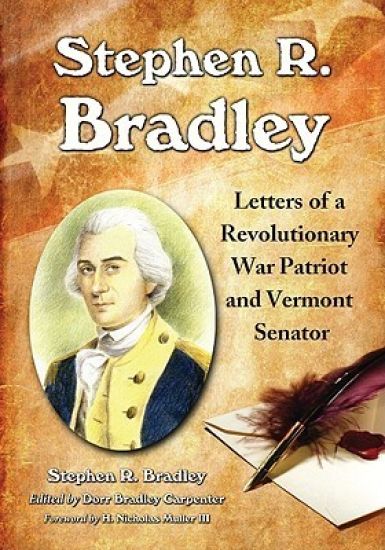
Stephen R. Bradley was a Revolutionary War commander and U.S. Senator credited with writing the Twelfth Amendment and advocating a banning of the slave trade. This collection of Bradley's letters and personal papers provides a range of rare and significant material. This previously unpublished correspondence with presidents and the country's founders reflect Bradley's influence and diversity of interests as well as the political and cultural climate of the era. The book features transcriptions of 550 letters, 25 illustrations, and a catalog of Bradley's documents.

The face of 1980s television was shaped by a man who stayed behind the scenes. Stephen Cannell's reluctant white knights--put-upon private eye James Rockford, World War II fly-boys the Black Sheep Squadron, hapless superhero Ralph Hinckley, fugitive mercenaries the A-Team, and maverick cop Hunter--traversed the television landscape from the 1970s to the 1990s. Cannell changed the face of the action-adventure genre, updating the crime-show format with a hybrid of rebellious morality, juvenile wit, intelligent sarcasm, and radical conservatism. This book discusses in detail the programs of the writer-producer and lists every episode of his award-winning productions from the early 1970s to the early '90s. The book features publicity photos and descriptions of unsold pilots.
This critical study analyzes Stephen R. Donaldson's role as a modern writer who uses the fantasy genre to discuss situations and predicaments germane to the modern world. Donaldson reclaims an epic vision in his Thomas Covenant novels that is lacking in most modern literature. Chapters demonstrate how this use of epic heroism helps solve seemingly insurmountable problems and provides more meaning and purpose for individuals. As Donaldson's characters learn to transcend their world, the reader is engaged in a serious, enlightened discussion about the need for imagination, responsibility and acceptance to resolve such problems as alienation, pollution, disease and despair.
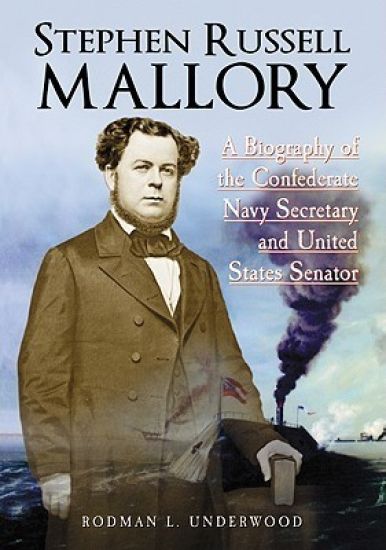
Just as Confederate naval action is commonly overshadowed by the land battles of the Civil War, the navy's originator, Stephen Mallory, is often overlooked in favor of more famous leaders. Mallory had served as one of Florida's U.S. senators for ten years before becoming navy secretary in the Confederate government, challenged to create a valid military force where none had existed. This biography chronicles Mallory's formative years in Key West, his decades of public service, and his declining days. It discusses his career in the United States Senate, where he chaired the Committee for Naval Affairs, helping to strengthen--in an ironic twist of fate--the very navy he would later attempt to defeat. The work also examines the challenges and obstacles Mallory faced in creating a navy for the South. Special attention is given to Mallory's family relationships. Primary sources include autobiographical documents and archival records.

This companion provides a two-part introduction to best-selling author Stephen King, whose enormous popularity over the years has gained him an audience well beyond readers of horror fiction, the genre with which he is most often associated. Part I considers the reception of King's work, the film adaptations that they gave rise to, the fictional worlds in which some of his novels are set, and the more useful approaches to King's varied corpus. Part II consists of entries for each series, novel, story, screenplay and even poem, including works never published or produced, as well as characters and settings.

North Carolina artist Stephen Shoemaker and writer Janet Pittard have teamed up to present a selection of Shoemaker's paintings and drawings and the stories behind them. Known for his dramatic railroad paintings and scenes of life in the Blue Ridge mountains, Shoemaker shares the thought processes involved in creating his artwork, reveals his sources of inspiration (which often include events in local history or personal experiences) and points out clues and symbols appearing in his art. Together with 48 images, several of which were created especially for this publication, and occasional short poems by Pittard, the lively storytelling sheds light on an artist's development as well as the unique culture and history of the mountain region served by the train called the Virginia Creeper, which ran from Abingdon, Virginia, to Elkland, North Carolina (now Todd), from the early 1900s through the mid-1970s.

Stephen King's Modern Macabre
McFarland Co Inc
2014
pokkari
As Stephen King has continued to publish numerous works beyond one of the many high points of his career, in the 1980s, scholarship has not always kept up with his output. This volume presents 13 essays (12 brand new) on many of King's recent writings that have not received the critical attention of his earlier works. This collection is grouped into three categories--"King in the World Around Us," "Spotlight on The Dark Tower" and "Writing into the Millennium"; each examines an aspect of King's contemporary canon that has yet to be analyzed.

When newly elected Illinois State Representative Abraham Lincoln first saw his diminutive colleague Stephen A. Douglas, he sized him up as ""the least man I ever saw."" With the introduction of Douglas' first bill in 1834, Lincoln soon thought differently. The General Assembly not only passed the bill, it appointed the 21-year old Douglas State's Attorney of Illinois' largest judicial district, replacing John J. Hardin, one of Lincoln's most powerful political allies.It was the first of many Douglas-Lincoln contests in the decade ahead. Struggles over banking, internal improvements, party organizations, the seat of government and slavery--even romantic rivalry--put them on opposing sides long before the 1860 presidential election. These battles were Douglas' political apprenticeship and he would use what he learned to obstruct Lincoln--his friend and nemesis--while becoming the most powerful Democrat in the nation.

Stephen Long and American Frontier Exploration
Roger L. Nichols; Patrick L. Halley
University of Oklahoma Press
1995
nidottu
Major Stephen H. Long of the United States Army was the most important government-sponsored explorer in the decade after the War of 1812. He led three major and several minor expeditions up the Mississippi, Missouri, and Arkansas rivers and the Red River of the north, as well as exploring the central and southern Plains, the Front Range of the Rocky Mountains, and the Great Lakes. His campanions included engineers, cartographers, Naturalists, ethnologists, and artists, and they gathered a wealth of scientific, military, and artistic data about the interior of North America. For years Long's expeditions have been overlooked or misunderstood; here for the first time they are placed in the context of American scientific development.

Stephen Sayre's career was far more remarkable for its diversity than for its success. At one time or another, Sayre was a soldier, merchant, banker, shipbuilder, politician, speculator, propagandist, diplomat, and inventor. He was also considered by some, as John Alden relates, ""a wicked schemer, a fool, a madman, an embezzler, and a traitor.""Following the dizzying course of Sayre's career, this biography reveals a vast panorama of life, both high and low, in the era of the American Revolution. Sayre frequented the polite society of England, Europe, and New York; twice married into a wealthy English family; and was elected for a term as sheriff of London. He also consorted with the actress Sophia Baddeley, one of the most notorious women of the time; was arrested and confined in the Tower of London for allegedly plotting to kidnap the king; and spent twenty months in a debtors' prison.If there was one constant in Sayre's life, it was his involvement in revolutionary politics. He was a fearless advocate of colonial rights in England, and after the outbreak of war in America he traveled to Prussia, Denmark, Sweden, and Russia to seek support for the revolution. Years later, he was an enthusiastic supporter of France's revolution. Working as an agent for the new French regime, he tried to secure it financial aid, promoted a scheme to purchase American weapons for the French army, argued for a French attack on Spanish Louisiana, and was active in diplomatic efforts to stave off war between Britain and France.Eventually, the turmoil of events in Paris drove away even as devoted a supporter as Sayre. He returned to America, where he continued to argue the cause of the French Revolution and quickly gained a reputation as an extremist. Engaging in the politics of the new American republic, Sayre assailed conservative forces in the nation, in particular the emerging Federalist party. He devoted much of his energy in later years to a persistent but unrewarded attempt to secure a post within the federal government and to somewhat more successful attempts to obtain payment for his past services to his country. In time he moved to Virginia to live with his stepson; he died there in 1818.From the beginning of his career, Stephen Sayre aspired to wealth, social position, and political influence. At various points in his life he achieved each of these goals, but finally they all eluded him. An outstanding patriot, Sayre was far too erratic in his behavior, far too mercurial a personality ever to be counted as a father of his country. He is better remembered as a kind of principled rogue, an adventurer in the service of his own ambitions and those of his country.